REVIEW OF (Document 2-4, HELCOM 40-2019) OBJECTIVES updated BSAP - - PowerPoint PPT Presentation

review of
SMART_READER_LITE
LIVE PREVIEW

REVIEW OF (Document 2-4, HELCOM 40-2019) OBJECTIVES updated BSAP - - PowerPoint PPT Presentation

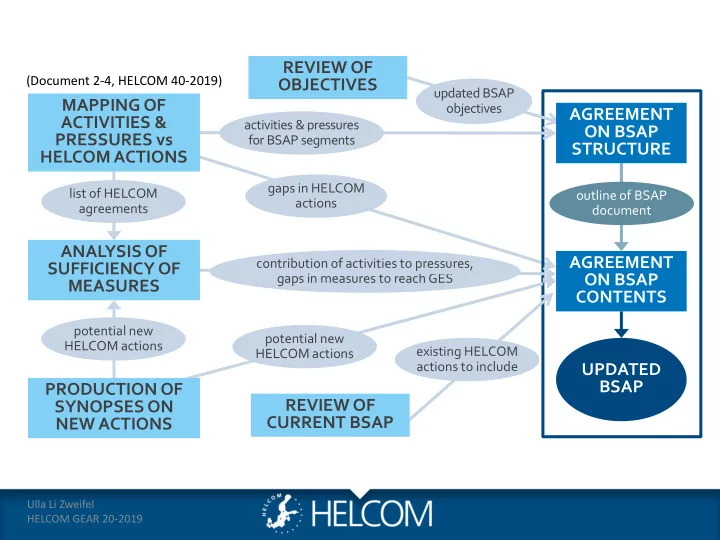
REVIEW OF (Document 2-4, HELCOM 40-2019) OBJECTIVES updated BSAP MAPPING OF objectives AGREEMENT ACTIVITIES & activities & pressures ON BSAP PRESSURES vs for BSAP segments STRUCTURE HELCOM ACTIONS gaps in HELCOM list of HELCOM


slide-1
SLIDE 1

Ulla Li Zweifel HELCOM GEAR 20-2019

activities & pressures for BSAP segments potential new HELCOM actions potential new HELCOM actions list of HELCOM agreements

MAPPING OF ACTIVITIES & PRESSURES vs HELCOM ACTIONS ANALYSIS OF SUFFICIENCY OF MEASURES REVIEW OF OBJECTIVES AGREEMENT ON BSAP STRUCTURE AGREEMENT ON BSAP CONTENTS PRODUCTION OF SYNOPSES ON NEW ACTIONS REVIEW OF CURRENT BSAP

existing HELCOM actions to include

  • utline of BSAP

document updated BSAP

  • bjectives

UPDATED BSAP

(Document 2-4, HELCOM 40-2019) gaps in HELCOM actions contribution of activities to pressures, gaps in measures to reach GES

slide-2
SLIDE 2

Ulla Li Zweifel HELCOM GEAR 20-2019 Ulla Li Zweifel HELCOM GEAR 20-2019

activities & pressures for BSAP segments potential new HELCOM actions potential new HELCOM actions list of HELCOM agreements

MAPPING OF ACTIVITIES & PRESSURES vs HELCOM ACTIONS ANALYSIS OF SUFFICIENCY OF MEASURES REVIEW OF OBJECTIVES AGREEMENT ON BSAP STRUCTURE AGREEMENT ON BSAP CONTENTS PRODUCTION OF SYNOPSES ON NEW ACTIONS REVIEW OF CURRENT BSAP

existing HELCOM actions to include

  • utline of BSAP

document updated BSAP

  • bjectives

UPDATED BSAP

(Document 2-4, HELCOM 40-2019) gaps in HELCOM actions contribution of activities to pressures, gaps in measures to reach GES

slide-3
SLIDE 3

Ulla Li Zweifel HELCOM GEAR 20-2019

Baltic Sea unaffected by eutrophication Baltic Sea undisturbed by hazardous substances Environmentally friendly maritime activities Favourable status of Baltic Sea biodiversity A healthy Baltic Sea environment, with diverse biological components functioning in balance, resulting in good environmental/ecological status and supporting a wide range of sustainable human economic and social activities

SEGMENT and GOALS (original): VISION (HOD 55-2018 agreed that the Vision of the current BSAP will be maintained):

Baltic Sea unaffected by eutrophication Baltic Sea undisturbed by hazardous substances pollution Environmentally friendly maritime activities Favourable status of Baltic Sea biodiversity

SEGMENT and GOALS (as implied by GEAR 19-2018):

Baltic Sea unaffected by eutrophication Baltic Sea undisturbed by hazardous substances and marine litter Environmentally friendly maritime sea-based activities Favourable status of Baltic Sea biodiversity

SEGMENT and GOALS (as implied by HOD 55-2018):

New objectives:

  • marine litter
  • underwater noise

New objectives:

  • marine litter

New objectives:

  • loss and disturbance

to the seabed New objectives:

  • loss and disturbance

to the seabed

  • underwater noise

To support agreement: clarify activities and pressures that would be covered by each segment of the BSAP document

slide-4
SLIDE 4
  • Activity-pressures mapping

e.g. from HELCOM TAPAS project

  • >300 potential linkages
  • What are the activities that

contribute most to the pressures?

  • Carried out as part of the

analyses of sufficiency of measures

  • Ready in autumn 2019
  • Matrices in Annex 1

document 5-5 are provisional to guide further discussion on the BSAP structure and disposition of the BSAP document

Ulla Li Zweifel HELCOM GEAR 20-2019

slide-5
SLIDE 5

Background

  • HELCOM 39-2018 adopted a proposal for the BSAP update that states that

existing segments should remain while new ecological objectives can be developed for additional issues, for example, marine litter, underwater sound and seabed damage and disturbance Discussion points:

  • Is it important that the structure of the updated BSAP (segments and

goals) stay close to the structure of the current BSAP?

  • Should the ambition remain that goals should be easy to communicate?
  • Is it important that outward communication of the ‘BSAP structure’ and

‘BSAP document’ follow the same outline; or would it be acceptable for them to differ?

Ulla Li Zweifel HELCOM GEAR 20-2019

slide-6
SLIDE 6

Activity-pressures matrices (Annex 1)

  • Provisional agreement by HOD 55-2018 used as a starting point
  • Sea-based activities mapped against tentative segment on ’Sea-based

activites’

  • Land-based activities mapped against tentative segments on

’Eutrophication’ and ’Hazardous substances and marine litter’

  • Conservation activites mapped against segment on ’Biodiversity’
  • Main overlaps: eutrophication, hazardous substances and marine litter
  • riginate from both land-based and sea-based activities
  • Sea-based activities are likely to cause more types of pressures of concern
  • Maritime Spatial Planning linked to segment on sea-based activities
  • Biodiversity segment focused on conservation and protection activites,

including Marine Protected Areas

Ulla Li Zweifel HELCOM GEAR 20-2019

slide-7
SLIDE 7

Activity-measure linkage (Annex 2)

Ulla Li Zweifel HELCOM GEAR 20-2019

Reduce nutrient pollution from agriculture (2) Measures to reduce sediment from soil erosion and surface run-off (17) Natural water retention measure (23) Reduce pesticides pollution from agriculture (3) Measures to prevent or control the input of pollution from forest (22) Remediation of contaminated site (4) Measures to prevent or control the input of pollution from urban areas, transport and built infrastructure (21) Construction or upgrades of wastewater treatment plant (1) Upgrades or improvements of industrial wastewater treatment plan (16) Measures for the phasing-out and reduction of emissions, discharges and losses of priority hazardous substances Measures to prevent or control the adverse impacts of recreation including angling (19) Measures to reduce litter in the marine environment (29) Measures related to Spatial Protection Measures for the marine environment (38) – Relevant for all sea-based activities Measures to reduce physical damage in marine waters (27) Measures to reduce physical loss of seabed habitats in marine waters (26) Measures to reduce inputs of energy, including underwater noise (28) Measures to reduce contamination by hazardous substances and their systematic and/or intentional release from sea-based or air-based sourc Measures to reduce sea-based accidental pollution (32) Measures to reduce nutrient and organic matter inputs to the marine environment from sea-based or air-based sources 33) Measures to reduce the introduction and spread of non-indigenous species in the marine environment and for their control (34) Measures to reduce biological disturbances in the marine environment from the extraction of species, including incidental non-target catches ( Measures to reduce other types of biological disturbance (36) Forestry Urban land use Waste treatment and disposal Industrial uses Tourism and leisure infrastructure and activities Shipping Extraction of living resources Extractive activities Production of energy Agriculture Physical restructuring of coastline and seabed Aquaculture e.g. fossil fuel e.g.w ind farms SEA-BASED ACTIVITIES EUTROPHICATION HAZ SUBSTANCES, MARINE LITTER Tentative type of measures Activity Segment

Type of measures/actions will to a large degree differ between the segments

slide-8
SLIDE 8

Ulla Li Zweifel HELCOM GEAR 20-2019

Box 1. Eutrophication segment Goals addressed:

  • Baltic Sea unaffected by Eutrophication

[Cross-reference to goal on ‘Sea-based activities’ for achieving the goal and

  • bjectives on eutrophication, Cross-reference to goal on ‘Biodiversity’ on need to

achieve the goal and objectives] Pressures addressed:

  • Input of nutrients and organic matter

[Management objectives and Ecological objectives to be added at a later stage] Tentative activities addressed:

  • Agriculture
  • Forestry
  • Urban land uses (e.g. stormwater)
  • Waste treatment and disposal
  • Aquaculture

Tentative action areas:

  • Sustainable agriculture, aquaculture* and forestry practices
  • Effective treatment of waste water and airborne pollutants
  • Well planned urban land use
slide-9
SLIDE 9

Ulla Li Zweifel HELCOM GEAR 20-2019

Box 2. Hazardous substances and marine litter segment Goals addressed:

  • Baltic sea undisturbed by Hazardous substances and marine litter

[Cross-reference to segment on ‘Sea-based activities’ for achieving the goal and objectives for achieving the goals for hazardous substances and marine litter, Cross-reference to segment on ‘Biodiversity’ on need to achieve the goal and objectives] Pressures addressed:

  • Input of hazardous substances
  • Input of marine litter

[Management objectives and Ecological objectives to be added at a later stage] Tentative activities addressed:

  • Agriculture
  • Forestry
  • Industrial uses (e.g. oil and gas refineries, industrial plants)
  • Waste treatment and disposal
  • Tourism and leisure infrastructure and activities
  • Production of energy (fossil fuel, nuclear)

Tentative action areas:

  • Sustainable agriculture and forestry practices
  • Effective treatment of waste water and airborne pollutants
  • Life cycle management of products
  • Responsible tourism
slide-10
SLIDE 10

Box 3. Sea-based activities segment Goals addressed:

  • Environmentally friendly sea-based

activities [Cross-reference to goals for ‘Eutrophication’ and ‘Hazardous substances and marine litter’] Pressures addressed:

  • Input of nutrients
  • Input of hazardous substances
  • Input of marine litter
  • Loss and disturbance to the seabed
  • Disturbance of species
  • Extraction and mortality species
  • Introduction of non-indigenous species
  • Introduction of underwater noise

Ulla Li Zweifel HELCOM GEAR 20-2019

Tentative activities addressed:

  • Tourism and leisure infrastructure and activities
  • Production of energy (e.g. operational wind

farms)

  • Shipping (e.g. transport and transport

infrastructure)

  • Extraction of living resources (e.g. fishing,

hunting, marine plant extraction)

  • Extraction of non-living resources (e.g. mineral

extraction, oil and gas extraction)

  • Restructuring of seabed morphology (e.g.

dredging)

  • Aquaculture, marine (including infrastructure

Tentative actions areas:

  • Shipping based on green technology
  • Efficient ballast water management
  • Effective waste treatment
  • Aquaculture practices based on BAT and BEP
  • Environmentally safe offshore installations
  • Sustainable practices of activities that cause

impacts on the seabed

  • Responsible tourism
  • Mitigating emissions of anthropogenic noise
  • Maritime Spatial Planning
slide-11
SLIDE 11

Ulla Li Zweifel HELCOM GEAR 20-2019

Box 4. Biodiversity Goals addressed:

  • Favourable conservation status of biodiversity*

[Cross-reference to need to reach goals of other segments to reach the goal of ‘Biodiversity’] Pressures addressed:

  • Not applicable

Tentative activities addressed:

  • Marine Protected Areas
  • Restoration of habitats
  • Reintroduction of species
  • Conservation and management plans

Tentative actions areas:

  • Conservation and protection of ecosystem attributes, including species and

habitats, diversity and replication of traits, ecosystem services, genetic variation etc.

  • Restoration of habitats
slide-12
SLIDE 12

Supporting framework

  • Action areas: clarify the intention and aim of HELCOM actions

and agreements. Establish links SDGs.

– Follow-up: implementation of strategic HELCOM actions.

  • Management objectives: describe the desired change or effect
  • f measures and HELCOM actions

– Follow-up: pressures/conservation targets and associated indicators.

  • Ecological objectives: describe aspirational state of the

environment

– Follow-up: threshold values and associated indicators.

5/16/2019 12 Ulla Li Zweifel HELCOM GEAR 20-2019

slide-13
SLIDE 13

Example of use in BSAP document for Eutrophication

Goals and objectives:

  • The overall goal of HELCOM is to have a Baltic Sea unaffected by eutrophication which is

characterized by the following ecological objectives: [X, Y, Z], The achievement of objectives is assessed every [X] years through HELCOM core indicators [ref to eutrophication indicators].

Ulla Li Zweifel HELCOM GEAR 20-2019

  • To reach the goal of a Baltic Sea unaffected by eutrophication the management objective is to

minimize input of nutrients from all sources. This management objective is operationalized by the nutrient reduction targets [list MAI/CART]. The achievement of the targets is assessed every [X] years. To reach the goals and objectives:

  • [ACTION AREA 1] We will ensure sustainable agriculture, aquaculture and forestry practices

in the Baltic Sea region, in line with SDG target 2.4. To this end we ADOPT…: [ACTION X,Y,Z]

  • [ACTION AREA 2] We will ensure furtherd improve water quality by increasing the

effectiveness of waste water treatment, thereby also contributing to reaching SDG target 6.3. WE FIRMLY COMMIT to… [ACTION X,Y,Z]

slide-14
SLIDE 14

Ulla Li Zweifel HELCOM GEAR 20-2019

Tab able le 2.1 M Man anag agement o

  • bjectives an

and ecol

  • log
  • gic

ical o al objectives

Subject Existing Comment Management objectives Partly A management objective exists related to input of nutrients from the current Maritime segment: ‘Minimum sewage pollution from ships’. A potential general management objective could be: ‘Minimum input of nutrients from all sources’. Management

  • bjectives could however also be formulated for specific activities

such as the existing example from the BSAP maritime segement. Indicators for pressure Yes Inputs of nutrients to the sub-basin Targets for pressures Yes MAI Ecological objectives Yes Concentrations of nutrients close to natural levels Indicators for status Yes Nitrogen (DIN), Phosphorous (DIP) Total nitrogen (TN), Total phosphorous (TP) Chlorophyll-a Water clarity Oxygen debt Threshold values for status Partly Not agreed for all sub-basins for TN, TP and oxygen debt Indicators under development Yes Cyanobacterial bloom index (pre-core, tested in HOLAS II)

Input of nutrients (document 2-4 HELCOM 40-2019)

Table 2.6 Activity: Industrial and urban waste treatment and disposal, Pressure: Input of nutrients

Subject Existing Additional information HELCOM actions Yes HELCOM Rec 28E/5 Municipal wastewater treatment. Provides guidelines on the development of sewerage systems and limit values on the discharge of municipa wastewater. HELCOM Rec 28E/6, On-site wastewater treatment of single family homes, small businesses and settlements up to 300 person equivalents HELCOM Rec 28E/7 Measures aimed at the substitution of polyphosphates (phosphorus) in detergents HELCOM Rec 38-1 Sewage sludge handling Not yet accomplished national actions Status  Target the elimination of phosphorus in laundry detergents for consumer use as soon as possible but not later than by 2015 8 / 9  Enhance the recycling of phosphorus (especially in agriculture and wastewater treatment) and to promote development of appropriate methodology 3 / 9  Advanced municipal waste water treatment under HELCOM Recommendation 28E/5 3 / 9 HELCOM restrictions

  • r limit values

Yes Rec 28E/5; includes %reduction or limit values for BOD, TP, TN, for 300 -2.000 PE, 2.000-10.000 PE, 10 000-100.000 PE, >100.000 PE Rec 28E/6; includes Maximum permissible daily load per capita for BOD 5 TP and TN of treated wastewater for <300 PE. Rec 28E-7; includes that a maximum limit for the content of TP should be applied and a hurdle of 0.2 to 0.5% P weight/weight could be recommended Information on magnitude or extent Partly Share of nitrogen from municipal point sources is 73.5% (7214 tonnes per year) and share of phosphorus is also 73.5% (488 tonnes per year). Share of nitrogen from industrial point sources is 18,3% (1793 tonnes per year) and share of phosphorus is 13,6% (90 tonnes per year) (PLC 6, BSEP 153). Information on share of municipal and industrial wastewater from diffuse sources is not available.
slide-15
SLIDE 15

Ulla Li Zweifel HELCOM GEAR 20-2019

Physcial disturbance to the seabed (document 2-4 HELCOM 40-2019)

Table 1. 1.7. O Objectives, p pressure ta targets ts a and indicator for physical disturbance of s sea eabed ed

Subject Existing Comment Management objectives No Potential general management objective: ‘Minimum impact on seabed habitats from sea-based activities’. Management

  • bjectives could however also be formulated for specific activities

Indicators for pressures No Although there are no officially agreed indicators collation of information on extent of activities that are causing physical disturbance of the seabed as well as pressures to the seabed per se takes place on an ad hoc basis (e.g. for use in BSII). Targets for pressures No MD 2018 however states: “to develop the necessary regionally coordinated quantitative targets for the reduction of physical disturbance caused by human activities and habitat loss”; Ecological objectives No There is no specific ecological objective linked to the pressure at this time but the current biodiversity segment of the BSAP states that existing ecological objectives are covering the topic to: “restoring and maintaining sea floor integrity at a level that safeguards the functions of the ecosystems”. Indicators for status Partly State of the soft-bottom macrofauna community. The indicator considers only the condition of communities associated to one habitat type (soft-bottoms). This is currently the only operational indicator and condition of other habitat types or changes to the extent of habitats are not covered by the indicator. Threshold values for status Partly Not for all sub-basins [add information on missing sub-basins) Indicators under development Yes Cumulative impact on benthic biotopes, Condition of benthic habitats

Table 1.9 Activity: Extraction of minerals (S), Pressure: Disturbance to seabed

Subject Existing Additional information HELCOM actions Yes HELCOM Rec 19/1, Marine Sediment Extraction in the Baltic Sea Area (including guidelines for sediment extraction). Provides guidelines for carrying out sediment extraction including EIA, extraction practice (e.g. BAT, BEP), monitoring. HELCOM Rec 18/2, Offshore activities. Provides guidelines i.e. on environmental assessments prior to start of activity, rules for discharge of drilling cuttings, on monitoring HELCOM restrictions

  • r limit values

Yes No restrictions to the disturbance from the activity, however: HELCOM Rec 19/1 places restrictions in that permits to extract sediments should not be granted for nature reserves, national parks, Natura 2000 areas. In other sensitive areas (as defined in the recommendation) permits should only be granted if an EIA according to the Guidelines is proving that the extraction is not likely to cause significant negative ecological effects HELCOM Rec 18/2 places restrictions on e.g. no exploration or exploitation in Baltic Sea Protected Areas Information on magnitude or extent Yes GIS layer: Area of extraction of sand and gravel