
SLIDE 1
=
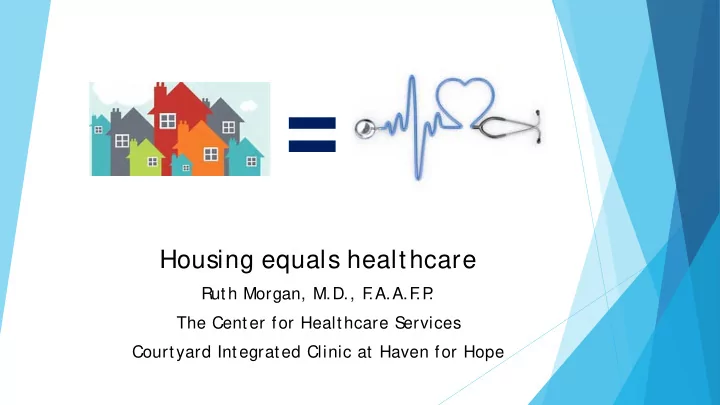
Housing equals healthcare
Ruth Morgan, M.D., F .A.A.F .P . The Center for Healthcare S ervices Courtyard Integrated Clinic at Haven for Hope
= Housing equals healthcare Ruth Morgan, M.D., F .A.A.F .P . - - PowerPoint PPT Presentation
= Housing equals healthcare Ruth Morgan, M.D., F .A.A.F .P . The Center for Healthcare S ervices Courtyard Integrated Clinic at Haven for Hope Social determinants of health (SDH) S ource: Dahlgren, G. and Whit ehead, M. (1991). Policies
Ruth Morgan, M.D., F .A.A.F .P . The Center for Healthcare S ervices Courtyard Integrated Clinic at Haven for Hope
S
t rat egies t o Promot e S
t ockholm: Inst it ut e for Fut ures S t udies.
S
3.5 million people are homeless in U.S . during the course of a year
5.4 million people in U.S . live in substandard housing and/ or paying more than half their income in rent
San Antonio Point in Time Count Year` Total Unsheltered Children <18 yrs 2016 2781 1137 488 2015 2891 1158 546
S
ARAH: S
Mental Illness Physical Disabilities Intellectual Development Disabilities Addiction Abused Women / Children Former Foster Care Ex-offenders
HIV Care Continuum Initiative / HOPWA
(Housing Opportunities for People with AIDS )
Proj ect 25 Enterprise Community Partners, Inc/ Center for
Outcomes Research and Education (CORE)
1990: The Housing Opportunities for Persons With AIDS
(HOPWA) Program was created.
2010: The first National HIV/ AIDS
S trategy was released
2013: HIV Care Continuum Initiative
S
https:/ / www.health.ny.gov/ diseases/ aids/ ending_the_epidemic/ docs/ key_resources/ housing_and_supportive_services/ hopwa.pdf
At least half of Americans living with HIV experience
homelessness or housing instability following diagnosis.
Persons experiencing homelessness are at heightened risk
, with rates of new infections as high as 16 times the rate in the general population.
Evidence shows that housing assistance improves HIV
health outcomes at each stage of the HIV Care Continuum.
1. Aidala, et al. (2007). Housing need, housing assistance, and connection to medical care. AIDS & Behavior; 11 (6)/ Supp 2:S101 – S115. 2. Kerker, B., et al. (2005). The health of homeless adults in NewYork City:A report from the New - York City Departments of Health and Mental Hygiene and Homeless Services. Available at - http:/ / www.nyc.gov/ html/ doh/ downloads/ pdf/ epi/ epi-homeless-200512.pdf. 3. Aidala, et al. 2012; Leaver, et al. 2007. -
S
Tested and diagnosed with HIV infection
S
Linked to HIV medical care within 3 months after diagnosis
S
2 or more primary care visits per year, at least 3 months apart
S
Prescribed antiretroviral medications
S
Most recent viral load undetectable or ,</ = 200 copies/ ML
For persons who lack a safe, stable place to live, housing assistance is
a proven, cost--effective health care intervention.
S
table housing has a direct, independent, and powerful impact on HIV incidence, health outcomes, and health disparities.
Housing status is a more significant predictor of health care access
and HIV outcomes than individual characteristics, behavioral health issues or access to other services.
S
Compared to stably housed persons, persons who are homeless or unstably housed:
Are more likely to become HIV infected
Are more likely to be diagnosed late, after infection has progressed to HIV illness
Are more likely to delay entry into HIV care
Experience higher rates of discontinuous health care
Are less likely to be prescribed ARV treatment
Are less likely to achieve sustained viral suppression
Have worse health outcomes with greater reliance on emergency and inpatient care
Experience higher rates of HIV- related mortality.
Homeless/ unstably housed people with HIV whose housing status improves
Reduce behaviors that can transmit HIV
Increase rates of HIV primary care visits, continuous care, and care that meets clinical practice standards
Are more likely to return to care after drop out
Are more likely to be receiving AR V treatment
Are more likely to be virally suppressed
Reduce avoidable use of expensive emergency and inpatient health care
Use less public resources even taking into account housing supports
S
an Diego County
Homeless population: 8600 individuals Targeted homeless individuals who were high utilizers
, emergency rooms, hospitals, j ails, etc.
Housing first model
S
S
S
S
S
S
S
S
S
S
S
S
Time and care must be devoted to finding the appropriate
housing for each individual.
A close relationship between the landlord and the
program must be established.
Intensive case management is essential. To effectively deliver health care, case managers must be
closely involved.
Portland, Oregon area. Homeless population: 3800
individuals
Explored the impact on healthcare cost when low income
individuals move into affordable housing.
Medicaid claims data was used to measure changes in
health care costs and use.
S
urvey data was used to examine health care access and quality.
The study included 145 housing properties of the three
different types: family housing (F AM), permanent supportive housing (PS H), and housing for seniors and people with disabilities (S PD).
The impact of integrated services with housing.
S
PProd/ ERC_Upload/ 0100981.pdf
S
PProd/ ERC_Upload/ 0100981.pdf
S
PProd/ ERC_Upload/ 0100981.pdf
S
PProd/ ERC_Upload/ 0100981.pdf
Housing positively affects health outcomes. Access to integrated services in affordable housing further
reduces health care costs and significantly reduces use of expensive health care services, such as emergency department visits.
The greater the client health needs at move-in, the more
housing helped.
“The bottom rungs of the housing ladder are broken and we need to fix them. It makes our whole society stronger.”
Using Peer S
upport/ Resident S ervices Coordinators to Increase Awareness
Improve Access to Mental Health and Dental Care
S ervices
Establish a Coordinated Care Organization (CCO)
Metric to Address Housing S tability
Increase Medicaid Flexibility to Allow Investment in
Affordable Housing and Related S ervices
Include Affordable Housing in Hospital Community
Improvement Plans
Invest in Housing and Urban Development S
ection 4 Resources
Increase Use of Flexible S
ervices Funding for Health and Housing
Dahlgren, G. and Whitehead, M. (1991). Policies and S trategies to Promote S
S tockholm: Institute for Futures S tudies.
http:/ / drawingchange.com/ wp-content/ uploads/ 2013/ 11/ GW6-S
S ARAH: S
http:/ / www.sarahomeless.org/
HIV Care Continuum: The connection between housing and improved outcomes along the HIV care continuum. https:/ / www.health.ny.gov/ diseases/ aids/ ending_the_epidemic/ docs/ key_resources/ housing_and_supp
Aidala, et al. (2007). Housing need, housing assistance, and connection to medical care. AIDS & Behavior; 11 (6)/ S upp 2:S 101 – S 115.
Kerker, B., et al. (2005). The health of homeless adults in NewY
City Departments of Health and Mental Hygiene and Homeless S ervices. http:/ / www.nyc.gov/ html/ doh/ downloads/ pdf/ epi/ epi-homeless-200512.pdf.
Proj ect 25: Housing the most frequent users of public services among the Homeless (2015). https:/ / uwsd.org/ files/ galleries/ Proj ect_25_Report.pdf
Health in Housing: Exploring the Intersection between Housing and Health Care (2016). https:/ / s3.amazonaws.com/ KS PProd/ ERC_Upload/ 0100981.pdf