Needs California Medical Innovations Institute Translational Animal - - PowerPoint PPT Presentation

needs
SMART_READER_LITE
LIVE PREVIEW

Needs California Medical Innovations Institute Translational Animal - - PowerPoint PPT Presentation

4/14/2016 Chronic Venous Insufficiency Biomechanical Insights into Prevalence Affects up to 10-35% of Americans Venous Disease and Deep Venous Disease Emerging Treatments Persistent Reflux/Hypertension Inflammation, endothelial


slide-1
SLIDE 1

4/14/2016 1 Ghassan S. Kassab

California Medical Innovations Institute (Calmi2) San Diego, California

Biomechanical Insights into Venous Disease and Emerging Treatments

Chronic Venous Insufficiency

Prevalence

Affects up to 10-35% of Americans

Deep Venous Disease

Persistent Reflux/Hypertension Inflammation, endothelial dysfunction, etc.

Needs

Translational Animal Models (Science & Therapy) Emerging Treatment: Prosthetic Valves

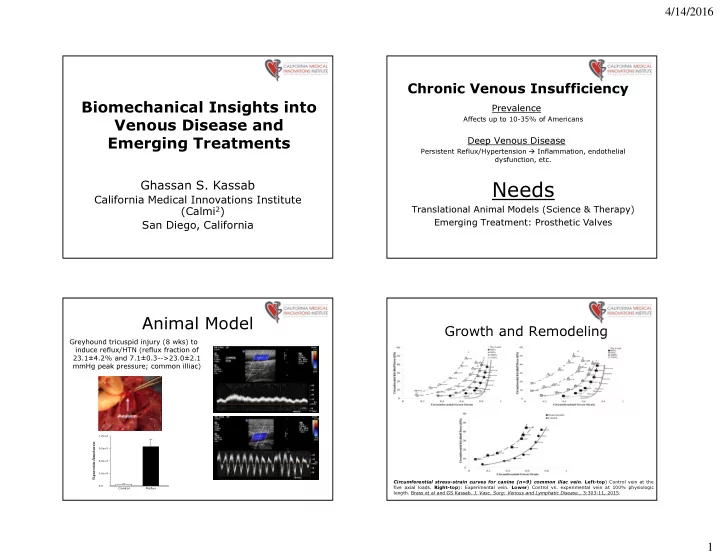
Animal Model

Greyhound tricuspid injury (8 wks) to induce reflux/HTN (reflux fraction of 23.1±4.2% and 7.1±0.3-->23.0±2.1 mmHg peak pressure; common illiac)

Superoxide Absorbance

0.0 3.0e+3 6.0e+3 9.0e+3 1.2e+4 Control Reflux

Growth and Remodeling

Circumferential stress-strain curves for canine (n=9) common iliac vein. Left-top) Control vein at the five axial loads. Right-top): Experimental vein. Lower) Control vs. experimental vein at 100% physiologic

  • length. Brass et al and GS Kassab. J. Vasc. Surg: Venous and Lymphatic Disease., 3:303-11, 2015.
slide-2
SLIDE 2

4/14/2016 2

Remodeling of Microstructure

Histological and merged SHG/TPEG images of the common iliac venous wall for control and experimental veins. Histological section of an experimental (A) and control (B) canine common iliac

  • vein. C: Merged SHG/TPEG image of an experimental (C) and control (D) canine common iliac vein.

Remodeling of Collagen and Elastin

Collagen and elastin in control and experimental common iliac venous tissue. Left) Percent of collagen and elastin areas within the venous wall of control and experimental common iliac veins using

  • MPM. Right) Collagen-to-elastin ratio. Figures show grouped average for n = 6 dogs.

Uniform Stress Hypothesis?

No load state wall thickness and Circumferential stress at different states. Left) Total wall thickness and intimal-medial thickness at the no load state in control and experimental canine common iliac veins. Right) Circumferential stress for control pressure (Control; 7 mmHg), pressure-overload (Control; 20 mmHg) immediately after injury and chronic hypertensive pressure (8 weeks; 20 mmHg) in canine common iliac vein. * p < 0.05 vs. Control; 20 mmHg

Emerging Treatment?

Prosthetic Venous Valves Synthetic Urethane, Pellethane, Polymers Biological Autologous, allografts, xenograft, manufactured Failure modes Thrombosis, Leaflet Remodeling: Design, material selection

slide-3
SLIDE 3

4/14/2016 3

In Vivo: Valve Performance

Safety and Competency of Prosthestic Valve at 4 weeks Post Implant. Left) DUS image of valve in open position. Right) Flow waveforms showing elimination of reflux post implant.

In Vivo: Valve Performance

* *

Venous Reflux Fraction (%)

10 20 30 40 50 60

Mean Venous Outflow Velocity (cm/s)

5 10 15 20 25

Reflux Fraction Venous Outflow

Reflux Valve

Superoxide Absorbance

0.0 3.0e+3 6.0e+3 9.0e+3 1.2e+4

Control Reflux Valve Efficacy of Prosthestic Valve at 4 weeks Post Implant. Left) Reflux fraction and venous outflow velocities and Right) Superoxide production in common iliac vein before and after implant.

Conclusions

Canine model of CVI provides both scientific understanding of venous disease as well as translational model for assessment of potential therapies Growth and remodeling of veins under reflux/HTN show increased vein stiffness, wall thickness, and collagen-to-elastin ratio A potential prosthetic venous valve shows early (4 wks) pre- clinical promise but requires longer implant durations prior to FIM.