Large Vessel Stiffening and Pulmonary Hypertension: Contribution of - - PowerPoint PPT Presentation

large vessel stiffening and pulmonary hypertension
SMART_READER_LITE
LIVE PREVIEW

Large Vessel Stiffening and Pulmonary Hypertension: Contribution of - - PowerPoint PPT Presentation

6/21/2013 RV Failure is the Proximate Cause of Death in Patients With Pulmonary Hypertension Large Vessel Stiffening and Pulmonary Hypertension: Contribution of Extracellular Proteins and Inflammation K. R. Stenmark University of Colorado


slide-1
SLIDE 1

6/21/2013 1

University of Colorado Denver, CO 80262, USA

  • K. R. Stenmark

Large Vessel Stiffening and Pulmonary Hypertension: Contribution of Extracellular Proteins and Inflammation

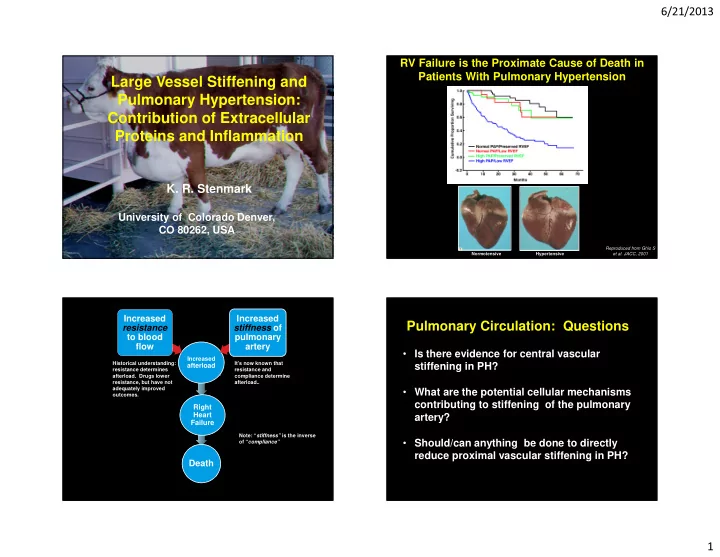
RV Failure is the Proximate Cause of Death in Patients With Pulmonary Hypertension

Reproduced from Ghio S et al. JACC, 2001 Normotensive Hypertensive

PAH

Increased

afterload

Increased resistance to blood flow Increased stiffness of pulmonary artery

Right Heart Failure

Death

Note: “stiffness” is the inverse

  • f “compliance”

Historical understanding: resistance determines

  • afterload. Drugs lower

resistance, but have not adequately improved

  • utcomes.

It’s now known that resistance and compliance determine afterload..

  • Is there evidence for central vascular

stiffening in PH?

  • What are the potential cellular mechanisms

contributing to stiffening of the pulmonary artery?

  • Should/can anything be done to directly

reduce proximal vascular stiffening in PH?

Pulmonary Circulation: Questions

slide-2
SLIDE 2

6/21/2013 2 Pulmonary Hypertensive Vessels Enlarge and Stiffen.

D= 1.6 cm D= 2.5 cm

Normotensive PA Hypertensive PA

Artery Wall At Systole Wall Deformation Over Cardiac Cycle

Measured by MRI (Age, Gender and BSA Matched)

Significant Increases in Impedance are Observed in Patients with PAH

  • Significant elevation in modulus of impedance for the first three harmonics in patients with PH.
  • Z0: resistance, Z1, Z2: oscillatory function / capacitance

Hunter et al., Am H.J., 2008

PAH-Associated Vascular Remodeling in Human

Normal PA Hypertensive PA

2-Photon Second Harmonic Generation Microscopy: Elastin ; Collagen

Elastin fragmentation

Collagen accumulation Collagen

Circumferential Stress

PA Stiffening in Severe PH

Physiologic Stiffness is Increased in Patients with PAH

HEALTHY HYPERTENSIVE HYPERTENSIVE HEALTHY

slide-3
SLIDE 3

6/21/2013 3 Can Animal Models be Used to Study Proximal Vascular Stiffening in Pulmonary Hypertension?

Mouse

Chronic Hypoxia Results in Stiffening of the Extralobar Pulmonary Arteries in Mice and Rats

Ex Vivo biaxial stress strain testing of rat PAs

Rat

Marked Increases in Resistance and Stiffening in Chronically Hypoxic Neonatal Calves

Indices of Pulmonary Vascular Stiffening

Indices of Ventricular Resistance

Neonatal (2 wk-old) Calves 287±101 51.2±16.9 8.0±2.0 73.4±10 101.5±17.7 Severe PH (n=8) 112±35 20.1±2 2.1±1.0 20.1±3 31.0±3 Control (n=12) MPA Stiffness (mm KPa) Pulse Pressure (mm Hg) Total Pulmonary Resistance (mm Hg/L/min) Mean PAP (mm Hg) Peak Systolic Pressure (mm Hg) Moderate PH (n=6) 163±51 32.3±7.3 5.6±1.4 42.3±7.8 59.4±7.5

Interim Summary: PH-Associated Pulmonary Vascular Remodeling in Human

Significantly elevated stiffness Early collagen engagement Significant anisotropy (different

longitudinal vs. circumferential mechanics)

Loss of elastin-dependent

mechanics

Near total loss of PA capacitive

function

Matrix Remodeling in PH STRUCTURAL:

  • Elastin fragmentation
  • Collagen accumulation

FUNCTIONAL

slide-4
SLIDE 4

6/21/2013 4

  • Is there evidence for central vascular

stiffening in pulmonary hypertension?

  • What are the potential cellular

mechanisms contributing to stiffening of the pulmonary artery?

  • Should/can anything be done to directly

reduce proximal vascular stiffening in PH? Pulmonary Circulation: Questions

Elevated mPAP, pulse pressure, and disturbed flow patterns → High Afterload → Right Heart Failure.

Hypothesis:

Large Vessel Stiffening is Due to Accumulation and Activation of Mononuclear Cells

Humans with PAH: Accumulation of Monocyte/Macrophage in Pulmonary Artery Media, Neointima, and Adventitia

Medial “resident” immunomodulatory cells

  • PA media normally contains “resident”

immunomodulatory leukocytic cells;

  • in PAH, numbers of these cells within

vascular media markedly increase.

Calf Model Exhibits Greater Similarities to Human PAH than Rodent Models

Rat

Influx of inflammatory cells in PA Adventitia only.

Calf

Accumulation of inflammatory cells in PA Media, Adventitia, (and Neointima); Elastin fragmentation is observed

slide-5
SLIDE 5

6/21/2013 5

Extracellular Matrix (ECM) Derived Fragments Can Drive a Vascular Inflammatory Response

ECM peptides with immune / inflammatory effects:

  • Elastin
  • Collagen (I and IV)
  • Fibronectin
  • Laminin
  • Thrombospondin
  • Hyaluron

Vascular Inflammation, Elastin Fragmentation, and Vascular Stiffening

Activated Macrophages

Degradation of Elastin

Elastin Fragments (“Elastokines”) Chemotactic for leukocytes Pro-Mitogenic for VSMCs & Fibs Pro- Angiogenic

Chronic Inflammation

Rabinovitch M. 1999; Antonicelli F. et al. 2007 Duca L. et al 2004

Anti- Apoptotic

Vascular Remodeling

Expression of Pro-Inflammatory Mediators, Pro-Fibrotic Markers, and Proteolytic Enzymes is Augmented in Vascular Media of Hypoxic Hypertensive Calves (Hx)

?

?

(SDF-1) Il1b Il6 Ccl2 Ccl12 Ssp1

Col3a1 Col1a1 Thbs-1 Mmp1

C O H x 2 4 6 8 Expression relative to HPRT CO Hx 125 250 375 500 C O H x 2 3 4 6 6 9 9 2 11 5 CO Hx 42 84 126 168 210 CO Hx 300 600 900 1200

(MCP-1) (Osteopontin) (Collagen I) (Collagen III) (Thrombospondin-1) (MMP-1)

C O H x 200 400 600 CO Hx 40000 80000 120000 160000 CO Hx 25 50 75 100 125 CO Hx 55 110 165 220 275

RT-PCR

Bone Marrow-Derived Macrophages (BMDMs) – but not SMCs – Respond to Elastin Peptide Treatment by Upregulating Pro-Inflammmatory Mediators

*

*

Relative Expression to HPRT

* * Il1β

Νos2 (iNOS)

Ccl2 (MCP-1) RT-PCR

* ** * *

slide-6
SLIDE 6

6/21/2013 6

Bone Marrow-Derived Macrophages (BMDMs) – but not SMCs – Responded to Elastin Peptide Treatment by Upregulating Pro-Fibrotic Markers

Ccl12 (SDF-1) Ssp1 (Osteopontin) Tnc (Tenascin-C) Col3a1 (Collagen III) Col1a1 (Collagen I) Thbs1 (Thrombospondin- 1)

Relative Expression to HPRT Relative Expression to HPRT

* * * * ** * ** * * *

Interim Summary:

  • Normal conduit PA media (human and bovine,

but not rodent) contains “resident” inflammatory/immunomodulatory leukocytic cells.

  • In pulmonary hypertension, increased

accumulation of numbers of these leukocytic cells is observed.

  • Elastin peptides induce activation of naïve

macrophages (BMDMs): upregulated mRNA expression of pro-inflammatory and pro-fibrotic markers.

  • Is there evidence for central vascular

stiffening in pulmonary hypertension?

  • What are the potential cellular

mechanisms contributing to stiffening of the pulmonary artery?

  • Should/can anything be done to directly

reduce proximal vascular stiffening in PH?

Pulmonary Circulation: Questions

Low compliance is the leading independent predictor of

mortality

Compliance correlates directly with exercise capacity and

quality of life

Low compliance accounts for up to 50% of RV afterload Low compliance stimulates progression of the disease Pulmonary vascular stiffness is increased 25- to 30-fold etc…

Compliance is Fundamental to PH

1 Campo et al, Am J Respir Crit Care Med, 2009, 2 Mahapatra et al, J Am Soc. Echocardiography, 2006, 3 Mahapatra et al, J Am Col Card, 2006, 4 Gan et al, Chest, 2007, 5 Hunter et al, J Appl Physiol, 2010, 6 Sanz et al, JACC Card. Imag. 2009, 7 Li and Chesler, Pulm. Circ. 2011, 8 Perrot et al, Chest, 2011, 9 Bonderman et al, Chest, 2011, 10 Saouti et al, Am J Respir Crit Care Med, 2010, 11 Milnor et al, Circ Res, 1966, 12 Milnor et al, Circ Res, 1969, 13 Wang and Chesler, Pulm Circ, 2011, 14 Stenmark et al, Circ Res, 2006, 15 Birukov Andiox Redox Sig, 2009 , 16 Li et al, Ann Biomed Eng, 2009 , 17 Stevens et al, JACC, Cardiovascular Imaging, 2012

slide-7
SLIDE 7

6/21/2013 7 Potential Mechanisms of HPF-Induced Perpetuation of Distal PA Remodeling In PH

SM Ce SM Ce

SMC hypertrophy

Fibroblst-myod

Fibs--Myofibs differentiation

Therapies Aimed at Reducing Vascular Stiffening

  • Renin Angiotensin Aldosterone System (RAAS) blockers
  • AGE – cross-link breakers (alagebrium)
  • Statins
  • Anti-Inflammatory agents
  • Elafin (serine protease inhibitor)

Aria CV’s Device Restores Compliance to PA

Gas filled balloon & anchor

SQ access port

Conduit

Reservoir

  • Implanted like a pacemaker
  • Mimics function of elastic pulmonary artery
  • Balloon collapses during systole & expands

during diastole

  • Acts like a passive IABP
  • By restoring compliance, it allows more

blood to flow for less heart work

KV1

Bench: Hemodynamic Benefits

20 40 60 80 100 120 140 0.2 0.4 0.6 0.8 Pa Pressure (mmHg) Time (s)

Pressure in Pulmonary Artery

Off On

Systole Diastole

Device Compliance increased by 0.51 ml/mmHg (in this example) Hemodynamic Effects Lower systolic pressure

  • reduces RV work & wall stress
  • increases SV

Higher diastolic pressure

  • Increases blood flow

Reduction of pulse pressure

  • breaks the disease-stimulating

feedback loop Expected Patient Effects

  • Increase in exercise

capacity & QOL

  • Decrease in

mortality likely

slide-8
SLIDE 8

Slide 27 KV1 Do we want to say that it functions similar to an IABP? Stick in slide with benchtop data in it.

Karl Vollmers, 6/17/2013

slide-9
SLIDE 9

6/21/2013 8

Device efficacy studies using high altitude cattle Brisket disease = RHF due to PH caused by chronic hypoxia Histology of the pulmonary vessels resembles vessels of PAH patients

Bovine Studies

Device increased Pulmonary Vascular Compliance by 1.3 ml/mmHg (~ 47% increase)

Device in vivo

Implications for PH Patients: Mayo Clinic Study

An increase of compliance by 1.3 ml/mmHg (as in Bovine Study 3)

would move patients up two quartiles.

Good chance of Survival Benefit

Relationship of Capacitance and Mortality in Patients with iPAH (JACC 2006, McGoon, et al)

Q1 Q2 Q3 Q4

Compliance is Fundamental to PH

1 Bonderman et al, Chest, 2011, 2 Lankhaar et al, Eur Heart J, 2008,

drug & device drug only Normal person

slide-10
SLIDE 10

6/21/2013 9

Elevated mPAP, pulse pressure, and disturbed flow patterns → High Afterload → Right Heart Failure.

Conclusion:

Pulmonary Hypertension is a Disease of Disordered Coupling

  • f the RV to the Pulmonary Circulation, Where Large Vessel

Stiffening is Critical

Cardiovascular Pulmonary Laboratories Dunbar Ivy Maria Frid Suzette Riddle Min Li Mike Yeager Dale Brown Joe Albietz Lori Walker Peter Buttrick Department of Bioengineering Robin Shandas Steve Lammers Kendall Hunter Jerry Qi Wei Tan Luciano Mazzaro University of Pittsburgh Hunter Champion et al University of Minnesota John Scandura (Aria) Ken Weir

UC Denver

Large Vessel Stiffening, via Effects on Pulse Wave Intensity, Modulates Distal Vessel Structure and Function

Mimetic Circulatory System

Pressure (mmHg) Pressure (mmHg)

High Pulsatility Flow (HPF) Stimulates Bovine Distal PA-EC Inflammation

slide-11
SLIDE 11

6/21/2013 10 Ventricular-Arterial Coupling in the Pulmonary Circulation

Endothelium:

  • Endothelial dysfunction
  • Increased permeability

Extrinsic Influences: NaCl, Lipids, AngII, Sympathetic Neurohormones, Shear Stress, Increased Luminal Diameter

Potential Mechanisms Contributing to Vascular Stiffening

Adventitia: Collagen, Fibroblasts MΦ, T-cells Intima:

  • Collagen, VSMCs,

Leukocytes ( MΦ ), MMPs, AGE’s, TGF-β, etc etc.

  • Elastin

Media:

  • Collagen, VSMCs,

AGE’s, MMPs, MΦ?

  • Elastin, (elastases )

from: Zieman SJ et al., ATVB 2005

In Vivo Depletion of Macrophages via Clodronate- Liposomes Results in Attenuation of Hypoxia-Induced Fibrosis and Vascular Remodeling in Rats

In pulmonary hypertension, vascular remodeling and stiffening are the result of augmented Accumulation and Activation of Inflammatory / Immunomodulatory cells within the media of large PAs.

Hypothesis

slide-12
SLIDE 12

6/21/2013 11

Endothelium:

  • Endothelial dysfunction
  • Increased permeability

Extrinsic Influences: NaCl, Lipids, AngII, Sympathetic Neurohormones, Shear Stress, Increased Luminal Diameter

Potential Mechanisms Contributing to Vascular Stiffening

Adventitia: Collagen, Fibroblasts MΦ T-cells Intima:

  • Collagen, VSMCs,

Leukocytes ( MΦ ), MMPs, AGE’s, TGF-β, etc etc.

  • Elastin

Media:

  • Collagen, VSMCs,

AGE’s, MMPs, MΦ?

  • Elastin, (elastases )

Elastin peptides, generated in the setting of PH in the media of large elastic PAs, perpetuate pro-inflammatory and pro-fibrogenic gene programs in monocytes/macrophages.

Hypothesis

MMP’s

Non-transgenic Elafin-transgenic Injured Sham Injured Sham Non-transgenic Elafin-transgenic

Movat’s pentachrome stain Mac-3 antigen stain

Elafin Treatment Reverses Established Severe PH in Rats

*P <0.05, One-way ANOVA with Dunnett's Multiple Comparison

  • N. Nickel and M. Rabinovitch unpublished