
SLIDE 1
Vessel TRIAGE categories: examples
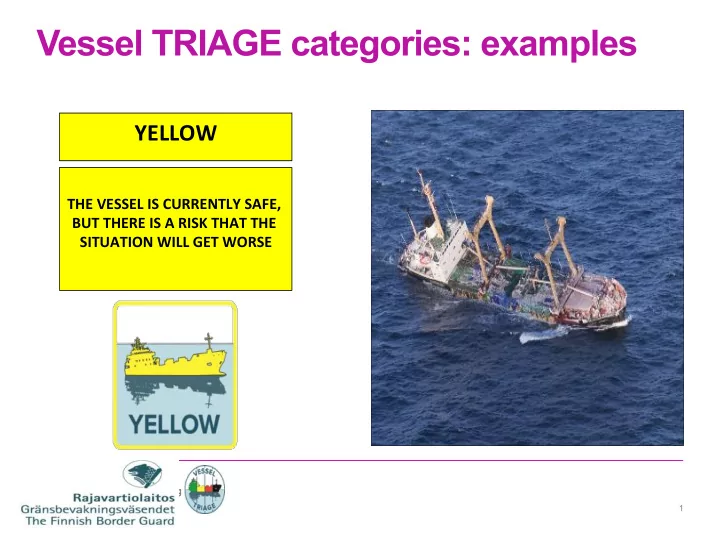
YELLOW
THE VESSEL IS CURRENTLY SAFE, BUT THERE IS A RISK THAT THE SITUATION WILL GET WORSE
1
Vessel TRIAGE categories: examples YELLOW THE VESSEL IS CURRENTLY - - PowerPoint PPT Presentation
Vessel TRIAGE categories: examples YELLOW THE VESSEL IS CURRENTLY SAFE, BUT THERE IS A RISK THAT THE SITUATION WILL GET WORSE 1 Vessel TRIAGE categories: examples RED THE LEVEL OF SAFETY HAS SIGNIFICANTLY WORSENED AND EXTERNAL ACTIONS ARE
YELLOW
THE VESSEL IS CURRENTLY SAFE, BUT THERE IS A RISK THAT THE SITUATION WILL GET WORSE
1
THE LEVEL OF SAFETY HAS SIGNIFICANTLY WORSENED AND EXTERNAL ACTIONS ARE REQUIRED TO ENSURE THE SAFETY OF THE PEOPLE ABOARD
RED
2
THE VESSEL IS NO LONGER SAFE AND HAS BEEN LOST
BLACK
3
2) Decision on vessel’s Vessel Triage category 1) Exchange of information
4
Threat factors GREEN YELLOW RED BLACK
Flooding
Flooding affects a limited or contained space and has no effect on the vessel’s stability and seaworthiness. Flooding can be kept under control with pumps and water;ght compartments, but the seaworthiness of the vessel is restricted. Extensive flooding or progressive flooding to undamaged water;ght compartments. Flooding cannot be kept under control and poses a direct danger
Flooding is so severe that evacua;on opera;ons are no longer possible. OR Vessel has capsized or sunk.
LisHng, decrease of stability
Lis;ng or decrease of stability does not affect the seaworthiness of the vessel. Seaworthiness of the vessel is restricted due to a decrease of stability or a notable list. Large heel angles. The seaworthiness of the vessel is significantly impaired, its stability is threatened and there is an imminent need to evacuate. Stability is decreased to such an extent that evacua;on
possible. OR Vessel has capsized or sunk.
Decrease of manoeuvrability
Vessel’s manoeuvrability is hampered, but the vessel can s;ll proceed on its course. Vessel has lost its manoeuvrability, but is s;ll capable of emergency anchoring
Vessel has lost its manoeuvrability and is not capable of emergency anchoring
(Not applicable)
Black-out
Func;ons important for ship
backup systems while the fault is repaired. Opera;onal capability of the vessel is limited: Backup systems do not work as planned OR func;ons important for ship
backup systems, but the fault cannot be repaired at sea. A full black-out of long dura;on that cannot be repaired at sea poses a direct danger on the en;re vessel. (Not applicable)
Fire, explosion
Fire has been ex;nguished and there is no danger of reigni;on AND/OR the consequences of an explosion do not affect the vessel's safety. Fire or explosion affects only a limited area and can be brought under control with the vessel’s
firefigh;ng resources. Fire cannot be kept under control OR the consequences of an explosion pose a direct danger on the en;re vessel. Condi;ons on board the vessel are not survivable. The consequences of the fire or explosion pose a direct danger to persons aboard. OR Vessel has been destroyed.
Danger posed by hazardous substances
Release of hazardous substances
danger on the vessel. Release of hazardous substances
certain sec;ons of the vessel, but Release of hazardous substances
(Not applicable)
5
Threat factors GREEN YELLOW RED BLACK Flooding
Flooding affects a limited or contained space and has no effect
and seaworthiness. Flooding can be kept under control with pumps and water;ght compartments, but the seaworthiness of the vessel is restricted. Extensive flooding or progressive flooding to undamaged water;ght compartments. Flooding cannot be kept under control and poses a direct danger
Flooding is so severe that evacua;on
longer possible. OR Vessel has capsized or sunk.
6
Threat factors GREEN YELLOW RED BLACK
Flooding
Flooding affects a limited or contained space and has no effect on the vessel’s stability and seaworthiness. Flooding can be kept under control with pumps and water;ght compartments, but the seaworthiness of the vessel is restricted. Extensive flooding or progressive flooding to undamaged water;ght
cannot be kept under control and poses a direct danger on the en;re vessel. Flooding is so severe that evacua;on opera;ons are no longer possible. OR Vessel has capsized or sunk.
LisHng, decrease of stability
Lis;ng or decrease of stability does not affect the seaworthiness of the vessel. Seaworthiness of the vessel is restricted due to a decrease of stability or a notable list. Large heel angles. The seaworthiness of the vessel is significantly impaired, its stability is threatened and there is an imminent need to evacuate. Stability is decreased to such an extent that evacua;on
possible. OR Vessel has capsized or sunk.
Decrease of manoeuvrability
Vessel’s manoeuvrability is hampered, but the vessel can s;ll proceed on its course. Vessel has lost its manoeuvrability, but is s;ll capable of emergency anchoring or driGing safely. Vessel has lost its manoeuvrability and is not capable of emergency anchoring or driGing safely. (Not applicable)
Black-out
Func;ons important for ship
backup systems while the fault is repaired. Opera;onal capability of the vessel is limited: Backup systems do not work as planned OR func;ons important for ship
backup systems, but the fault cannot be repaired at sea. A full black-out of long dura;on that cannot be repaired at sea poses a direct danger on the en;re vessel. (Not applicable)
Fire, explosion
Fire has been ex;nguished and there is no danger of reigni;on AND/OR the consequences of an explosion do not affect the vessel's Fire or explosion affects only a limited area and can be brought under control with the vessel’s own or external damage control/firefigh;ng Fire cannot be kept under control OR the consequences
danger on the en;re vessel. Condi;ons on board the vessel are not survivable. The consequences of the fire or explosion pose a direct danger to persons aboard.
YES YES YES YES NO NO
7
THE VESSEL IS SAFE AND CAN BE ASSUMED TO REMAIN SO THE LEVEL OF SAFETY ABOARD HAS SIGNIFICANTLY WEAKENED AND IMMEDIATE EXTERNAL ACTION IS REQUIRED TO ENSURE THE SAFETY OF THE PEOPLE ABOARD THE VESSEL IS NO LONGER SAFE AND HAS BEEN LOST
GREEN RED BLACK
THE VESSEL IS CURRENTLY SAFE, BUT THERE IS A RISK THAT THE SITUATION WILL GET WORSE
YELLOW
8
9
Finnish Transport Safety Agency and Finnish Border Guard will submit the Vessel Triage iniHaHve IMO approval:
with a proposal for tes;ng and a long term goal to implement it in the IAMSAR Manual 2016 Vessel TRIAGE METHOD is submibed to NCSR 3. Proposed to be include to the IAMSAR Manual as long-term aim. Proposed and agreed to recommend further tes;ng. 2017 Feedback Vessel TRIAGE tests will be submibed to NCSR 4 GOAL Vessel Triage method included to the IAMSAR 2019 edi;on. JWG 22 Sept 2015 NCSR 3 March 2016 JWG 23/24 2016/2017 MSC 98/99 2018/2019 IAMSAR 2019
11
should be confirmed
not become Master responsibility
emergency assessment and communication methods
between individuals
should be harmonized across multiple SAR regions
be accounted for
12
Shore Side Responders JRCC / MRCC Distress Vessel Shipping Company
”No: Vessel TRIAGE is not the answer to life, the universe and everything. But it will help improve understanding. And that alone makes it worthwhile”
David Jardine-Smith IMRF secretary
16
Thank you!
The Finnish Border Guard (HQ) SAR Unit Commander Petteri Leppänen email: petteri.leppanen@raja.fi