Esophageal Cancer Treated leads to possible fistulas and spread to - - PDF document

esophageal cancer treated
SMART_READER_LITE
LIVE PREVIEW

Esophageal Cancer Treated leads to possible fistulas and spread to - - PDF document

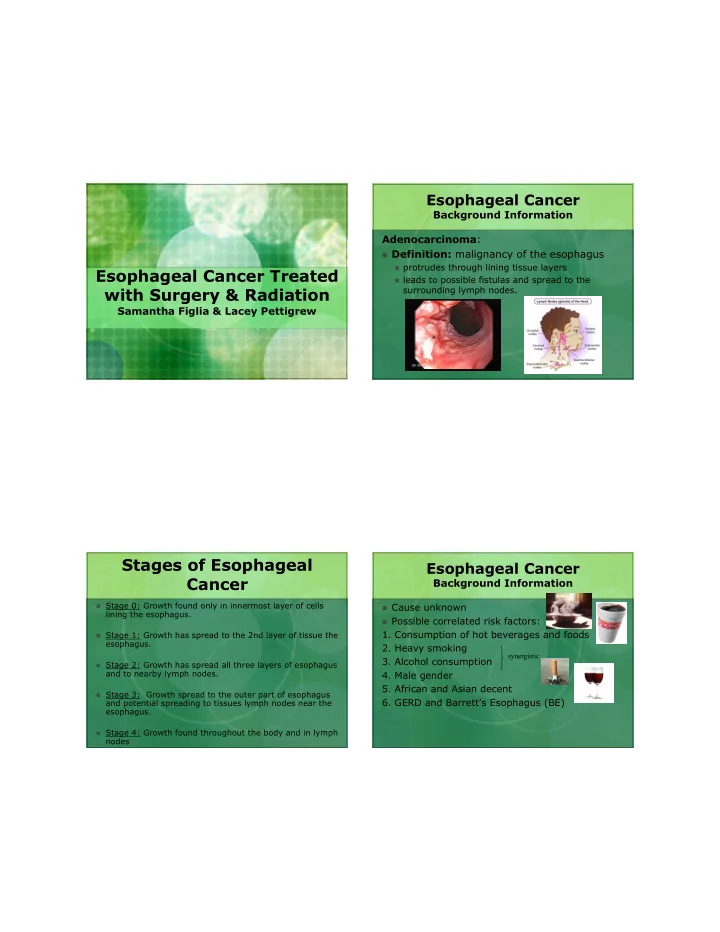
Esophageal Cancer Background Information Adenocarcinoma : Definition: malignancy of the esophagus protrudes through lining tissue layers Esophageal Cancer Treated leads to possible fistulas and spread to the surrounding lymph nodes.


slide-1
SLIDE 1

Esophageal Cancer Treated with Surgery & Radiation

Samantha Figlia & Lacey Pettigrew

Esophageal Cancer

Background Information Adenocarcinoma:

 Definition: malignancy of the esophagus

 protrudes through lining tissue layers  leads to possible fistulas and spread to the

surrounding lymph nodes.

Stages of Esophageal Cancer

 Stage 0: Growth found only in innermost layer of cells

lining the esophagus.

 Stage 1: Growth has spread to the 2nd layer of tissue the

esophagus.

 Stage 2: Growth has spread all three layers of esophagus

and to nearby lymph nodes.

 Stage 3: Growth spread to the outer part of esophagus

and potential spreading to tissues lymph nodes near the esophagus.

 Stage 4: Growth found throughout the body and in lymph

nodes

Esophageal Cancer

Background Information

 Cause unknown  Possible correlated risk factors:

  • 1. Consumption of hot beverages and foods
  • 2. Heavy smoking
  • 3. Alcohol consumption
  • 4. Male gender
  • 5. African and Asian decent
  • 6. GERD and Barrett’s Esophagus (BE)

synergistic

slide-2
SLIDE 2

Esophageal Cancer

Background Information

Progression often leads to:

1.

Aspiration

2.

Inability to consume beverages and foods orally

Prognosis almost always fatal; 5 year survival rate

  • f 16%.

Incidence:

1.

New cases in 2008: 16,470

2.

Deaths per year: 14,280

Prevalence:

1.

Third most common cancer in G.I. Tract.

2.

United States: highest incidence in urban areas and overall incidence is about 5 in 100,000.

Literature Review CAM

Title: Transitioning From Preclinical to Clinical Chemopreventive Assessments of Lyophilized Black Raspberries: Interim Results Show Berries Modulate Markers of Oxidative Stress in Barrett’s Esophagus Patients

 Hypothesis: “Dietary administration of black

raspberries may inhibit the progression of Barrett’s Esophagus”

Literature Review CAM

 Variables:

Dependent:

  • 1. Stress Markers: 8-epi-prostaglandin F2a

& 8-hydroxy-2’-deoxyguanosine

  • 2. Cell and DNA Damage

Independent: Lyophilized Black Raspberries (LBR) Results: Overall oxidative stress and cell/ DNA damage decreased. Discussion/Conclusions:

 Not significant decrease in oxidative stress and

malignant cell growth.

 LBR high anti-oxidant properties & combined with

traditional cancer treatment provide additional relief.

Literature Review MNT

Title: Modulating Effects of the Feeding Route on Stress Response and Endotoxin Translocation in Severely Stressed Patients Receiving Thoracic Esophagectomy.

  • Retrospective study on 29 Male patients who

underwent an esophagectomy.

  • Separated into 2 groups: TPN or Enteral Nutrition
  • Interleukin-6 &10 and endotoxins were monitored 1

wk before operation, and 2 hours, 1,3,7 days post

  • peration.
slide-3
SLIDE 3

Literature Review MNT

 Results

 Acute phase responders were

significantly lower in EN patients than TPN patients.

 Perioperative EN may be the

preferred method of nutrition for esophagectomy patients.

Patient Information

  • Mr. Nick Seyer

 Male  Age: 58 years  Height: 6’3”  Current Weight: 198lbs  Occupation: Contractor  Lifestyle: Smoker (2 packs daily) and

alcohol (1-2 beers daily)

Patient information Cont.

 Chief Complaint: Heartburn and difficulty

swallowing (4-5 months)

 Medical History: No prior hospitalizations  Nutrition History: Normal appetite and diet/

No aversions to foods previous to illness

 Medical Diagnosis: Stage IIB

adenocarcinoma of the esophagus

Previous Surgery to MNT

Type: Transhiatal Esophagectomy

Description: diseased esophagus is removed and…

  • 1. Reconnected with the stomach.
  • 2. Part of the descending colon is used and

reconnected to the stomach.

slide-4
SLIDE 4

Patient Information

Diet- Drug interactions: None Usual Food Intake: Good (previous to illness) 24-hour recall: Decreased food intake and overall Kcals due dysphagia and heart burn

Patient Information Cont.

Allergies: None Family Influences: Wife purchases and prepares foods. Lifestyle risk factors: heavy smoking and moderate alcohol consumption

Patient Assessment

Medical History: None Biochemical Parameters: Normal: BMI (24.8), Sodium (136 mEq/L) and BUN (10 mg/dL) Low: Albumin (3.0 g/dL), Total Protein (5.7 g/dL), Prealbumin (12 mg/dL), Transferrin (175 mg/dL), RBC (4.3 x10^6/mm^3), Hgb (13.9 g/dL), and Hct (38%) High: CPK (172U/L), ESR (15 mm/hr) [reactant to acute illness]

Patient Assessment Cont.

Physical Assessment:

 Moderately weight loss  %UBW: 86%

(14% loss over several months: Moderate)

 BMI: 24.8 (Normal)  Dysphagia (3-4 months)  Odynophagia (5-6 months)  Eyes sunken

slide-5
SLIDE 5

Prescribed Tube Feeding

By Physician

Placement: Jejunal Feeding Tube Formula: Isosource HN 1.5 @75ml/hr Provides: Total: 2700 kcals Protein: 122g Free Water:1386 ml Flushes: 75ml/ hr *** Not meeting his Caloric needs of 2919 Kcals**

Diagnosis

Inadequate oral food/beverage intake (NI-2.1) related to dysphagia and decreased appetite as evidenced by 14% unintentional weight loss over several months and patient report of difficulty swallowing.

Nutrition Intervention

 The patient’s current TF is not meeting

his kcal and protein needs.

 We recommend increasing TF formula

rate to 85ml/hr. This provides:

 3060 kcals  138g Protein  1571ml Water  335ml flushes every 6 hrs

Nutrition Intervention Cont.

 If signs of intolerance, switch to

elemental formula, Peptamen1.5 @ 85ml/hr

 Education on smoking cessation &

alcohol consumption

slide-6
SLIDE 6

Patient Goals

 Outcome Goals: Stop involuntary

weight loss, and increase all serum protein levels to normal range.

Monitor/Evaluate

 Monitor any changes in electrolytes,

serum proteins, and weight.

 Monitor for tolerance of tube feeding.

Check for diarrhea, and nausea.

 Follow up in 24 hours. Referral to speech

pathologist in1-2 wks for swallow test to determine whether pt. can be advance to PO diet.

 Radiation usually occurs 2-4 week post

surgery referral to outpatient RD if side effects affecting PO intake occur

References

1.

Black, J.M. & Hokanson Hawks, J. (2005). Medical- Surgical Nursing: Clinical Management for Positive Outcomes. Pennsylvania: Elsevier Inc.

2.

Benz, C.C. & Park, J.W. (2007). Immunotherapy Cancer Treatment

3.

Christiani, D., Kim, J., Mukherjee, S., and Ngo, L. (2004). Urinary 8-Hydroxy-2'- Deoxyguanosine as a Biomaker of Oxidative DNA Damage in Workers Exposed to Fine Particulates. Health Perspect 112(6):666-671. National Institute of Environmental Health Sciences.

4.

Escott- Stump, S. & Mahan, L.K. (2008). Krause’s Food and Nutrition Therapy. Pennsylvania: Elsevier Inc.

5.

Frankel, W.L., Hammond, C.D., Kresty, L.A. (2006). Transitioning From Preclinical to Clinical Chemopreventive Assessments of Lyophilized Black Raspberries: Interim Results Show Berries Modulate Markers of Oxidative Stress in Barrett’s Esophagus Patients. Nutrition and Cancer: 54(1), 148-156. Lawrence Erlbaum Associates, Inc.

6.

Halushka, P., Wong, P., Yan, Y., and Yin, K. (1994). Antiaggregatory activity of 8-epi- prostaglandin F2 alpha and other F- series prostanoids and their binding to thromboxane A2/prostaglandin H2 receptors in human platelets. Volume 270, Issue 3, pp. 1192-1196. American Society for Pharmacology and Experimental Therapeutics.

7.

National Cancer Institute.(2007). U.S. National Institutes of Health. www.cancer.gov

8.

Nestle Nutrition Institute. www.nestle-nutrition.com

9.

American Cancer Society. (2008). www.cancer.org