Definition of Reproduction Asexual Reproduction The process by - - PDF document

definition of reproduction asexual reproduction
SMART_READER_LITE
LIVE PREVIEW

Definition of Reproduction Asexual Reproduction The process by - - PDF document

Definition of Reproduction Asexual Reproduction The process by which living organisms produce new organisms of their own kind Two types of Reproduction Asexual Reproduction A single parent produces an identical Sexual offspring


slide-1
SLIDE 1

1

Asexual Reproduction Definition of Reproduction

The process by which living organisms

produce new organisms of their own kind

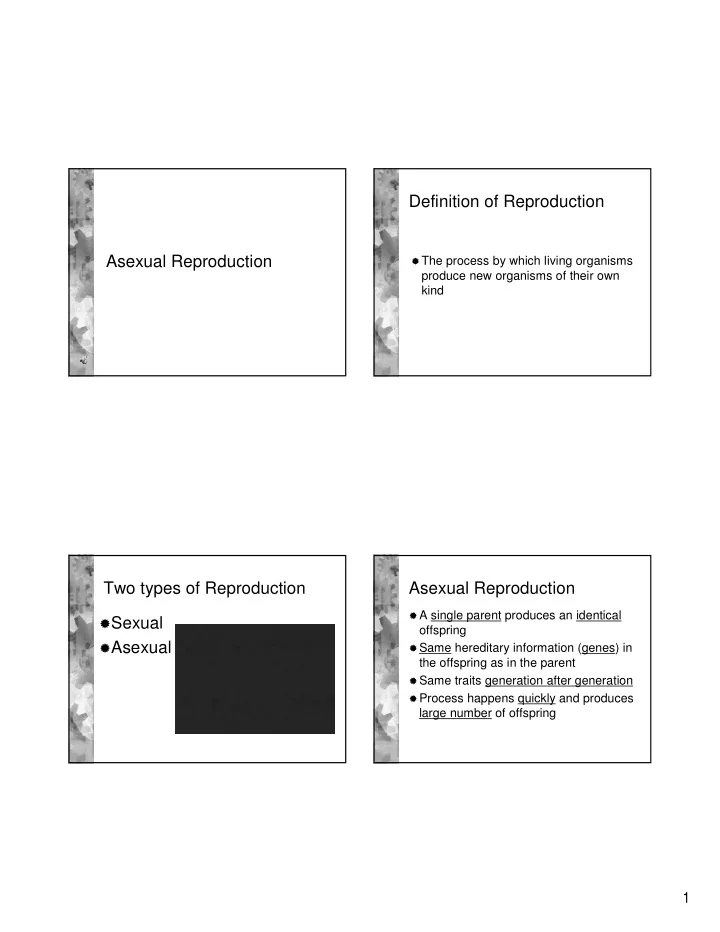
Two types of Reproduction

Sexual Asexual

Asexual Reproduction

A single parent produces an identical

  • ffspring

Same hereditary information (genes) in

the offspring as in the parent

Same traits generation after generation Process happens quickly and produces

large number of offspring

slide-2
SLIDE 2

2

Concerns

Limited genetic variation (they are all

the same) makes the organism more susceptible to mass extinction

Rapid growth may be limited by the

food, water, space, etc. which may lead to death of organisms

Seven Types of Asexual Reproduction

  • 1. Mitosis
  • 2. Binary fission
  • 3. Budding
  • 4. Spores
  • 5. Regeneration
  • 6. Vegetative propagation
  • 7. Cloning

Mitosis (#1)

Produces body cells in animals and

plants

Process studied in 7th Grade Cells produce an identical cell with the

same function

http://www.cellsalive.com/mitosis.htm

Binary Fission (#2)

Simplest form Parent cell divides

into two equal parts

Example : bacteria

www.DennisKunkel.com

slide-3
SLIDE 3

3

Binary Fission Video Paramecium

Many swimmers Oral groove (mouth) Cilia for propulsion

http://micro.magnet.fsu.edu/moviegallery/pondscum/protozoa/parameciu m/index.html

Budding (#3)

New individual

”grows” off parent

  • rganism

New offspring may

break off or remain attached

Examples : yeast,

hydra, sponges

http://micro.magnet.fsu.edu/optics/olympusmicd/galleries/movieg allery/pondscum/coelenterata/hydra/index.html

Spores (#4)

Specialized cell

similar to a seed

Thick, tough outer

covering

Example: fungi

slide-4
SLIDE 4

4

Regeneration (5)

Ability to re-grow lost body parts Examples : starfish, planarian,

earthworms

http://micro.magnet.fsu.edu/optics/olympusmicd/galleries/darkfi eld/planaria.html

Vegetative Propagation (#6)

Growing new plants from:

roots – sweet potato stems – philodendron leaves – african violet

Grafting

Combining the roots of one plant with the

stem of another

Grapes : tough wild roots + seedless (yummy)

stems

Roses : tough wild roots + pretty stems 5 in 1 apple trees : roots of one tree + 5 varieties

  • f

http://aggie-

horticulture.tamu.edu/propagation/graftingmovies/i ndex.html

Remove nucleus

  • Haploid = 1/2

chromosomes of the body cell

  • Human = 23

chromosomes Replace nucleus

  • blood, skin, muscle

cell * Diploid Cell 46 chromosomes Zap with electricity

Wait 7 Days *7 *6 *5 *4 *3 *2 *1

Place in the uterus

  • f the host organism

9 months

*Not genetically like host

  • rganism

*Exact genetic copy of donor cell

Offspring
slide-5
SLIDE 5

5

Cloning

Process ensures the new plant/animal

is an exact copy of the donor cell

http://www.guardian.co.uk/gall/0,8542,627251,00.html

Pictures of Cloned Animals

http://www.guardian.co.uk/gall/0,8542,6

27251,00.html

Dolly Video