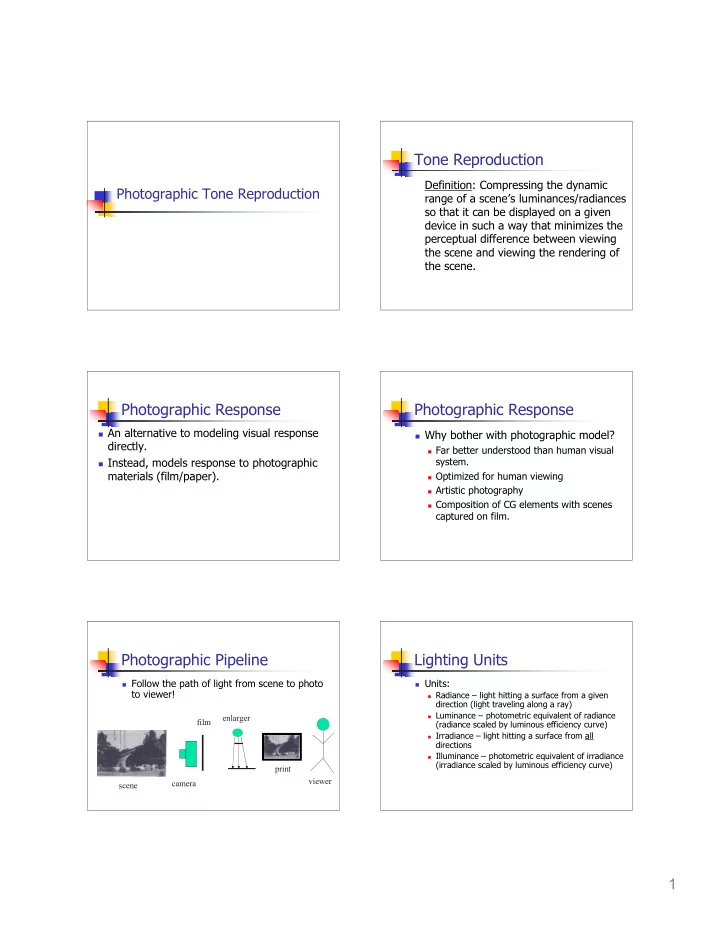
Tone Reproduction Definition: Compressing the dynamic Photographic - - PDF document

tone reproduction
SMART_READER_LITE
LIVE PREVIEW

Tone Reproduction Definition: Compressing the dynamic Photographic - - PDF document

Tone Reproduction Definition: Compressing the dynamic Photographic Tone Reproduction range of a scenes luminances/radiances so that it can be displayed on a given device in such a way that minimizes the perceptual difference between viewing


slide-1
SLIDE 1

1

Photographic Tone Reproduction

Tone Reproduction

Definition: Compressing the dynamic range of a scene’s luminances/radiances so that it can be displayed on a given device in such a way that minimizes the perceptual difference between viewing the scene and viewing the rendering of the scene.

Photographic Response

 An alternative to modeling visual response

directly.

 Instead, models response to photographic

materials (film/paper).

Photographic Response

 Why bother with photographic model?

 Far better understood than human visual

system.

 Optimized for human viewing  Artistic photography  Composition of CG elements with scenes

captured on film.

Photographic Pipeline

 Follow the path of light from scene to photo

to viewer!

scene camera film enlarger print viewer

Lighting Units

 Units:

 Radiance – light hitting a surface from a given

direction (light traveling along a ray)

 Luminance – photometric equivalent of radiance

(radiance scaled by luminous efficiency curve)

 Irradiance – light hitting a surface from all

directions

 Illuminance – photometric equivalent of irradiance

(irradiance scaled by luminous efficiency curve)

slide-2
SLIDE 2

2 Photographic Units

exposure

E = It

I = Illuminance (lux) t = time (sec) E = exposure (lux-sec) density

D = log (O)

O = opacity = 1 / T T = transmission = It / Io It = transmitted light Io = incident light

Photographic Units

 Exposure

 Essentially defines the amount of light

hitting the photographic material at each point

 Density

 A logarithmic means for describing

transparency once the material is developed

Step 1: Calculate exposure

 Follow the path of light from scene to photo

to viewer!

scene camera film enlarger print viewer

Radiance / luminance exposure Radiance / luminance exposure

Photographic Response

 Print photography process Camera Film Process Process Negative Print Paper Printer [Geigel97]

Optics Photographic Material Processed Photographic Material

Luminance to exposure

To get irradiance at a given point on the film plane, we must integrate radiance values over a circle representing the exit pupil.

Luminance to exposure

 Things to consider when figuring out

exposure.

 Irradiance from scene radiance  Vignetting  Transmittance (formerly called transmission)  Flare  Shutter efficiency

 A bit more than the basic pinhole camera!

slide-3
SLIDE 3

3

set by photographer

Luminance to exposure

Final model time shutter eff. flare scene from e illuminanc 4 2

) cos 4 ( ) ( t I n L x Exposure

f

η θ π τ + = ′

Step 2: Simulate film response

 We now know how much exposure is present on each

point in our film plane: scene camera film enlarger print viewer

Photographic Materials

 Comprised of microscopic grains of

silver halide in a gelatin (emulsion)

 Latent image formed when exposed to

light

 Silver halide converted to metallic silver

during processing.

 Converted silver results in opacity

Photographic Response

 Brightness Response - high level response of

an emulsion to light

 Spectral Sensitivity - Response of a material

to different wavelengths of light

 Acuity - Level at which material can

reproduce spatial details

 Graininess - Observed variation due to grain

distribution

Photographic Response

 Sensitometry

 The science of measuring the sensitivity of

photographic materials

 Each characteristic has its own unique

sensitometric measure.

Photographic Response

 A typical brightness response / characteristic curve

Log Exposure D e n s i t y

I II III IV I - toe II - straight line section III - shoulder IV - area of solarization γ - gamma

γ

[Geigel97]

slide-4
SLIDE 4

4 Photographic Response

gamma - slope of region II gives contrast range speed - indicates sensitivity to light S

1 2 3

  • 2

2

γ

1 2 3

  • 2

2

Photographic Response Effects of film Speed

Original 100 Speed Film 400 Speed Film 800 Speed Film [Geigel97]

Photographic Response - Gamma

Original Low Contrast Medium Contrast High Contrast [Geigel97]

Photographic Response Spectral Response for Three Types of Film

100

panchromatic

100

  • rthochromatic

100

300 400 500 600

blue sensitive

(Entire visible spectrum) (Blue/Green sensitive) (Untreated- blue/ultraviolet) [Geigel97]

Photographic Response Effects of Spectral Sensitivity

Original Panchromatic Blue Sensitive [Geigel97]

Photographic Response - Grain

ΔDi = deviation of sample

i from the mean

rms deviation: A = area of scanning

aperture

Selwyn Granularity:

G = (2A) σ

Indication of sample uniformity Measure of granularity

σ

1 NΣ(ΔDi) 2 = 2

slide-5
SLIDE 5

5

Photographic Response - Grain

[Geigel97]

Photographic Response – Acuity (Resolution)

modulation transfer function point spread function

20 40 60 80 100 40 80 120 spatial freq. (cycles/mm) (%)

Photographic Response - Acuity

Without MTF With MTF With MTF & Grain [Geigel97]

Photographic Response

 High level description of photographic

response

 Model can process at grain level, but

impractical to do so.

 All sensiometic measurements are available

for photo materials from the manufacturer.

Modeling Photographic Response

 Uses sensitometric measures to model

characteristics of photo materials

 Physically based  Built using an imaging pipeline where

each module in the pipe represents an image processing operation.

Modeling Photographic Response

exposure density conversion

expose spectral sensitivity resolution density response granularity convert to transmission/ reflection input image

negative

  • r

print [Geigel97]

slide-6
SLIDE 6

6 Okay, where are we?

 We now know how transparent our negative is

at each point in our film plane:

scene camera film enlarger print viewer

Step 3: Create the print

 To create the print:

 Negative is placed in an enlarger  Light is shown through the negative onto

photographic paper (which contains an emulsion)

 Paper is exposed and then developed  Note that the enlarger has its own lens

system.

Photographic Units

 Exposure

 Essentially defines the amount of light hitting the

photographic material at each point

 Density

 A logarithmic means for describing reflection once

the material is developed

 For photographic paper, reflective density is calculated.  Reflective density = fraction of light that goes through

the emulsion on the paper, hits the paper base and reflects back to the viewer.

Modeling Photographic Response

 Must run thru pipeline twice, once for

capture on film and once for printing

 Result of model

 Image of floats [0, 1]  Represents transmission or reflection

values

Step 4: View the print

 Follow the path of light from scene to photo

to viewer!

scene camera film enlarger print viewer

Modeling Photographic Response

 Prints are reflective media  Are not visible unless illuminated  Values from model must be modified to

account for the luminance / color characteristic of the assumed print illumination

slide-7
SLIDE 7

7

Modeling Photographic Response

 Some nice factoids

 Photographic engineers have spent an awful

lot of time and energy in designing films and papers to assure, to the best of their power:

 A photo viewed using “normal” or “typical” lighting

will be a nice perceptual match with the scene photographed.

 The luminance range of CRTs approximates

normal interior viewing conditions fairly well.

 Scaling reflectances to CRT luminaces produces a decent

picture

Modeling Photographic Response

 Virtual Darkroom Applet

http://www.jogle.com/Research/vdr/java/vdr.html

Issues with Tone Reproduction

 Tone, not color  Viewing /display conditions generally

not considered

 Real time tone reproduction

Issues with Tone Reproduction

 Tone, not color

 Most tone reproduction operators are

applied equally to RGB.

 Not necessarily the way to gain best

results.

 As an example, look at color film.

Photographic Response

 So what about color?

 Color Materials have multiple emulsion

layers, each sensitive to a certain range (red, green, blue) of wavelength.

Photographic Response

 Additive Color (light)

 Primaries (red, green, blue)

slide-8
SLIDE 8

8

Photographic Response

 Subtractive color (dyes)

 primaries (magenta, cyan, yellow)

Photographic Response

 Note that in additive system:

 White - Red = Cyan  White - Green = Magenta  White - Blue = Yellow

 In subtractive system

 Cyan dye absorbs red light  Magenta dye absorbs green light  Yellow dye absorbs blue light

Photographic Response

 Color Materials

 Each layer has

it’s own spectral sensitivity

Photographic Response

 Color Brightness Response

 Each emulsion layer will have its own

characteristic curve

Photographic Response

 Color Grain and Acutity

 Each layer will have its own MTF and grain

characteristics.

 Applying same TR to each color channel

may not be the best approach.

 Questions.

Photographic Pipeline (back in the day)

Follow the path of light from scene to photo to viewer!

scene camera film enlarger print viewer

slide-9
SLIDE 9

9

Issues with Tone Reproduction

 Viewing conditions

 Viewing conditions can affect perception  Adaptation

 The process by which the visual mechanism adjusts to

the conditions under which the eyes are exposed to radiant energy.

 Considered by Ferwerda in his TR Operator  Should also be considered in viewing conditions.

General Brightness Adaptation

 Note also…differences in acuity [Ferwerda96]

Adaptation

 General brightness adaptation

 Adjustments in response to the overall level of

stimulus exposed

 Lateral brightness adaptation

 Adjustments in response due to stimulus in

adjacent areas of the retina

 Chromatic adaptation

 Adjustments in response to the average

chromaticity in the stimulus.

So what’s the point

 If the viewing conditions of the “virtual

scene” does not match those of the viewing of the rendered image of the virtual screen.

 Perceptual match will not occur.

Characteristics of a observer

 Brightness response  Spectral response  Acuity  Noise (Grain)  For a human observer, all are variable

based on viewing conditions.

Tone Reproduction in real time

 With advances in graphics hardware,

some Tone Reproduction algorithms have been programmed on GPUs

 Ferwerda [Durand, Dorsey 2001]  Reinhard [Goodnight, et al, 2003]  Tumbin (and others) [Artusi, et. Al, 2003]

slide-10
SLIDE 10

10 Human Visual System

 A good overview of CG tone reproduction operators is

available from

 “Tone Reproduction and Physically Based Spectral

Rendering” by Devlin et al., State of the Art Report, EUROGRAPHICS 2002.

 Questions?

Tone Reproduction

 Summary

 Means of compressing dynamic range of scene

to fit that of display

 Observer / Response Model

 Human Visual System  Photographic Systems

 Map to Device Model

Next time

 Unifying framework  The last of the checkpoints