Elucidating the Electromagnetic Properties of Carlo Giunti INFN, - - PowerPoint PPT Presentation

elucidating the electromagnetic properties of carlo giunti
SMART_READER_LITE
LIVE PREVIEW

Elucidating the Electromagnetic Properties of Carlo Giunti INFN, - - PowerPoint PPT Presentation

Elucidating the Electromagnetic Properties of Carlo Giunti INFN, Torino, Italy 9-11 November 2019, Chapel Hill, North Carolina, USA Neutrinos with CE NS Magnifjcent CE NS 2019 2 Magnifjcent CE NS 2019 C. Giunti


slide-1
SLIDE 1

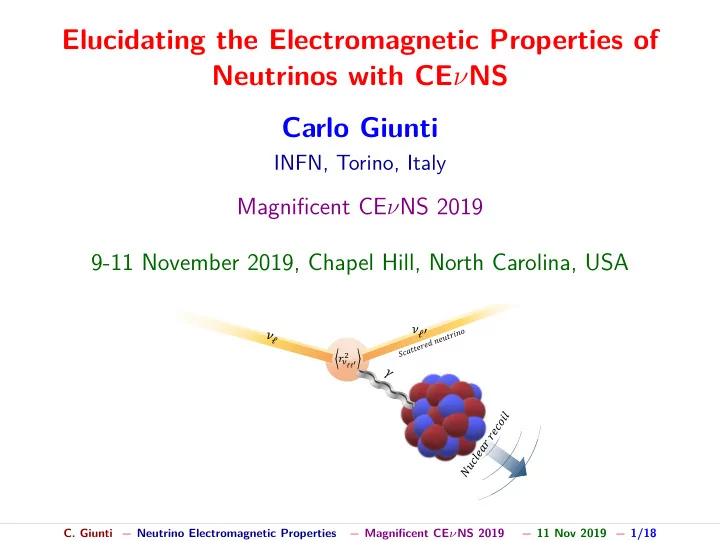
Elucidating the Electromagnetic Properties of Neutrinos with CEνNS Carlo Giunti

INFN, Torino, Italy

Magnifjcent CEνNS 2019 9-11 November 2019, Chapel Hill, North Carolina, USA

𝑠

𝜉ℓℓ′ 2

  • C. Giunti − Neutrino Electromagnetic Properties

− Magnifjcent CEνNS 2019 − 11 Nov 2019 − 1/18

slide-2
SLIDE 2

Neutrino Electromagnetic Interactions

◮ Efgective Hamiltonian: H(ν)

em (x) = j(ν) µ (x)Aµ(x) =

  • k,j=1

νk(x)Λkj

µ νj(x)Aµ(x)

◮ Efgective electromagnetic vertex: νi(pi) Λ γ(q) νf (pf ) νf (pf )|j(ν)

µ (0)|νi(pi) = uf (pf )Λfi µ(q)ui(pi)

q = pi − pf ◮ Vertex function: Λµ(q) =

  • γµ − qµ/

q/q2 FQ(q2) + FA(q2)q2γ5

  • − iσµνqν

FM(q2) + iFE(q2)γ5

  • form factors:

Lorentz-invariant charge anapole q2 = 0 = ⇒ q a helicity-conserving magnetic electric µ ε helicity-fmipping

  • C. Giunti − Neutrino Electromagnetic Properties

− Magnifjcent CEνNS 2019 − 11 Nov 2019 − 2/18

slide-3
SLIDE 3

Neutrino Charge Radius

◮ In the Standard Model neutrinos are neutral and there are no electromagnetic interactions at the tree-level. ◮ Radiative corrections generate an efgective electromagnetic interaction vertex Λµ(q) =

  • γµ − qµ/

q/q2 F(q2)

W ℓ ℓ γ ν ν ℓ W W γ ν ν

◮ F(q2) = ✟✟

✟ ❍❍ ❍

F(0) + q2 dF(q2) dq2

  • q2=0

+ . . . = q2 r2 6 + . . . ◮ In the Standard Model:

[Bernabeu et al, PRD 62 (2000) 113012, NPB 680 (2004) 450]

r2

νℓSM = −

GF 2 √ 2π2

  • 3 − 2 log

m2

m2

W

  • r2

νeSM = −8.2 × 10⁻³³ cm2

r2

νµSM = −4.8 × 10⁻³³ cm2

r2

ντ SM = −3.0 × 10⁻³³ cm2

  • C. Giunti − Neutrino Electromagnetic Properties

− Magnifjcent CEνNS 2019 − 11 Nov 2019 − 3/18

slide-4
SLIDE 4

Experimental Bounds

Method Experiment Limit [cm2] CL Year Reactor ¯ νe e− Krasnoyarsk |r2

νe| < 7.3 × 10⁻³²

90% 1992 TEXONO −4.2 × 10⁻³² < r2

νe < 6.6 × 10⁻³²

90% 2009 Accelerator νe e− LAMPF −7.12 × 10⁻³² < r2

νe < 10.88 × 10⁻³²

90% 1992 LSND −5.94 × 10⁻³² < r2

νe < 8.28 × 10⁻³²

90% 2001 Accelerator νµ e− BNL-E734 −5.7 × 10⁻³² < r2

νµ < 1.1 × 10⁻³²

90% 1990 CHARM-II |r2

νµ| < 1.2 × 10⁻³²

90% 1994

[see the review Giunti, Studenikin, RMP 87 (2015) 531, arXiv:1403.6344 and the update in Cadeddu, Giunti, Kouzakov, Y.F. Li, Studenikin, Y.Y. Zhang, PRD 98 (2018) 113010, arXiv:1810.05606]

  • C. Giunti − Neutrino Electromagnetic Properties

− Magnifjcent CEνNS 2019 − 11 Nov 2019 − 4/18

slide-5
SLIDE 5

◮ Neutrino charge radii contributions to νℓ–N CEνNS: dσνℓ-N dT (Eν, T) = G2

FM

π

  • 1 − MT

2E 2

ν

−1 2

  • gn

V

NFN(| q|2) +

  • 1

2 − 2 sin2ϑW

  • gp

V ≃ 0.023

−2 3 m2

W sin2ϑW r2 νℓℓ

  • ZFZ(|

q|2) 2 +4 9 m4

W sin4ϑW Z 2F 2 Z(|

q|2)

  • ℓ′=ℓ

|r2

νℓ′ℓ|2

  • ◮ In the Standard Model there are only diagonal charge radii r2

νℓ ≡ r2 νℓℓ

because lepton numbers are conserved. ◮ Diagonal charge radii generate the coherent shifts sin2ϑW → sin2ϑW

  • 1 + 1

3m2

W r2 νℓ

⇒ νℓ + N → νℓ + N ◮ Transition charge radii generate the incoherent contribution 4 9 m4

W sin4ϑW Z 2F 2 Z(|

q|2)

  • ℓ′=ℓ

|r2

νℓ′ℓ|2

⇐ ⇒ νℓ + N →

  • ℓ′=ℓ

νℓ′=ℓ + N

[Kouzakov, Studenikin, PRD 95 (2017) 055013, arXiv:1703.00401]

  • C. Giunti − Neutrino Electromagnetic Properties

− Magnifjcent CEνNS 2019 − 11 Nov 2019 − 5/18

slide-6
SLIDE 6

COHERENT Neutrino Spectrum and Time

◮ Neutrinos at the Oak Ridge Spallation Neutron Source are produced by a pulsed proton beam striking a mercury target. ◮ Prompt monochromatic νµ from stopped pion decays: π+ → µ+ + νµ ◮ Delayed ¯ νµ and νe from the subsequent muon decays: µ+ → e+ + ¯ νµ + νe ◮ The COHERENT energy and time information allow us to distinguish the interactions of νe, νµ, and ¯ νµ. ◮ Note that r2

¯ νℓℓ′ = −r2 νℓℓ′ , but also

gp,n

V (¯

ν) = −gp,n

V (ν).

E [MeV] 10−13 dN ν/dE [cm−2 MeV−1]

5 10 20 30 40 50 0.0 0.4 0.8 1.2 1.6 2.0

Neutrino Spectra νµ νµ νe

t [µs] pν(t)

1 2 3 4 5 6 7 8 9 10 12 0.0 0.4 0.8 1.2 1.6 2.0

νµ νµ + νe

  • C. Giunti − Neutrino Electromagnetic Properties

− Magnifjcent CEνNS 2019 − 11 Nov 2019 − 6/18

slide-7
SLIDE 7

Fits with the old and new quenching factors

[Cadeddu, Dordei, Giunti, Y.F. Li, Y.Y. Zhang, arXiv:1908.06045]

◮ Old quenching factor: COHERENT Collaboration, arXiv:1708.01294 ◮ New quenching factor: Collar, Kavner, Lewis, arXiv:1907.04828 See also:

  • D. Papoulias, arXiv:1907.11644
  • A. Khan, W. Rodejohann, arXiv:1907.12444
  • C. Giunti − Neutrino Electromagnetic Properties

− Magnifjcent CEνNS 2019 − 11 Nov 2019 − 7/18

slide-8
SLIDE 8

Fits with the old and new quenching factors

[Cadeddu, Dordei, Giunti, Y.F. Li, Y.Y. Zhang, arXiv:1908.06045]

|〈rνeµ

2 〉| [10−32cm2]

|〈rνµτ

2 〉| [10−32cm2]

20 40 60 80 100 20 40 60 80 100 Old quenching New quenching 90% CL (solid) and 99% CL (dashed)

|〈rνeτ

2 〉| [10−32cm2]

|〈rνµτ

2 〉| [10−32cm2]

20 40 60 80 100 20 40 60 80 100 Old quenching New quenching 90% CL (solid) and 99% CL (dashed)

|〈rνeµ

2 〉| [10−32cm2]

|〈rνeτ

2 〉| [10−32cm2]

20 40 60 80 100 20 40 60 80 100 Old quenching New quenching 90% CL (solid) and 99% CL (dashed)

〈rνee

2 〉 [10−32cm2]

〈rνµµ

2 〉 [10−32cm2]

−100 −50 50 100 −100 −50 50 100 Old quenching New quenching 90% CL (solid) and 99% CL (dashed)

◮ Free neutron distribution radii Rn(133Cs), Rn(127I). ◮ Slight improvement of 90% CL bounds with the new quenching factor. ◮ Signifjcant improvement of 99% CL bounds strengthen the statistical reliability. ◮ The bounds on the diagonal charge radii are still not competitive with

  • ther measurements.

◮ Note the unique bounds on the transition charge radii that were not considered before Cadeddu et al, arXiv:1810.05606.

  • C. Giunti − Neutrino Electromagnetic Properties

− Magnifjcent CEνNS 2019 − 11 Nov 2019 − 8/18

slide-9
SLIDE 9

Fits without transition charge radii

[Cadeddu, Dordei, Giunti, Y.F. Li, Y.Y. Zhang, arXiv:1908.06045]

〈rνe

2 〉 [10−32cm2]

〈rνµ

2 〉 [10−32cm2]

−100 −50 50 100 −100 −50 50 100 Old quenching New quenching 90% CL (solid) and 99% CL (dashed)

Free Rn

◮ Motivated by the Standard Model, where there are only diagonal charge radii. ◮ Explanation of the excluded area in the middle:

◮ The cross section contribution of a diagonal charge radius r2

νℓ

approximately cancel the weak neutral current contributions for r2

νℓ ≃ −

3 N 4 Z m2

W sin2ϑW

≃ −26 × 10−32 cm2 ◮ Around this value the cross section is strongly suppressed and cannot fjt the COHERENT data.

  • C. Giunti − Neutrino Electromagnetic Properties

− Magnifjcent CEνNS 2019 − 11 Nov 2019 − 9/18

slide-10
SLIDE 10

Neutrino Electric Charges

◮ Neutrinos can be millicharged particles in theories beyond the Standard Model. ◮ Neutrino charge contributions to νℓ–N CEνNS:

dσνℓ-N dT (Eν, T) = G2

FM

π

  • 1 − MT

2E 2

ν

−1 2

  • gn

V

NFN(| q|2) +

  • 1

2 − 2 sin2ϑW

  • gp

V ≃ 0.023

+2m2

W sin2ϑW

MT qνℓℓ

  • ZFZ(|

q|2) 2 +4m4

W sin4ϑW

M2T 2 Z 2F 2

Z(|

q|2)

  • ℓ′=ℓ

|qνℓℓ′ |2

  • ◮ q¯

νℓℓ′ = −qνℓℓ′, but also gp,n V (¯

ν) = −gp,n

V (ν).

  • C. Giunti − Neutrino Electromagnetic Properties

− Magnifjcent CEνNS 2019 − 11 Nov 2019 − 10/18

slide-11
SLIDE 11

Approximate limits on neutrino millicharges

Limit Method Reference |qνe| 3 × 10⁻²¹ e Neutrality of matter Rafgelt (1999) |qνe| 3.7 × 10⁻¹² e Nuclear reactor Gninenko et al, (2006) |qνe| 1.5 × 10⁻¹² e Nuclear reactor Studenikin (2013) |qντ | 3 × 10⁻⁴ e SLAC e− beam dump Davidson et al, (1991) |qντ | 4 × 10⁻⁴ e BEBC beam dump Babu et al, (1993) |qν| 6 × 10⁻¹⁴ e Solar cooling (plasmon decay) Rafgelt (1999) |qν| 2 × 10⁻¹⁴ e Red giant cooling (plasmon decay) Rafgelt (1999)

Neutrality of matter

◮ From electric charge conservation in neutron beta decay (n → p + e− + ¯ νe) qνe = qn − (qp + qe) = A Z (qn − qmat) with qmat = Z(qp + qe) + Nqn A ◮ qmat = (−0.1 ± 1.1) × 10−21 e with SF6, which has A = 146.06 and Z = 70

[Bressi, et al., PRA 83 (2011) 052101, arXiv:1102.2766]

◮ qn = (−0.4 ± 1.1) × 10−21 e

[Baumann, Kalus, Gahler, Mampe, PRD 37 (1988) 3107]

◮ qνe = (−0.6 ± 3.2) × 10−21 e

[Giunti, Studenikin, RMP 87 (2015) 531, arXiv:1403.6344]

  • C. Giunti − Neutrino Electromagnetic Properties

− Magnifjcent CEνNS 2019 − 11 Nov 2019 − 11/18

slide-12
SLIDE 12

COHERENT constraints on neutrino millicharges

[Cadeddu, Dordei, Giunti, Y.F. Li, Y.Y. Zhang, arXiv:1908.06045]

|qνeµ| [10−8e] |qνµτ| [10−8e]

10 20 30 40 50 10 20 30 40 50 Fixed Rn Free Rn 90% CL (solid) and 99% CL (dashed)

|qνeτ| [10−8e] |qνµτ| [10−8e]

10 20 30 40 50 10 20 30 40 50 Fixed Rn Free Rn 90% CL (solid) and 99% CL (dashed)

|qνeµ| [10−8e] |qνeτ| [10−8e]

10 20 30 40 50 10 20 30 40 50 Fixed Rn Free Rn 90% CL (solid) and 99% CL (dashed)

|qνee| [10−8e] |qνµµ| [10−8e]

−40 −20 20 40 60 80 −40 −20 20 40 Fixed Rn Free Rn 90% CL (solid) and 99% CL (dashed)

◮ The bounds on the charges involving the electron neutrino fmavor qνee qνeµ qνeτ are not competitive with respect to those obtained in reactor neutrino experiments, that are at the level of 10−12 e in neutrino-electron elastic scattering experiments. ◮ The bounds on qνµµ qνµτ are the fjrst ones obtained from laboratory data.

  • C. Giunti − Neutrino Electromagnetic Properties

− Magnifjcent CEνNS 2019 − 11 Nov 2019 − 12/18

slide-13
SLIDE 13

Neutrino Magnetic and Electric Moments

◮ Extended Standard Model with right-handed neutrinos and ∆L = 0: µD

kk ≃ 3.2 × 10⁻¹⁹µB

mk eV

  • εD

kk = 0

µD

kj

iεD

kj

  • ≃ −3.9 × 10⁻²³µB

mk ± mj eV

ℓ=e,µ,τ

U∗

ℓkUℓj

mℓ mτ 2

  • fg-diagonal moments are GIM-suppressed

[Fujikawa, Shrock, PRL 45 (1980) 963; Pal, Wolfenstein, PRD 25 (1982) 766; Shrock, NPB 206 (1982) 359; Dvornikov, Studenikin, PRD 69 (2004) 073001, JETP 99 (2004) 254]

◮ Extended Standard Model with Majorana neutrinos (|∆L| = 2): µM

kj ≃ −7.8 × 10⁻²³µBi (mk + mj)

  • ℓ=e,µ,τ

Im [U∗

ℓkUℓj] m2 ℓ

m2

W

εM

kj ≃ 7.8 × 10⁻²³µBi (mk − mj)

  • ℓ=e,µ,τ

Re [U∗

ℓkUℓj] m2 ℓ

m2

W

[Shrock, NPB 206 (1982) 359]

GIM-suppressed, but additional model-dependent contributions of the scalar sector can enhance the Majorana transition dipole moments

[Pal, Wolfenstein, PRD 25 (1982) 766; Barr, Freire, Zee, PRL 65 (1990) 2626; Pal, PRD 44 (1991) 2261]

  • C. Giunti − Neutrino Electromagnetic Properties

− Magnifjcent CEνNS 2019 − 11 Nov 2019 − 13/18
slide-14
SLIDE 14

dσνe− dTe

  • mag

= πα2 m2

e

1 Te − 1 Eν µν µB 2

  • C. Giunti − Neutrino Electromagnetic Properties

− Magnifjcent CEνNS 2019 − 11 Nov 2019 − 14/18

slide-15
SLIDE 15

Method Experiment Limit [µB] CL Year Reactor ¯ νe e− Krasnoyarsk µνe < 2.4 × 10⁻¹⁰ 90% 1992 Rovno µνe < 1.9 × 10⁻¹⁰ 95% 1993 MUNU µνe < 9 × 10⁻¹¹ 90% 2005 TEXONO µνe < 7.4 × 10⁻¹¹ 90% 2006 GEMMA µνe < 2.9 × 10⁻¹¹ 90% 2012 Accelerator νe e− LAMPF µνe < 1.1 × 10⁻⁹ 90% 1992 Accelerator (νµ, ¯ νµ) e− BNL-E734 µνµ < 8.5 × 10⁻¹⁰ 90% 1990 LAMPF µνµ < 7.4 × 10⁻¹⁰ 90% 1992 LSND µνµ < 6.8 × 10⁻¹⁰ 90% 2001 Accelerator (ντ, ¯ ντ) e− DONUT µντ < 3.9 × 10⁻⁷ 90% 2001 Solar νe e− Super-Kamiokande µS(Eν 5 MeV) < 1.1 × 10⁻¹⁰ 90% 2004 Borexino µS(Eν 1 MeV) < 2.8 × 10⁻¹¹ 90% 2017

[see the review Giunti, Studenikin, RMP 87 (2015) 531, arXiv:1403.6344]

◮ Gap of about 8 orders of magnitude between the experimental limits and the 10−19 µB prediction of the minimal Standard Model extensions. ◮ µν ≫ 10−19 µB discovery ⇒ non-minimal new physics beyond the SM. ◮ Neutrino spin-fmavor precession in a magnetic fjeld

[Lim, Marciano, PRD 37 (1988) 1368; Akhmedov, PLB 213 (1988) 64]

  • C. Giunti − Neutrino Electromagnetic Properties

− Magnifjcent CEνNS 2019 − 11 Nov 2019 − 15/18

slide-16
SLIDE 16

◮ Neutrino magnetic (and electric) moment contributions to CEνNS νℓ + N →

  • ℓ′

νℓ′ + N: dσνℓ-N dT (Eν, T) = G2

FM

π

  • 1 − MT

2E 2

ν

gn

V NFN(|

q|2) + gp

V ZFZ(|

q|2) 2 +πα2 m2

e

1 T − 1 Eν

  • Z 2F 2

Z(|

q|2)

  • ℓ′=ℓ

|µℓℓ′|2 µ2

B

◮ The magnetic moment interaction adds incoherently to the weak interaction because it fmips helicity. ◮ The me is due to the defjnition of the Bohr magneton: µB = e/2me.

  • C. Giunti − Neutrino Electromagnetic Properties

− Magnifjcent CEνNS 2019 − 11 Nov 2019 − 16/18

slide-17
SLIDE 17

COHERENT constraints on ν magnetic moments

[Cadeddu, Dordei, Giunti, Y.F. Li, Y.Y. Zhang, arXiv:1908.06045]

|µνe| [10−10µB] |µνµ| [10−10µB]

10 20 30 40 50 60 70 10 20 30 40 50 60 70 Fixed Rn Free Rn 90% CL (solid) and 99% CL (dashed)

◮ The sensitivity to |µνe| is not competitive with that of reactor experiments: |µνe| < 2.9 × 10⁻¹¹ µB (90% CL)

[GEMMA, AHEP 2012 (2012) 350150]

◮ The constraint on |µνµ| is not too far from the best current laboratory limit: |µνµ| < 6.8 × 10⁻¹⁰ µB (90% CL)

[LSND, PRD 63 (2001) 112001]

  • C. Giunti − Neutrino Electromagnetic Properties

− Magnifjcent CEνNS 2019 − 11 Nov 2019 − 17/18

slide-18
SLIDE 18

Conclusions

◮ The observation of CEνNS in the COHERENT experiment opened the way for new powerful measurements of the properties of nuclei and neutrinos. ◮ CEνNS measurements probe the electromagnetic properties of neutrinos:

◮ Neutrino charge radii (predicted by the Standard Model). ◮ Neutrino millicharges (possible in theories beyond Standard Model). ◮ Neutrino magnetic moments (possible in theories beyond Standard Model).

◮ COHERENT data constrain this properties, but are still not competitive with other measurements, except for the constraint on qνµ that is the fjrst one obtained from laboratory data. ◮ The new CEνNS experiments will allow to improve the current constraints and maybe observe the neutrino charge radii predicted by the Standard Model. ◮ It is important to continue and improve CEνNS observation not only with ¯ νe from reactors, but also with νµ beams in order to explore the properties of νµ, that are typically less constrained than the properties of νe in other experiments.

  • C. Giunti − Neutrino Electromagnetic Properties

− Magnifjcent CEνNS 2019 − 11 Nov 2019 − 18/18