Diet Supplements No strong evidence for use of supplements in - - PowerPoint PPT Presentation

diet supplements
SMART_READER_LITE
LIVE PREVIEW

Diet Supplements No strong evidence for use of supplements in - - PowerPoint PPT Presentation

12/10/2016 I have no financial disclosures. Sports Concussion: Questions Our Patients Are Asking and the Evidence-Based Responses Carlin Senter, MD Co-Director UCSF Sports Concussion Program Associate Professor Primary Care Sports Medicine


slide-1
SLIDE 1

12/10/2016 1

Sports Concussion: Questions Our Patients Are Asking and the Evidence-Based Responses

Carlin Senter, MD Co-Director UCSF Sports Concussion Program Associate Professor Primary Care Sports Medicine UCSF Medicine and Orthopaedics

UCSF Primary Care Sports Medicine Course December 9, 2016

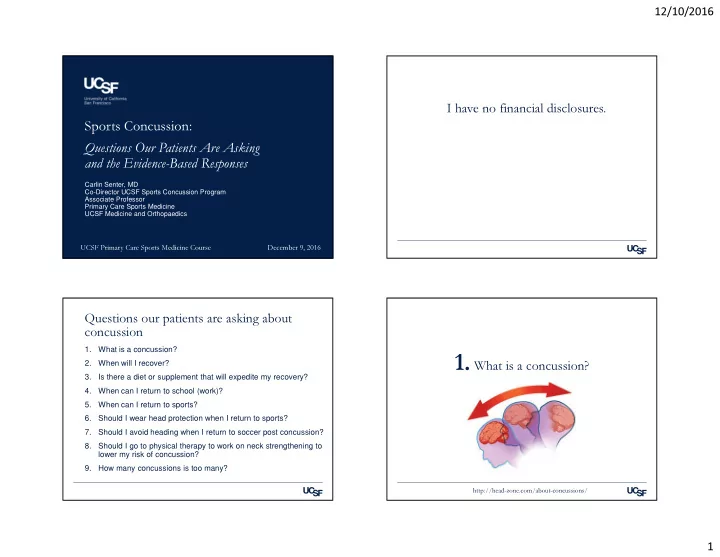
I have no financial disclosures. Questions our patients are asking about concussion

1. What is a concussion? 2. When will I recover? 3. Is there a diet or supplement that will expedite my recovery? 4. When can I return to school (work)? 5. When can I return to sports? 6. Should I wear head protection when I return to sports? 7. Should I avoid heading when I return to soccer post concussion? 8. Should I go to physical therapy to work on neck strengthening to lower my risk of concussion? 9. How many concussions is too many?

  • 1. What is a concussion?

http://head-zone.com/about-concussions/

slide-2
SLIDE 2

12/10/2016 2

Definition

Blow to head, neck, body force to head Rapid onset of neurologic impairment Symptoms usually resolve in weeks, spontaneously, but in some cases can be prolonged. Does not have to include loss of consciousness. CT and MRI studies are normal

Force to brain Ion fluxes; vasocon- striction Need glucose but less blood flow Energy crisis Giza CC and Hovda DA, J of Athletic Training, 2001. Vespa et al, J Cerebral Blood Flow and Metabolism, 2005.

Sequence of events Window of vulnerability

Giza and Hovda, JAT 2001

The period between the concussion and the recovery. Return to play during this time could cause worse, even catastrophic, brain injury

  • 2. When will I recover from my

concussion?

http://kidstoyhire.com.au/2014/12/05/mum-im-bored/

slide-3
SLIDE 3

12/10/2016 3

Symptom resolution

50% recovered and returned to play in 1 week; 90% in 3 weeks (Collins et al. Neurosurgery, 2006.) Recovery in athletes may be faster than recovery in others (Levin HS and Diaz-Arrastia RR. Lancet Neurol 2015; 14: 506-17.) Recovery in kids may take longer than recovery in adults

Majority return to play in < 1 month in FB

15.5% of concussions required ≥30 days before return to play. Odds of return-to-play time of ≥30 days were greater in youth (odds ratio = 2.75; 95% CI, 1.10-6.85) and high school (odds ratio = 2.89; 95% CI, 1.61-5.19) athletes than in college athletes. No difference was found between high school and youth.

Percentage of concussions in youth, high school, and college football requiring ≥30 days before return to play, 2012 to 2014 seasons.

0% 5% 10% 15% 20% 25% Youth High School College Total Concussions, %

Kerr ZY et al. Concussion Symptoms and Return to Play Time in Youth, High School, and College American Football Athletes. JAMA Pediatr. 2016 Jul 1;170(7):647-53.

Who is at risk for longer recovery?

LOC > 1 minute Amnesia Convulsions History of multiple concussions Injuries close together in time Repeat injuries with less and less force Younger age Migraine headaches Depression ADHD Sleep disorders

Broglio SP et al. NATA Position Statement on

  • Concussion. J of Athletic Training, 2014.
  • 3. Is there a certain diet or supplement

that you would recommend for my child to expedite his/her recovery from concussion?

http://www.nutrascienceusa.net/pages/blog[2]

slide-4
SLIDE 4

12/10/2016 4

Diet

Sparse literature High fat diet exacerbated behavioral problems post mTBI in rats (Mychasiuk et al. Diet, age, and prior injury status differentially alter behavioral outcomes following concussion in rats. Neurobiol Dis. 2015 Jan;73:1-11.)

Supplements

No strong evidence for use of supplements in concussion management at this time. Promising results in animal studies and a few human studies on traumatic brain injury in recovery or prevention of concussion:

  • Omega-3 fatty acids
  • Curcumin
  • Resveratrol
  • Melatonin
  • Creatine
  • S. baicalensis
  • Vitamins C, D, E

Ashbaugh A, McGrew C. Curr Sports Med Rep. 2016 Jan-Feb;15(1):16-9.

Omega-3 fatty acids

Promising animal data (mainly rats)

  • Mostly using docosahexaenoic acid (DHA)
  • Protective effects before injury - role for prevention?
  • Reduces effect of concussion post injury – expedite recovery?

2 double-blind RCTs presently underway in US:

  • NCAA D1 athletes taking 2200mg DHA x 30 days post injury to

see if this affects recovery

  • UT Southwestern supplementing kids 14-18 y/o 2000mg DHA

daily x 3 mo post injury to see if this affects recovery

Ashbaugh A, McGrew C. Curr Sports Med Rep. 2016 Jan-Feb;15(1):16-9.

Melatonin

May have utility in reducing post traumatic headache after mTBI

  • Kuczynski A et al. Characteristics of post-traumatic headaches in children

following mild traumatic brain injury and their response to treatment: a prospective cohort. Dev Med Child Neurol. 2013;55(7):636–41.

  • Study underway: Barlow KM et al. A double-blind, placebo-controlled

intervention trial of 3 and 10 mg sublingual melatonin for post-concussion syndrome in youths (PLAYGAME): study protocol for a randomized controlled trial. Trials. 2014 Jul 7;15:271.

Growing interest in sleep disorders that contribute to post concussion syndrome - ?role for melatonin as treatment (Sullivan KA

et al. Poor sleep predicts subacute postconcussion symptoms following mTBI. Appl Neuropsychol Adult. 2016 Nov-Dec;23(6):426-35.)

slide-5
SLIDE 5

12/10/2016 5

Acupuncture

1 case study on acupuncture + neck manipulation in concussion (Gergen DM. Management of Mild Traumatic Brain Injury Symptoms in a 31-Year-Old Woman Using Cervical Manipulation and Acupuncture: A Case Report. J Chiropr Med. 2015 Sep;14(3):220-4.) Lack of high quality studies precludes ability to make conclusion regarding risk/benefit in TBI. (Wong V et al. Acupuncture for acute management and rehabilitation of traumatic brain injury. Cochrane Database Syst Rev. 2013 Mar 28;(3):CD007700.)

  • 4. Should I wait until I am 100% better

before I return to school? How much rest after a concussion?

88 patients (11-22 y/o) seen at pediatric ED randomized Strict rest x 5 days vs. “usual care” of 1-2 days rest, then stepwise return to activity Neurocognitive and balance outcomes same Strict rest group had more daily post concussive symptoms and slower symptom resolution Thomas DG et al. Benefits of strict rest after acute concussion: a randomized controlled trial. Pediatrics. 2015 Feb;135(2):213-23. Slide courtesy of Cindy Chang, MD

Return to learn after a concussion

Return to learn ASAP Ok to return to learn with symptoms Avoid disruptions to the student’s life with return to school Physician should suggest academic adjustments if needed Most concussions resolve within 3 weeks so 504 plan or IEP usually not necessary Halstead ME et al. Pediatrics. 2013 Nov;132(5):948-57.

slide-6
SLIDE 6

12/10/2016 6

Team approach to return to learn

Halstead ME et al. Pediatrics. 2013 Nov;132(5):948-57.

Return to learn progression

No school. OK to do light reading, little bit TV, drawing, cooking as long as doesn’t worsen symptoms. 15 min cognitive activity at a time. Return to full day of school.

http://www.chop.edu/service/concussion-care- for-kids/returning-to-school.html

30 min schoolwork at a time until can do 1-2 hours. Return to ½ day of school.

CIF: Physician letter to school

24

  • 5. When can I return to sports after my

concussion?

slide-7
SLIDE 7

12/10/2016 7

Concussion Legislation

50 states have adopted youth concussion laws California: education code 49475 (effective 1/2012) 1. Athletes and guardians sign a concussion information form yearly 2. Athlete suspected of having concussion removed at time of injury for the rest of the day 3. Athlete can return only after cleared by healthcare professional trained in evaluation and management of concussion

Concussion legislation

California Assembly Bill 2127 (in effect 1/2015)

  • Adds to AB 25

‒ FB full-contact practice limits: No more than 2/week during preseason and season These practices cannot exceed 90 minutes No full-contact in off-season ‒ Once clear must follow gradual return to play protocol

  • f at least 7 days under supervision of licensed provider

Return to Play Progression

Light aerobic activity Sport specific activity Game play Non- contact training Full contact practice

Clinician clearance Asymptomatic

Return to play activity examples

Step Objective Activities 1 Recovery No activity 2 Light aerobic activity: Increase heart rate Walking, swimming, or stationary bike. < 70% max heart rate. No weights. 3 Sport Specific: Add movement Skating drills in hockey, running drills in

  • soccer. No head impact activities.

4 Non contact training: Add coordination and cognitive load More complex drills (passing). Can start weights. 5 Restore confidence and assess functional skills by coaching staff Full-contact practice 6 Normal game play Consensus statement on concussion in sport: the 4th International Conference on Concussion in Sport held in Zurich, November 2012. Br J Sports Med. 2013 Apr;47(5):250-8.

slide-8
SLIDE 8

12/10/2016 8

CIF: Return to play handout Symptoms during return to play

If symptomatic during a step of the return to play protocol…

  • Stop activity
  • Rest until symptoms resolve, at least 24 hours.
  • Resume return to play protocol at the step where athlete was

last asymptomatic

Consensus statement on concussion in sport: the 4th International Conference on Concussion in Sport held in Zurich, November 2012. Br J Sports Med. 2013 Apr;47(5):250-8

  • 6. This is my daughter’s 3rd concussion

while playing soccer. Should she keep playing?

https://www.football.com/en-us/soccer-is- heading-for-trouble/

Is Concussion Really a “Mild” Traumatic Brain Injury?

http://www.bu.edu/cte/about/what-is-cte/

slide-9
SLIDE 9

12/10/2016 9

Chronic traumatic encephalopathy

Athletes and military personnel Chronic, progressive depression, cognitive impairment, aggression Symptoms develop 8-20 years after retirement from sport 158 potential CTE cases reported, 6 high school age Diagnosed at autopsy: tau protein deposition Difficult to draw causality – no prospective data yet Concerning association between professional sports participation and long term neurologic/psychological problems

Gardner A et al. Chronic traumatic encephalopathy in sport: a systematic review. BJSM. 2013 Jun 26. Randolph C. Is chronic traumatic encephalopathy a real disease? Current Sports Med Review, 2014. Love S and Solomon G. Talking with parents of high school football players about chronic traumatic encephalopathy: a concise summary. AJSM 2015.

How Many Concussions is Too Many?

Individualized to athlete. Short term risk vs long term risk Concussion hx.

  • Number.
  • Less force.
  • More frequent.
  • Increased severity of sxs
  • Increased duration of sxs.
  • Age: possibly more consequences if younger at time of

concussion.

I think best to have this conversation once the athlete has recovered from their most recent injury.

  • 7. Would you recommend we purchase

head protection for my child in order to reduce the risk of repeat concussion when he/ she returns to sport?

http://i00.i.aliimg.com/img/pb/573/767/888/888767573_942.jpg

Protective gear?

Benson BW et al. What are the most effective risk-reduction strategies in sport concussion? Br J Sports Med. 2013.

slide-10
SLIDE 10

12/10/2016 10

Do I lower my concussion risk in soccer if I avoid heading?

Contact with another player is most common reason for concussion in soccer. Fewer concussions from impact of head with ball. (Comstock RD et al. An Evidence-Based Discussion of

Heading the Ball and Concussions in High School Soccer. JAMA Pediatr. 2015 Sep 1;169(9):830-7.)

Highest head acceleration: head-to-head impacts and unintentional head impacts by the ball (Hanlon EM, Bir CA. Real-

time head acceleration measurement in girls’ youth soccer. Med Sci Sports

  • Exerc. 2012;44(6):1102–8; Withnall C et al. Biomechanical investigation of

head impacts in football. Br J Sports Med. 2005;39(Suppl 1):i49–57.)

Purposeful heading unlikely to cause concussion but the effect of heading (chronic sub concussive blows) on brain long term is unclear (Caccese JB and Kaminski TW. Minimizing head

acceleration in soccer: A review. Sports Med 2016 Nov;46(11):1591-1604.)

Neck strengthening to reduce risk

Hypothesis: strong neck muscles may diminish the acceleration of the head on impact, lowering concussion risk Studies measure isometric neck strength in flexion + extension, sometimes with left and right-lateral flexion Increased neck strength was associated with lower risk of concussion in high school athletes (Collins CL et al. Neck strength: a

protective factor reducing risk for concussion in high school sports. J Prim

  • Prev. 2014 Oct;35(5):309-19.)

Neck strengthening programs can increase neck strength in athletes (Hrysomallis C. Neck Muscular Strength, Training, Performance and

Sport Injury Risk: A Review. Sports Med. 2016 Aug;46(8):1111-24.)

Next step = development of neck strengthening intervention to see if can reduce risk of concussion in athletes

Have you thought about playing sports

  • ther than soccer / football / rugby?

Decrease exposures

http://www.ncaapublications.com/productdownloads/MD15.pdf. Accessed 12/5/15.

slide-11
SLIDE 11

12/10/2016 11

Incidence of concussion

Sport Male Female Pooled incidence Rugby 4.18 NR 4.18 Hockey NR NR 1.20 American football 0.53 NR 0.53 Lacrosse 0.29 0.17 0.24 Soccer 0.19 0.27 0.23 Wrestling 0.17 NR 0.17 Basketball 0.10 0.17 0.13 Softball NR 0.10 0.10 Field hockey NR 0.10 0.10 Cheerleading NR 0.07 0.07 Baseball 0.06 NR 0.06 Volleyball NR 0.03 0.03

Reported as events per 1000 athlete exposures (AEs)

Pfister T et al. The incidence of concussion in youth sports: a systematic review and meta-analysis. Br J Sports Med. 2016 Mar;50(5):292-7.

Highest risk positions by sport

Water polo – goalie (Blumenfeld RS et al. The Epidemiology of Sports-

Related Head Injury and Concussion in Water Polo. Front Neurol. 2016 Jun 24;7:98.)

Baseball –catcher during fielding (vs batting or running)

(Green GA et al. Mild traumatic brain injury in major and Minor League Baseball players. Am J Sports Med. 2015 May;43(5):1118-26.)

Football – 1. quarterback, 2. running back, 3. linebacker

(Powell JW. Traumatic brain injury in high school athletes. JAMA. 1999 Sep 8;282(10):958-63.)

Ice Hockey – forwards (Hutchison MG et al. A systematic video

analysis of National Hockey League (NHL) concussions, part I: who, when, where and what? Br J Sports Med. 2015 Apr;49(8):547-51.)

Soccer – goalkeepers and defensive midfield players due to collision with other player (Helmich I. Game-specific characteristics

  • f sport-related concussions. J Sports Med Phys Fitness. 2016 Sep 14.)

Volleyball – “libero” position due to hits from the ball (Helmich

  • I. Game-specific characteristics of sport-related concussions. J Sports Med

Phys Fitness. 2016 Sep 14.)

Concussion resources

California Interscholastic Federation

http://www.cifstate.org/sports-medicine/ concussions/index

Consensus statement on concussion in sport, 2012.

http://bjsm.bmj.com/content/47/5/250.full

CDC concussion toolkit for physicians

www.cdc.gov/concussion/HeadsUp/physicians_tool_kit.html

Concussion@UCSF.edu

UCSF Sports Concussion Program
slide-12
SLIDE 12

12/10/2016 12

Questions our patients are asking about concussion

1. What is a concussion? 2. When will I recover? 3. Is there a diet or supplement that will expedite my recovery? 4. When can I return to school (work)? 5. When can I return to sports? 6. Should I wear head protection when I return to sports? 7. Should I avoid heading when I return to soccer post concussion? 8. Should I go to physical therapy to work on neck strengthening to lower my risk of concussion? 9. How many concussions is too many?

My evidence-based responses

1. Concussion = energy crisis of the brain. 2. Majority of high school athletes recover within 1 month of injury 3. No specific diet or supplements recommended yet 4. Return to learn (work) asap 5. Return to play once asymptomatic with gradual RTP protocol 6. Risk reduction 1. Head protection – data equivocal. Increases aggressive play? 2. Neck strengthening – too early to know risks/benefits 3. Heading – not the primary cause of concussion in soccer 4. Decrease the exposure to contact: lower risk sport/position 7. Retirement from sport is an individual decision 8. In most cases concern re: short term rather than long term consequences of concussion.