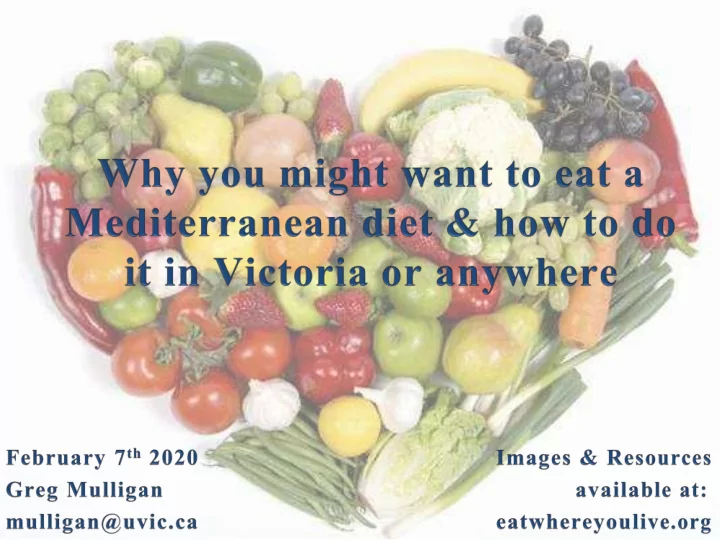
SLIDE 1
SLIDE 2
Topics for the Day
What is a Mediterranean diet? Why might you want to eat a Mediterranean diet? How might you eat a Mediterranean diet in Victoria? Tools for informed food choices. Time for questions.
SLIDE 3
What is a diet? In nutrition, a diet, is simply “the foods you eat”
SLIDE 4
Why the Name ‘Mediterranean Diet’
Inspired by research into the eating habits of Greece, Southern Italy, and Spain in the 1940s and 1950s
SLIDE 5
The Mediterranean Diet
UNESCO Representative List of the Intangible Cultural Heritage of Humanity of Italy, Spain, Portugal, Morocco, Greece, Cyprus, and Croatia.
"The Mediterranean diet involves a set of skills, knowledge, rituals, symbols and traditions concerning crops, harvesting, fishing, animal husbandry, conservation, processing, cooking, and particularly the sharing and consumption of food."
SLIDE 6 Any diet is only as good as its context
All diets, including a Mediterranean diet are only effective in the context of a healthful lifestyle … … in order to be healthful, your lifestyle must be:
- 1. Physically active: walking ~150 minutes per week.
- 2. Restful: subjectively you must ‘get enough rest’.
- 3. Inclusive: sharing meals with family and friends.
SLIDE 7
The Mediterranean Diet
UNESCO Representative List of the Intangible Cultural Heritage of Humanity of Italy, Spain, Portugal, Morocco, Greece, Cyprus, and Croatia.
"The Mediterranean diet involves a set of skills, knowledge, rituals, symbols and traditions concerning crops, harvesting, fishing, animal husbandry, conservation, processing, cooking, and particularly the sharing and consumption of food."
SLIDE 8
Eat Where You Live
Between the ages of 20 yr and 40 yr the average Canadian gains about 22 lbs … and it’s not muscle! Eating at home or meals prepared at home is one of the biggest behavioural factors preventing weight- gain for adults and teaches your family and friends positive health behaviours.
SLIDE 9 Why might you choose a Mediterranean diet?
Rees at al. 2013 Schwingshackl et al. 2019
One diet is never exactly right for everyone, but food habits have been studied for disease risk … and Med Diet, in retrospective cohort studies shows:
- Reduced all-cause mortality risk by 8%
- Reduced cardiovascular disease risk by 10%
- 48% reduced risk in young men with diet high in brassicas
- Decreased risk of death from cancer by 6%
- Reduced risk of depression by 32%
- Decreased risk of type 2 diabetes
- Better cognitive performance/slower cognitive decline
- Reduced risk of Alzheimer’s disease
Looking back at the lives of large groups of older adults
SLIDE 10 The Mediterranean Diet
Definition in nutrition research is:
At least two of the following;
- 1. High monounsaturated/saturated fat ratio
- 2. High consumption of vegetables & fruits
- 3. High consumption of legumes
- 4. High consumption of grains and cereals
- 5. Moderate consumption of milk and dairy products
- 6. Low to moderate red wine consumption
- 7. Low consumption of meat and meat products and
increased consumption of fish. Must be in the context of a healthful lifestyle.
Rees at al. 2013 Schwingshackl et al. 2019
SLIDE 11 What does is look/taste like? High intake (daily) of:
- Olive oil – principle source of fat
- Animal fats (saturated) only ~ ¼ of fat calories
- Vegetables – green leafy and brassicas
- Fresh fruits – consumed as desserts and snacks
- Nuts & seeds – e.g. 10-12 almonds, 1 tbsp pumpkin seeds
- Legumes – e.g. chick peas, lentils, beans, tofu
- Whole grains – e.g. brown rice, oats, barley, quinoa
The Mediterranean Diet
SLIDE 12 The Mediterranean Diet
What does is look/taste like? Moderate intake (1-4 per week) of:
- Fish & seafood
- Poultry
- Dairy products – mostly cheese & yogurt
- Red wine with meals
- ~1 glass for women, ~2 for men on some but not all days
- BC low-risk drinking guidelines
SLIDE 13 The Mediterranean Diet
What does is look/taste like? Low intake (0-3 per week) of:
- Eggs
- Red meat
- Processed meat
- Sweets – pastries, candy, cookies, etc.
SLIDE 14 Brassicas or Cruciferous Vegetables
Cruciferous vegetables such as:
- Broccoli
- Cauliflower
- Cabbage
- Brussel sprouts
- Arugula
- Bok choy
- Radishes
- Kale
Contain the bioactive phytochemical family glucosinolates (Webb, 2018) The 2015-2020 Dietary Guidelines for Americans recommend that adults consume 1.5-2.5 cups of dark green vegetables a week.
SLIDE 15 The Mediterranean Diet
Olive Oil (especially EVOO)
- Regular consumption may:
- Lower risk of all-cause mortality
- Lower risk of cardiovascular disease
- Lower risk of cancer
- Lower risk of neurodegenerative disorders
- Lower risk of several/most chronic diseases
- The only monounsaturated fat to show this effect
- Why aren’t avocados a substitute?
- Olives contain:
- 1. Oleic acid – a specific type of monounsaturated fat
- 2. Polyphenols – a family of phytochemicals
Rees at al. 2013 Schwingshackl et al. 2019
SLIDE 16
How does the Med Diet compare to the revised Canada’s Food Guide?
The plate is mostly plants. Half vegetables & fruits. Limited meat & fish. Large variety of foods. Be mindful of eating habits. Cook more often. Enjoy your food. Eat meals with others.
SLIDE 17 A Take Home Message, Not Take Out Food
- 1. Eat where you live
- Eat at home or food prepared at home
- 2. Cultivate a healthful lifestyle
- Go for a walk
- Find ‘enough’ rest
- Eat meals with friends or family
- 3. Eat more plants
- Choose fruits & nuts/seeds for snacks
- Eat vegetables with each meal
- Choose plant based protein more often
SLIDE 18
Tools for Informed Food Choices
Tools from Dieticians of Canada: 1. Find a Dietician 2. Example one-week meal plan 3. Meal planning resources 4. Online tool “My Menu Planner” 5. Food Portions Toolkit Canada’s Food Guide: food-guide.canada.ca Main academic sources: Schwingshackl et al. 2019 Rees et al. 2013 Slides from today available at eatwhereyoulive.org