SLIDE 1
Collaborative Mentoring Webinar Series
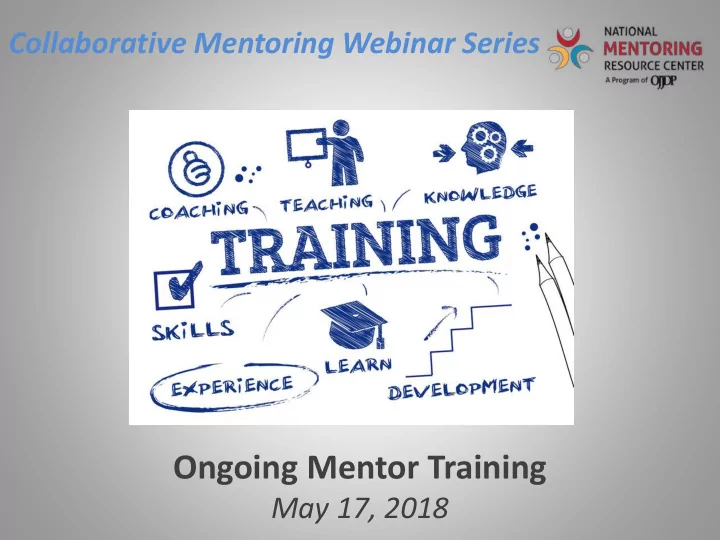
Ongoing Mentor Training
May 17, 2018
SLIDE 2 Collaborative Mentoring Webinar Series
2018 Collaborative Mentoring Webinar Series Planning Team
The Collaborative Mentoring Webinar Series is funded by the Office of Juvenile Justice and Delinquency Prevention through the National Mentoring Resource Center and facilitated in partnership with MENTOR: The National Mentoring Partnership
SLIDE 3 Collaborative Mentoring Webinar Series
Good to Know…
One week after the webinar, all attendees receive an email with:
- Instructions for how to access a PDF of presentation slides and
webinar recording
- Link to the Collaborative Mentoring Webinar Series webpage,
where all slides, recordings and resources are posted Please help us out by answering survey questions at the end of the webinar.
SLIDE 4 Collaborative Mentoring Webinar Series
- All attendees muted for best sound
- Type questions and comments in
the question box
- Respond to polls
- Who is with us today?
Participate in Today’s Webinar
SLIDE 5 Collaborative Mentoring Webinar Series
Today’s Webinar
- Judy Strother Taylor
- Wesley West, M.Ed.
- Jerry Sherk, M.A.
Q & A throughout the presentation (use the Q & A panel)
SLIDE 6 Collaborative Mentoring Webinar Series
Judy Strother Taylor
OJJDP’s National Mentoring Resource Center and the California Mentoring Partnership
- 40 years of experience in
human services
- Former Director of Mentoring
Services for the U.S. Department of Education Mentoring Grant
SLIDE 7 Collaborative Mentoring Webinar Series
Wesley West, M. Ed.
- Coordinator HS Project Arrive
Group Mentoring Program, Mentoring For Success
- Facilitated Groups and Managed
Programs for over 15 years in South Florida, Chicago, and San Francisco
Teacher in Chicago Public Schools and San Francisco Unified School District
SLIDE 8 Collaborative Mentoring Webinar Series
Jerry Sherk, M.A.
- Owner/operator of Mentor Management
Systems, a California-based consulting firm
- Almost 25 years of experience as a youth
mentoring consultant and trainer
- Through OJJDP’s National Mentoring
Resource Center and the California Mentoring Partnership, Jerry has provided TA and training to hundreds of mentoring programs
- Jerry was a school counselor, and he also
developed and implemented mentoring programs in San Diego City Schools
SLIDE 9 Collaborative Mentoring Webinar Series
Training Topics
- Overview of Ongoing Training
- Benefits of Providing These Trainings
- Overcoming Obstacles (e.g. Mentor Attendance)
- Supervision Strategies
- Various Interactive Exercises
- 12 Modules / Curriculum for Ongoing Training
- Ongoing Training for Group Mentoring
- Resources for Developing Ongoing Training
SLIDE 10 Collaborative Mentoring Webinar Series
Ongoing Training -- Overview
- Terminology: “ongoing, advanced, post-match,
in-service, mentor roundtables”
- Effective Practices on Ongoing Trainings
- Formats: Individual and Group Mentoring
- Not all programs provide ongoing training
- Attendance for these trainings is sporadic
- Few Internet resources on Ongoing Training and
little research
SLIDE 11 Collaborative Mentoring Webinar Series
The Research Says
Martin, S.M., & Sifers, S.K., (2012) -- This study highlights the importance of quality training.
– Agency support could be more frequent in the beginning
- f a relationship to provide more support in the critical
beginning stages of a mentoring relationship…
NMRC website – “Post-match Training for Mentors”
- - “Insufficient Research on Post-match Training”
Common Sense = Ongoing Training is helpful!
SLIDE 12 Collaborative Mentoring Webinar Series
Benefits of Ongoing Training (1)
- Educate and remind mentors of basics
- Introduce advanced topics
- Provide monitoring and support—help to
problem solve
- Become aware of “patterns,” e.g. mentee
behaviors, parent dynamics, unrealistic expectations, problems with boundaries
SLIDE 13 Collaborative Mentoring Webinar Series
Benefits of Ongoing Training (2)
- Monitor mentors who are not upholding their
commitments, program rules
- Revise initial trainings (and supervision) based on
what’s seen in ongoing trainings
- Encourage mentors to recruit friends
- Acknowledge, reward, praise, thank and
encourage mentors
SLIDE 14 Collaborative Mentoring Webinar Series
Obstacles to Ongoing Training
- Getting mentor buy-in and commitment
- Mentor and staff time overload
- Mentor no-shows– and no accountability from
staff
- Staff not sure how to develop and implement
- ngoing trainings
SLIDE 15 Collaborative Mentoring Webinar Series
Increasing Attendance
- Make them fun and interactive
- Bring in guest speakers
- Consider meeting over coffee or a meal
- Create a sense of team through the “mentor
roundtable approach”
- If mandatory, make mentors accountable for their
attendance
SLIDE 16 Collaborative Mentoring Webinar Series
For Those Not Confident in Supervision Abilities…
- Ask other staff to attend
- Reach out to social workers, school counselors,
therapists, intern counselors, etc.; (could be brought in as guest speakers.)
- Consider asking one or more experienced
mentors to assist you
- If you don’t have an answer to a specific problem
that is brought up: “This is an important issue--I’ll get back to you on it.”
SLIDE 17 Collaborative Mentoring Webinar Series
Training Frequency & Length
- Larger programs and those with youth that are
facing more obstacles typically have more frequent trainings
– Monthly – Quarterly
- Duration for training sessions differ, but 60 to 90
minutes is typical; shorter for group mentoring debriefs
- Some site–based programs schedule trainings
before or after match activities
SLIDE 18 Collaborative Mentoring Webinar Series
“Obstacles and Successes”
The exercise uses the “Mentor Roundtable Format” -- in a small setting (around 8 mentors), ask each mentor to describe one
success they are having with their mentee, in that order. For a mentor that is looking for help, the facilitator 1st asks other mentors for ideas—but can later give his/her advice
SLIDE 19 Collaborative Mentoring Webinar Series
Determining Topics for Trainings
Canvas mentees, mentors, parents, & staff for problem areas--Examples:
- Mentors’ inability to connect with mentees
- Unrealistic mentor expectations
- Commitment breaches/broken rules
- Parent contact issues
- Prescriptive/directive mentors (unrealistic
mentor expectations)
- Any topic missed during initial training
Also look for and accentuate positives, strengths
SLIDE 20 Collaborative Mentoring Webinar Series
Additional Training Topics
- COMMUNICATION SKILLS
- Problem Solving
- Diversity
- Gender Issues
- Child Development
- Goal Setting
- Academic Assistance
- Growth Mindset
- Match Activities
- Dealing with a Crisis
- Adverse Childhood
Experiences (ACES)
- Developmental Assets
- Advice on Bullying
- Social Media
- Confidentiality, Child
Abuse Reporting
SLIDE 21
Collaborative Mentoring Webinar Series
Publication for Ongoing Training
SLIDE 22 http://educationnorthwest.org/sites/default/files/ongoing-training-for-mentors.pdf
SLIDE 23
Collaborative Mentoring Webinar Series
SLIDE 24 Collaborative Mentoring Webinar Series
Training Tips
- Address participants’ training needs
- Provide an opportunity to practice skills and to
allow mentors to come up with their answers
– Self-reflection – Work in pairs, triads, small groups
- Interactive, Interactive, Interactive
– Quizzes – Scenarios and Role Plays – Ask mentors to come up with answers, share something, make something, solve something
SLIDE 25
Collaborative Mentoring Webinar Series
Make Something (Build an Ideal Mentor)
SLIDE 26
Collaborative Mentoring Webinar Series
Solve Something
(Scenarios)
You have been mentoring Scott, 14, for several months and things have gone well. As you drop him off, his mother meets you both at the front door and and in an angry and loud voice she startles you by saying, “Would you please tell Scott get his act together and start getting his schoolwork done!” If you were the mentor, what might you say in the moment? What might you say to Scott, later? Choose a recorder to write down and share the responses you came up with in your group.
SLIDE 27 Collaborative Mentoring Webinar Series
Supervision Facilitation Tips While Problem-Solving
- Never embarrass anyone
- If they are off target on their answer, go to their
intent: “I think I can see what you are getting at…”
- Consider using the “cost-benefit analysis” – You
could try that, but what might happen?
- Ask other mentors for suggestions before you
give your advice
- If you don’t have the answer let them know that
you will get back to them
SLIDE 28 Collaborative Mentoring Webinar Series
Wrong Way/Right Way Role Plays
- 1st, provide training on a specific topic
- Ask for two volunteers to do a role play (tell
them that you will ensure their safety)
- Give them a situation/scenario, and then ask
them to do it the wrong way
- Debrief—ask the group what they did “wrong”
- Ask them to repeat, but do it “a little better”
- Debrief – “what improvements did you see?”
SLIDE 29 Collaborative Mentoring Webinar Series
Evaluate Trainings
Mentor satisfaction surveys:
- Are mentors feeling more prepared?
- Do youth report better relationships?
- Mentor attendance affect match length?
- Do trainings help mentors deliver key
messages to youth?
- What might happen if we changed the
content, delivery methods, etc. of training?
– Extrapolated from NMRC Practice Review
SLIDE 30 Collaborative Mentoring Webinar Series
Ongoing Training for Group Mentoring
- School-Based Group Mentoring Model 2:10
- Supporting students through school transition
- 30+ mentors/serving 150+ students/6 schools
- Curriculum and training Provided
- Initial Training: Tuckman’s Stages of Group
Development and Restorative Practices Project Arrive: http://sites.gsu.edu/project-arrive/
SLIDE 31 Collaborative Mentoring Webinar Series
Session Debriefings / Ongoing Trainings
We use session debriefs as opportunities for ongoing trainings: Today’s Session:
- How did it go today? What worked? What didn’t?
- How was your work together—chemistry?
- Curriculum on target?
- How did the students respond?
- Any suggestions for improvement?
- Preparation for next week’s session
- Review (and sometimes practice) curriculum
SLIDE 32 Collaborative Mentoring Webinar Series
Topics for Ongoing Training
- Mentors Wearing Multiple Hats
- Handling Shy and Unresponsive Mentees
- Managing Discipline Problems
- Personal Questions and Boundaries
- Building Mentee Support Systems
- Developmental Assets
SLIDE 33 Collaborative Mentoring Webinar Series
Strategies for Group Mentoring Ongoing Training & Mentor Support
- Send out curriculum and pertinent info on email
- Group Mentoring Activities and Curriculum:
http://sites.gsu.edu/project-arrive/activities-2/
- Encourage mentors to work together
- Make staff available at program sites
- Sit in on groups when possible
- Utilize surveys to get feedback
SLIDE 34 Collaborative Mentoring Webinar Series
Resources for Ongoing Training
Attachments on this webinar:
- Obstacles and Successes (exercise for mentor
supervision & support during ongoing trainings)
- Right Way / Wrong Role Plays
- 8 Sample Scenarios for Ongoing Training
- 60 Training Tips
- Ongoing Training for Mentors: 12 Sessions
SLIDE 35
Collaborative Mentoring Webinar Series
Q&A
Type your questions in the question box:
SLIDE 36 Collaborative Mentoring Webinar Series
Additional Resources
Affiliates Affiliates serve as a clearinghouse for training, resources, public awareness and
- advocacy. Find your local affiliate here: http://www.mentoring.org/our-
work/our-affiliates/ Mentoring Connector Recruit mentors by submitting your program to the Mentoring Connector https://connect.mentoring.org/admin National Mentoring Resource Center Check out the OJJDP National Mentoring Resource Center for no-cost evidence- based mentoring resources
SLIDE 37 Collaborative Mentoring Webinar Series
Remember…
After the webinar:
- Please help us out by answering survey questions at
the end of the webinar.
- Everyone will get an email with information on how to
download the slides, recording, and resources on the CMWS webpage on the MENTOR website: http://www.mentoring.org/program_resources/training_o pportunities/collaborative_mentoring_webinar_series/
SLIDE 38 Collaborative Mentoring Webinar Series
Stay Connected
- Email us at collaborativewebinarseries@mentoring.org
- Tweet with hashtag #MentoringWebinar
- Visit our webpage on the MENTOR website for past and upcoming webinars:
SLIDE 39
Collaborative Mentoring Webinar Series
Youth-Initiated Mentoring June 21, 2018 1 - 2:15 pm Eastern
Join Us Next Month!