
SLIDE 1
SOCIAL INCLUSION FORUM 2019
COLLABORATIVE WORKING AT LOCAL AND NATIONAL LEVEL
Preparatory Workshops
Focus Group with
Community Workers
Waterford Tralee Dundalk Dublin Castlerea
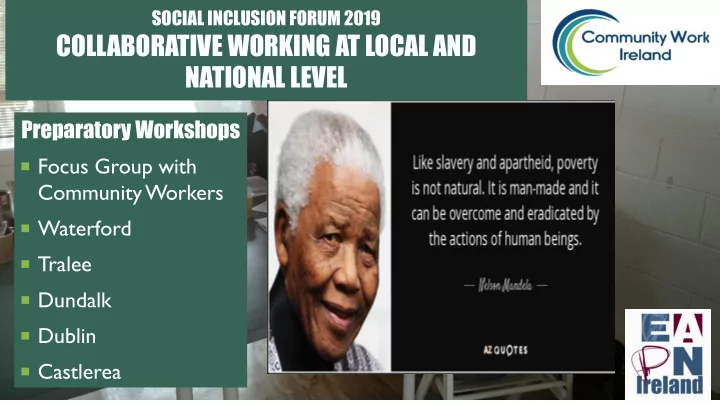
COLLABORATIVE WORKING AT LOCAL AND NATIONAL LEVEL Preparatory - - PowerPoint PPT Presentation
SOCIAL INCLUSION FORUM 2019 COLLABORATIVE WORKING AT LOCAL AND NATIONAL LEVEL Preparatory Workshops Focus Group with Community Workers Waterford Tralee Dundalk Dublin Castlerea POVERTY LEVELS Poverty levels continue
SOCIAL INCLUSION FORUM 2019
Focus Group with
Waterford Tralee Dundalk Dublin Castlerea
Poverty levels continue to be
unacceptably high
Structural causes – not just
symptoms
Cost of living – esp. housing A consistency of inequality Many groups and
communities including Travellers and other minorities not featured
“Poverty is hidden and dispersed – because people and families are getting HAP, they often live in areas that are not included in SICAP or other target areas”
2004 2005 2006 2007 2008 2009 2010 2011 2012 2013 2014 2015 2016 2017 At Risk of Poverty Rate (%) 19.4 18.3 17 16.5 14.4 14.1 14.7 16 16.5 15.2 16.3 16.3 16.2 15.7 Deprivation Rate (%) 14.2 14.8 14 11.8 13.7 17.1 22.6 24.5 26.9 30.5 28.9 25.4 21 18.8 Consistent Poverty Rate (%) 6.8 7 6.5 5.1 4.2 5.5 6.3 6.9 8.2 9 8.3 8.5 8.2 6.7 5 10 15 20 25 30 35
Poverty & Deprivation
At Risk of Poverty Rate (%) Deprivation Rate (%) Consistent Poverty Rate (%)
What is essential is commitment to consultation and an understanding that consultation makes for better policy-making. It is too late now for consultation on the National Strategy so what we need is a clear commitment to robust processes built into the implementation of the Strategy. “People are really struggling but it is not always visible. The Resource Allocation Model and the targets that are set preclude us from working with people that really need it. There are a large number of refugees living in [name of area] but the Index indicates this is an affluent area – work we do there is not counted by the system” Deprivation measures need to be updated and reflect new forms of poverty, including exclusion and lack of access to services, particularly in rural areas
Gaps in the implementation of
policy
Monitoring mechanisms for
progress on poverty and social inclusion need to be reviewed and given additional status.
Efforts to re-establish the
network of social inclusion
department was welcomed
SIF – re-established as a robust
mechanism for accountability on progress.
“How do we get the words on the pages of the National Report into action? Do these forums work? Does anything change?”
COLLABORATIVE WORKING AT LOCAL & NATIONAL LEVELS
Welcome the shift to collaborative ways of working Mechanisms such as the Local Community
Development Committees not reaching full potential – failing to get the government departments and agencies to collaborate on locally shared targets in many areas
Competitive tendering and target setting for the
Social Inclusion Community Activation Programme and other programmes have been damaging
“Community development has been decimated – we really need autonomous infrastructure and programmes if we are serious about collaboration and making a real impact on poverty and social exclusion”
Data and information sources currently used is problematic for a
number of reasons:
Main sources of data, such as SILC, fail to capture minorities, including Travellers;
Over-reliance on quantitative data - fails to reflect the lived experience and the impact of poverty on people and communities;
The over-reliance on income as a measure of poverty fails to reflect more comprehensive notions of wellbeing; There is a myriad of data being collected at local, regional and
national levels by community organisations and government agencies but there are few attempts to collate the information being gathered.
SOCIAL INCLUSION AND PEOPLE WITH DISABILITIES
Added cost of disability Disproportionate number of people with disabilities in poverty Measures needed to address barriers - clamp-down on behaviour
that inhibits people with disabilities -
Access to employment - still very difficult and the ‘reasonable’
accommodation requirement on employers does not go far enough
Greater measures required to support entrepreneurship for
people with disabilities
Need greater awareness of disabilities amongst employers.
NEGATIVE ATTITUDE OF MANY EMPLOYERS TO MANY INCLUDING MINORITIES AND THOSE WITH DISABILITIES ISSUES FOR (WORKING) PARENTS ON LOW INCOME
Issues have been well rehearsed
Action based on Social
Determinants of Health that link social, economic and cultural conditions
Traveller health and wellbeing cannot
be addressed in isolation of the wide range of issues being faced
Traveller voice essential – need for
an autonomous Traveller
Fear of the unknown – return
Already having an effect
Supports to enterprise need