
SLIDE 1
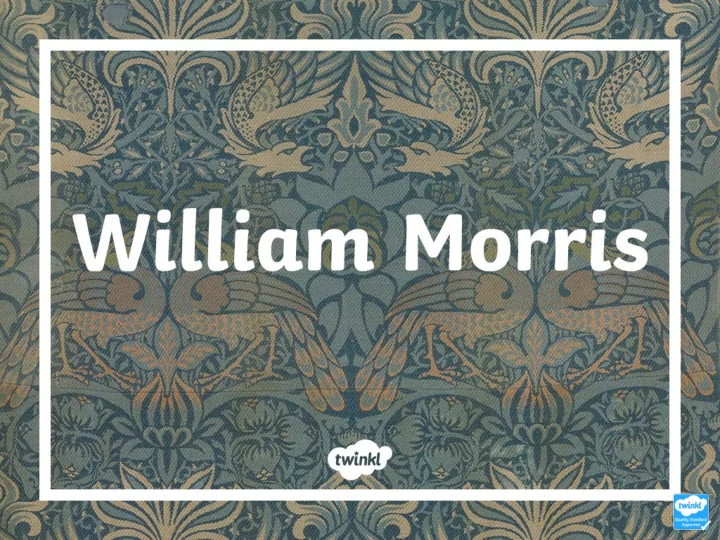
Aim To understand who William Morris was. To recognise examples - - PowerPoint PPT Presentation
Aim To understand who William Morris was. To recognise examples of William Morris patterns. William Morris Have nothing in your house that you do not know to be useful, or believe to be beautiful. - William Morris Who Was
William Morris was born on 24th March, 1834.
He originally was going to become a priest but decided to devote his life to art instead. He became a poet, artist and manufacturer. He had lots of friends who were writers, poets and artists. His career in designing started when he decorated his own house in London. He was the son of a wealthy business man.
William Morris is very famous for his wallpaper designs. He created some beautiful designs, the likes of which had never been used before. In fact, wallpaper before his day was quite plain. The Victorian era was the era of industrialisation; factories were being built in the cities in Britain, especially London. People flocked to the cities to work in these factories
bigger and bigger. As a result, people led more urban lifestyles and grew to miss the countryside. Wealthier people did have gardens, but still, it was desirable to feel closer to nature. William Morris, who was also an environmental campaigner, created designs of floral patterns (patterns inspired by flowers and plants) which were repeated many times by block printing.
What William Morris did was to make designs of floral patterns (patterns inspired by flowers and plants) that could be repeated many times by block printing techniques on large pieces of paper to make patterned wallpaper. This process was later improved through advances in technology, using printing machines and synthetic coloured inks.
“Machine Typographique Ghande Dimension” is licensed under CC BY 2.0
“Windrush” 1881-1883
“Trellis” 1876
“Daisy” 1864
“Peacock and Dragon” 1878