9/30/2015 Detecting oestrus by monitoring sows visits to a boar T. - - PDF document

9 30 2015
SMART_READER_LITE
LIVE PREVIEW

9/30/2015 Detecting oestrus by monitoring sows visits to a boar T. - - PDF document

9/30/2015 Detecting oestrus by monitoring sows visits to a boar T. Ostersen, C. Cornou, A.R. Kristensen Katarina Nielsen Dominiak Department of Large Animal Sciences Department of Large Animal Sciences Introduction 5 25 % return to


slide-1
SLIDE 1

9/30/2015 1

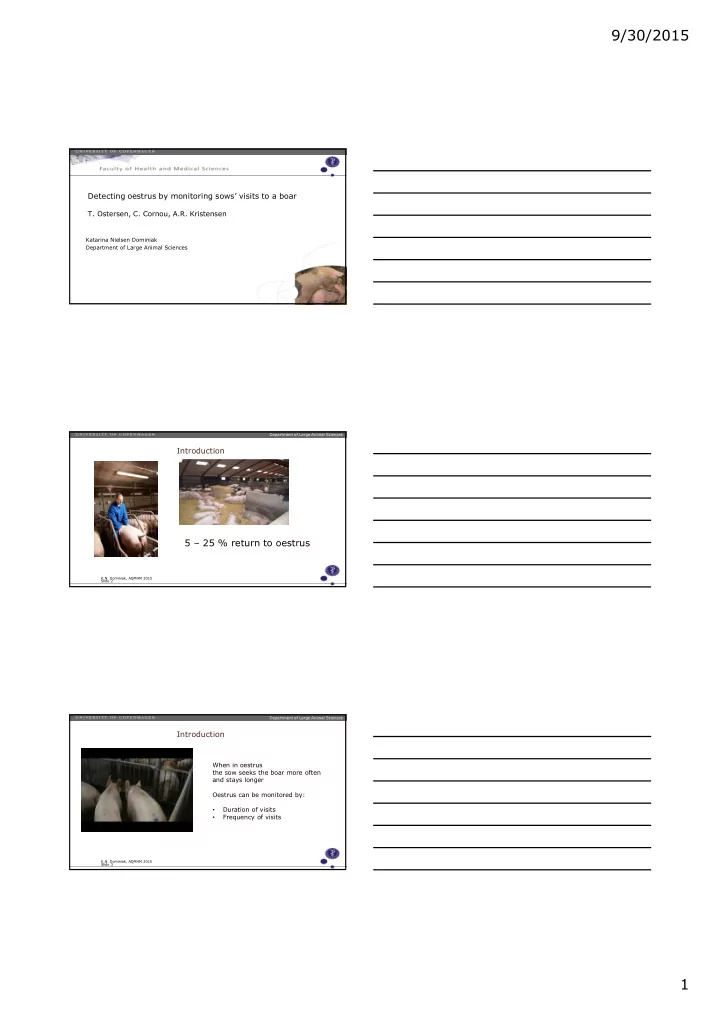
Detecting oestrus by monitoring sows’ visits to a boar

  • T. Ostersen, C. Cornou, A.R. Kristensen

Katarina Nielsen Dominiak Department of Large Animal Sciences

Introduction

K.N. Dominiak, AQMHM 2015 Department of Large Animal Sciences Slide 2

5 – 25 % return to oestrus

Introduction

Department of Large Animal Sciences K.N. Dominiak, AQMHM 2015 Slide 3

When in oestrus the sow seeks the boar more often and stays longer Oestrus can be monitored by:

  • Duration of visits
  • Frequency of visits
slide-2
SLIDE 2

9/30/2015 2

Department of Large Animal Sciences K.N. Dominiak, AQMHM 2015 Slide 4

Variation between sows – visiting patterns

Department of Large Animal Sciences K.N. Dominiak, AQMHM 2015 Slide 5

Individual variation in both level and variance Diurnal pattern Oestrus:

  • Change in level of

duration

  • Change in frequency
  • Increase in variance

Outliers does not necessarily indicate oestrus

Model characteristics

Department of Large Animal Sciences K.N. Dominiak, AQMHM 2015 Slide 6

Duration model:

  • Response variable sec/hour
  • Adapt to individual level of

duration and variance

  • Ignore outliers
  • Detect oestrus based on level shift

and increase in variance Multiproces dynamic linear model MP-DLM Dynamic generalized linear model DGLM Frequency model:

  • Response variable visits/6 hours
  • Two diurnal periods (5 am - 5 pm)
  • Adapt to individual level
  • Handle Poisson distributed data
slide-3
SLIDE 3

9/30/2015 3

Duration model I

Department of Large Animal Sciences K.N. Dominiak, AQMHM 2015 Slide 7

More DLMs = Multiproces DLM Connected by First order Markov prior probabilities First six observations reset to ‘Normal’ > 6 hours between two observations resets to ‘Normal’

Duration model II

Department of Large Animal Sciences K.N. Dominiak, AQMHM 2015 Slide 8

Normal Level shift Oestrus Outliers P(MOE) = Indicator for oestrus

Frequency model I

Department of Large Animal Sciences K.N. Dominiak, AQMHM 2015 Slide 9

Remember from raw data: Two diurnal periods

  • High frequency at day
  • Low frequency at night
  • 1-step forecast of the mean
  • Comparison with actual
  • bservations
slide-4
SLIDE 4

9/30/2015 4

Frequency model II

Department of Large Animal Sciences K.N. Dominiak, AQMHM 2015 Slide 10

Relative deviation from expected = oestrus indicator Threshold value 3.3 Normal Oestrus Change in frequency Combined probability of oestrus given the result from the frequency model is positive or negative

Combining the two models

P(MOE) from the duration model Test results of frequency model

Department of Large Animal Sciences K.N. Dominiak, AQMHM 2015 Slide 11

Combined by Bayes Theorem SE of frequency model 1 - SE of frequency model P(MOE)

Results I

Department of Large Animal Sciences K.N. Dominiak, AQMHM 2015 Slide 12

SP: Ability to identify non-oestrus correctly SE: Ability to identify oestrus correctly LR+: Reliability of positive test result Error rate: Proportion of alarms being false

slide-5
SLIDE 5

9/30/2015 5

Discussion

Extremely high SP – important when rare condition High error rates – too many false alarms Duration output communicated as a probability of oestrus

  • how do you think a farmer would embrace such an output?

Department of Large Animal Sciences K.N. Dominiak, AQMHM 2015 Slide 13

Thank you

Department of Large Animal Sciences K.N. Dominiak, AQMHM 2015 Slide 14