5/8/2015 The Islamic Civilization A Study of the Faith / Empire / - - PDF document

5 8 2015
SMART_READER_LITE
LIVE PREVIEW

5/8/2015 The Islamic Civilization A Study of the Faith / Empire / - - PDF document

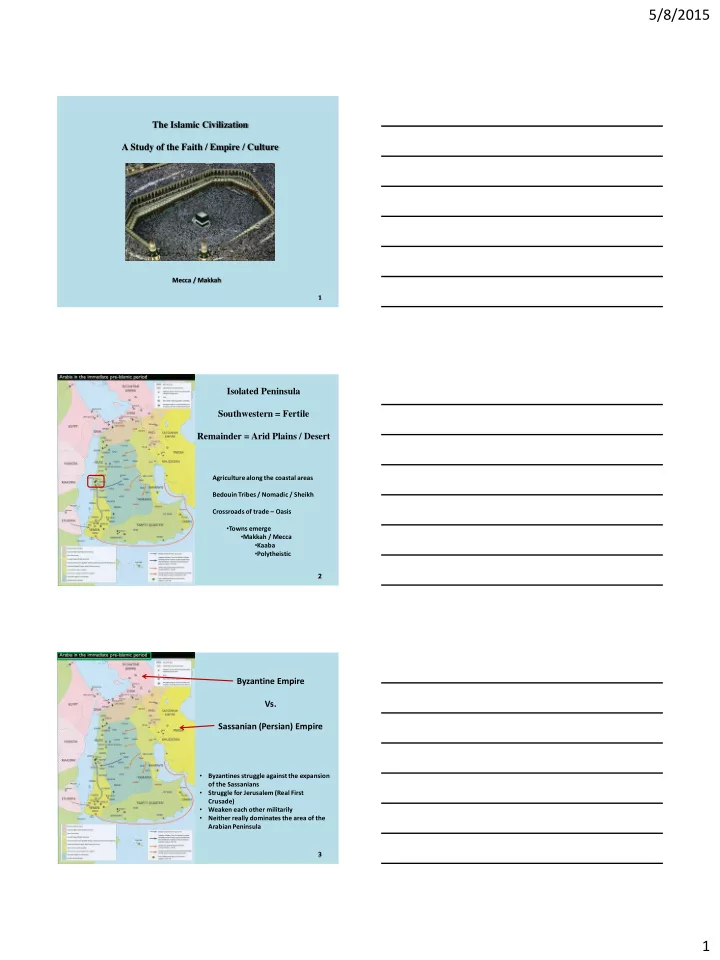
5/8/2015 The Islamic Civilization A Study of the Faith / Empire / Culture Mecca / Makkah 1 1 Isolated Peninsula Southwestern = Fertile Remainder = Arid Plains / Desert Agriculture along the coastal areas Bedouin Tribes / Nomadic / Sheikh


slide-1
SLIDE 1

5/8/2015 1

1

The Islamic Civilization A Study of the Faith / Empire / Culture

Mecca / Makkah

1

2

Isolated Peninsula Southwestern = Fertile Remainder = Arid Plains / Desert

Agriculture along the coastal areas Bedouin Tribes / Nomadic / Sheikh Crossroads of trade – Oasis

  • Towns emerge
  • Makkah / Mecca
  • Kaaba
  • Polytheistic

2

3

3

Byzantine Empire Vs. Sassanian (Persian) Empire

  • Byzantines struggle against the expansion
  • f the Sassanians
  • Struggle for Jerusalem (Real First

Crusade)

  • Weaken each other militarily
  • Neither really dominates the area of the

Arabian Peninsula

slide-2
SLIDE 2

5/8/2015 2

4

4

Mohammed

Born 570 – Mecca

  • Orphaned
  • Lives with uncle
  • Become a Merchant
  • Travels throughout the

Middle East

  • Marries Khadija (15 yrs older)
  • Influenced by Christianity and

Judaism The Flight of Mohammed Hijrah (Hegira)

  • Start of the Islamic

Calendar – 622 A.D.

  • Medina Compact
  • Political Capital of Islam

5

5

During Mohammed’s Life After Mohammed’s Death

Expansion of Islam

Mohammed Enters Mecca – 630 A.D. Kaaba becomes place

  • f worship tied

to Abraham Mohammed dies at Medina in 632 A.D.

Fought to re-establish power of “Rightly Guided Caliphs”

6

6

The Kaaba

Exterior Interior

slide-3
SLIDE 3

5/8/2015 3

7

7

Islam = “Submission to the Will of God”

Koran / Quran (“Recital”) Written in Arabic

Final authority in matters of faith and lifestyle

  • God’s messages revealed to Mohammed
  • Old Testament Stories
  • Specific Rules
  • Alcohol

Shari’ah

  • Quran / Sayings of Mohammed
  • Islamic moral principles
  • Public / Private Life

8

8

9

9

Building the Islamic Empire through military conquest

slide-4
SLIDE 4

5/8/2015 4

10

10

The Spread of Islam The Early Islamic Warrior

11

11

Expansion of Islam

Caliph = “Successor” Mohammed left no clear line of succession Rightly Guided Caliphs (Rashidun Caliphs) -- 632 A.D. – 661 A.D.

  • Four immediate successors of Mohammed
  • All knew, lived, followed Mohammed

Abu Bakr (632 – 634) Father-in-Law, Died Naturally Omar (634 – 644) Appointed by Abu Bakr, Assassinated Othman (644 – 656) Elected by peers, Assassinated Ali (656 – 661) Cousin and son-in-law (Fatima), Assassinated

“jihad” begins

12

Islam Fragments

661 Death of Ali --- Muawiyah (Governor of Syria) Husayn (Ali’s son later killed in battle – 680 A.D.) Establishment of the Umayyad Dynasty (661 – 750 A.D.)

  • Damascus established as capital city instead of Medina
  • Greatest Period of Islamic Expansion

Divisions in the Islamic Faith Emerge Umayyad’s Political Leaders Sunni Muslims 90% in the World Fatimah – Mohammed’s Descendants Religious Leaders Shiite Muslims 10% in the World Further divided into smaller sects Settle in North Africa (Fatimid's)

slide-5
SLIDE 5

5/8/2015 5

13

13

Continues Dynasty in Spain Emirate / Caliphate of Cordoba (756 – 1031)

The Umayyad Dynasty in Power 661 – 750 A.D.

  • Spread Arabic Language
  • Minted 1st Arabic Currency
  • Built Roads

Overthrown in 750

14

14

The Umayyad Political World

15

15

Expansion into Europe (Spain) 711 – 714 A.D. Defeat the Catholic Visigoths Internal Civil War

slide-6
SLIDE 6

5/8/2015 6

16

16

Prince Eudes (Aquitaine) Meets (S.W. Paris) with Charles Martel (732)

Old Enemies – Warns about the Advance of the Muslims

Notice Absence

  • f Stirrups!)

17

17

Arab / Muslim Expansion into Europe

Charles Martel & Eudes Meet 732 A.D.

Arab Raids into France 714 - 731

Summer 732 A.D.

Franks = 20 – 30,000 Troops Arabs = 15 – 20,000 Troops

18

18

Muslim Raiding Party Advances past Poitiers, France

slide-7
SLIDE 7

5/8/2015 7

19

19

Key Turning Point

20

20

Major fight at Muslim Camp

21

21

Death of Abd al-Rahman / End of Muslim Efforts for Expansion into Western Europe

slide-8
SLIDE 8

5/8/2015 8

22 22

Muslim Forces Retreat at the Death of their Leader

22 23 24

Muslim Focus on Spain Begins

Eight Centuries  711 – 1492 Distinct Culture  Combination of Europe / N. Africa / Middle East Cordoba / Cordova  Umayyad Capital  70 Libraries – 500,000 books Granada  Alhambra

slide-9
SLIDE 9

5/8/2015 9

25

25

26

26

Umayyad Caliphate of Cordoba “al-Andalus” (Andalusia) 27

Exterior of the Cordoba Cathedral European Features Islamic Features

slide-10
SLIDE 10

5/8/2015 10

Traditional Catholic Church Interior

28 29

29

Combination

  • f Islamic

Architecture and European Gothic Islamic Features Catholic Features

30

slide-11
SLIDE 11

5/8/2015 11

31 32

Rise of the Abbasid Dynasty 747 – 750 A.D.

  • Baghdad becomes capital of the Islamic Empire
  • Islamic Culture emerges as being distinct and unique
  • Height of Islamic Culture reached under early Abbasid rulers
  • Abbasid dynasty rules 750 – 1258

Dissatisfaction with Umayyad's

  • Discrimination among non-Arabs / Others
  • Shiite opposition join
  • Rebel in areas to east – Iraq / Persia

Descendant of Mohammed comes to power

  • Baghdad becomes new Abbasid capital
  • Tigris River
  • Trade Routes

33

slide-12
SLIDE 12

5/8/2015 12

34

Height of Islamic Culture

Caliph Harun al-Rashid (786 – 809) Baghdad Flourishes Corresponds with Charlemagne

  • Charlemagne sent illuminated manuscripts & bales of furs
  • Harun al-Rashid sent fabrics, perfumes and an elephant named Abu-

Lababah (“Father of Intelligence”)

Baghdad center of trade routes – Population

35

35

Abbasids live in luxurious surroundings

  • Begin to become corrupt over time.

Women lose much of their freedoms – veiled, secluded Lose control over North Africa and Spain Rely on Seljuk Turks as Mercenaries – 1055 – Seljuk’s assume control

  • Abbasid Ruler becomes a figurehead

36

Will control nearly all of North Africa Internal Divisions / Will Face the Crusades Fall to Ayyubid Dynasty / Rise of Saladin Fatimid’s Emerge in North Africa and Egypt Rule 909 – 1171 Cairo is capital city Shiite Islam

slide-13
SLIDE 13

5/8/2015 13

37

37

Ayyubid Dynasty Saladin Fight the Crusaders Eventually recapture the areas taken by the Europeans during the Crusades (1099 – 1291)

Face a new threat – the Mongols

38

Persian Muslims set up cities – Samarkand -- Tamerlane Mongol Advance from the East Baghdad sacked and destroyed in 1258

  • Muslim world is shattered

Mongols continue advance to the west “Tomb of the King”

39

39

Mamluks of Egypt Halt Mongols

  • Horse Archers
  • Similar Tactics
  • Only Mongol Defeat
  • Save Islam for Middle East?
slide-14
SLIDE 14

5/8/2015 14

40

The Islamic Culture Develops

Role of Men and Women in Society (Distinct) Women: Lives revolved around family (1 of 4 Wives) Some other roles available – Scholarship / Arts Men: Politics / Military / Business Responsible for family – treat women fairly Education: Boys (age 7) – Mosque schools (small costs) Madrasas (Theological schools) -- Select become leaders

41

Agriculture: Irrigation / Fruit Orchards Trade: Crossroads Bazaars / Marketplaces / Urban Centers

42

42

Damascene Jewelry

slide-15
SLIDE 15

5/8/2015 15

43

43

44

House of Wisdom -- Baghdad

Ma’mun – 830 Intellectual Center – Research / Science Translation of earlier literature – Greek / Persian / Indian

45

Cultural - Scholarship

Mathematics: Arabic Numerals – India Chemistry & Medicine: al-Razi / Classify Substances Ibn Sina / “Canon of Medicine” Art and Architecture: Calligraphy / Elegant Handwriting Arabesques / Geometric Designs Literature: Omar Khayyam / “Rubaiyat”

slide-16
SLIDE 16

5/8/2015 16

46

Cultural - Scholarship

Literature: Omar Khayyam / “Rubaiyat”

19th Century Loose English Translation

"A Book of Verses underneath the Bough, A Jug of Wine, a Loaf of Bread--and Thou Beside me singing in the Wilderness-- Oh, Wilderness were Paradise enow!"

47

Cultural - Scholarship

Mathematics: Arabic Numerals – India Chemistry & Medicine: al-Razi / Classify Substances Ibn Sina / “Canon of Medicine” Art and Architecture: Calligraphy / Elegant Handwriting Arabesques / Geometric Designs Literature: Omar Khayyam / “Rubaiyat” Arabian Nights Tales

48

Cultural - Scholarship

Mathematics: Arabic Numerals – India Chemistry & Medicine: al-Razi / Classify Substances Ibn Sina / “Canon of Medicine” Art and Architecture: Calligraphy / Elegant Handwriting Arabesques / Geometric Designs Literature: Omar Khayyam / “Rubaiyat” Arabian Nights Tales Philosophy & History: Averroes (Ibn-Rushd) & Moses Maimonides Correspondence with St. Thomas Aquinas?

slide-17
SLIDE 17

5/8/2015 17

49

49

50 51

Examples of Islamic Architecture