10/24/2015 Building an Active City WHY ACTIVE CITIES? Designed to - - PDF document

10 24 2015
SMART_READER_LITE
LIVE PREVIEW

10/24/2015 Building an Active City WHY ACTIVE CITIES? Designed to - - PDF document

10/24/2015 Building an Active City WHY ACTIVE CITIES? Designed to Move Karen K. Lee, MD, MHSc www.drkarenlee.com For more information or assistance, or permission to use information from this presentation, contact Dr. Karen Lee at For more


slide-1
SLIDE 1

10/24/2015 1

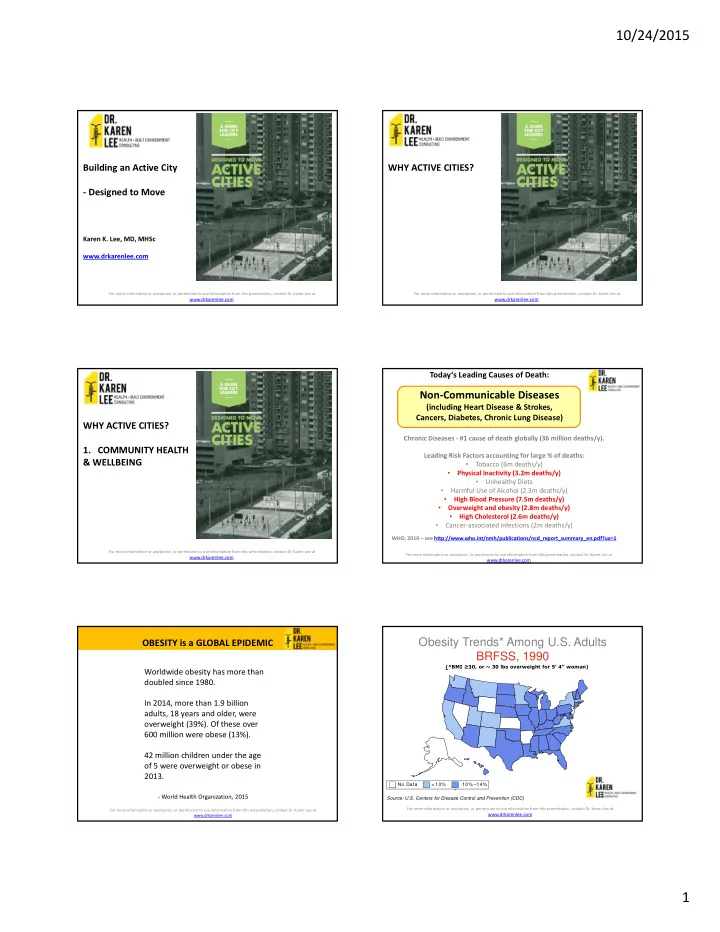
Building an Active City ‐ Designed to Move

Karen K. Lee, MD, MHSc www.drkarenlee.com

For more information or assistance, or permission to use information from this presentation, contact Dr. Karen Lee at

www.drkarenlee.com.

WHY ACTIVE CITIES?

For more information or assistance, or permission to use information from this presentation, contact Dr. Karen Lee at

www.drkarenlee.com.

WHY ACTIVE CITIES?

  • 1. COMMUNITY HEALTH

& WELLBEING

For more information or assistance, or permission to use information from this presentation, contact Dr. Karen Lee at

www.drkarenlee.com.

Today‘s Leading Causes of Death:

Non‐Communicable Diseases

(including Heart Disease & Strokes, Cancers, Diabetes, Chronic Lung Disease)

Chronic Diseases ‐ #1 cause of death globally (36 million deaths/y). Leading Risk Factors accounting for large % of deaths:

  • Tobacco (6m deaths/y)
  • Physical Inactivity (3.2m deaths/y)
  • Unhealthy Diets
  • Harmful Use of Alcohol (2.3m deaths/y)
  • High Blood Pressure (7.5m deaths/y)
  • Overweight and obesity (2.8m deaths/y)
  • High Cholesterol (2.6m deaths/y)
  • Cancer‐associated infections (2m deaths/y)

WHO, 2010 – see http://www.who.int/nmh/publications/ncd_report_summary_en.pdf?ua=1

For more information or assistance, or permission to use information from this presentation, contact Dr. Karen Lee at

www.drkarenlee.com

For more information or assistance, or permission to use information from this presentation, contact Dr. Karen Lee at www.drkarenlee.com

Worldwide obesity has more than doubled since 1980. In 2014, more than 1.9 billion adults, 18 years and older, were

  • verweight (39%). Of these over

600 million were obese (13%). 42 million children under the age

  • f 5 were overweight or obese in

2013.

OBESITY is a GLOBAL EPIDEMIC

‐ World Health Organization, 2015

Obesity Trends* Among U.S. Adults BRFSS, 1990

(*BMI ≥30, or ~ 30 lbs overweight for 5’ 4” woman) Source: U.S. Centers for Disease Control and Prevention (CDC) No Data < 10% 10% –14% For more information or assistance, or permission to use information from this presentation, contact Dr. Karen Lee at www.drkarenlee.com

slide-2
SLIDE 2

10/24/2015 2

Obesity Trends* Among U.S. Adults BRFSS, 1995

(*BMI ≥30, or ~ 30 lbs overweight for 5’ 4” woman) Source: U.S. Centers for Disease Control and Prevention (CDC) No Data < 10% 10% –14% 15% -19% For more information or assistance, or permission to use information from this presentation, contact Dr. Karen Lee at www.drkarenlee.com

Obesity Trends* Among U.S. Adults BRFSS, 2000

(*BMI ≥30, or ~ 30 lbs overweight for 5’ 4” woman) Source: U.S. Centers for Disease Control and Prevention (CDC) No Data < 10% 10% –14% 15% -19% 20% + For more information or assistance, or permission to use information from this presentation, contact Dr. Karen Lee at www.drkarenlee.com.

Obesity Trends* Among U.S. Adults BRFSS, 2005

(*BMI ≥30, or ~ 30 lbs overweight for 5’ 4” woman) (*BMI ≥30, or ~ 30 lbs overweight for 5’ 4” woman) Source: U.S. Centers for Disease Control and Prevention (CDC) No Data < 10% 10% –14% 15% -19% 20% -24% 25% -29% 30% + For more information or assistance, or permission to use information from this presentation, contact Dr. Karen Lee at www.drkarenlee.com

Obesity Trends* Among U.S. Adults BRFSS, 2010

(*BMI ≥30, or ~ 30 lbs overweight for 5’ 4” woman) Source: U.S. Centers for Disease Control and Prevention (CDC) No Data < 10% 10% –14% 15% -19% 20% -24% 25% -29% 30% + For more information or assistance, or permission to use information from this presentation, contact Dr. Karen Lee at www.drkarenlee.com

1994 2000

No Data <4.5% 4.5-5.9% 6.0-7.4% 7.5-8.9% >9.0%

Source: CDC’s Division of Diabetes Translation. National Diabetes Surveillance System available at http://www.cdc.gov/diabetes/statistics

2009

Diabetes trends among U.S. adults

For more information or assistance, or permission to use information from this presentation, contact Dr. Karen Lee at

www.drkarenlee.com According to the CDC……

$147 billion

per year .

the medical costs attributable to obesity today in the U.S. are estimated to be the total attributable health‐ care costs will be

$860‐

$956

billion

By 2030,

if obesity trends continue as shown,

per year .

For more information or assistance, or permission to use information from this presentation, contact Dr. Karen Lee at

www.drkarenlee.com

slide-3
SLIDE 3

10/24/2015 3

Obesity Trends Among Canadian Adults

For more information or assistance, or permission to use information from this presentation, contact Dr. Karen Lee at

www.drkarenlee.com

Obesity Trends Among Canadian Adults

For more information or assistance, or permission to use information from this presentation, contact Dr. Karen Lee at

www.drkarenlee.com

Obesity Trends Among Canadian Adults

For more information or assistance, or permission to use information from this presentation, contact Dr. Karen Lee at

www.drkarenlee.com

HEALTHY VS UNHEALTHY FOOD ACCESS IS KEY ALSO In the US:

  • Childhood obesity has more than doubled in children, and quadrupled in

adolescents in the past 30 years.

  • In 2012, >1/3 of children and adolescents were overweight or obese.

http://www.cdc.gov/healthyyouth/obesity/facts.htm

In CANADA:

  • Since the late 1970s, overweight and obesity has risen among children and

adolescents in Canada.

  • 2009‐2011: 31.5% of 5‐17 year olds (~1.6 million) were overweight or obese;

32.8% of 5‐11 year olds were overweight or obese (WHO Approach)

  • Excess weight in childhood has been linked to type 2 diabetes, hypertension,

poor emotional health, and diminished social well‐being.

  • Obese children tend to become obese adults.

http://www.statcan.gc.ca/pub/82‐003‐x/82‐003‐x2012003‐eng.htm http://www.statcan.gc.ca/pub/82‐003‐x/2012003/article/11706‐eng.htm

Obesity in Children has Risen Even More Rapidly

For more information or assistance,

  • r permission to use information

from this presentation, contact Dr. Karen Lee at

www.drkarenlee.com

Alberta’s Chronic Disease Rates Are Increasing

  • Twice as many people are living with

diabetes than 10 years ago 218,000 people now

  • 162,000 Albertans suffering with

ischemic heart disease in 2011

  • Over 14% diagnosed with hypertension

For more information or assistance, or permission to use information from this presentation, contact Dr. Karen Lee at

www.drkarenlee.com

Diabetes trends among:

Albertans‐ adults (20+)

2000

4.9% 7.2% 7.9%

2009 2012

Source: Alberta (2014). Interactive Health Data Application. Retrieved from: http://www.ahw.gov.ab.ca/IHDA_Retrieval/ihdaData.do

slide-4
SLIDE 4

10/24/2015 4

For more information or assistance, or permission to use information from this presentation, contact Dr. Karen Lee at www.drkarenlee.com

HIGH LEVELS OF PHYSICAL INACTIVITY IN CANADA

WHO‐Recommended Interventions

  • Protecting people from tobacco smoke and banning smoking in public

places;

  • Warning about the dangers of tobacco use;
  • Enforcing bans on tobacco advertising, promotion and sponsorship;
  • Raising taxes on tobacco;
  • Restricting access to retailed alcohol;
  • Enforcing bans on alcohol advertising;
  • Raising taxes on alcohol;
  • Reduce salt intake and salt content of food;
  • Replacing trans‐fat in food with polyunsaturated fat;
  • Promoting public awareness about diet and physical activity, including

through mass media;

  • Nicotine dependence treatment;
  • Enforcing drink‐driving laws;

For more information or assistance, or permission to use information from this presentation, contact Dr. Karen Lee at www.drkarenlee.com.

WHO‐Recommended Interventions

  • Promoting adequate breastfeeding and complementary feeding;
  • Restrictions on marketing of foods and beverages high in salt, fats and

sugar, especially to children;

  • Food taxes and subsidies to promote healthy diets.
  • Healthy nutrition environments in schools;
  • Nutrition information and counselling in health care;
  • National physical activity guidelines;
  • School‐based physical activity programs for children;
  • Workplace programs for physical activity and healthy diets;
  • Community programs for physical activity and healthy diets;
  • Designing the built environment to promote physical activity.

WHO, 2011 – see http://www.who.int/nmh/publications/ncd_report_summary_en.pdf?ua=1

For more information or assistance, or permission to use information from this presentation, contact Dr. Karen Lee at www.drkarenlee.com.

This image canno t

Evidence-based Research shows that we can Increase Physical Activity through Building, Street and Neighborhood Design OOD SCALES

Designing to increase active recreation Designing to increase active transportation Point-of-Decision stair prompts Signs placed at elevators & escalators encouraging stair use, w/ info

  • n benefits of stair use

Median 50% increase in stair use Design and aesthetic interventions Music & art in stairwells; natural lighting in stairwells Design stairs to be more convenient and visible Skip-stop elevators 3300% increase in stair use Enhancing access to places for physical activity, such as creating walking trails or having onsite or nearby parks, playgrounds and exercise facilities (homes & worksites) increases leisure-time activity and weight loss Walking, Bicycling and Transit-oriented development Designs to improve street safety and aesthetics (less crime and traffic / more greening), having sidewalks and bike paths connected to destinations, mixed land use, high population density Median increase in physical activity 35% to 161%

Evidence Base for Improving Physical Activity through Building, Street and Neighborhood Environments

Designing to increase stair use

For more information or assistance, or permission to use information from this presentation, contact

  • Dr. Karen Lee at

www.drkarenlee.com

WHY ACTIVE CITIES?

  • 2. ENVIRONMENTAL

BENEFITS

For more information or assistance, or permission to use information from this presentation, contact Dr. Karen Lee at

www.drkarenlee.com.

Fuel / Electricity Use Air Quality Obesity/Diabetes/ Heart Disease Biking or walking rather than automotive transport

  

Stairs rather than elevators and escalators

  

Active recreation rather than television

  

Active Cities Strategies Improve the Environment

For more information or assistance, or permission to use information from this presentation, contact Dr. Karen Lee at

www.drkarenlee.com

slide-5
SLIDE 5

10/24/2015 5

WHY ACTIVE CITIES?

  • 3. SOCIAL BENEFITS

For more information or assistance, or permission to use information from this presentation, contact Dr. Karen Lee at

www.drkarenlee.com.

Active Cities Strategies Promote Safety

For more information or assistance, or permission to use information from this presentation, contact Dr. Karen Lee at

www.drkarenlee.com

See http://www.drkarenlee.com/resources/usa

  • Creating safer places to walk,

take transit, & for wheelchair travel

  • Making elevators more

available for those who need them Active Cities Strategies Create More Accessible Places for All

For more information or assistance, or permission to use information from this presentation, contact Dr. Karen Lee at www.drkarenlee.com For more information or assistance, or permission to use information from this presentation, contact Dr. Karen Lee at

www.drkarenlee.com

See http://www.drkarenlee.com/resources/who‐citiesforhealth

Active Cities Strategies Can Be Used to Promote More Equitable Environments

See http://www.drkarenlee.com/resources/usa

Active Cities Strategies Can Promote Aging in Place & Healthy Aging

For more information or assistance, or permission to use information from this presentation, contact Dr. Karen Lee at

www.drkarenlee.com

See also http://www.drkarenlee.com/resources/additional

Taipei, Taiwan has many neighborhood parks that are used by seniors for physical activity and socialization.

“We like to come here to meet friends and exercise. It keeps us healthy, and it has become a habit to meet friends in the park.” ‐ Seniors’ survey participant

Pleson E, Nieuwendyk LM, Lee KK, Chaddah A, Nykiforuk CI, Schopflocher D. Understanding older adults’ usage of community green spaces in Taipei, Taiwan. Int. J. Environ. Res. Public Health 2014; 11(2): 1444‐1464. https://www.youtube.com/watch?v=mw2bO6GfPpE

Physically Fit Children Do Better Academically

For more information or assistance, or permission to use information from this presentation, contact Dr. Karen Lee at

www.drkarenlee.com

slide-6
SLIDE 6

10/24/2015 6

WHY ACTIVE CITIES?

  • 4. ECONOMIC BENEFITS

For more information or assistance, or permission to use information from this presentation, contact Dr. Karen Lee at

www.drkarenlee.com.

  • 2. ECONOMIC BENEFITS:

– Improved retail sales & rents – Improved real estate values – Improved tourism – Improved competitiveness – Decreased sickness absence and improved productivity

For more information or assistance, or permission to use information from this presentation, contact Dr. Karen Lee at

www.drkarenlee.com.

Karen Lee, MD, MHSc, FRCPC, NYC Dept. of Health & Mental Hygiene Skye Duncan, NYC Dept. of City Planning Story K. Bellows, Mayors’ Institute on City Design The Honorable Deke Copenhaver, Mayor, City of Augusta, GA

Active Cities Strategies Create Desirable Places to Live, Work & Play

Sprawl Community : Preferred by 43%

There are only single‐family houses on large lots There are no sidewalks Places such as shopping, restaurants, a library, and a school are within a few miles of your home and you have to drive most places There is enough parking when you drive to local stores, restaurants, and other places Public transportation, such as bus, subway, light rail, or commuter rail, is distant or unavailable

Smart Growth Community : Preferred by 56%

There is a mix of single‐family detached houses, townhouses, apartments, and condominiums on various sized lots Almost all of the streets have sidewalks Places such as shopping, restaurants, a library, and a school are within a few blocks of your home and you can either walk or drive Parking is limited when you decide to drive to local stores, restaurants, and other places Public transportation, such as bus, subway, light rail, or commuter rail, is nearby

Source: NAR National Poll, 2011 Q: In which community would you rather live? For more information or assistance, or permission to use information from this presentation, contact Dr. Karen Lee at www.drkarenlee.com

Edmontonians said…

They want communities that are liveable, vibrant and sustainable Accessibility, Walkability, Beauty and Community

Access to public transportation (Bus and LRT) that can connect them to other parts of the city Places such as shopping, restaurants, a library, and a school are accessible and act as community hubs where neighbours can connect with each other Walkability with quick access to amenities/services, activities or recreation –density and a more pedestrian lifestyle can help bring communities closer together People walking outside, kids playing and recreation opportunities Neighborhoods that are attractive and beautiful make them more livable and sustainable

Source: City of Edmonton (2010) and Edmonton’s Next Gen (2011) For more information or assistance, or permission to use information from this presentation, contact Dr. Karen Lee at www.drkarenlee.com

Active Cities Strategies Save Households Money

Source: Center for Transit‐Oriented Development

People in walkable, transit‐rich neighborhoods spend only 9 percent of their monthly income on transportation costs; those in auto‐dependent neighborhoods spend 25 percent.

For more information or assistance, or permission to use information from this presentation, contact Dr. Karen Lee at

www.drkarenlee.com

Active Cities Strategies Can Reduce Infrastructure Costs for Cities

Water & Sewer Laterals Required Water & Sewer Costs (billions) Road Lane Miles Required Road Land Miles Costs (billions) Sprawl Growth Scenario 45,866,594 $189.8 2,044,179 $927.0 Compact Growth Scenario 41,245,294 $177.2 1,855,874 $817.3 Savings 4,621,303 $12.6 (10.1%) 188,305 $109.7 (6.6%)

Sprawl Costs: Economic Impacts of Unchecked Development, Robert W. Burchell, Anthony Downs, Barbara McCann and Sahan Mukherji, Island Press, 2005

More compact, walkable development patterns save money

  • n avoided infrastructure costs

For more information or assistance, or permission to use information from this presentation, contact Dr. Karen Lee at

www.drkarenlee.com .

slide-7
SLIDE 7

10/24/2015 7

Active Cities Strategies Create Jobs

Source: Political Economy Research Institute: June 2011

Building bicycle and pedestrian infrastructure creates more jobs per dollar invested, compared to road infrastructure

  • nly

For more information or assistance, or permission to use information from this presentation, contact Dr. Karen Lee at

www.drkarenlee.com

WHAT DO ACTIVE CITIES DO? STEPS TO AN ACTIVE CITY NYC & OTHER CASE EXAMPLES

For more information or assistance, or permission to use information from this presentation, contact Dr. Karen Lee at

www.drkarenlee.com.

WHAT DO ACTIVE CITIES DO?

  • 1. PRIORITIZE PHYSICAL

ACTIVITY AS A SOLUTION

For more information or assistance, or permission to use information from this presentation, contact Dr. Karen Lee at

www.drkarenlee.com.

Fit‐City:

Promoting Physical Activity Through Design

Fit‐City 3:

Promoting Physical Activity Through Design
  • 1. PRIORITIZE PHYSICAL ACTIVITY

Align City Departments – NYC Fit City Conference

For more information or assistance, or permission to use information from this presentation, contact Dr. Karen Lee at www.drkarenlee.com .

See http://www.drkarenlee.com/resources/fitcity NOW WE MUST ADDRESS THE EPIDEMICS OF OBESITY AND CHRONIC DISEASES

  • 1. PRIORITIZE PHYSICAL ACTIVITY

Cities Around the World Aligning Their Departments

Fit City Conferences

NYC, Miami, Boston, London, NSW Australia, Sao Paolo

For more information or assistance, or permission to use information from this presentation, contact Dr. Karen Lee at

www.drkarenlee.com

See http://www.drkarenlee.com/presentations/ NYC Cross‐Dept Leadership Created the ACTIVE DESIGN GUIDELINES: Collaboration of 12 NYC Departments Urban Design and Building Design Strategies to Promote Physical Activity included Co‐Benefits of Strategies: ‐ Community Health and Wellbeing ‐ Environmental Sustainability ‐ Universal Accessibility

  • 1. PRIORITIZE PHYSICAL ACTIVITY

Aligned City Departments with Visible Leadership

For more information or assistance, or permission to use information from this presentation, contact Dr. Karen Lee at

www.drkarenlee.com.

See http://www.drkarenlee.com/resources/usa

slide-8
SLIDE 8

10/24/2015 8

  • 1. PRIORTIZE PHYSICAL ACTIVITY

Aligned Leadership Building Physical Activity into the Master Plan

For more information or assistance, or permission to use information from this presentation, contact Dr. Karen Lee at

www.drkarenlee.com.

  • 1. PRIORITIZE PHYSICAL ACTIVITY

Aligned Leadership Making City Workplaces Active Workplaces

NYC City Leaders used City Buildings to create LEED PILOT CREDIT “DESIGN FOR ACTIVE OCCUPANTS”, now registered for use in >250 developments in & outside NYC

For more information or assistance, or permission to use information from this presentation, contact Dr. Karen Lee at

www.drkarenlee.com

See http://www.drkarenlee.com/resources/usa and http://www.drkarenlee.com/projects/ Key Partners: NYC Health + NYC DDC + NYC DCAS + USGBC + Architecture Firms + LEED Consultants + Developers NYC, NY ~ Boston MA ~ Cherokee Nation OK ~ Chicago IL ~ Cook County IL ~ Douglas County NE ~ Jefferson County AL ~ King County WA ~ Louisville KY ~ Miami-Dade County FL ~ Multnomah County OR ~ Nashville TN ~ Philadelphia PA ~ Pima County AZ ~ San Diego CA

  • 1. PRIORITIZE PHYSICAL ACTIVITY

Cities Across the U.S. are Aligning Their Depts

For more information or assistance, or permission to use information from this presentation, contact Dr. Karen Lee at

www.drkarenlee.com

NOW WE MUST ADDRESS THE EPIDEMICS OF OBESITY AND CHRONIC DISEASES

  • 1. PRIORITIZE PHYSICAL ACTIVITY

Cities Across the U.S. Are Aligning their Departments .

Key Intergovernmental Partners in 15 Local Communities:

  • Public Health – 15
  • Planning – 15
  • Transportation – 14
  • Education/School Construction – 12
  • Parks and Recreation – 12
  • Public Works – 8
  • Housing Development or Management – 6
  • Buildings – 3

For more information or assistance, or permission to use information from this presentation, contact Dr. Karen Lee at

www.drkarenlee.com

NOW WE MUST ADDRESS THE EPIDEMICS OF OBESITY AND CHRONIC DISEASES

  • 1. PRIORITIZE PHYSICAL ACTIVITY

Aligning Additional Partners in U.S. Cities

Non‐Governmental Partnerships in 15 Local Communities:

  • Community‐Based/Non‐Profit Groups – 13
  • Environmental Organizations – 9
  • American Planning Association local chapter – 7
  • American Institute of Architects local chapter – 5
  • American Society of Landscape Architects local chapter –

3

  • Local Architecture, Planning and Design Institutions – 3
  • Building Owners and Managers Association – 1

For more information or assistance, or permission to use information from this presentation, contact Dr. Karen Lee at

www.drkarenlee.com

NOW WE MUST ADDRESS THE EPIDEMICS OF OBESITY AND CHRONIC DISEASES

  • 1. PRIORITIZE PHYSICAL ACTIVITY

Canadian Cities Are Aligning Across Sectors

  • Goal: creating healthy communities that support active transportation and

physical activity

  • Partnerships: health, planning and transportation organizations

+ non‐governmental organizations + university researchers + regional/local government authorities in 8 of the 10 provinces:

  • B.C. (Vancouver), Saskatchewan (Regina), Manitoba (Winnipeg), Ontario

(Peel Region, Toronto), Quebec (Montreal), Nova Scotia (Halifax), New Brunswick (Fredericton), Newfoundland

For more information or assistance, or permission to use information from this presentation, contact Dr. Karen Lee at

www.drkarenlee.com

See http://www.drkarenlee.com/presentations/

slide-9
SLIDE 9

10/24/2015 9

WHAT DO ACTIVE CITIES DO?

  • 2. MAKE EXISTING

RESOURCES ACTIVE RESOURCES

For more information or assistance, or permission to use information from this presentation, contact Dr. Karen Lee at

www.drkarenlee.com.

  • 2. MAKE EXISTING RESOURCES ACTIVE

RESOURCES – E.g. Complete Streets

For more information or assistance, or permission to use information from this presentation, contact Dr. Karen Lee at

www.drkarenlee.com.

For more information or assistance, or permission to use information from this presentation, contact Dr. Karen Lee at

www.drkarenlee.com See: NY Times: http://www.nytimes.com/2011/08/14/opinion/sunday /presto‐instant‐playground.html?_r=1 Chicago Tribune: http://articles.chicagotribune.com/2011‐10‐ 16/news/ct‐met‐open‐space‐solutions‐ 20111016_1_open‐space‐parking‐spaces‐green‐ space/2

  • 2. MAKE EXISTING RESOURCES ACTIVE

RESOURCES – E.g. Streets for Activity

PLAY STREETS ‐ E.g. NYC, Chicago SUMMER STREETS NYC Partners: NYC Depts of Transportation, Health, Parks, NYPD, Schools, Community Groups

  • 2. MAKE EXISTING RESOURCES ACTIVE

RESOURCES – E.g. Public Spaces to Walk To

For more information or assistance, or permission to use information from this presentation, contact Dr. Karen Lee at

www.drkarenlee.com .

89% OF THE ROAD SPACE FOR VEHICLES, 11% FOR PEOPLE

For more information or assistance, or permission to use information from this presentation, contact

  • Dr. Karen Lee at

www.drkarenlee.com

Pedestrian Volumes up 11% Injuries to motorists down 63%, pedestrian injuries down 35% Air pollution also down Retail sales up

For more information or assistance, or permission to use information from this presentation, contact Dr. Karen Lee at

www.drkarenlee.com

slide-10
SLIDE 10

10/24/2015 10

Key Partners: OCAD University + Georgia Institute of Technology + NYC Health + NYC Housing Preservation & Development + San Antonio and Atlanta Housing Authorities + Private-Sector Developers

  • 2. MAKE EXISTING RESOURCES ACTIVE

RESOURCES – E.g. Healthy Affordable Housing

For more information or assistance, or permission to use information from this presentation, contact Dr. Karen Lee at

www.drkarenlee.com

See http://www.drkarenlee.com /resources/usa http://www.drkarenlee.com/resources/peel Peel Human Services, Health Services, Corporate Services, Real Property Asset Management, and Public Works, with supports from Consultants

WHAT DO ACTIVE CITIES DO?

  • 3. DESIGN FOR PEOPLE TO

BE ACTIVE

For more information or assistance, or permission to use information from this presentation, contact Dr. Karen Lee at

www.drkarenlee.com.

In NYC: Bicycle parking now required for new buildings & public parking garages; Bike Sharing has been created

  • 3. DESIGN FOR PEOPLE TO BE ACTIVE –

Remove Barriers; Create Fresh Policies; Sustainable = Active Transport

For more information or assistance, or permission to use information from this presentation, contact Dr. Karen Lee at

www.drkarenlee.com

WHAT DO ACTIVE CITIES DO?

  • 4. CREATE A LEGACY OF

PHYSICAL ACTIVITY

For more information or assistance, or permission to use information from this presentation, contact Dr. Karen Lee at

www.drkarenlee.com.

NYC projects from community engagement for health & wellbeing: ‐ Stairwell and water fountain redesign at Innovation High School in East Harlem ‐ Mural in bus shelter in Staten Island (working with SI DOT and Parks) ‐ Renovation of Affordable Housing building in Williamsburg to include Active Design Guidelines strategies ‐ Creation of garden with access for seniors and disabled at Brooklyn Rescue Mission

Brooklyn Rescue Mission Innovation High School

For more information or assistance, or permission to use information from this presentation, contact Dr. Karen Lee at

www.drkarenlee.com

  • 4. CREATE A LEGACY OF PHYSICAL ACTIVITY

Give People What They Want

Give People What They Want ‐ Community Engagement in Winnipeg, Manitoba

Brooklyn Rescue Mission Innovation High School

For more information or assistance, or permission to use information from this presentation, contact Dr. Karen Lee at

www.drkarenlee.com

“… Manitoba Planner’s Conference…post‐ conference Active Design Workshop with

  • Dr. Karen Lee.

…The Active Design Workshop attracted a wide variety of participants; planners, members of the community, health authority staff, urban planners, and staff from local governments and NGOs across

  • Manitoba. It provided an opportunity for

sharing, learning and discussion between different sectors in Winnipeg and Manitoba about the built environment and its impact on health.” ‐ Winnipeg Regional Health Authority See http://www.drkarenlee.com/presentations/

slide-11
SLIDE 11

10/24/2015 11

  • 4. CREATE A LEGACY OF PHYSICAL ACTIVITY

Change the Infrastructure; Change the Policy

For more information or assistance, or permission to use information from this presentation, contact Dr. Karen Lee at

www.drkarenlee.com.

New York City: ‐Trainings of Infrastructure Department Staff on the Active Design Guidelines and the LEED Pilot Credit Design for Active Occupants ‐Routine Inclusion of the Active Design Guidelines and LEED Pilot Credit Design for Active Occupants in City construction and City construction RFPs ‐Integration of Active Design Guidelines strategies into Greening of Construction Codes and City Policies ‐Use of City Policy Mechanisms to Address Physical Activity, Health & Wellbeing – e.g. RFPs, Zoning Requirements and Incentives, Tax Incentives

  • 4. CREATE A LEGACY OF PHYSICAL ACTIVITY

Track Progress & Promote Success

For more information or assistance, or permission to use information from this presentation, contact Dr. Karen Lee at

www.drkarenlee.com.

New York City: ‐Childhood obesity trends reversed ‐Bicycle travel increased 126% ‐Transit ridership into CBD increased 11.3% ‐Traffic fatalities decreased almost 30% ‐Air pollution levels decreased at pedestrian plazas ‐Retail sales increased around pedestrian plazas ‐Record numbers of tourists (>50 million annually and growing) ‐“No Physical Activity in Last 30 Days” showed significant decline after no change in previous decade ‐Life expectancy 2.2 years longer and increasing faster than U.S.

For more information or assistance, or permission to use information from this presentation, contact Dr. Karen Lee at

www.drkarenlee.com

POTENTIAL NEXT STEPS IN EDMONTON/ALBERTA FOR QUICK WINS

(Dr. Karen Lee has Templates & Programs Already Developed for Other Cities, and a Team that can provide Technical Assistance):

‐Implement a Training Program for all relevant Staff of Infrastructure Departments on routine integration of physical activity‐promoting strategies, such as those in the Active Design Guidelines and the LEED Pilot Credit Design for Active Occupants, into development, design and construction projects ‐Implement Policies for Routine Inclusion of Physical Activity‐Promoting Strategies in all City & Provincial Construction and Construction RFPs ‐Integrate Physical Activity‐Promoting strategies into all relevant City and Provincial Policies, both administrative and legislative, including zoning codes, building codes, tax codes, guidelines and standards for new developments and redevelopments, affordable housing, public spaces, school construction and use, and transportation projects and funding ‐Implement Public Engagement Workshops for Youth, Parents and Seniors with Community Health & Well‐Being as a Key Theme and Shared Value ‐For Upcoming Relevant Conferences in Edmonton and Alberta, include Expanded Activities such as Workshops, Trainings and Field Tours ‐Use Future High‐Profile Events (E.g. the International Play Conference in Calgary in 2017; any in Edmonton?) as Milestone Events to Accelerate Progress and Promote Success, and to Engage the Public and the World’s Attention

For more information or assistance, or permission to use information from this presentation, contact Dr. Karen Lee at

www.drkarenlee.com

ACKNOWLEDGEMENTS:

  • Dr. Karen Lee would like to thank the many talented people from multiple cities and
  • rganizations that she has had the privilege to work with. She thanks her partners in

the U.S. CDC, the City of New York, NACTO, Healthy Canada by Design, the Office of the Chief Medical Officer of Health in Alberta Health, and the World Health Organization specifically for some of the information found in the presentation.

For more information, visit www.drkarenlee.com