
SLIDE 1
Child and Adolescent Obesity in Rhode Island
November 6, 2014
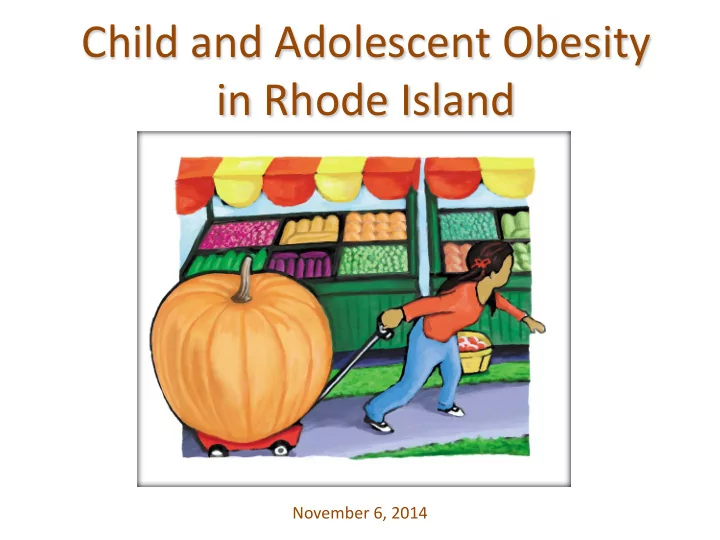
Child and Adolescent Obesity in Rhode Island November 6, 2014 - - PowerPoint PPT Presentation
Child and Adolescent Obesity in Rhode Island November 6, 2014 Special thanks to for their support of this Issue Brief And to all those who provided input Ob Obes ese: BMI at or above 95 th percentile Ov Over erwei eight: BMI between 85 th
November 6, 2014
11% reported b being o
se (7th best nationally) 16% reported b being ng o
Disparit itie ies A greater percentage of lesbian, gay, bisexual, or questioning (17%) and male (13%) students reported being
Additionally, a disproportionate number of obese high school students were male (63%).
A majority of students (regardless of BMI) were limiting screen time as recommended by the AAP, but obese and overweight students reported higher levels of longer screen time. Natio ional R l Rankin ings: Middle of the Pack RI T Trends: of TV Time; of Computer/Video Game Time
A majority of normal weight and overweight students reported being physically active 4+days/wk, while a majority of obese students reported being active 3 or less days/wk. Natio ional R l Rankin ing: 32nd for Daily Physical Activity RI T Trends: Daily Physical Activity
In Rhode Island between 2011-2013, all high school students regardless of their weight status, were equally as likely to consume too few fruits and vegetables and too much soda. Fruits & s & Vegetab ables 78% of students reported eating <5 fruits/vegetables a day RI Trends: in 5+ servings of fruits/vegetables a day Soda 22% of students reported consuming 1+ cans of soda a day RI Trends: in daily soda consumption 1+ cans of soda
Average of 100 m minu nutes per w week of Health and PE
PE is - 150 m minu nutes in elementary school 225 m minu nutes in middle and high school
well as physical activity opportunities other than PE.
improves academic achievement.
poorer academic achievement than their normal-weight peers.
Rhode Island middle and high schools are improving the nutritional quality of the foods they distribute and sell, as well as implementing a number of strategies to increase healthy food choice.
82% 82% 81% 81% 80% 80% 76% 76% 75% 75% De Decreased A d Availa ilabilit bility
nhealthy F Food
Inc ncreased P Promoti
thy F Food
90% 90% place fruits/vegetables near cashier 81% 81% use attractive fruits/vegetable displays 76% 76% serve locally/regionally grown food 51% 51% provided nutrition info to students/parents 49% 49% offer self-serve salad bar to students
towards obese/overweight youth can result in a wide range of negative outcomes.
educators, parents, the media, and others, and can have long- lasting effects, even after weight loss.
reported by 13% o
school st students 12% o
h scho hool s students
Acce ccess to to Outd tdoor R Recr creati tion S Space ce: In Rhode Island in 2011 - 19% of the total land area is dedicated to outdoor public recreation space 86% of residents live nearby (defined as either .25 miles or 5 miles away) Saf afe Plac aces t to Play ay an and B Be Ac Active: In Rhode Island in 2013 - 82% of high school students reported feeling safe when walking outside
Ac Access ss t to Heal althy Af Affordable F Food In Rhode Island in 2013 - 27% of residents live in a food desert (defined as living more than 1 mile from a supermarket, supercenter, or large grocery store in urban tracts or 10 miles in rural tracts) Proximity to to Fast F t Food
Convenience ce S Sto tores In Rhode Island in 2013 - Average of 2 fast food and convenience stores per square mile
disproportionately in rural America.
combating childhood obesity because of the availability and proximity of healthy food retailers, medical providers, public transportation, and physical activity facilities, among others.
designated 16 communities as rural/non- metropolitan.
Familie ilies
Health C Car are S Syst ystem
School
bullying/bias/stigma Child C Car are an and Af After-School Pro Progra rams
Communi unities
Data a a and C Coordinat ation
Join the Conversation on Facebook & Twitter!
Rhode Island KIDS COUNT @RIKidsCount