XL1C: Graph Times-Series Using Ratio Display 3/9/2017 V0D XL1C: V0D - - PDF document

xl1c graph times series using ratio display 3 9 2017 v0d
SMART_READER_LITE
LIVE PREVIEW

XL1C: Graph Times-Series Using Ratio Display 3/9/2017 V0D XL1C: V0D - - PDF document

XL1C: Graph Times-Series Using Ratio Display 3/9/2017 V0D XL1C: V0D XL1C: V0D Graph by Time Ratio Display Excel2013 1 Graph by Time Ratio Display Excel2013 2 Graph Time-Series Using Goal: Graph Data By Time Ratio Display in Excel 2013


slide-1
SLIDE 1

XL1C: Graph Times-Series Using Ratio Display 3/9/2017 V0D Excel2013-Graph-Ratio-Display-Slides.pdf

1

Graph by Time Ratio Display Excel2013 XL1C: V0D

1

by Milo Schield

Elected Member: International Statistical Institute (ISI) US Rep: International Statistical Literacy Project (ISLP) Vice President: National Numeracy Network (NNN) Director, W. M. Keck Statistical Literacy Project

Materials at: www.StatLit.org/pdf /Excel2013-Graph-Ratio-Display-Demo-Output.pdf /Excel2013-Graph-Ratio-Display-Slides.pdf

Graph Time-Series Using Ratio Display in Excel 2013

Graph by Time Ratio Display Excel2013 XL1C: V0D

2

Goal: Graph Data By Time Using a Ratio Display

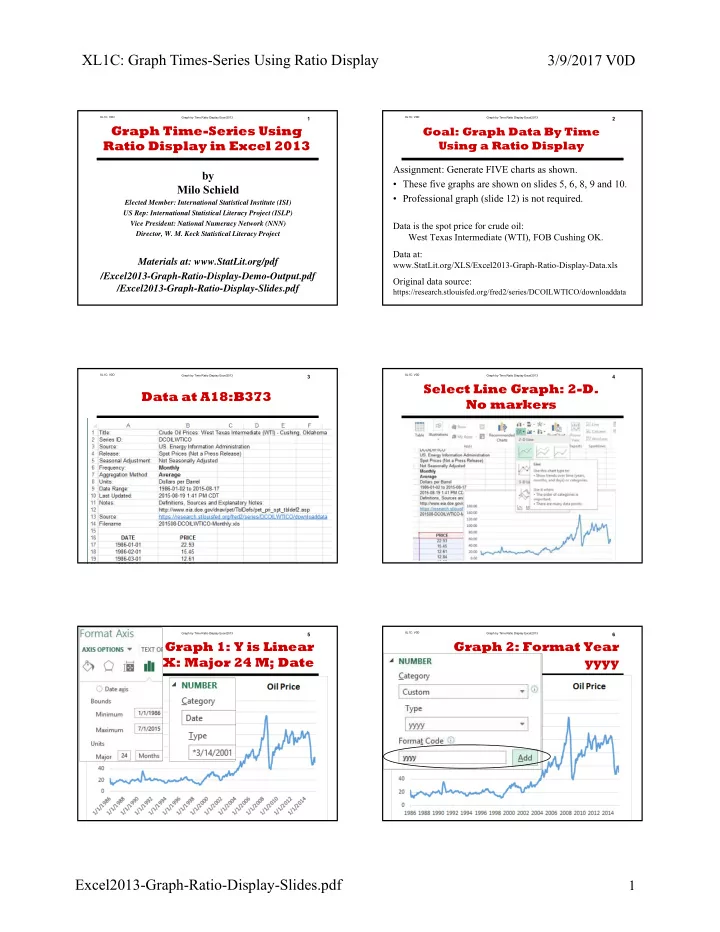
Assignment: Generate FIVE charts as shown.

  • These five graphs are shown on slides 5, 6, 8, 9 and 10.
  • Professional graph (slide 12) is not required.

Data is the spot price for crude oil: West Texas Intermediate (WTI), FOB Cushing OK. Data at:

www.StatLit.org/XLS/Excel2013-Graph-Ratio-Display-Data.xls

Original data source:

https://research.stlouisfed.org/fred2/series/DCOILWTICO/downloaddata

Graph by Time Ratio Display Excel2013 XL1C: V0D

3

Data at A18:B373

.

Graph by Time Ratio Display Excel2013 XL1C: V0D

4

Select Line Graph: 2-D. No markers

.

Graph by Time Ratio Display Excel2013 XL1C: V0D

5

Graph 1: Y is Linear X: Major 24 M; Date

.

Graph by Time Ratio Display Excel2013 XL1C: V0D

6

Graph 2: Format Year yyyy

.

slide-2
SLIDE 2

XL1C: Graph Times-Series Using Ratio Display 3/9/2017 V0D Excel2013-Graph-Ratio-Display-Slides.pdf

2

Graph by Time Ratio Display Excel2013 XL1C: V0D

7

Problem with Linear

Compare two doublings:

  • Doubling from 20 to 40 (20 points).
  • Doubling from 80 to 160 (80 points)

Second looks bigger than the first on a linear interval scale. Goal: Scale the y-axis so each doubling has the same size. Solution: Format the y-axis using a ‘ratio scale’. Ratio scale: Identical ratios (doublings) have same size. Technically, a ‘ratio scale’ is called a “logarithmic scale.”

Graph by Time Ratio Display Excel2013 XL1C: V0D

8

#3: Format Y Y axis: 10-1000 Log Base 10

.

Graph by Time Ratio Display Excel2013 XL1C: V0D

#4: Log Base 5 Y axis: 10-250

9

.

Graph by Time Ratio Display Excel2013 XL1C: V0D

10

#5: Log Base 2 Y axis: 10-160

To do: Better title, Darken Y major axis, Format Y axis darker, Extend X to 2016

Graph by Time Ratio Display Excel2013 XL1C: V0D

11

Results

US Oil since 1986. Min =10; Max = 140. Factor of 14. Use Log scale when Y data values more than double. Set base so there are 2-4 powers between min & max

  • Base 10: 10 to 1000. One power between min & max
  • Base 5: 5 to 125: One power between min & max.
  • Base 2: 10 to 160: Three powers between min & max.

Conclusion: Log scale with base 2 is preferred. Note: A professional graph (slide 12) should be easily readable from a distance and be self-explanatory.

Graph by Time Ratio Display Excel2013 XL1C: V0D

12

Professional Graph: Readable, Self-Explanatory

https://research.stlouisfed.org/fred2/ series/DCOILWTICO/downloaddata

slide-3
SLIDE 3

Graph by Time Ratio Display Excel2013 XL1C: V0D

1

by Milo Schield

Elected Member: International Statistical Institute (ISI) US Rep: International Statistical Literacy Project (ISLP) Vice President: National Numeracy Network (NNN) Director, W. M. Keck Statistical Literacy Project

Materials at: www.StatLit.org/pdf /Excel2013-Graph-Ratio-Display-Demo-Output.pdf /Excel2013-Graph-Ratio-Display-Slides.pdf

Graph Time-Series Using Ratio Display in Excel 2013

slide-4
SLIDE 4

Graph by Time Ratio Display Excel2013 XL1C: V0D

2

Goal: Graph Data By Time Using a Ratio Display

Assignment: Generate FIVE charts as shown.

  • These five graphs are shown on slides 5, 6, 8, 9 and 10.
  • Professional graph (slide 12) is not required.

Data is the spot price for crude oil: West Texas Intermediate (WTI), FOB Cushing OK. Data at:

www.StatLit.org/XLS/Excel2013-Graph-Ratio-Display-Data.xls

Original data source:

https://research.stlouisfed.org/fred2/series/DCOILWTICO/downloaddata

slide-5
SLIDE 5

Graph by Time Ratio Display Excel2013 XL1C: V0D

3

Data at A18:B373

.

slide-6
SLIDE 6

Graph by Time Ratio Display Excel2013 XL1C: V0D

4

Select Line Graph: 2-D. No markers

.

slide-7
SLIDE 7

Graph by Time Ratio Display Excel2013 XL1C: V0D

5

Graph 1: Y is Linear X: Major 24 M; Date

.

slide-8
SLIDE 8

Graph by Time Ratio Display Excel2013 XL1C: V0D

6

Graph 2: Format Year yyyy

.

slide-9
SLIDE 9

Graph by Time Ratio Display Excel2013 XL1C: V0D

7

Problem with Linear

Compare two doublings:

  • Doubling from 20 to 40 (20 points).
  • Doubling from 80 to 160 (80 points)

Second looks bigger than the first on a linear interval scale. Goal: Scale the y-axis so each doubling has the same size. Solution: Format the y-axis using a ‘ratio scale’. Ratio scale: Identical ratios (doublings) have same size. Technically, a ‘ratio scale’ is called a “logarithmic scale.”

slide-10
SLIDE 10

Graph by Time Ratio Display Excel2013 XL1C: V0D

8

#3: Format Y Y axis: 10-1000 Log Base 10

.

slide-11
SLIDE 11

Graph by Time Ratio Display Excel2013 XL1C: V0D

#4: Log Base 5 Y axis: 10-250

9

.

slide-12
SLIDE 12

Graph by Time Ratio Display Excel2013 XL1C: V0D

10

#5: Log Base 2 Y axis: 10-160

To do: Better title, Darken Y major axis, Format Y axis darker, Extend X to 2016

slide-13
SLIDE 13

Graph by Time Ratio Display Excel2013 XL1C: V0D

11

Results

US Oil since 1986. Min =10; Max = 140. Factor of 14. Use Log scale when Y data values more than double. Set base so there are 2-4 powers between min & max

  • Base 10: 10 to 1000. One power between min & max
  • Base 5: 5 to 125: One power between min & max.
  • Base 2: 10 to 160: Three powers between min & max.

Conclusion: Log scale with base 2 is preferred. Note: A professional graph (slide 12) should be easily readable from a distance and be self-explanatory.

slide-14
SLIDE 14

Graph by Time Ratio Display Excel2013 XL1C: V0D

12

Professional Graph: Readable, Self-Explanatory

https://research.stlouisfed.org/fred2/ series/DCOILWTICO/downloaddata