3D orientation Rotation matrix Fixed angle and Euler angle Axis - - PowerPoint PPT Presentation
3D orientation Rotation matrix Fixed angle and Euler angle Axis angle Quaternion Exponential map Joints and rotations Rotational DOFs are widely used in character animation 3 translational DOFs 48 rotational DOFs Each
- Rotation matrix
- Fixed angle and Euler angle
- Axis angle
- Quaternion
- Exponential map
Joints and rotations
Rotational DOFs are widely used in character animation 3 translational DOFs 48 rotational DOFs Each joint can have up to 3 DOFs
1 DOF: knee 2 DOF: wrist 3 DOF: arm
Representation of orientation
- Homogeneous coordinates (review)
- 4X4 matrix used to represent translation,
scaling, and rotation
- a point in the space is represented as
- Treat all transformations the same so that they
can be easily combined
p = x y z 1
Translation
x + tx y + ty z + tz 1 = 1 tx 1 ty 1 tz 1 x y z 1
translation matrix new point
- ld point
Scaling
sxx syy szz 1 = sx sy sz 1 x y z 1
scaling matrix new point
- ld point
Rotation
x y z 1 = cos θ − sin θ sin θ cos θ 1 1 x y z 1 x y z 1 = 1 cos θ − sin θ sin θ cos θ 1 x y z 1 x y z 1 = cos θ sin θ 1 − sin θ cos θ 1 x y z 1
X axis Y axis Z axis
Composite transformations
A series of transformations on an
- bject can be applied as a series of
matrix multiplications
p = T(x0, y0, z0)R(θ0)R(φ0)R(σ0)T(0, h0, 0)R(θ1)R(φ1)R(σ1)T(0, h1, 0)R(θ2)T(0, h2, 0)R(θ3)R(φ3)x
p θ3φ3 φ1 φ0 θ0 θ1 θ2
σ1 σ0 x0 y0 z0
p : position in the global coordinate
x : position in the local coordinate
h1 h2 h0 h3
(h3, 0, 0)
Interpolation
- In order to “move things”, we need both
translation and rotation
- Interpolation the translation is easy, but what
about rotations?
Interpolation of orientation
- How about interpolating each entry of the
rotation matrix?
- The interpolated matrix might no longer be
- rthonormal, leading to nonsense for the in-
between rotations
Interpolation of orientation
Example: interpolate linearly from a positive 90 degree rotation about y axis to a negative 90 degree rotation about y
1 1 −1 1 −1 1 1 1 1 1
Linearly interpolate each component and halfway between, you get this...
Properties of rotation matrix
- Easily composed? Yes
- Interpolate? No
- Rotation matrix
- Fixed angle and Euler angle
- Axis angle
- Quaternion
- Exponential map
Fixed angle
- Angles used to rotate about fixed axes
- Orientations are specified by a set of 3 ordered
parameters that represent 3 ordered rotations about fixed axes
- Many possible orderings
Euler angle
- Same as fixed angles, except now the axes move
with the object
- An Euler angle is a rotation about a single
Cartesian axis
- Create multi-DOF rotations by concatenating
Euler angles
- evaluate each axis independently in a set order
Euler angle vs. fixed angle
- Rz(90)Ry(60)Rx(30) = Ex(30)Ey(60)Ez(90)
- Euler angle rotations about moving axes written
in reverse order are the same as the fixed axis rotations
Z Y X
http://www.arielnet.com/adi2001/demos/007/gimballock.asp
Properties of Euler angle
- Easily composed? No
- Interpolate? Sometimes
- How about joint limit? Easy
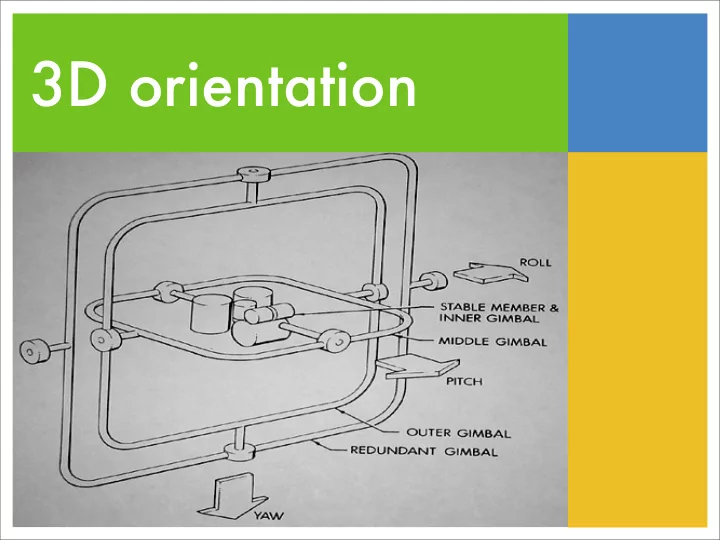
- What seems to be the problem? Gimbal lock
Gimbal Lock
A Gimbal is a hardware implementation
- f Euler angles used for mounting
gyroscopes or expensive globes Gimbal lock is a basic problem with representing 3D rotation using Euler angles or fixed angles
Gimbal lock
When two rotational axis of an object pointing in the same direction, the rotation ends up losing one degree
- f freedom
- Rotation matrix
- Fixed angle and Euler angle
- Axis angle
- Quaternion
- Exponential map
Axis angle
- Represent orientation as a vector and a scalar
- vector is the axis to rotate about
- scalar is the angle to rotate by
x y z
Properties of axis angle
- Can avoid Gimbal lock. Why?
- It does 3D orientation in one step
- Can interpolate the vector and the scalar
- separately. How?
Axis angle interpolation
B = A1 × A2 φ = cos−1 A1 · A2 |A1||A2|
- Ak = RB(kφ)A1
θk = (1 − k)θ1 + kθ2 x y z
A2 θ2 A1 θ1
Properties of axis angle
- Easily composed? No, must convert back to
matrix form
- Interpolate? Yes
- Joint limit? Yes
- Avoid Gimbal lock? Yes
- Rotation matrix
- Fixed angle and Euler angle
- Axis angle
- Quaternion
- Exponential map
Quaternion
θ2 θ1
1-angle rotation can be represented by a unit circle
(θ1, φ1) (θ2, φ2)
2-angle rotation can be represented by a unit sphere
What about 3-angle rotation?
Quaternion
4 tuple of real numbers:
w, x, y, z q = w x y z = w v
- scalar
vector
r
θ
q =
- cos (θ/2)
sin (θ/2)r
- Same information as axis angles but in a different form
Quaternion math
Unit quaternion
|q| = 1
x2 + y2 + z2 + w2 = 1
- w1
v1 w2 v2
- =
- w1w2 − v1 · v2
w1v2 + w2v1 + v1 × v2
- Multiplication
q1q2 = q2q1 q1(q2q3) = (q1q2)q3
Quaternion math
Conjugate
q∗ = w v ∗ =
- w
−v
- (q∗)∗ = q
(q1q2)∗ = q∗
2q∗ 1
Inverse
q−1 = q∗ |q| qq−1 = 1
identity quaternion
Quaternion Rotation
qp = p
- q =
- cos (θ/2)
sin (θ/2)r
- If is a unit quaternion and
q
then results in rotating about by
qqpq−1
r
θ p
proof: see Quaternions by Shoemaker
p
x y z
θ
r
Quaternion Rotation
qqpq−1 =
- w
v p w −v
- =
- w
v p · v wp − p × v
- = 0
=
- wp · v − v · wp + v · p × v
w(wp − p × v) + (p · v)v + v × (wp − p × v)
- w1
v1 w2 v2
- =
- w1w2 − v1 · v2
w1v2 + w2v1 + v1 × v2
Quaternion composition
If and are unit quaternion
q2 q1 q3 = q2 · q1
the combined rotation of first rotating by and then by is equivalent to
q1 q2
Matrix form
q = w x y z R(q) = 1 − 2y2 − 2z2 2xy + 2wz 2xz − 2wy 2xy − 2wz 1 − 2x2 − 2z2 2yz + 2wx 2xz + 2wy 2yz − 2wx 1 − 2x2 − 2y2 1
Quaternion interpolation
- Interpolation means moving on n-D sphere
θ2 θ1
1-angle rotation can be represented by a unit circle
(θ1, φ1) (θ2, φ2)
2-angle rotation can be represented by a unit sphere
Quaternion interpolation
- Moving between two points on the 4D unit
sphere
- a unit quaternion at each step - another point
- n the 4D unit sphere
- move with constant angular velocity along
the great circle between the two points on the 4D unit sphere
Quaternion interpolation
Direct linear interpolation does not work Spherical linear interpolation (SLERP)
slerp(q1, q2, u) = q1 sin((1 − u)θ) sin θ + q2 sin(uθ) sin θ
Normalize to regain unit quaternion Linearly interpolated intermediate points are not uniformly spaced when projected onto the circle
θ
Quaternion constraints
Cone constraint
θ 1 − cos θ 2 = y2 + z2 q = w x y z tan (θ/2) = qaxis w θ
Twist constraint
Properties of quaternion
- Easily composed?
- Interpolate?
- Joint limit?
- Avoid Gimbal lock?
- So what’s bad about Quaternion?
- Rotation matrix
- Fixed angle and Euler angle
- Axis angle
- Quaternion
- Exponential map
Exponential map
- Represent orientation as a vector
- direction of the vector is the axis to rotate about
- magnitude of the vector is the angle to rotate by
- Zero vector represents the identity rotation
Properties of exponential map
- No need to re-normalize the parameters
- Fewer DOFs
- Good interpolation behavior
- Singularities exist but can be avoided
Choose a representation
- Choose the best representation for the task
- input:
- joint limits:
- interpolation:
- compositing:
- rendering:
axis angle, quaternion or exponential map Euler angles
- rientation matrix ( quaternion can be
represented as matrix as well) quaternions or orientation matrix Euler angles, quaternion (harder)
Summary
- What is a Gimbal lock?
- What representations are subject to Gimbal
lock?
- How does the interpolation work in each type
- f rotations?
What’s next?
- Physics!
- Ordinary differential equations
- Numeric solutions
- Read: Quaternions by Ken Shoemake