
SLIDE 1
V2 1/3/2015 111 Ch 01-02 1
1
Programming in C
2
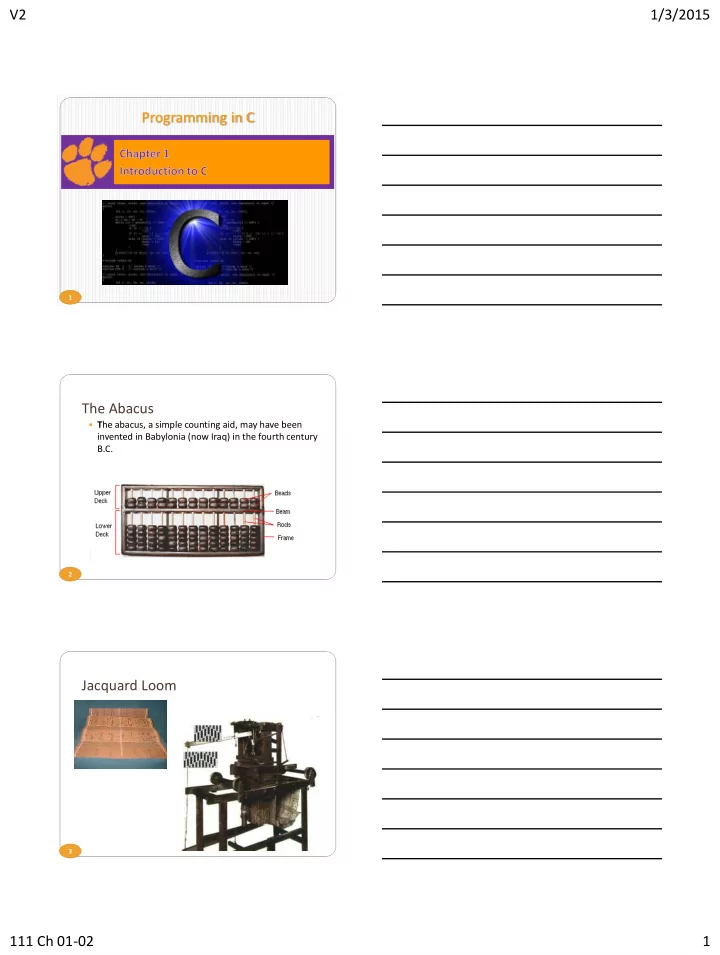
The Abacus
- The abacus, a simple counting aid, may have been
invented in Babylonia (now Iraq) in the fourth century B.C.
3
V2 1/3/2015 Programming in C 1 The Abacus T he abacus, a simple - - PDF document
V2 1/3/2015 Programming in C 1 The Abacus T he abacus, a simple counting aid, may have been invented in Babylonia (now Iraq) in the fourth century B.C. 2 Jacquard Loom 3 111 Ch 01-02 1 V2 1/3/2015 Babbage Difference Engine,
1
2
invented in Babylonia (now Iraq) in the fourth century B.C.
3
4
Babbage Difference Engine, reconstructed by the British Government in 1991.
5
Vacuum Tube 6
7
8
9
contains on it the entire CPU
Mass produced at a very low
price
Computers become smaller and
cheaper
computer on a chip, more powerful than the original ENIAC.
10
computers.” – Thomas Watson, chairman of IBM, 1943
mind will want a computer in their home.” – Ken Olson, President of Digital Equipment Corp, 1977.
11
computer (often referred to as the computer system)
12
CPU (machine) cycle – retrieve, decode, and execute
instruction, then return result to RAM if necessary
CPU speed measured in gigahertz (GHz)
Also called Memory, Main Memory, or Primary Storage Measured in gigabytes (GB, billions of bytes) today
RAM is volatile
13
14
the computer what to do
Application software - enables you to solve specific
problems or perform specific tasks.
System software - handles tasks specific to technology
management and coordinates the interaction of all technology devices
Utility software - provides additional functionality to
your operating system software
15
UNIX / Linux Windows MAC OS Palm OS Android
C, C++, Basic, Java, …
16
All but core of Unix is in C
American National Standards Institute (ANSI)
dDwtNzI3
17
18
Optionally under control
19
Editor Compiler Debugger
MS Visual C++ Xcode
20
21