
SLIDE 1
Marine . Offshore . Defence . Aviation
www.survitecgroup.com
Kevin Peters – Engineering Lead – Survitec Group Joseph Chamberlin – MEng(Student) – University Of Liverpool
Marine . Offshore . Defence . Aviation
www.survitecgroup.com
using 3D Digital Image Correlation Kevin Peters Engineering Lead - - PowerPoint PPT Presentation
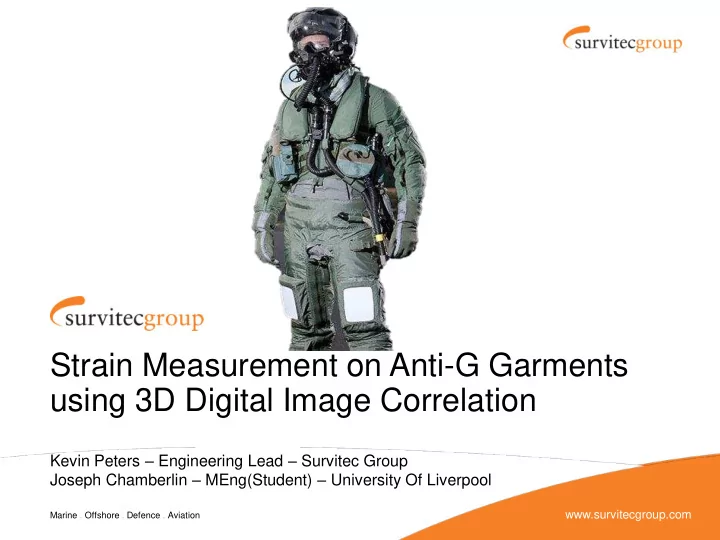
Strain Measurement on Anti-G Garments using 3D Digital Image Correlation Kevin Peters Engineering Lead Survitec Group Joseph Chamberlin MEng(Student) University Of Liverpool www.survitecgroup.com www.survitecgroup.com Marine .
Marine . Offshore . Defence . Aviation
www.survitecgroup.com
Kevin Peters – Engineering Lead – Survitec Group Joseph Chamberlin – MEng(Student) – University Of Liverpool
Marine . Offshore . Defence . Aviation
www.survitecgroup.com
Marine . Offshore . Defence . Aviation
www.survitecgroup.com
Why Anti-G Garments…
Loss Of Consciousness (GLOC) in high performance aircraft capable
manoeuvrability and higher Gz performance
accomplishment and minimizes the risk of loss of Situational Awareness (SA).
effectiveness is increased Operation benefits
reductions in:
dehydration halves tolerance at 7Gz*
taken into account when making equipment decisions
Maximising pilot performance
improved GLOC performance.
incidents since introduction of FCAGT vs. 23% of pilots experiencing GLOC previously
Marine . Offshore . Defence . Aviation
www.survitecgroup.com
Informed Design decisions
Current Approach
repeatable intrinsic properties (flame resistance, uv degradation, washing cycles)
results to the garment level as an undefined function but validated and consistent Future Approach
repeatable intrinsic properties (flame resistance, uv degradation, washing cycles) variance with
simulations by understanding the stress/ strain distribution
results to the garment level as an defined functions
real test set up
More assured requirement specifications
Marine . Offshore . Defence . Aviation
www.survitecgroup.com
Enhanced Approach
test values variance on the garment performance
strain generated in the garment
stitch and layering of the garments
with a DEFINED function to the garment performance
thermal combined with cyclic pressurization & depressurization on the Anti-G
restraints applied on the pilot
simulate the fabric, swatch and garment performance
Industry & Academia working together
Marine . Offshore . Defence . Aviation
www.survitecgroup.com
Identify viable technique to obtain full- field data on large surface areas Install ejection seats and pressure equipment from RFD in to the Laboratory Prepare garments and integrate setup with 3D DIC equipment Complete experiments and process data
Marine . Offshore . Defence . Aviation
www.survitecgroup.com
3D DIC is a full-field, non-contact technique that measures the in-plane and out-of-plane deformations
Apply a speckle pattern to the area of interest Calibrate the system, each facet in the grid contains a unique speckle pattern A reference image is taken in the specimens un- deformed state As the specimen is loaded the system tracks the movement of the facets and computes displacement
Marine . Offshore . Defence . Aviation
www.survitecgroup.com
Speckle patterns applied to areas
Fit garments on to the ATD’s and secure in to ejection seats Set up pressure line with control system and digital manometer Integrate setup with 3D DIC equipment and calibrate system Conduct 3D DIC experiments and process the data Ejection seats and pressure equipment delivered to laboratory
1 2 3 4 5 6
Marine . Offshore . Defence . Aviation
www.survitecgroup.com
Full Coverage Garment
material removed from right leg and black speckle applied
to thigh and abdomen Skeletal Garment
applied to the green
material of the thigh and abdomen area
Marine . Offshore . Defence . Aviation
www.survitecgroup.com
Pressure Increments
kPa (1 psi)
Marine . Offshore . Defence . Aviation
www.survitecgroup.com
Map
strain at 81kPa White Critical Layer
compression at safety harness and knee stitch line Green Protective Layer
Marine . Offshore . Defence . Aviation
www.survitecgroup.com
channel adjacent to knee cut out Outer Protective Layer
compression in channel adjacent to knee cut out
Marine . Offshore . Defence . Aviation
www.survitecgroup.com
Future work
data for a mature product and process the data for comparison with real test data.
knowledge built up by technology right at the concept phase of the design for an inherently better product.
improve the current design and perform the validation
Survitec benefits
management
Reduced time to market
Customer benefits
level Statement of Requirement
Marine . Offshore . Defence . Aviation
www.survitecgroup.com
Summary
pressurised anti-g garments
location affect the strain field at local areas
the garment
failure regions on the garments
data (Sanity Check)
when integrated into a system