UMBC A B M A L T F O U M B C I M Y O R T 1 - - PowerPoint PPT Presentation

umbc
SMART_READER_LITE
LIVE PREVIEW

UMBC A B M A L T F O U M B C I M Y O R T 1 - - PowerPoint PPT Presentation

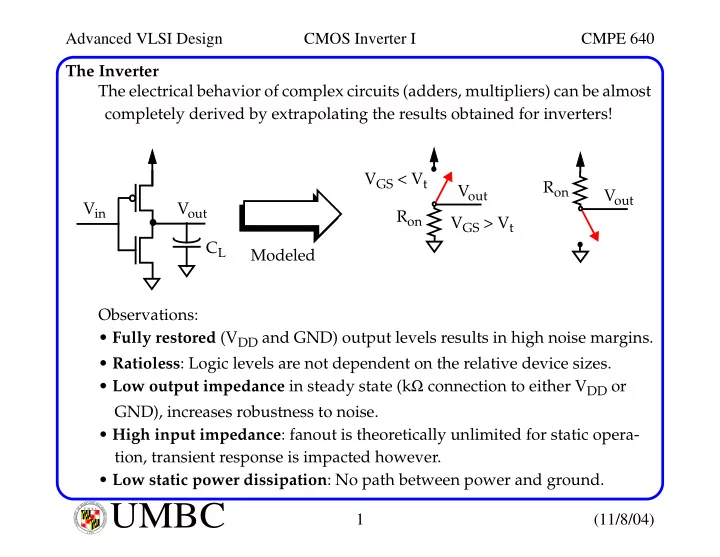
Advanced VLSI Design CMOS Inverter I CMPE 640 The Inverter The electrical behavior of complex circuits (adders, multipliers) can be almost completely derived by extrapolating the results obtained for inverters! V GS < V t R on V out V out V


slide-1
SLIDE 1

Advanced VLSI Design CMOS Inverter I CMPE 640 1 (11/8/04)

UMBC

U M B C U N I V E R S I T Y O F M A R Y L A N D B A L T I M O R E C O U N T Y 1 9 6 6

The Inverter The electrical behavior of complex circuits (adders, multipliers) can be almost completely derived by extrapolating the results obtained for inverters! Observations:

  • Fully restored (VDD and GND) output levels results in high noise margins.
  • Ratioless: Logic levels are not dependent on the relative device sizes.
  • Low output impedance in steady state (kΩ connection to either VDD or

GND), increases robustness to noise.

  • High input impedance: fanout is theoretically unlimited for static opera-

tion, transient response is impacted however.

  • Low static power dissipation: No path between power and ground.

Vout Vin CL Modeled Ron Vout Ron Vout VGS < Vt VGS > Vt

slide-2
SLIDE 2

Advanced VLSI Design CMOS Inverter I CMPE 640 2 (11/8/04)

UMBC

U M B C U N I V E R S I T Y O F M A R Y L A N D B A L T I M O R E C O U N T Y 1 9 6 6

The Inverter DC current characteristics

IDS (mA)

0.5V 1V 1.5V 2.0V 2.5V 2.0V 1.5V 1V 0.5V 0V 2.5V 0V

Here, PMOS curves have been mirrored around x and shifted. The current of the NMOS and PMOS device MUST be equal. All points are located at either the high or low output levels. Load-line plot Vout Vin 1.25V VDD 1.25V VDD NMOS sat PMOS sat NMOS lin PMOS sat NMOS lin PMOS off NMOS sat PMOS lin 0V NMOS off PMOS lin Inverter exhibits a very narrow transition zone.

slide-3
SLIDE 3

Advanced VLSI Design CMOS Inverter I CMPE 640 3 (11/8/04)

UMBC

U M B C U N I V E R S I T Y O F M A R Y L A N D B A L T I M O R E C O U N T Y 1 9 6 6

Inverter Models It is possible to approximate the transient response to an RC model. The response is dominated by the output capacitance of the gate, CL. Load capacitance, CL, is due to diffusion, routing and downstream gates. The propagation delay assuming an instantaneous input transition is RpCL. This indicates a fast gate is built by keeping either or both of Rp and CL small. Rp is reduced by increasing the W/L ratio. Bear in mind that, in reality, Rn/p is a nonlinear function of the voltage across the transistor. Rn Vout CL Rp Vout CL

slide-4
SLIDE 4

Advanced VLSI Design CMOS Inverter I CMPE 640 4 (11/8/04)

UMBC

U M B C U N I V E R S I T Y O F M A R Y L A N D B A L T I M O R E C O U N T Y 1 9 6 6

Switching Threshold Previously, we defined VM as the inverter threshold voltage but did not derive an analytical expression for it. The same is true for VIH and VIL, and consequently the noise margins (see text for this analysis). VM is defined as the intersection of the line Vin = Vout and the inverter VTC. In this region, both the NMOS and PMOS transistors are in saturation since VDS = VGS. VM (gate threshold voltage) Vin=Vout Vin Vout VTC

slide-5
SLIDE 5

Advanced VLSI Design CMOS Inverter I CMPE 640 5 (11/8/04)

UMBC

U M B C U N I V E R S I T Y O F M A R Y L A N D B A L T I M O R E C O U N T Y 1 9 6 6

Switching Threshold Therefore, the value of VM can be obtained by equating the NMOS and PMOS currents (assuming devices are velocity saturated). VM is set by the ratio r, and r compares the relative driving strengths of the PMOS and NMOS transistors. It is desirable to have r = 1, i.e., VM situated in the middle of the available voltage swing (VDD/2) to provide comparable low and high noise margins. knVDSATn VM VTn VDSATn 2

–     kpVDSATp VM VDD VTp VDSATp 2

– –     2 + VM r VTn VDSATn 2

    r VDD VTp VDSATp 2

  • +

+     + 1 r +

  • =

r kpVDSATp knVDSATn

  • υsatpW p

υsatnWn

  • =

= with Solving for VM: Further simplified: VM rVDD 1 r +

slide-6
SLIDE 6

Advanced VLSI Design CMOS Inverter I CMPE 640 6 (11/8/04)

UMBC

U M B C U N I V E R S I T Y O F M A R Y L A N D B A L T I M O R E C O U N T Y 1 9 6 6

Switching Threshold The required ratio can be determined for any value of VM using: Using a generic 0.25 µm CMOS process, this means making the PMOS 3.5 times wider than the NMOS. VM plotted as a function of the PMOS-to-NMOS ratio. W L ⁄ ( )p W L ⁄ ( )n

  • VDSATnk′n VM

VTn VDSATn 2

–     VDSATpk′p VDD VM VTp VDSATp 2

  • +

+ –    

  • =

Wp-Wn 0.1 0.8 1.2 1.6 2.0 1.0 10.0 VM (V) x scale gives the log of the ratio of PMOS and NMOS widths as the difference.

slide-7
SLIDE 7

Advanced VLSI Design CMOS Inverter I CMPE 640 7 (11/8/04)

UMBC

U M B C U N I V E R S I T Y O F M A R Y L A N D B A L T I M O R E C O U N T Y 1 9 6 6

Switching Threshold Observations from plot:

  • VM is relatively insensitive to variations in device ratio.

Small variations in the ratio (3.0 -> 2.5) do not disturb the VTC much. Industry sets the ratio of PMOS width to NMOS width to values smaller than that needed for an exact symmetry. For example, setting the ratio to 3, 2.5 and 2 yields switching thresholds

  • f 1.22 V, 1.18 V and 1.13 V, respectively.
  • Increasing the width of the PMOS or the NMOS moves VM toward VDD or

GND, respectively. This feature may be desirable in some applications, e.g., when the input signal is noisy (see text). Bear in mind that when the ratio of VDD to VT is relatively small, e.g. 2.5/ 0.4 = 6), moving VM a lot is difficult and requires very large differences in the width ratios.

slide-8
SLIDE 8

Advanced VLSI Design CMOS Inverter I CMPE 640 8 (11/8/04)

UMBC

U M B C U N I V E R S I T Y O F M A R Y L A N D B A L T I M O R E C O U N T Y 1 9 6 6

Inverter Threshold Robustness under process variations: Process variations will cause only small shifts in the transfer curve. The functionality of the gate is not effected however, and this feature has con- tributed in a big way to the popularity of the static CMOS gate.

Vout Vin 1.25V VDD

1.25V

VDD

Strong NMOS Weak PMOS Nominal Weak NMOS Strong PMOS

slide-9
SLIDE 9

Advanced VLSI Design CMOS Inverter I CMPE 640 9 (11/8/04)

UMBC

U M B C U N I V E R S I T Y O F M A R Y L A N D B A L T I M O R E C O U N T Y 1 9 6 6

Dynamic Behavior Propagation delay is determined by the time it takes to charge/discharge the load cap, CL, so it’s worth looking closely at CL before developing a delay model. Simple propagation delay models lumps all capacitances into CL. In this analysis, assume Vin is driven by an ideal voltage source with fixed rise/fall times.

Vout

Vin Cdb1 Cdb2 Cgd12 Vout2 M1 M2 M3 M4 Cw Cg3 Cg4 All cap influencing transient response

  • f node Vout.
slide-10
SLIDE 10

Advanced VLSI Design CMOS Inverter I CMPE 640 10 (11/8/04)

UMBC

U M B C U N I V E R S I T Y O F M A R Y L A N D B A L T I M O R E C O U N T Y 1 9 6 6

Dynamic Behavior Gate-drain capacitance:

  • Cgd12: Capacitance between the gate and drain of the first inverter.

M1 and M2 are either in cut-off or in saturation during the first half (up to 50% point) of the output transient. It is reasonable to assume that only M1 & M2 overlap capacitances contrib- ute. Remember, gate cap is either completely between gate/bulk (cut-off)

  • r gate/src (sat).

In the lumped model, we need to replace the Cgd12 with a capacitor to GND. The value of this capacitor is given as Cgd = 2*CGD0*W where CGD0 is

  • verlap capacitance per unit width.

Note it is doubled due to the Miller effect.

slide-11
SLIDE 11

Advanced VLSI Design CMOS Inverter I CMPE 640 11 (11/8/04)

UMBC

U M B C U N I V E R S I T Y O F M A R Y L A N D B A L T I M O R E C O U N T Y 1 9 6 6

Dynamic Behavior Diffusion capacitances:

  • Cdb1 and Cdb2: Capacitances due to the reversed biased pn-junction.

These caps are quite nonlinear (voltage dependent). We linearized these caps over the voltage range of interest: with Cj0 the junction cap/unit area under zero bias conditions. The bottom plate and sidewall zero bias values can be obtained from the SPICE model CJ and CJSW parameters. Keq was derived in an earlier lecture. Ceq KeqC j0 = Keq φ – 0

m

Vhigh Vlow – ( ) 1 m – ( )

  • φ0

Vhigh – ( )1

m –

φ0 Vlow – ( )1

m –

– [ ] =

slide-12
SLIDE 12

Advanced VLSI Design CMOS Inverter I CMPE 640 12 (11/8/04)

UMBC

U M B C U N I V E R S I T Y O F M A R Y L A N D B A L T I M O R E C O U N T Y 1 9 6 6

Example Consider a 0.25 µm 2.5 V technology and the previous inverter chain. Assume φ0 is 0.9 V for both NMOS and PMOS and m = 0.5. Let’s compute Cdb1 for the NMOS transistor. Propagation delay is computed between the 50% points. This is the time-instance when Vout reaches 1.25 V. For the high-to-low (H-to-L) transition, we linearize over {2.5 V, 1.25 V} and for the low-to-high transition over {0, 1.25 V}. H-to-L: Vout is initially 2.5 V: Vhigh = -2.5V. At 50%, Vlow = -1.25V. Keq= 0.57. L-to-H: Vout is initially 0 V: Vlow = 0. At 50%, Vhigh = -1.25 V. Keq = 0.79. Sidewall capacitance can be computed in a similar way (see text). Also, similar, but reversed, values are obtained for PMOS device. This linearized simplification has only minor effects on logic delays.

slide-13
SLIDE 13

Advanced VLSI Design CMOS Inverter I CMPE 640 13 (11/8/04)

UMBC

U M B C U N I V E R S I T Y O F M A R Y L A N D B A L T I M O R E C O U N T Y 1 9 6 6

Dynamic Behavior Wire capacitance:

  • Cw: The capacitance is dependent on the length and width of the intercon-

necting wires and is growing in importance. Gate capacitance of fan-out:

  • Cg3 and Cg4: Includes both overlap and gate capacitance of each transistor:

But what about the Miller effect? We can safely ignore it here by assuming the driven gate’s output does not change until after the 50% point of the input is reached. We also assume, with about a 10% over-estimation error, that the channel cap of the driven gate remains constant over this interval. C fan

  • ut

Cgate NMOS ( ) Cgate PMOS ( ) + = CGSOn CGDOn WnLnCox + + ( ) CGSOp CGDOp W pLpCox + + ( ) + =

slide-14
SLIDE 14

Advanced VLSI Design CMOS Inverter I CMPE 640 14 (11/8/04)

UMBC

U M B C U N I V E R S I T Y O F M A R Y L A N D B A L T I M O R E C O U N T Y 1 9 6 6

Dynamic Behavior Text gives the capacitance calculated from the layout of a two-inverter chain. Results are given as follows:

  • Overlap capacitance:

NMOS: 0.31 fF/µm PMOS: 0.27 fF/µm

  • Bottom junction capacitance:

NMOS: 2.0 fF/µm2 PMOS: 1.9 fF/µm2

  • Sidewall junction capacitance:

NMOS: 0.28 fF/µm PMOS: 0.22 fF/µm

  • Gate capacitance:

NMOS = PMOS: 6.0 fF/µm2

  • Wire capacitance:

Cwire: 0.12 fF Total load for H-to-L: 6.1 fF, for L-to-H: 6.0 fF In text, this cap is almost evenly split between intrinsic and extrinsic srcs.

slide-15
SLIDE 15

Advanced VLSI Design CMOS Inverter I CMPE 640 15 (11/8/04)

UMBC

U M B C U N I V E R S I T Y O F M A R Y L A N D B A L T I M O R E C O U N T Y 1 9 6 6

Propagation Delay: First-Order Analysis One way to compute delay is to integrate the capacitor (dis)charge current: But both CL(v) and i(v) are nonlinear functions of v. Instead, we can use a simple switch model given earlier to derive an approxi- mation. Here, both the "on" resistance and load capacitance are replaced by a constant elements, assigned average values over the region of interest. Although we didn’t cover it in class, the average "on" resistance is given by: tp CL v ( ) i v ( )

  • dv

v1 v2

= Req 1 VDD 2 ⁄

  • V

IDSAT 1 λV + ( )

  • dV

3 4

  • VDD

IDSAT

  • 1

7 9

  • λVDD

–     ≈

VDD 2 ⁄ VDD

= with IDSAT k′W L

  • VDD

VT – ( )VDSAT VDSAT

2

2

      = (see text)

slide-16
SLIDE 16

Advanced VLSI Design CMOS Inverter I CMPE 640 16 (11/8/04)

UMBC

U M B C U N I V E R S I T Y O F M A R Y L A N D B A L T I M O R E C O U N T Y 1 9 6 6

Propagation Delay: First-Order Analysis The linearized load capacitance is derived as shown previously. Propagation delay is then computed using a first-order linear RC network model: Assuming that the equivalent load cap is approximately the same for either transition. The propagation delay is the average of the two: This indicates to make rise and fall times identical, it is necessary to make the "on" resistance of the NMOS and PMOS equal. See text for a good example. tpHL 2 ( ) ln ReqnCL 0.69ReqnCL = = tpLH 2 ( ) ln ReqpCL 0.69ReqpCL = = tp tpHL tpLH + 2

  • 0.69CL

Reqn Reqp + 2

   = =

slide-17
SLIDE 17

Advanced VLSI Design CMOS Inverter I CMPE 640 17 (11/8/04)

UMBC

U M B C U N I V E R S I T Y O F M A R Y L A N D B A L T I M O R E C O U N T Y 1 9 6 6

Propagation Delay: First-Order Analysis Minimizing propagation delay amounts to:

  • Reducing CL.

Which is composed of self-loading (diffusion) (intrinsic), routing and fan-out (extrinsic) capacitance. Careful layout can reduce diffusion and interconnect caps.

  • Increase W/L ratio of the transistors.

Warning: doing so increases the self-loading and therefore CL! Once intrinsic (self-loading) cap starts to dominate the extrinsic load cap (wires + fan-out), increasing the width doesn’t help delay.

  • Increase VDD.

The delay of a gate can be modulated by modifying the supply voltage. This allows the designer to trade off energy dissipation for performance. However, rising above a certain level yields on a minor improvement. Also, reliability concerns (oxide breakdown, hot-electron effects) set firm upper bounds.