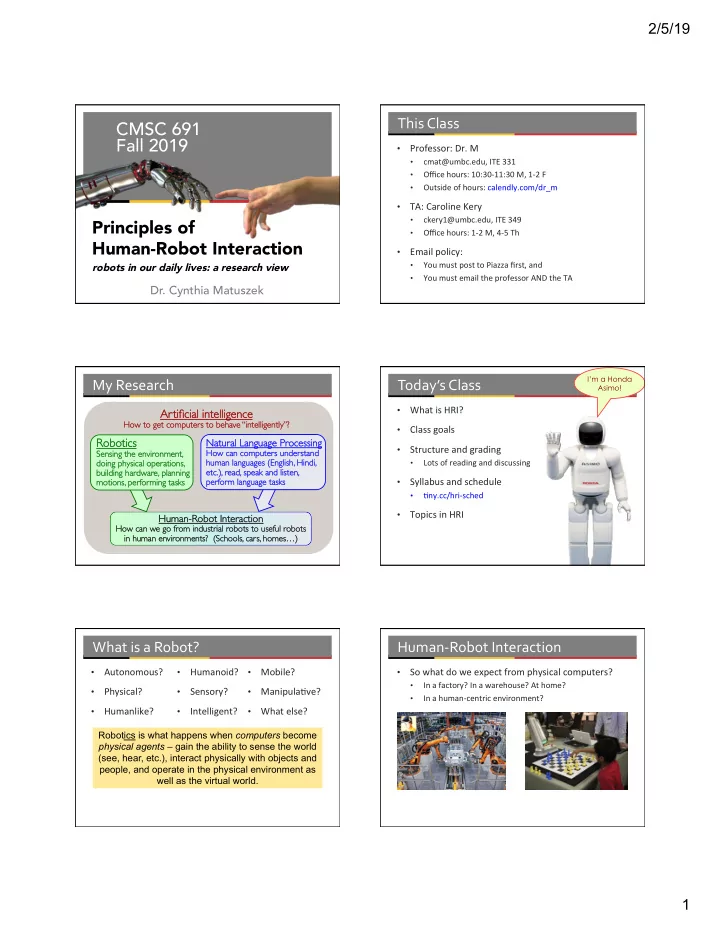
CMSC 691 Fall 2019 Professor: Dr. M cmat@umbc.edu, ITE 331 - - PDF document

cmsc 691 fall 2019
SMART_READER_LITE
LIVE PREVIEW

CMSC 691 Fall 2019 Professor: Dr. M cmat@umbc.edu, ITE 331 - - PDF document

2/5/19 This Class CMSC 691 Fall 2019 Professor: Dr. M cmat@umbc.edu, ITE 331 Office hours: 10:30-11:30 M, 1-2 F Outside of hours: calendly.com/dr_m TA: Caroline Kery ckery1@umbc.edu, ITE 349 Principles of Office


slide-1
SLIDE 1

2/5/19 1

CMSC 691 Fall 2019

  • Dr. Cynthia Matuszek

Principles of Human-Robot Interaction

robots in our daily lives: a research view

This Class

  • Professor: Dr. M
  • cmat@umbc.edu, ITE 331
  • Office hours: 10:30-11:30 M, 1-2 F
  • Outside of hours: calendly.com/dr_m
  • TA: Caroline Kery
  • ckery1@umbc.edu, ITE 349
  • Office hours: 1-2 M, 4-5 Th
  • Email policy:
  • You must post to Piazza first, and
  • You must email the professor AND the TA

My Research

Ar Artificia ificial l in intellig elligen ence ce

How w to

  • get

et comp computer ers s to

  • beh

ehave e “in “intellig elligen ently”? y”?

Na Natural l Language e Processin rocessing

How w ca can comp computer ers s under erst stand huma man la languages es (E (English lish, Hin indi, i, et etc.), ), rea read, sp spea eak and list listen en, perf erfor

  • rm

m la language e task sks

Rob

  • bot
  • tics

ics

Sen ensin sing the e en environ ironmen ment, doin

  • ing physica

ysical l op

  • per

eration ions, s, build ildin ing hard rdwa ware re, pla lannin ing mot motion ions, s, perf erfor

  • rmin

ming task sks

Huma man-R

  • Rob
  • bot
  • t In

Inter eract ction ion

How w ca can we e go

  • from

rom in indust stria ial l rob robot

  • ts

s to

  • usef

seful l rob robot

  • ts

s in in huma man en environ ironmen ments? s? (S (Sch chools,

  • ols, ca

cars, s, homes…)

  • mes…)

Today’s Class

  • What is HRI?
  • Class goals
  • Structure and grading
  • Lots of reading and discussing
  • Syllabus and schedule
  • Zny.cc/hri-sched
  • Topics in HRI

I’m a Honda Asimo!

What is a Robot?

  • Autonomous?
  • Physical?
  • Humanlike?
  • Humanoid?
  • Sensory?
  • Intelligent?
  • Mobile?
  • ManipulaZve?
  • What else?

Robotics is what happens when computers become physical agents – gain the ability to sense the world (see, hear, etc.), interact physically with objects and people, and operate in the physical environment as well as the virtual world.

Human-Robot Interaction

  • So what do we expect from physical computers?
  • In a factory? In a warehouse? At home?
  • In a human-centric environment?
slide-2
SLIDE 2

2/5/19 2 Goals of This Course

  • Understand HRI
  • What is the field about?
  • Why is it important?
  • Introduce (some of) the huge range of current HRI

research

  • Gain experience conducZng HRI research
  • Learn to idenZfy HRI problems in your own research
  • Find out whether HRI and roboZcs are for you
  • One semester-long project
  • Thinking, implemenZng, wriZng, and presenZng

the H and the R

Class Structure

  • This is mostly a seminar class
  • Reading and discussing research papers
  • Per lecture:
  • Read ~2 papers
  • One person will sign up to present and lead discussion
  • Everyone will read and discuss
  • Journal about papers and topics
  • No exams
  • Project milestones are the only assignments

This is a lot of reading!

Journals

  • One entry per person, per topic (lecture)
  • Post on the Piazza thread:
  • 1. Read the papers
  • 2. Read the thread so far
  • 3. Post something new
  • Summary, quesZon, answer

to a quesZon, …

  • Usually 1-2 paragraphs
  • You will visit these every class:
  • Zny.cc/hri-sched

Zny.cc/hri-piazza

The Schedule

Read these and post before that class day

Expectations

  • Do the reading.
  • This is a seminar class!
  • A=end.
  • You must agend for the

en>re semester.

  • Par>cipate.
  • Do journal assignments consistently and on Zme
  • ParZcipate ac>vely in class discussions
  • Let other people parZcipate, and

listen agenZvely

  • Ask quesZons!

Classroom Policies

  • Be courteous to classmates and instructors.
  • No devices in use except when specified.
  • You don’t learn as much.
  • People around you don’t learn as much.
  • Read Zny.cc/devices-in-class, then ask to talk about it
  • No food in class.
slide-3
SLIDE 3

2/5/19 3 Academic Integrity

  • Instructor’s responsibiliZes:
  • Be respecjul
  • Be fair
  • Be available
  • Students’ responsibiliZes:
  • Be respecjul
  • Do not cheat, plagiarize, or lie, or help anyone else do so
  • Do not interfere with other students’ academic acZviZes

Academic Integrity Policy

  • “By enrolling in this course, each student assumes the

responsibilities of an active participant in UMBC’s scholarly community, in which everyone’s academic work and behavior are held to the highest standards of

  • honesty. Cheating, fabrication, plagiarism, and

helping others to commit these acts are all forms of academic dishonesty, and they are wrong. Academic misconduct could result in disciplinary action that may include, but is not limited to, suspension or dismissal.”

[UMBC’s Undergraduate Council and Provost’s OfEice]

Academic Integrity Policy

  • “By enrolling in this course, each student assumes the

responsibilities of an active participant in UMBC’s scholarly community, in which everyone’s academic work and behavior are held to the highest standards of

  • honesty. Cheating, fabrication, plagiarism, and

helping others to commit these acts are all forms of academic dishonesty, and they are wrong. Academic misconduct could result in disciplinary action that may include, but is not limited to, suspension or dismissal.”

[UMBC’s Undergraduate Council and Provost’s OfEice]

Summary version, as this is an advanced class – Integrity is cultural. Know what it means. – ANY copying is plagiarism, even a sentence. – Syllabus has more. Read it!

Integrity: Penalties

  • PenalZes depend on the offense
  • The minimum penalZes are:
  • 5% off your final grade
  • Being required to redo the assignment,

without credit, in order to pass

  • AddiZonal penalZes may include:
  • Receiving a full grade reducZon in the class
  • Failing the class without possibility of dropping it
  • Suspension or expulsion from the university

Samples of Project Types

  • EvaluaZon of human factors
  • In-person or crowd-sourced user studies
  • StaZsZcal analysis
  • Novel HRI system
  • Robot is doing something new and different
  • The “human” element can be environmental
  • PercepZon and manipulaZon
  • Pure research
  • AcZve learning from human interacZon

Project Milestones (Roughly)

  • 1. Research quesZon
  • 2. User study design
  • 3. Technical implementaZon and first demo
  • 4. User study analysis
  • 5. PresentaZon to professor
  • 6. Write-up
  • 7. Final PresentaZons
slide-4
SLIDE 4

2/5/19 4 HRI Topics

  • Expression and Gaze
  • PerspecZve-taking
  • Systems Engineering
  • Shared Autonomy
  • Exoskeletons
  • AssisZve RoboZcs
  • EducaZonal RoboZcs
  • Proxemics
  • Expressive MoZon
  • Speech
  • PercepZon
  • InteracZon Design
  • ManipulaZon
  • Decision-making
  • Mental Models
  • Remote Presence
  • Social Learning
  • CommunicaZon

Some High-Level Topics

  • Where will we begin seeing robots?
  • What is a “Human-centric environment”? Task?”
  • And how is it relevant to robots?
  • Social robots
  • How can robots be social beings? When do we want them to?
  • How can robots express emoZon – and (when) should they?
  • Human-robot collaboraZon – how and when?
  • AssisZve robots – helping people with special needs
  • Robot ethics – what should and shouldn’t robots do?

What is HRI?

  • It is an applica>on area

Slides adapted from Reid Simmons & Illah Nourbakhsh

What is HRI?

  • It is a field of inquiry

Slides adapted from Reid Simmons & Illah Nourbakhsh

What is HRI?

  • It is work on a boundary

Slides adapted from Reid Simmons & Illah Nourbakhsh

For Next Class

Read this ar>cle through chapter 5:

  • hgp://Zny.cc/goodrich-survey
  • I will lead the next discussion
  • Read the syllabus
  • hgp://Zny.cc/hri-syllabus
  • Read the academic integrity page
slide-5
SLIDE 5

2/5/19 5 What Should They Do?

  • Robots are moving away from factory floors to…
  • Entertainment, toys
  • Homes (personal roboZcs)
  • Medical, surgery
  • Industrial automaZon (mining, harvesZng, warehouses, …)
  • Hazardous environments (space, underwater, baglefields, …)
  • Roads
  • Research Trends
  • ManipulaZon of everyday objects
  • Complex household tasks
  • Object recogniZon, mapping, interacZon
  • Human robot interacZon
slide-6
SLIDE 6

2/5/19 6