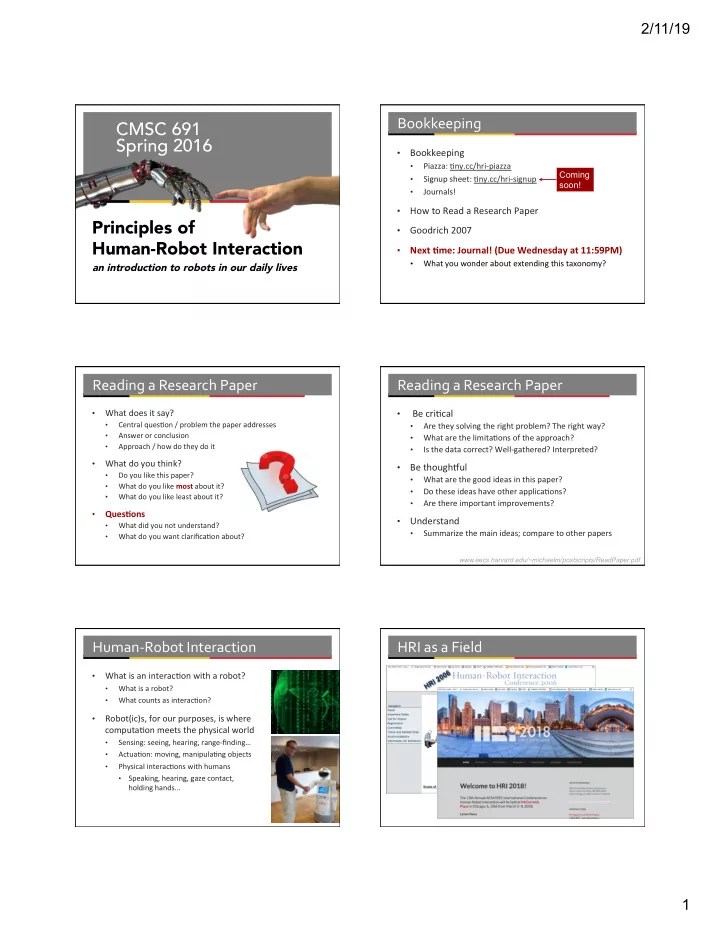
CMSC 691 Spring 2016 Bookkeeping Piazza: .ny.cc/hri-piazza - - PDF document

cmsc 691 spring 2016
SMART_READER_LITE
LIVE PREVIEW

CMSC 691 Spring 2016 Bookkeeping Piazza: .ny.cc/hri-piazza - - PDF document

2/11/19 Bookkeeping CMSC 691 Spring 2016 Bookkeeping Piazza: .ny.cc/hri-piazza Coming Signup sheet: .ny.cc/hri-signup soon! Journals! How to Read a Research Paper Principles of Goodrich 2007 Human-Robot


slide-1
SLIDE 1

2/11/19 1

CMSC 691 Spring 2016

  • Dr. Cynthia Matuszek

Principles of Human-Robot Interaction

an introduction to robots in our daily lives

Bookkeeping

  • Bookkeeping
  • Piazza: .ny.cc/hri-piazza
  • Signup sheet: .ny.cc/hri-signup
  • Journals!
  • How to Read a Research Paper
  • Goodrich 2007
  • Next &me: Journal! (Due Wednesday at 11:59PM)
  • What you wonder about extending this taxonomy?

Coming soon!

Reading a Research Paper

  • What does it say?
  • Central ques.on / problem the paper addresses
  • Answer or conclusion
  • Approach / how do they do it
  • What do you think?
  • Do you like this paper?
  • What do you like most about it?
  • What do you like least about it?
  • Ques&ons
  • What did you not understand?
  • What do you want clarifica.on about?

Reading a Research Paper

  • Be cri.cal
  • Are they solving the right problem? The right way?
  • What are the limita.ons of the approach?
  • Is the data correct? Well-gathered? Interpreted?
  • Be thoughSul
  • What are the good ideas in this paper?
  • Do these ideas have other applica.ons?
  • Are there important improvements?
  • Understand
  • Summarize the main ideas; compare to other papers

www.eecs.harvard.edu/~michaelm/postscripts/ReadPaper.pdf

Human-Robot Interaction

  • What is an interac.on with a robot?
  • What is a robot?
  • What counts as interac.on?
  • Robot(ic)s, for our purposes, is where

computa.on meets the physical world

  • Sensing: seeing, hearing, range-finding…
  • Actua.on: moving, manipula.ng objects
  • Physical interac.ons with humans
  • Speaking, hearing, gaze contact,

holding hands...

HRI as a Field

slide-2
SLIDE 2

2/11/19 2 Design Axes to Consider

  • Autonomy (or “neglect tolerance”)
  • Can it func.on by itself?
  • Informa.on Exchange
  • Who knows what, when?
  • Team Structure
  • Humans, robots, so^ware agents…
  • Adapta.on and Learning
  • “Shape of the Task”

Sometimes we don’t care! Do we need to know what it does, and vice versa? Harder than autonomy When shouldn’t a robot learn?

Competitions and Areas

  • Driving
  • Search & Rescue
  • Useful near-term
  • Hors d’oeuvres, anyone?
  • Crowd naviga.on, direct social interac.on
  • Assis.ve Robo.cs
  • Social, physical, and cogni.ve support
  • Vulnerable popula.ons
  • Space and Extreme Condi.on Robo.cs
  • Extreme opera.ng condi.ons
  • Par.al, delayed, or no communica.on

Robocup Search and Rescue

  • fewkahbc

Search and Rescue Space Robots

Valkyrie, NASA Curiosity, NASA Mars InSight, NASA Dextre, Canadian

Assistive Robotics

HAL exoskeleton: construc.on, disaster response www.youtube.com/watch?v=Zd9WhJPa2Ok www.enablemart.com/obi-feeding-device

slide-3
SLIDE 3

2/11/19 3 Assistive Robotics

Cyberdyne rehab exoskeleton

Assistive Wheelchairs

www.youtube.com/watch?v=t2SHKyq5yCU- Chiba group

Assistive Robotics

RIBA-II Transfer Robot

Assistive Robotics

Casper Cognitive/Social Assistant

Assistive Robotics

Intelligent System Corporation PARO social robot

Social Robotics

Leonardo, Personal Robot Group, MIT

slide-4
SLIDE 4

2/11/19 4 Types of Interaction

  • Non-interac.ve work
  • S.ll doing tasks for humans
  • Teleopera.ng
  • Supervising
  • Correct errors, give low-level instruc.ons
  • Providing goals
  • From “Pick up the block” to “Cook dinner”
  • Non-supervisory interac.ons
  • With people
  • In environments (e.g., cleaning)

Low High Interaction Directness

Types of Interaction

  • Engineering:
  • Building, maintaining, (re)programming
  • Teleopera.ng
  • Supervising
  • Correct errors, give low-level instruc.ons
  • Providing goals
  • From “Pick up the block” to “Cook dinner”
  • Non-supervisory interac.ons
  • With people
  • In environments (e.g., cleaning)

Low High Autonomy There are a number of formal autonomy scales!

System Design

  • How autonomous should (this) robot(s) be?
  • What kind of group is the robot in?
  • Other robots? Humans?
  • How is it structured? Who’s in charge?
  • Informa.on management
  • Who knows what? Is it transferred?
  • How adap.ve or predefined is the task?
  • What is the task or task domain?

Autonomy

  • How autonomous should this robot(s) be?
  • For what kind of interac.on?
  • What is the target problem(s)?
  • Are their human collaborators?
  • Par.al; full; social; correctable; hap.c; feedback; …
  • What kind of autonomy?
  • Goal-based
  • Behavior-based
  • Probabilis.c

In practice, these are incredibly high-level simpli6ications of all of arti6icial intelligence – but useful!

Information Exchange

  • Who knows what? Who needs to know what?
  • When informa.on transferred:
  • When exactly?
  • From whom to whom?
  • How slow? How costly?
  • How informa.on is transferred:
  • Using what media?
  • In what format? (Scripted, one-way, free?)
  • Do you need a cogni.ve model
  • f the agents?

Many human- robot interactions can also be human- human, robot- robot, or a more complex

  • mix. This is

why I often say agent.

Information Exchange (II)

  • The medium
  • Seeing
  • Hearing
  • Touch

“Put the pot here and hand me the sugar, please” OKAY

slide-5
SLIDE 5

2/11/19 5 Group Makeup

  • Humans and robots
  • 1-1, many-many, 1-many, many-1, 1-0, 0-many, …
  • Related to autonomy, task
  • Who has authority? Who has responsibility?
  • When does the human not have pure authority?
  • Timing? Task-based?
  • What is op.mal?

Autonomy Authority

Adaptation

  • What can be learned?
  • Task domain; task ac.ons
  • Changes over .me
  • Communica.on style and kind
  • Authority and communica.on flow
  • What can change?
  • The task? The authority? Agent capabili.es?
  • Over what span of .me?
  • In response to what informa.on?
  • What agent(s) should do the learning?

Progressively more!

  • Search & Rescue
  • Assis.ve Robo.cs
  • Transfer
  • Social
  • Wheelchair
  • Space/Extreme

Condi.ons

  • Surgical
  • Hors d’oeuvres, anyone?

Practical Discussion

  • Autonomy
  • Group Structure
  • Informa.on exchange
  • Adapta.on and Learning