
SLIDE 1
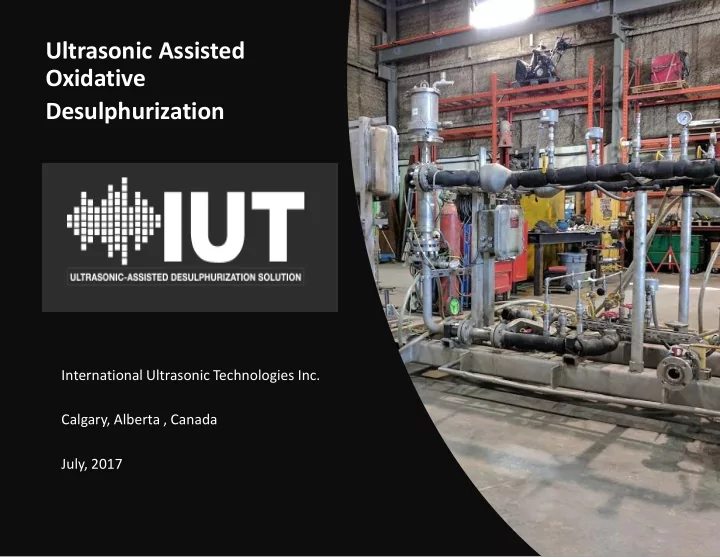
Ultrasonic Assisted Oxidative Desulphurization
International Ultrasonic Technologies Inc. Calgary, Alberta , Canada July, 2017
Ultrasonic Assisted Oxidative Desulphurization International - - PowerPoint PPT Presentation
Ultrasonic Assisted Oxidative Desulphurization International Ultrasonic Technologies Inc. Calgary, Alberta , Canada July, 2017 Executive Summary IUT is a private company based in Calgary, Alberta Canada, developing and commercializing a
International Ultrasonic Technologies Inc. Calgary, Alberta , Canada July, 2017
commercializing a proprietary ultrasonic-assisted oxidative desulfurization (“UAOD”) technology.
sulfur content in refined oil products by at least 97%.
gas liquids (NGL), gasoline, kerosene and diesel, reducing the Sulphur content to 10 parts per million (ppm) or less, meeting or exceeding the ultra low sulfur (ULS) transportation fuel standards of most countries.
and market our technology.
Country/Application Fuel Current Regulations 2020 Regulations Canada/US Diesel 30ppm 15 ppm Gasoline 30ppm 10 ppm China Diesel/Gasoline 50 ppm 5 ppm India Diesel 50 ppm 10 ppm Africa Diesel/Gasoline 50 ppm 10 ppm Europe Diesel/Gasoline 10 ppm 10 ppm Marine Shipping Heavy Fuel Oil (HFO) 3.5% (35,000 ppm) .5% (5,000 ppm)
increases sulfur conversion efficiency with very low residence times (<500 ms).
xhibit high solubility in water allowing for easy separation of the sulfur from the hydrocarbon stream.
processing separation, removal of the oxidized sulfur compounds can be achieved via a basic water wash.
sulfur content of 10 ppm and potentially less
hydrodesulphurization (“HDS”)
Oxidation and Ultrasonic Processing Phase Separation Adsorption and solvent regeneration (used only for
more complex aromatic sulfur compounds)
scale trials reduced sulfur in Natural Gasoline from 150-500 ppm to less than 12 ppm
$1.00/bbl.
S H H CH 3 H H H CH 3 H H H CH 3 H H H CH 3 H H H H H H H H H
+ H 2 S + 5 H 2
P > 800 psi T > 650 F
S S O O + Oxidant
Catalyst Δ T
+ 2 H 2 O
DBT DBTS
Dibenzothiophene Dibenzothiophene Sulfone
Traditional HDS
IUT ODS Hydrogen addition Yes No Pressure 2000 PSI 50 PSI or less Temperature 300-400o C 80o C or less Equipment cost $12,000/barrel/day 25% or less of HDS Operating costs $4-5/bbl. $ 1.5 / bbl. Movable No Yes Modular and capacitive No Yes Removal
compounds Less effective removal of Sulphur in cyclic compounds Effective with all Sulphur compounds Operation Complex, several operators Simple, 1 to 2 operators Effect on octane/cetane number Reduced No effect
Refiners Crude Producers Shipping Industry Power Generation
sulfur content in marine fuel to be reduced from the current 3.5% to no more than 0.5% worldwide starting in 2020. More stringent requirements is now imposed in Europe - 0.1% of Sulphur.
ports/terminals worldwide that serve as a potential market.
– Catalyst poisoning of the residual fuel by heavy metals – Less efficient (can only achieve ~1% sulfur) – Very costly.
– No risk of catalyst poisoning – Efficient – can achieve <5ppm – Inexpensive, modular and relatively easy to implement
developing market for hydrocarbon fuel desulphurization
(gasoline, naphtha, diesel, marine fuel, etc.)
demonstrated effectiveness of process, scalability and commercial readiness