SLIDE 1
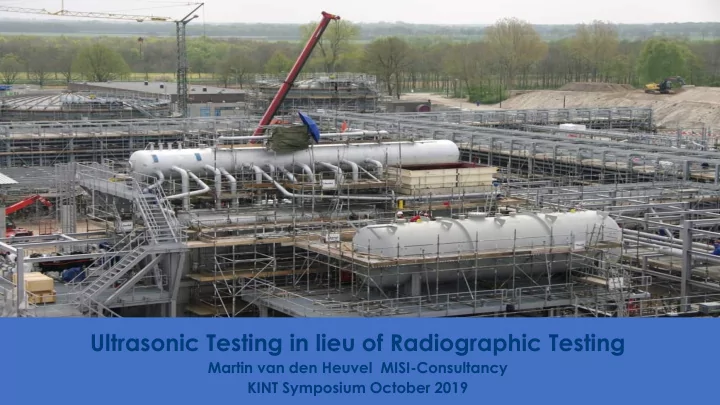
Ultrasonic Testing in lieu of Radiographic Testing
Martin van den Heuvel MISI-Consultancy KINT Symposium October 2019
SLIDE 2
Agenda
Ultrasonic Testing in lieu of Radiographic Testing: ‘UT ilo RT’
▪
NIL Thin Plate
▪
Innovation in NDT The case for change
▪
Why use UT ilo RT
▪
Suitable UT Techniques Business Cases
▪
Project
▪
Maintenance Way forward
▪
Collaboration
SLIDE 3 UT in lieu of RT: historic information
NIL Thin Plate project 1992 Objectives
▪
To assess the reliability of mechanized ultrasonic inspection. in comparison with the 'standard' non-destructive inspection techniques (i.e. standard radiography and manual UT) for detection of defects in welds in steel plate in the wall thickness range 6-15 mm.
▪
To contribute to the development of suitable acceptance/rejectance criteria and, if necessary, initiate their implementation criteria in national and international regulations on non-destructive testing Conclusion
▪
The detection reliability of mechanized ultrasonic testing techniques is at least as good as but usually better than that of conventional non-destructive testing techniques such as manual ultrasonic testing and standard radiography.
Improvements since 1992
▪
Mechanized (PA)UT is standardized and thus reliable Automated UT (AUT) and semi-automated UT with encoded scan enables permanent record keeping of UT inspection data
▪
Data storage is now common practice
SLIDE 4
Innovation in NDT (These Wassink 2012)
Key points
▪
It takes a long time to develop and implement changes in NDT applications
▪
Collaboration of all parties is key, the Cyclic Innovation Model is a way to shorten the time
▪
Entrepreneurs are needed to make it a success
SLIDE 5
Why use RT in lieu of UT
RT in lieu of UT? Historic performance, we have done it so many years with good outcomes
▪
Large capacity of experienced inspectors
▪
Common practice, less preparation needed, flexible in application
▪
Cheaper teams and equipment compared to UT
▪
Less limitations on geometry/size versus UT
New developments in (digital) radiography
▪
Fast films
▪
Lower radiation exposure and shorter distances
▪
Digital imaging and filing
SLIDE 6
Field weld inspection
▪
Plot clearance is required → delay for construction
▪
Long backlog of inspection work and feedback to welders
▪
No opportunity for welders to improve on weld quality!
▪
RT quality issues when gamma radiation is used, (3mm double wall, 160 KeV X-ray. Ir 480 KeV, Se 200 KeV) Shop weld inspection RT is either done:
▪
In the night → backlog + delay construction
▪
In a bunker → logistics RT inspection is slow RT uses radiation: major HSSE risk → plot clearance / bunker RT is not sensitive to planar defects
Why use UT in lieu of RT
SLIDE 7 Production Schedule
▪
No plot clearance required, welding can continue
▪
Fast inspection (20-40 welds per shift) → no backlog HSSE risks
▪
No radiation risks Quality
▪
No backlog: direct feedback to welders
▪
Improved quality: finds critical planar defects
Mechanised and Encoded UT solves these issues:
RT: no direct feedback UT: direct feedback, dropping rejection due weld quality Time Rejection rate
SLIDE 8
Suitable UT technologies TOFD (PA)UT
SLIDE 9 Time Of Flight Diffraction (TOFD)
Advantages
- High POD and low False call rate
- High Accuracy of Flaw Location and Flaw Sizing
- All inspection Results/Data is Digitized and Stored and can be
Recalled and Processed for In-Service Inspection
- Most efficient for inspection of thick-walled vessels where X &
Gamma ray would have difficulties Limitations
- Difficult for thin welds <9mm thickness.
- Sizing of shallow crack close to the inspection surface is less
accurate → use surface methods
- Need access to both side of the weld.
- Difficult/impossible for coarse grain materials
SLIDE 10 Mechanised PAUT
Advantages
- Array transducer enables beam steering and focusing.
- Beam steering enables inspection from one probe location rather than raster
scan
- Beam focusing enables increased sensitivity for small defects
- More user friendly and versatile signal display(C scan, B scan, A scan, Sector
scan) for defect location, characterization, and sizing.
- All inspection Results/Data can be digitized and stored so that the
permanent record can be kept. Limitations
- Equipment pricing is relatively higher
- Need more extensive operator training
- Difficult for coarse grained materials
SLIDE 11
Examples in this conference
Day 1
▪ Doosan Babcock: Applications with qualifications conform ENIQ criteria ▪ TUV Rheinland Sonovation: project on thin walled stainless steel,
significant savings
Day 2
▪ Gasunie: how UT ilo RT was implemented and is now common practice ▪ Olympus: This walled heat exchanger tubes ▪ Many technical presentations with background information to help
understand the technological opportunities and restrictions
▪ Several companies will present their strategic approach
SLIDE 12 Application case Prelude
Outcomes UT in lieu of RT:
- 100.000 inspected piping field welds on Prelude, of which:
- 50% was 100% inspection scope
- 50% was 10% inspection scope
UT in lieu of RT was applied for:
- 2000 carbon steel welds
- 60 stainless steel welds
Only 2% of total scope !
- GAP between opportunity <-> realization
SLIDE 13
UT ilo RT for Piping
SLIDE 14 The business case for projects
- Significant reduction of QA/QC time
- Direct feedback to the welder
- Cost savings
- Direct cost per weld
- Logistics for piping
- 24 hrs/day available for welding and NDT
- If UT inspection is considered in the design stage the outcome
also enhances capability for in service inspection.
- Improves life cycle safety and cost of inspection. Eg root
corrosion of welds
SLIDE 15 Application case Steam Boiler repair
Situation
- Overhaul of internals in steam boiler, Low alloy steel, 1”-2”diameter and 3.4mm –
11mm wall thickness, thousands welds in scope
- RT scope on critical path, enormous impact on schedule
- PAUT knowledge available
- Regulator agreed with deviation from code which required RT inspection →
qualification needed
- Time required before overhaul starts
Impact
- 1 (of 5) month construction time reduction
- Significant cost saving, Lower HSSE risk
- Qualification can be replicated and re-used
SLIDE 16 Implementation
- Increase the knowledge of QA/QC staff of end users
- Explain business cases, simple showcases, gain (€) support for qualifications
- Development of standards with acceptance criteria
- Collaboration between end users and technology suppliers
SLIDE 17 Thank you for your attention
Martin van den Heuvel Principal Asset Management Consultant MISI: Maintenance and Inspection Strategic Improvement Zuiderstraat 17 9444 PJ Grolloo
www.MISI-Consultancy.nl martin.vandenheuvel@misi-consultancy.nl