
SLIDE 1
SEIKA Optimal Cleaning Performance TOP Ultrasonic Cleaning Head - - PowerPoint PPT Presentation
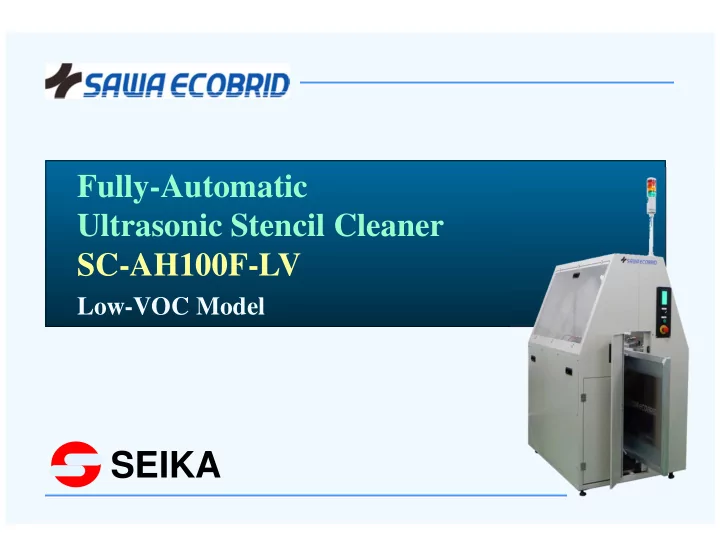
Fully-Automatic Ultrasonic Stencil Cleaner SC-AH100F-LV Low-VOC Model SEIKA Optimal Cleaning Performance TOP Ultrasonic Cleaning Head Shower Pipe Two ultrasonic cleaning head panels clean both the front Ultrasonic and back sides of the
Shower Pipe Ultrasonic Cleaning Head Suction Nozzle
TOP BOTTOM
Cleaning unit
Without stencil With stencil
Stencil moves up and down. Two ultrasonic cleaning head panels clean both the front and back sides of the metal stencil simultaneously. Ultrasonic energy is applied directly to the stencil providing superior cleaning capability. The ultrasonic cleaning and vacuum drying system work simultaneously. It takes 5 to 10 minutes to complete the combined process of cleaning and drying resulting in reduced energy consumption.
Ultrasonic Cleaning Head
Simultaneous Cleaning & Drying Operation Metal Stencil
Fast Tact Time Low-Running Costs
With the Sawa EcoBrid, the cleaning agent is applied to the stencil area only, vacuum- dried, and then recycled (including filtering). Therefore, only a small amount of agent is used for cleaning. Other types of systems (dipping and spray types) require large amounts
No Deterioration of Stencil
The ultrasonic cleaning and vacuum drying system work simultaneously to complete within five to ten minutes.
Sawa EcoBrid SC-AH100F-LV
The adhesive area of the stencil is not affected by usage of cleaning agent with Sawa EcoBrid. Delamination will not occur no matter how
Powerful Cleaning Capability Reduction of CO2 Emission
Sawa EcoBrid SC-AH100F-LV reduces energy consumption due to the shortened tact time and accordingly reduces CO2 emissions.
Low-VOC Cleaning Agent
Low-VOC cleaning agent, VIGON SC200 can be used for Sawa EcoBrid SC-AH100F-LV. There is no flash point, low evaporation and almost no odor. A good working environment can be maintained.
Ease of Operation
Just press the start button and the process of cleaning and drying will be completed. No operator handling is required. Two ultrasonic cleaning head panels clean both the front and back sides of the metal stencil simultaneously. Ultrasonic energy is applied directly to the stencil providing superior cleaning capability.
QFP 0.4㎜
Flip chip bump φ0.2㎜
0402(01005) QFP 0.4㎜
Flip chip bump φ0.2㎜
0402(01005)
Squeegee/spatula cleaner can be connected as an option.
Squeegee Cleaner
SC-145A
Adaptor for 550 x 650 mm (21.65 x 25.59 in) stencil
Adaptor
Compact Machine Footprint Ergonomic Stencil Insertion
Output Terminal Maintenance
Easy Replacement
* Signal tower is an optional item.
P F
Pump Filter Motor Stencil Solvent Spray
Spray-Type
Cleaning Tank Solvent Metal Stencil
Ultrasonic Generator Ultrasonic Transducers
Cavitations Tank-Type
Frequent solvent change-out is required to maintain good cleaning capability.
Cavitation?
Cavitation is the formation of empty cavities in solvent caused by disuniform ultrasonic waves. Shock waves that occur by cavitation bubbles impinging against an object can damage to the adhesives of the stencil.