Dry-ice (CO 2 -snow) Cleaning - Motivation - Cleaning mechanism, - - PowerPoint PPT Presentation

dry ice co 2 snow cleaning
SMART_READER_LITE
LIVE PREVIEW

Dry-ice (CO 2 -snow) Cleaning - Motivation - Cleaning mechanism, - - PowerPoint PPT Presentation

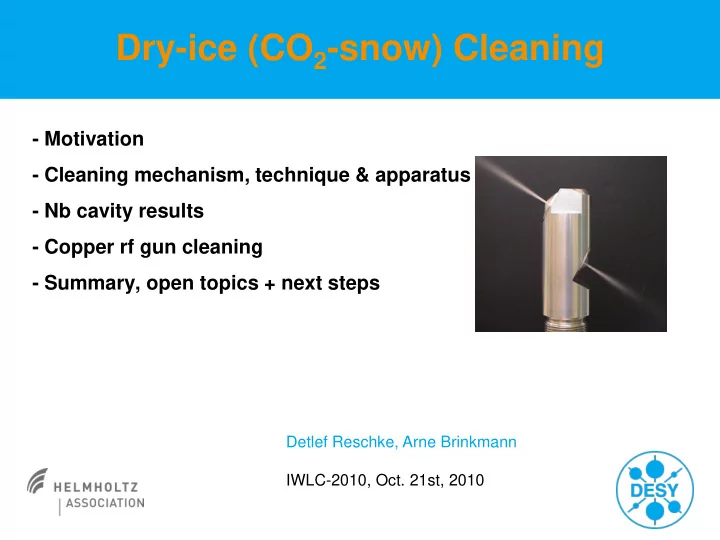
Dry-ice (CO 2 -snow) Cleaning - Motivation - Cleaning mechanism, technique & apparatus - Nb cavity results - Copper rf gun cleaning - Summary, open topics + next steps Detlef Reschke, Arne Brinkmann IWLC-2010, Oct. 21st, 2010 Motivation


slide-1
SLIDE 1
  • Motivation
  • Cleaning mechanism, technique & apparatus
  • Nb cavity results
  • Copper rf gun cleaning
  • Summary, open topics + next steps

Detlef Reschke, Arne Brinkmann IWLC-2010, Oct. 21st, 2010

Dry-ice (CO2-snow) Cleaning

slide-2
SLIDE 2

Detlef Reschke, Arne Brinkmann | IWLC-2010 | Oct. 21, 2010 | Page 2

Motivation for dry-ice cleaning

> High cleaning potential for removal of particles + field emission by dry- ice cleaning proven on samples

=> publications by Univ. Wuppertal (e.g. SRF Workshops, …)

> Additional cleaning option: no replacement of high pressure water rinse ! > advantages of dry-ice cleaning:

  • Effective removal of particulate and film contamination
  • Dry cleaning process

=> horizontal cleaning option of Nb cavities => final cleaning just before string assembly => all applications unsuitable for water e.g. application to Cu gun cavity => no drying procedure necessary

slide-3
SLIDE 3

Detlef Reschke, Arne Brinkmann | IWLC-2010 | Oct. 21, 2010 | Page 3

Effect of DIC on a flake-like emitter (courtesy Univ. Wuppertal)

emitter of ~ 20 µm size destroyed by DIC remnants emitting at higher Eon! EDX: no foreign element detected (probably oxide of Nb)

2.4 10-13 1.2 10-15 S (m2) 8.3 10-13 2 10-17 S (m2) 38.0 51.2  35.4 67.4  62.8 54.3 Eon (MV/m) HPR+DIC HPR emitter

slide-4
SLIDE 4

Detlef Reschke, Arne Brinkmann | IWLC-2010 | Oct. 21, 2010 | Page 4

Motivation for dry-ice cleaning

> High cleaning potential for removal of particles + field emission by dry- ice cleaning proven on samples

=> publications by Univ. Wuppertal (e.g. SRF Workshops, …)

> Additional cleaning option: no replacement of high pressure water rinse ! > advantages of dry-ice cleaning:

  • Effective removal of particulate and film contamination
  • Dry cleaning process

=> horizontal cleaning option of Nb cavities => final cleaning just before string assembly => all applications unsuitable for water e.g. application to Cu gun cavity => no drying procedure necessary

slide-5
SLIDE 5

Detlef Reschke, Arne Brinkmann | IWLC-2010 | Oct. 21, 2010 | Page 5

Cleaning mechanism

> dry-ice “snow”: mechanical, thermal + chemical cleaning forces

  • thermo-mechanical:

i) embrittling by shock-freezing ii) shearing forces by high momentum iii) drastic volume increase by sublimation

  • chemical: liquid CO2 acts as solvent for hydrocarbons + silicone

=> embrittling, blasting, shearing, dissolving, washing > removal of particles down to < 100nm > local, dry, without residues > simple checks with air and surface particle counters possible

slide-6
SLIDE 6

Detlef Reschke, Arne Brinkmann | IWLC-2010 | Oct. 21, 2010 | Page 6

Cleaning technique

> patent-registered nozzle design for CO2 surrounded by nitrogen designed by Fraunhofer IPA, Stuttgart, Germany > spontaneous formation of snow/gas mixture by relaxation of liquid CO2

  • app. 40-45% snow at -78,9 C; ~50-55 bar

> surrounding supersonic nitrogen gas (20 C; (12-18)bar) => accelerating + focussing of jet => (partially) avoidance of condensation of humidity

slide-7
SLIDE 7

Detlef Reschke, Arne Brinkmann | IWLC-2010 | Oct. 21, 2010 | Page 7

Apparatus: General

> schematic of dry-ice cleaning set-up

nitrogen carbon dioxide 1 1 2 3 4 5 5 1 valve 2 pressure reducer 3 gas purifier 4 chiller 5 filter

slide-8
SLIDE 8

Detlef Reschke, Arne Brinkmann | IWLC-2010 | Oct. 21, 2010 | Page 8

Apparatus: key components + operation

slide-9
SLIDE 9

Detlef Reschke, Arne Brinkmann | IWLC-2010 | Oct. 21, 2010 | Page 9

Apparatus: key components + operation

> system for horizontal cleaning of (1-3)-cell cavities in stable operation

slide-10
SLIDE 10

Detlef Reschke, Arne Brinkmann | IWLC-2010 | Oct. 21, 2010 | Page 10

Single cell Nb cavity results

> Results with actual cleaning parameters: => 3 of 5 tests show no fieldemission up to 35 MV/m; 2 tests with moderate FE > Potential to remove HPR resistant field emitters ??

1.00E+09 1.00E+10 1.00E+11 5 10 15 20 25 30 35 40 MV/m Qo

1DE10, test 4 at 1.8K (leak at 2K) 1DE11, Test 3: Q(E) at 2K 1DE11, Test 4: Q(E) at 2K 1DE11, Test 5: Q(E) at 2K 1DE11, Test 7 at 1.8K (leak at 2K)

1.00E+09 1.00E+10 1.00E+11 5 10 15 20 25 30 35 40 MV/m Qo first test after bake + HPR test 2 after add. DIC with old parameters test 3 after add. DIC with improved parameters

slide-11
SLIDE 11

Detlef Reschke, Arne Brinkmann | IWLC-2010 | Oct. 21, 2010 | Page 11

Copper rf gun cavity cleaning

> Task: cleaning of the copper rf gun cavity of the photo injector for FLASH and European XFEL > Goal: effective removal of particles => low dark current with no oxidation of Cu Photo injector area with rf gun cavity at FLASH

slide-12
SLIDE 12

Detlef Reschke, Arne Brinkmann | IWLC-2010 | Oct. 21, 2010 | Page 12

Copper rf gun cavity cleaning (ctd.)

> new vertical cleaning stand with modified movable nozzle

slide-13
SLIDE 13

Detlef Reschke, Arne Brinkmann | IWLC-2010 | Oct. 21, 2010 | Page 13

Copper rf gun cavity cleaning: first result

> three guns cleaned example: gun cavity 4.2 conditioning at PITZ => dark current during gun processing app. factor 20 reduced

1 2 3 4 5 6 7 1000 2000 3000 4000 5000

maximum dark current (A) rf power (MW) Gun 3.1 (standard cleaned)

Cs2Te #58.1 (2006-05-08)

Gun 3.2 (standard cleaned)

Cs2Te #42.4 (2007-08-05)

Gun 4.2 (CO2 cleaned)

Mo 2008-01-14: 60 s Mo 2008-02-06: 400 s Mo 2008-02-11: 700 s

slide-14
SLIDE 14

Detlef Reschke, Arne Brinkmann | IWLC-2010 | Oct. 21, 2010 | Page 14

Open topics + ideas

> Further optimisation of cleaning parameters:

reduced CO2-capillary size, cleaning speed => reduce consumption of CO2 => reduce/avoid moisture condensation => avoid heating ??

> What is the “better” nozzle head: One movable nozzle vs. two fixed nozzles? (angle of nozzles?) > Heating of cavity or inert gas atmosphere ?? > Improved drive system of cavity

slide-15
SLIDE 15

Detlef Reschke, Arne Brinkmann | IWLC-2010 | Oct. 21, 2010 | Page 15

Summary + Outlook

> In operation:

  • horizontal cleaning of (1-3) cell cavities => successful
  • cleaning of 1.3 GHz Cu gun cavity with movable nozzle => successful

> Future:

  • Cleaning of REGAE (Relativistic Electron Gun for Atomic Explorations)
  • Regular cleaning of 1.3 GHz gun cavities for FLASH and European XFEL
  • Cleaning of water sensitive special parts

> Options:

  • Extension to Nb nine-cell accelerator cavities ?
  • Cleaning of full accelerator modules ???
slide-16
SLIDE 16

Detlef Reschke, Arne Brinkmann | IWLC-2010 | Oct. 21, 2010 | Page 16