Tredyffrin/Easttown School District BOARD EDUCATION COMMITTEE April - - PDF document

tredyffrin easttown school district board education
SMART_READER_LITE
LIVE PREVIEW

Tredyffrin/Easttown School District BOARD EDUCATION COMMITTEE April - - PDF document

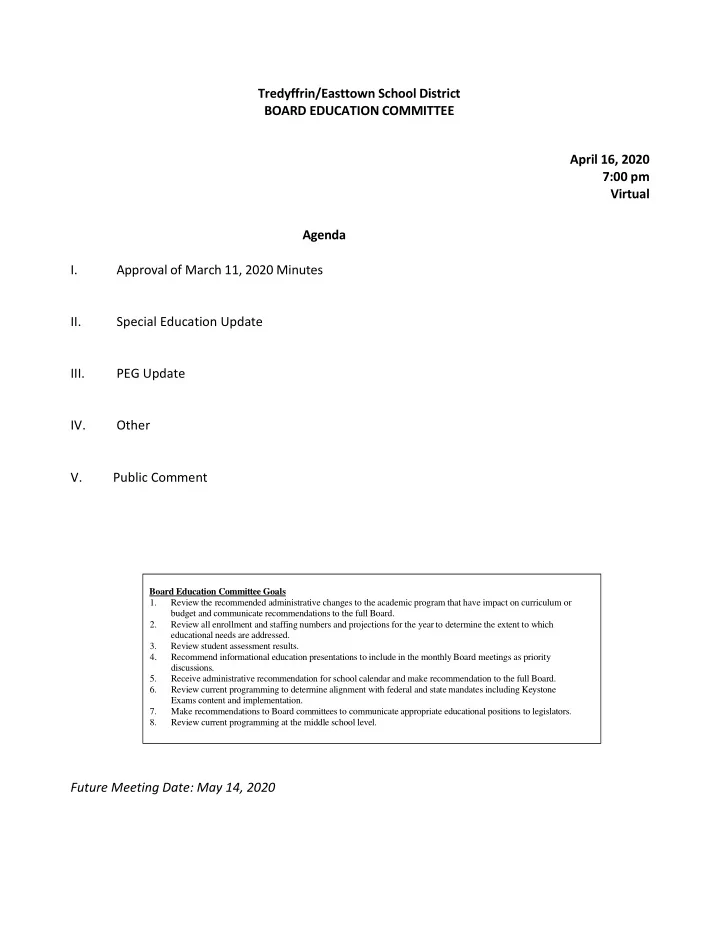
Tredyffrin/Easttown School District BOARD EDUCATION COMMITTEE April 16, 2020 7:00 pm Virtual Agenda I. Approval of March 11, 2020 Minutes II. Special Education Update III. PEG Update IV. Other V. Public Comment Board Education Committee


slide-1
SLIDE 1

Tredyffrin/Easttown School District BOARD EDUCATION COMMITTEE April 16, 2020 7:00 pm Virtual Agenda I. Approval of March 11, 2020 Minutes II. Special Education Update III. PEG Update IV. Other V. Public Comment Future Meeting Date: May 14, 2020

Board Education Committee Goals 1. Review the recommended administrative changes to the academic program that have impact on curriculum or budget and communicate recommendations to the full Board. 2. Review all enrollment and staffing numbers and projections for the year to determine the extent to which educational needs are addressed. 3. Review student assessment results. 4. Recommend informational education presentations to include in the monthly Board meetings as priority discussions. 5. Receive administrative recommendation for school calendar and make recommendation to the full Board. 6. Review current programming to determine alignment with federal and state mandates including Keystone Exams content and implementation. 7. Make recommendations to Board committees to communicate appropriate educational positions to legislators. 8. Review current programming at the middle school level.

slide-2
SLIDE 2

DRAFT PENDING COMMITTEE APPROVAL BOARD EDUCATION COMMITTEE MEETING MINUTES March 11, 2020 Tredyffrin/Easttown Administrative Offices 7:00 p.m. Attending all or part of the meeting: Board Committee Members: Tina Whitlow (chair), Kyle Boyer, Scott Dorsey, Stacy Stone Other Board Members: Michele Burger, Mary Garrett Itin, Roberta Hotinski, Todd Kantorczyk, Sue Tiede TE School District Representatives: Wendy Towle (Administrative Liaison), Richard Gusick, Horace Rooney, Chris Groppe Community Members: Jeremy Hampton, Ali Brazunas, Nancy Coradi, Michael Coradi, Ghada Bistanji, Wendy Brooks, Jill Semmer, Arlene Talley, Heather McConnell, Sophia Pan, Jian Zhou, Haixiao Chieu, Yeng Zhan, Deana Wang, Jamie Lynch, Nicole Scherer, Bo Zhang, Liliane Man, Bob Desipio, Talath Nasreen, Kate Murphy, Beth Guistwhite, Ellen Turk, Amy Alvarez, Kristen Duffy The meeting was called to order at 7:00 p.m. Public Comment: Haixiao Chieu commented on the DRAFT TESD Pandemic Plan. Kate Murphy commented on the DRAFT TESD Pandemic Plan. Jill Semmer commented on the DRAFT TESD Pandemic Plan. Yeng Zhan commented on the DRAFT TESD Pandemic Plan. Heather McConnell commented on the DRAFT TESD Pandemic Plan. Wendy Brooks commented on the DRAFT TESD Pandemic Plan. Deana Wang commented on the DRAFT TESD Pandemic Plan. Sophia Pan commented on the DRAFT TESD Pandemic Plan. Jamie Lynch commented on the Proposed Change to Kindergarten Specials Schedule. Wendy Brooks commented on the Proposed Change to Kindergarten Specials Schedule. Approval of Minutes: The February 13, 2020 minutes were approved. Committee Discussion and Recommendations: The Committee discussed the DRAFT TESD Pandemic Plan.

  • Dr. Gusick began the meeting with a report regarding the Pandemic Plan to address COVID-19.

He stated the authorities that were contacted to provide essential information towards the formulation of the plan and discussed further details explaining the process as well as the individuals involved in developing the plan. He emphasized that the Chester County Health Department had, at that time, not recommended that T/E schools close, and had communicated

1

slide-3
SLIDE 3

that stance with a statement on their website. He also outlined different aspects of the plan that included what to do in the event that a student visits a “level 3” country. Later, Dr. Gusick described the concept of deep cleaning and how the District was implementing that task to effect. Next, Dr. Gusick discussed the current “level” of the District as it pertained to the Pandemic

  • Plan. At this time, he explained that the District was in the “Limiting and Postponing” phase. He

also explored various scenarios that would be flexibly addressed, including sports, District travel, and career week. He noted that decisions would be made based on the level of risk a given event would present. The Committee inquired if the cleaning/custodial staff had been provided with the necessary resources to effectively clean and maintain the facilities. Additionally, they inquired about the District’s ability to deep clean various buildings as well as implement statewide

  • assessments. Moreover, they discussed the District’s communication processes and how

information will be displayed on the web page. Members suggested that information be placed

  • n each individual school’s home page and/or be clearly displayed on the main District web
  • page. They also lauded the efforts of teachers and administrators in dealing with this issue and

inquired about the input of PIAA officials. Dr. Gusick discussed various ideas including holding sports events that would not include attendance by the public to decrease health risks. Afterwards, Dr. Gusick shared information regarding school closings. His report included scenarios to prepare for one or more school closing days. He also discussed Act 80 days that could count as school days. Dr. Gusick explained a framework of how Distance Learning would be implemented on a day-to-day basis, including the timeframe for learning activities, as well as the means to take attendance. Lastly, other topics were considered such as addressing the needs

  • f students with IEPs, parent access to technology, differentiation of assignments, Spring Break

days, the dispensation of food to families in need, transportation, community outreach, student absenteeism, and overcoming barriers. At the completion of the discussion, the Committee recommended that an emergency inservice day be installed on Monday, March 16 to implement the training sessions and develop the strategies associated with Distance Learning. The Committee discussed the Proposed Change to Kindergarten Specials Schedule.

  • Dr. Towle reported on the need to change aspects of the Kindergarten specials area program.

These factors included increased enrollment and increased demand for space within classrooms. She specified concerns associated with the schedules of the media specialists, as well as the fact that there are four art teachers in five buildings, which limits flexibility. Given that there will be a need to increase the elementary special area staffing by one FTE to accommodate the increased enrollment, she proposed hiring an additional art teacher, increasing the number of kindergarten art classes to 2 per cycle and decreasing the number of kindergarten library classes to 1 per cycle. These adjustments would allow for greater flexibility in the overall scheduling of special classes and would simultaneously negate the need for certain media specialists to leave their buildings and teach classes in other schools, giving them increased access to the students in their own

  • schools. Dr. Towle shared that this proposed change was discussed with the Elementary

Principals, Art Teachers and Media Specialists, all of whom supported the plan. When concerns were shared regarding the decrease in the students’ exposure to literature, Dr. Towle noted that various aspects of art classes included opportunities for literacy connections. At the conclusion

  • f the report the Committee recommended that the proposed change be implemented.

The meeting was adjourned at 10:00 p.m. Future Meeting Dates: April 16, 2020; May 14, 2020

2
slide-4
SLIDE 4

T/E Student Services

Education Committee April 16, 2020

Individualized Student Services

We serve students Pre‐referral Interventions Special Education (K‐21)

‐‐

Health & Medical Services Homebound, Home Schooling Mental Health Specialists

3

slide-5
SLIDE 5

Pre‐referral interventions

Collaboration with regular education staff Student Intervention Teams (SIT) in the elementary schools. Services provided by reading specialists, math specialists, guidance counselors, and behavior specialists. Multi‐tiered intervention teachers at the secondary level CARE team/Student Assistance Program at secondary level to provide supports to students regarding mental health, drug & alcohol use

Students receiving MIT support

Referred to MIT Continuing in MIT Exited from MIT IEP qualified

17‐18 18‐19 19‐20 17‐18 18‐19 19‐20 17‐18 18‐19 19‐20 17‐18 18‐19 19‐20

Middle School

107 126 100 45 71 66 32 32 22 22 23 12

High School

160 129 119 66 64 53 51 41 40 38 24 16

4

slide-6
SLIDE 6

If pre‐referral intervention is not sufficient

Identifying a Need:

Team or parent identify a concern or share a diagnosis Pre‐referral interventions Permission for assessment through the PWN (Prior Written Notice)

Formal assessment Multidisciplinary evaluation to determine special education eligibility The IEP is developed with the family Individualized Education Program Strengths, Needs, Goals, Specially Designed Instruction, Placement NOREP provided to family to obtain consent to the proposed IEP Cannot begin services without signed consent. If the IEP is declined, the previous IEP stays in effect until the conflict is resolved. Annual IEP review, Re‐Evaluations, Progress Monitoring

Meet with the IEP team at least once annually to review progress and update the IEP You can also request an IEP meeting at any time throughout the school year if you feel there is an issue that must be resolved by the IEP team. Re‐Evaluations occur every three (3) years,; every two (2) years for a student with an Intellectual Disability

5

slide-7
SLIDE 7

504 Accommodation plans

  • For students with a disability who need accommodations

to access the general education setting.

  • School counselors and school nurses are case managers.
  • Examples:
  • Student with ADHD and requires seating away from

distractions, testing accommodations such as a small group and extended time.

  • Student with a physical disability and requires

physical therapy, occupational therapy, and increased supervision getting on and off the bus and on the playground.

  • Student with a life‐threatening allergy who requires a

health plan incorporated into their plan.

  • Approximately 110 students have active 504

plans within T/E

Nursing services

  • State mandate requires a Certified School Nurse for every 1500 students,

and includes serving private schools within our boundaries that request this service.

  • We have a combination of Certified School Nurses and Health Room

nurses so that student medical needs are supported during the school day.

  • Nursing support on field trips continues to be a need that is impacting
  • ur use of contracted agency providers for this service.

6

slide-8
SLIDE 8

Mental Health Specialists

  • Services provided:
  • Consultation with school staff regarding student

issues.

  • Provide counseling to identified students, both

long term and short term

  • Conduct clinical interviews of students who may

be in danger of harming themselves or others

  • Assist with transition of students to/from
  • utside health facilities.
  • Facilitate family access of community based

mental health resources.

  • Participate on school‐based pre‐referral

intervention teams such as CARE.

  • Support when making CYF referrals.
  • 4.0 District staff are supplemented by

contracted provider 2017‐18 2018‐19 (end of year) 2019‐20 (as of March) Counseling Service K‐8 CHS 35 29 41 45 42 35 Clinical Interviews K‐8 CHS 50 85 103 129 103 118 SAIP K‐8 CHS 6 32 12 12 9 11 Hospitalization Placements K‐8 CHS (not collected) 17 57 21 65

7

slide-9
SLIDE 9

Special Education

  • For students with disabilities who require

specially designed instruction

  • Our obligation is to provide FAPE (Free

Appropriate Public Education) in the Least Restrictive Environment.

  • Approximately 15% of T/E students have an
  • IEP. This aligns with state and national

averages.

  • Approximately 75% of students with IEPs are

educated in the regular education environment for 80% or more of their school day. This is higher than state and national averages.

  • The process is highly regulated and designed to

protect the rights of the person with a disability.

IDEA and CHAPTER 14

IDEA

PA Chapter 14

TESD Policies and Procedures

Federal Regulations Ensures all children with a disability have a FAPE and that the rights of these children and their families are protected

State Regulations In PA School Code, articulates the school district’s responsibility to provide a FAPE for students with

  • disabilities. Includes

regulations that are specific to Pennsylvania…above and beyond IDEA

Local Procedures The District’s responsibility and commitment to meet the individual needs of all students…above and beyond IDEA and Chapter 14 8

slide-10
SLIDE 10

Special education students

968 975 953 1008 978 982 1022 1043 1137 1174 200 400 600 800 1000 1200 1400 IEPs

Number of students with IEPs

2010‐11 2011‐12 2012‐13 2013‐14 2014‐15 2015‐16 2016‐17 2017‐18 2018‐19 2019‐20

Percentage (and Number) of Special Education Students Within Each Disability Category 2019‐20

* Other – Deaf/Blind; Hearing Impairment; Multiple Disabilities; Orthopedic Impairment; Traumatic Brain Injury.

Autism 12% (145 students, ‐5 from 18‐19) Emotional Disturbance 10% (121 students, +5 from 18‐19) Intellectual Disability 3% (34 students, +4 from 18‐19) **Other Health Impairment 29% (344 students, +7 from 18‐19) Specific Learning Disability 31% (358 students, +31 from 18‐19) Speech or Language Impairment 13% (147 students, ‐2 from 18‐19) *Other 2% (27 students, +4 from 18‐19)

** Other health impairment is due to chronic or acute health problems such as asthma, attention deficit disorder or attention deficit hyperactivity disorder, diabetes, epilepsy, a heart condition, hemophilia, lead poisoning, leukemia, nephritis, rheumatic fever, sickle cell anemia, and Tourette syndrome; and adversely affects a child’s educational performance.

9

slide-11
SLIDE 11

Caseload limits

  • All students with an IEP must have a case manager. The size of the caseload is

limited by state mandates. This is not the same as class size.

  • Level of support refers to amount of time in special education.
  • Maximum number of students by caseload.

Itinerant Supplemental Full‐Time Autistic Support 12 8 8 Emotional Support 50 20 12 Learning Support 50 20 12 Life Skills Support 20 20 12 Speech & Language Support 65 8

Type of support totals

Type of Support 2017‐18 2018‐19 2019‐20 Change from 18‐19 to 19‐20 Autistic Support 64 75 79 +5 Blind/Visually Impaired Support 2 3 2 ‐1 Deaf/Hearing Impaired Support 5 4 4 Emotional Support 170 232 238 +6 Learning Support 637 661 685 +24 Life Skills Support 27 30 32 +2 Multiple Disabilities Support 9 14 13 ‐1 Physical Support Speech & Language Support 108 118 121 ‐3

10

slide-12
SLIDE 12

Disproportionality update

  • For the period 2015‐2018 we were flagged in two areas for African‐American students:

identification of Specific Learning Disability, and Total Removals (out of school suspensions). This means our risk ratio exceeded the threshold for three consecutive years.

  • For the period 2016‐2019 we are no longer flagged in Total Removals, and in warning

status for SLD identification.

11

slide-13
SLIDE 13

Disproportionality

  • IDEA requires States to collect and examine data to

determine if significant disproportionality based on race and ethnicity is occurring within LEAs. This includes:

  • Identification of disabilities
  • Placement in particular types of settings
  • Discipline incidents
  • Identified using a risk ratio to analyze disparities; states may

use data from three consecutive years.

  • Remedy:
  • Review, and if appropriate, revise policies, procedures

and practices

  • Set aside 15% of IDEA flow‐through funds for

Coordinated Early Intervening Services ($158,000). These funds are being used for additional behavior support and working with Pacific Education Group.

  • Publicly report on the review and revision of these

policies, procedures, and practices

Professional Staffing

2015‐16 2016‐17 2017‐18 2018‐19 2019‐20 2020‐2021 (proposed) Special Education Teachers Elementary 15 14.5 16 17 19 20 Middle 12.5 13 13 14 15 18 High School 11.5 11.5 12 14 16 16 Speech Therapists 4.0 4.0 4.0 4.0 4.5 5.5 Mental Health Specialists 4.0 4.0 4.0 4.0 4.0 5.0 Certified School Nurses 6.0 6.0 6.0 6.0 6.8 6.8 Health Room Nurses 3.75 3.75 3.75 3.75 3.75 4.75

12

slide-14
SLIDE 14

Specialized program locations

  • Proposed locations in 2020‐2021
  • Facilities impact:
  • Elementary: identify a

classroom at Devon Elementary (pending, based

  • n pre‐school special

education impact)

  • Middle school: Autistic

Support anticipated at TEMS

  • High school: no impact

Autistic Support Emotional Support Life Skills Support

Elementary Beaumont, Devon, Hillside New Eagle VF Elementary Middle School VFMS & TEMS TEMS & VFMS VFMS High School CHS CHS CHS

Out of district programming

  • IEP teams may recommend

programs not implemented within TESD. The family has to agree to changes in placement. The District is responsible for transporting the student.

  • The average monthly cost for
  • ut of district transportation is

$155,143.60

Approved Private Schools, Separate Public Facility Alternate Regular Education Setting Secondary Transition program (18‐21) TCHS programs What are the names

  • f some of

these schools or progams? CCIU Child & Career Development Center, Vanguard School, Timothy School, Elwyn Gateway, Reach, Teach, Lifeworks, Buxmont, Options CCIU Aspire, Transitional Living Program, Project Search Technical College High School – Pickering or Brandywine Current # of TESD students 37 22 12 17 13

slide-15
SLIDE 15

Special Education Students by Cost Range

Range 15‐16 16‐17 17‐18 18‐19 Change (17‐18 to 18‐19) $1 ‐ $24,999 913 937 1026 1118 +92 $25,000 ‐ $49,999 98 201 194 127 ‐67 $50,000 ‐ $74,999 31 26 51 54 +3 $ 75,000 and above 16 15 36 39 +3

Total students

1058 1179 1307 1338 +31

Educational service agreements

  • At times we enter into agreement with a family in which the parents waive

their rights to the legal protections under IDEA in exchange for tuition

  • reimbursement. These are only entered into with the recommendation of
  • ur solicitor, and with the approval of the School Board. The cost is often

roughly equivalent to the cost of educating the student under their IEP.

Cost Range 18‐19 19‐20 $1 ‐ $24, 999 7 5 $25,000 ‐ $49,999 20 24 $50,000 ‐ $74,999 5 5 $75,000 and higher 3 5 35 39

Number of Students

14

slide-16
SLIDE 16

13

Conestoga Class of 2019 outcomes

Most frequently occurring colleges Delaware County Community 13 West Chester University 9 Temple University 7 Penn State (any) 4 Cabrini University 3 University of Pittsburgh 3 Elon University 3 Widener University 2

113 graduates* with an IEP 2 – year college 16 4 – year college 78 Employment 14 Military enlistment 1 Community programs (adult serving agencies such as OVR) 4

*Includes only students taking their diplomas from CHS. Does not include students continuing in 18‐21 services, or those enrolled in Approved Private Schools.

15

slide-17
SLIDE 17

TESD and Pacific Educational Group

An Update on Racial Equity Work Provided to the Education Committee April 2020

Introduction

In the spring of 2018, the District began a partnership with Pacific Educational Group (PEG) specifically to enhance the polices and practices around racial equity. As stated by PEG, the goal is to “engage in sustained partnerships with educational

  • rganizations to transform beliefs, behaviors, and

results so people of all races can achieve at their highest levels and live their most empowered and powerful lives.”

16

slide-18
SLIDE 18

Components

  • f the Work
  • Beyond Diversity
  • District Executive Equity Leadership Team (DELT)
  • Leadership for Racial Equity Team (LEADS)
  • Site Equity Leadership Teams (E‐Teams)
  • PEG Affiliate Practitioners
  • Students Organized for Anti‐Racism (SOAR)

Beyond Diversity

  • Provides a foundation for all other work
  • 2‐day seminar designed to foster thoughtful

exploration of how race influences the culture and climate of our schools and to practice strategies for engaging in conversations around issues related to race

  • Offered August of 2018 and 2019
  • Approximately 150 participants to date –

faculty, administrators, support staff and School Board members

17

slide-19
SLIDE 19

District Executive Equity Leadership Team (DELT)

  • DELT is focused on building executive capacity

and accountability for leading and implementing district equity transformation

  • Includes Superintendent, Directors and Teacher

Affiliates

  • All members participated in Beyond Diversity

training

  • DELT has participated in 8 full day seminars
  • Areas of focus have included examination of

polices and practices, student achievement data, strategic initiatives

Leadership for Racial Equity Team (LEADS)

  • LEADS is focused on deepening the will, skill,

knowledge and capacity of administrators to lead, oversee, and manage the dynamic process

  • f system‐wide racial equity transformation
  • Includes Superintendent, Directors, Principals

and Assistant Principals

  • All members participated in Beyond Diversity

training

  • LEADS has completed 6 full day seminars
  • The LEADS curriculum is designed to assist in

reaching the goal of establishing building level Equity Teams

18

slide-20
SLIDE 20

Site Equity Leadership Teams (E‐ Teams)

  • E‐Teams examine their school’s policies,

practices, programs, structures, climate and culture to identify barriers to equity and excellence and lead systemic change efforts that result in high levels of achievement for all students.

  • Includes Building Administrators and 5‐8

Teachers from each building

  • All members participated in Beyond Diversity

training

  • E‐teams will complete two sessions of training

as a group by the end of this year with a goal of beginning building‐level implementation

PEG Affiliate Practitioners

  • The Affiliate Program is designed to enable

participants to serve as Courageous Conversations About Race Practitioners, Facilitators, and Coaches within their own school districts

  • A group of seven – 5 teachers and 2

administrators – are certified as Affiliates

  • Affiliates received 50 hours of additional

training and on‐going coaching

  • Currently, the Affiliates are engaged in the next

level of training with the goal of becoming facilitators of the Beyond Diversity training in TESD

19

slide-21
SLIDE 21

Students Organized for Anti‐Racism (SOAR)

  • SOAR is designed to empower young people of all races

to become catalysts for change through leadership for racial equity.

  • Focused currently on Conestoga
  • First session took place in Spring 2019 and continues

through this school year

  • Students were recommended by teachers, counselors

and administrators

  • Approximately 50 student members in SOAR –

representing many diverse perspectives

  • Students receive training in Beyond Diversity that is

similar to what is provided to adults

  • Training is provided by PEG consultant
  • Intersessions are designed and facilitated by CHS SOAR

Advisers

Examples of Additional Work

  • Affiliates prepared and delivered inservice

sessions for those who had participated in Beyond Diversity and for those who had not yet had the chance but had a strong interest in equity

  • Ongoing review and revision of ELA and Social

Studies curriculum through the lens of equity and social justice

  • Dialogue using the Courageous Conversations

protocol incorporated into Diversity Committee

  • The development of a lending library of

professional resources related to equity

20

slide-22
SLIDE 22

Moving Forward

  • Consideration of equity as a component of the

next Strategic Plan

  • Continue discussion around District policies and

practices that impede or support equity

  • Implementation of E‐Teams at all schools
  • Next sessions of Beyond Diversity TBD
  • Consideration of how SOAR might be

established at the middle schools and what connections can be made to elementary

  • Develop a plan for parent involvement in the

initiative

21