Time-Variable Atmospheric Phenomena Time-Variable Atmospheric - - PowerPoint PPT Presentation

time variable atmospheric phenomena time variable
SMART_READER_LITE
LIVE PREVIEW

Time-Variable Atmospheric Phenomena Time-Variable Atmospheric - - PowerPoint PPT Presentation

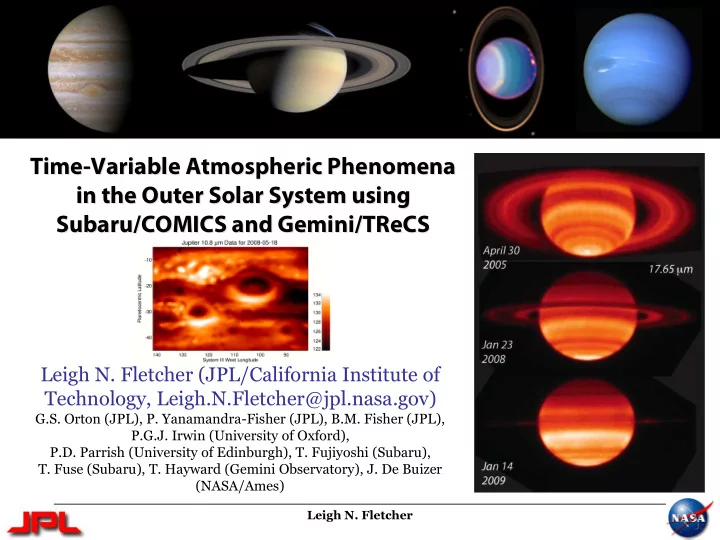
Time-Variable Atmospheric Phenomena Time-Variable Atmospheric Phenomena in the Outer Solar System using in the Outer Solar System using Subaru/COMICS and Gemini/TReCS TReCS Subaru/COMICS and Gemini/ Leigh N. Fletcher (JPL/California Institute


slide-1
SLIDE 1

Leigh N. Fletcher

Leigh N. Fletcher (JPL/California Institute of Technology, Leigh.N.Fletcher@jpl.nasa.gov)

G.S. Orton (JPL), P. Yanamandra-Fisher (JPL), B.M. Fisher (JPL), P.G.J. Irwin (University of Oxford), P.D. Parrish (University of Edinburgh), T. Fujiyoshi (Subaru),

  • T. Fuse (Subaru), T. Hayward (Gemini Observatory), J. De Buizer

(NASA/Ames)

Time-Variable Atmospheric Phenomena Time-Variable Atmospheric Phenomena in the Outer Solar System using in the Outer Solar System using Subaru/COMICS and Gemini/ Subaru/COMICS and Gemini/TReCS TReCS

slide-2
SLIDE 2

Leigh N. Fletcher

Introduction

  • Spacecraft provided incredible snapshots:

– Voyager imaging and spectroscopy revealed composition, chemistry and dynamics for the first time. – Galileo permitted a new understanding of Jupiter, but the low data rate restricted science capabilities.

  • To really understand complex atmospheres we must

study temporal phenomena - change…

– Require long-lifetime missions (Cassini), or continual monitoring from ground-based observatories. – Comparisons between the gas giants reveal their different responses to seasons, convective instabilities, etc.

  • This talk will highlight changing phenomena on the

four gas giants.

slide-3
SLIDE 3

Leigh N. Fletcher

Data Reduction and Analysis Technique

Telluric-corrected Filter functions Coadd images Input chop-nod target images Input sky images Flat field Bad pixel mask Filter transmission functions Telluric transmission spectrum CIRS/IRIS Planetary spectra ABAB Subtraction Sky subtraction Defect-free Target images Fourier noise filter PSF Deconvolution Star PSF image K-tables for each instrument Geometry registration Cylindrical projection Expected filtered radiance from CIRS/IRIS Radiometric scaling Calibrated radiance maps Stack filtered images Estimate radiance error Bin spectra Optimal estimation retrievals Flat field correction Pixel defect removal Planet reference atmosphere Gaseous line data and CIA coefficients

1 2 3 4

START GOAL

Modified from Fletcher et al. (2009, Icarus 200, 154-175)

slide-4
SLIDE 4

Leigh N. Fletcher

  • Thermal infrared

imaging of Jupiter’s giant anticyclonic storm systems:

– Galileo limited by low telemetry rate, stuck filter wheel.

  • Hard to compare low-

resolution thermal images with high- resolution Galileo/HST visible images.

  • Subaru/Gemini superb

spatial resolution permits proper comparisons for the first time.

slide-5
SLIDE 5

Leigh N. Fletcher

Jupiter from COMICS and TReCS

  • First detection of inhomogeneous thermal structure

within the GRS.

  • Changing morphology of warm southern periphery with

depth, perturbations by passing storms.

  • Observe interactions with smaller anticyclones,

changing temperature of turbulent wake region.

  • But we can do more with Optimal Estimation

Retrievals…

COMICS images acquired as the Great Red Spot, Oval BA and a newly-formed Little Red Spot interacted on June 24th 2008.

slide-6
SLIDE 6

Leigh N. Fletcher

Retrievals of Atmospheric Properties

  • Stack images to form a low-resolution spectral

cube to retrieve:

– (a) atmospheric temperatures; (b) ammonia distribution; (c) aerosol opacity; and (d) para-hydrogen.

  • GRS and BA have similar properties:

– Upwelling cold cores lofting aerosols to high altitudes.

Cassini/CIRS retrievals from full spectra are consistent with filtered imaging results.

Temperature s Ammonia Aerosols

slide-7
SLIDE 7

Leigh N. Fletcher

Tracing Atmospheric Dynamics

  • First ground-based determination

(COMICS) of ortho/para-hydrogen ratio within Jupiter’s storms:

– Dark (sub-equilibrium) indicated upwelling. – Bright (super-equilibrium) indicates subsidence.

  • All storm have upwelling cores, GRS has

possible subsidence in the warm centre associated with the deepest red colouration.

Hubble June 28th Pressure in an isentropic surface indicates upwelling storms reach lower pressures/higher altitudes.

Jupiter results submitted to Icarus (Fletcher et al., 2009)

slide-8
SLIDE 8

Leigh N. Fletcher

  • Saturn’s orbital obliquity of

26 degrees causes large seasonal variations in

  • insolation. Between April

2005 and January 2009 we track the closing of the ring angle as southern summer progresses to autumn (the equinox is August 2009).

Warm stratospheric vortex at the summer pole. Belt/zone structure and hemispheric asymmetry in troposphere.

slide-9
SLIDE 9

Leigh N. Fletcher

Saturn Temperature Retrievals

  • Comparing COMICS T(p) retrievals from 17-25 um and 7-12 um filters with

Cassini results:

– General cooling of northern mid-latitudes, cooling in south. – Cooling of south polar vortex, equatorial structure associated with Semi-Annual Oscillation. – Measurements consistent with radiative-climate model of Greathouse et al.

1.0 mbar

slide-10
SLIDE 10

Leigh N. Fletcher

Saturn’s Atmospheric Dynamics

  • Para-H2 and PH3 trace atmospheric motions.
  • Elevated equatorial PH3 and sub-equilibrium

para-H2 conditions suggest equatorial upwelling, consistent with Cassini (Fletcher et al., 2009, in press.).

  • North-south para-H2 asymmetry suggests a

relation with aerosol opacity.

Saturn results are being prepared for publication (Yanamandra-Fisher et al.)

slide-11
SLIDE 11

Leigh N. Fletcher

  • Uranus extreme seasonal insolation variations

due to 98 deg. obliquity.

  • Image reconstruction techniques to obtain an

image from low-signal data.

  • Comparison between Voyager-era pseudo-

image and present day reveals north polar cooling.

slide-12
SLIDE 12

Leigh N. Fletcher

  • Pseudo-images based on Voyager/IRIS

temperature retrieval.

  • Calibrate with (a) standard stars and (b)

comparison to Spitzer/IRS observations.

  • Combine all COMICS and VISIR
  • bservations of Uranus 2006-08 to form

a low resolution spectral cube to derive T(p) structure.

  • Temperature asymmetry developed.

Uranus Temperature Retrievals

slide-13
SLIDE 13

Leigh N. Fletcher

  • Using the same

technique as Uranus:

– PSF reconstruction. – PIXON image. – Voyager/IRIS Synthetic image comparison.

  • Revealed the hot

south pole (VISIR data, September 2006, Orton et al., 2007).

slide-14
SLIDE 14

Leigh N. Fletcher

Neptune Temperature Retrievals

  • The 12.5 micron filter provides stratospheric

sensitivity via ethane emission (see comparison to Spitzer/IRS spectra). Voyager was not sensitive to the stratosphere.

  • Tropospheric temperatures have similar

morphologies in COMICS and Voyager retrievals, demonstrating the capabilities for ground-based thermal monitoring.

  • Cold temperatures = upwelling. Band of discrete

cloud features observed in the visible/near-IR

Courtesy O. Marco, NACO

slide-15
SLIDE 15

Leigh N. Fletcher

Neptune’s Wandering Hot Pole

Orton et al., 2007, A&A Hammel et al., 2005

slide-16
SLIDE 16

Leigh N. Fletcher

Conclusions

  • “Snapshots” of the planets provide a lot
  • f information about the atmosphere,

but monitoring change (both in discrete features and seasonal effects) improves

  • ur understanding of the gas giants.

– Jupiter: interactions between storm systems elucidates three-dimensional structure and thermochemical changes. – Saturn and Uranus: Different responses to seasonal insolation because

  • f different composition.

– Uranus and Neptune: Temperature monitoring from the ground for the first time since Voyager. – Neptune: Wandering hot polar vortex is not seen elsewhere on the giant planets.

  • Key advances from using 8-m

telescopes for outer solar system studies can support and surpass spacecraft missions.

~2010, northern spring ~2024, northern autumn ~2018, northern summer