Chapter 12: Phenomena Phenomena: Different wavelengths of - - PowerPoint PPT Presentation

chapter 12 phenomena
SMART_READER_LITE
LIVE PREVIEW

Chapter 12: Phenomena Phenomena: Different wavelengths of - - PowerPoint PPT Presentation

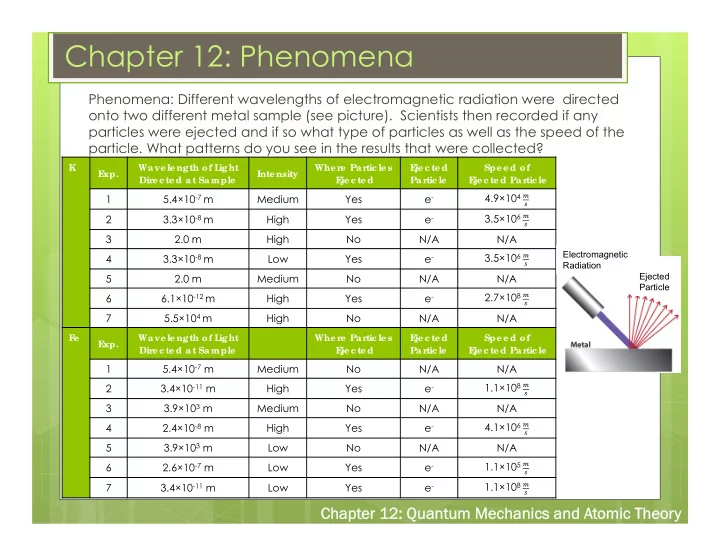
Chapter 12: Phenomena Phenomena: Different wavelengths of electromagnetic radiation were directed onto two different metal sample (see picture). Scientists then recorded if any particles were ejected and if so what type of particles as well as


slide-1
SLIDE 1

Chapt Chapter 12: r 12: Quant Quantum Mechanic m Mechanics and A s and Atomic Theor

  • mic Theory

Chapter 12: Phenomena

Phenomena: Different wavelengths of electromagnetic radiation were directed

  • nto two different metal sample (see picture). Scientists then recorded if any

particles were ejected and if so what type of particles as well as the speed of the

  • particle. What patterns do you see in the results that were collected?

K E xp. Wave le ngth of L ight Dir e c te d at Sample Inte nsity Whe r e Par tic le s E je c te d E je c te d Partic le Spe e d of E je c te d Partic le

1 5.4×10⁻⁷ m Medium Yes e- 4.9×10⁴

  • 2

3.3×10⁻⁸ m High Yes e- 3.5×10⁶

  • 3

2.0 m High No N/A N/A 4 3.3×10⁻⁸ m Low Yes e- 3.5×10⁶

  • 5

2.0 m Medium No N/A N/A 6 6.1×10⁻¹² m High Yes e- 2.7×10⁸

  • 7

5.5×10⁴ m High No N/A N/A

F e E xp. Wave le ngth of L ight Dir e c te d at Sample Whe r e Par tic le s E je c te d E je c te d Partic le Spe e d of E je c te d Partic le

1 5.4×10⁻⁷ m Medium No N/A N/A 2 3.4×10⁻¹¹ m High Yes e- 1.1×10⁸

  • 3

3.9×10³ m Medium No N/A N/A 4 2.4×10⁻⁸ m High Yes e- 4.1×10⁶

  • 5

3.9×10³ m Low No N/A N/A 6 2.6×10⁻⁷ m Low Yes e- 1.1×10⁵

  • 7

3.4×10⁻¹¹ m Low Yes e- 1.1×10⁸

  • Ejected

Particle Electromagnetic Radiation

slide-2
SLIDE 2

Chapter 12:

Quantum Mechanics and Atomic Theory

  • Electromagnetic

Radiation

  • Quantum Theory
  • Particle in a Box
  • The Hydrogen Atom
  • Quantum Numbers
  • Orbitals
  • Many-Electron Atoms
  • Periodic Trends

2

Big Ide a: The structure of atoms

must be explained using quantum mechanics, a theory in which the properties of particles and waves merge together.

slide-3
SLIDE 3

Chapt Chapter 12: r 12: Quant Quantum Mechanic m Mechanics and A s and Atomic Theor

  • mic Theory

Electromagnetic Radiation

 E

le c tr

  • magne tic Radiation: Consists of oscillating

(time-varying)electric and magnetic fields that travel through space at 2.998 108

(c = speed

  • f light) or just over 660 million mph.

3

No Note: All forms of radiation transfer energy from one region of space into another. Ex Examples amples of

  • f Electromag

Electromagne neti tic Radia c Radiation: n:

  • Visible light
  • Radio Waves
  • X-Rays
slide-4
SLIDE 4

Chapt Chapter 12: r 12: Quant Quantum Mechanic m Mechanics and A s and Atomic Theor

  • mic Theory

Electromagnetic Radiation

 Wave le ngth (λ): Is the

peak-to-peak distance.

 Amplitude : Determines

brightness of the radiation.

 F

r e que nc y (ν): The

number of cycles per second (1 1

).

4

No Note: Changing the wavelength changes the region of the spectrum (i.e. x-ray to visible).

slide-5
SLIDE 5

Chapt Chapter 12: r 12: Quant Quantum Mechanic m Mechanics and A s and Atomic Theor

  • mic Theory

Electromagnetic Radiation

5

slide-6
SLIDE 6

Chapt Chapter 12: r 12: Quant Quantum Mechanic m Mechanics and A s and Atomic Theor

  • mic Theory

Quantum Theory

 If white light is passed

through a prism, a continuous spectrum

  • f light is found.

However, when the light emitted by excited hydrogen atoms is passed through a prism the radiation is found to consist of a number

  • f components or

spectra lines.

6

slide-7
SLIDE 7

Chapt Chapter 12: r 12: Quant Quantum Mechanic m Mechanics and A s and Atomic Theor

  • mic Theory

Quantum Theory

 Blac k Body: An object that absorbs and emits all

frequencies of radiation without favor.

He ate d Blac k Bodie s

. .

  • 7

No Note: λmax is the most prevalent wavelength, not the longest wavelength.

slide-8
SLIDE 8

Chapt Chapter 12: r 12: Quant Quantum Mechanic m Mechanics and A s and Atomic Theor

  • mic Theory

Quantum Theory

T he or y

 Scientists used classical physics arguments to

derive an expression for the energy density (Rayleigh Jens Law). ∝

  • T

he Pr

  • ble m With E

xplaining Blac k Body Radiation Using Classic al Me c hanic s

 Classical mechanics put

no limits on minimum wavelength therefore at very small , would be a huge value even for low temperatures.

8

slide-9
SLIDE 9

Chapt Chapter 12: r 12: Quant Quantum Mechanic m Mechanics and A s and Atomic Theor

  • mic Theory

Quantum Theory

 Max Plank: Proposed that the exchange

  • f energy between matter and radiation
  • ccurs in quanta, or packets of energy.

His central idea was that a charged particle oscillating at a frequency , can exchange energy with its surroundings by generating or absorbing electromagnetic radiation only in discrete packets of energy.

9

 Quanta: Packet of energy (implies minimum

energy that can be emitted).

 Charged particles oscillating at a frequency, ,

can only exchange energy with their surroundings in discrete packets of energy.

slide-10
SLIDE 10

Chapt Chapter 12: r 12: Quant Quantum Mechanic m Mechanics and A s and Atomic Theor

  • mic Theory

Quantum Theory

 Photoe le c tr

ic E ffe c t: Ejection of electrons from a

metal when its surface is exposed to ultra violet radiation.

10

slide-11
SLIDE 11

Chapt Chapter 12: r 12: Quant Quantum Mechanic m Mechanics and A s and Atomic Theor

  • mic Theory

Quantum Theory

 F

indings of the Photoe le c tr ic E ffe c t

1)

No electrons are ejected unless the radiation has a frequency above a certain threshold value characteristic of the metal.

2)

Electrons are ejected immediately, however low the intensity of the radiation.

3)

The kinetic energy of the ejected electrons increases linearly with the frequency of the incident radiation.

 Albert Einstein

 Proposed that electromagnetic radiation consists

  • f massless “particles” (photons)

Photons are packets of energy Energy of a single photon =

11

slide-12
SLIDE 12

Chapt Chapter 12: r 12: Quant Quantum Mechanic m Mechanics and A s and Atomic Theor

  • mic Theory

Quantum Theory

 Photoe le c tr

ic E ffe c t

 Electromagnetic radiation consists of streams of photons

traveling with frequency, , and energy .

 Photons collide with metal.  If the photons have enough energy, electrons will be

removed from the metal.

 Wor

k F unc tion (): The minimum amount of

energy required to remove an electron from the surface of a metal.

 If Φ no electron ejected  If Φ electron will be ejected

12

No Note: This relationship is not intensity dependent.

slide-13
SLIDE 13

Chapt Chapter 12: r 12: Quant Quantum Mechanic m Mechanics and A s and Atomic Theor

  • mic Theory

Quantum Theory

With what speed will the fastest electrons

be emitted from a surface whose threshold wavelength is 600. nm, when the surface is illuminated with light of wavelength

7

?

13

slide-14
SLIDE 14

Chapt Chapter 12: r 12: Quant Quantum Mechanic m Mechanics and A s and Atomic Theor

  • mic Theory

Quantum Theory

H atoms only e mit/ absor b c e r tain fr e que nc ie s. What is c ausing the se pr

  • pe r

tie s?

 Electrons can only exist with

certain energies.

 The spectral lines are transitions

from one allowed energy level to another.

14

slide-15
SLIDE 15

Chapt Chapter 12: r 12: Quant Quantum Mechanic m Mechanics and A s and Atomic Theor

  • mic Theory

Quantum Theory

 F

inding e ne r gy le ve ls of H atom

 ∆  3.29 10

  • (Found experimentally)

 3.29 10

  • 6.626 10 ·

3.29 10

  •  -2.178 10
  • =

 E

ne rgy le ve l o f H ato m

 2.178 10

  • n= 1, 2, 3, …

 E

ne rgy le ve l o f o the r 1e - syste ms

 2.178 10

  • n= 1, 2, 3, …

15

No Note: In this equation n2 is always the large number which corresponds to the higher energy level. No Note: The negative sign appeared because a negative sign was taken out of parenthesis.

slide-16
SLIDE 16

Chapt Chapter 12: r 12: Quant Quantum Mechanic m Mechanics and A s and Atomic Theor

  • mic Theory

Student Question

Quantum Theory

What is the wavelength of the radiation emitted by a 2 atom when an electron transitions between 4 to the 2 levels? He lpful Hint: c = 2.998×10⁸

  • a)
  • 1.664×1024 m

b)

  • 5.399×10⁻⁸ m

c ) 1.621×10⁻⁷ m d) 4.864×10⁻⁷ m e ) No ne o f the Abo ve

16

slide-17
SLIDE 17

Chapt Chapter 12: r 12: Quant Quantum Mechanic m Mechanics and A s and Atomic Theor

  • mic Theory

Quantum Theory

 Constr

uc tive Inte r fe r e nc e : When the

peaks of waves coincide, the amplitude

  • f the resulting wave is

increased.

 De str

uc tive Inte r fe r e nc e :

When the peak of one wave coincides with the trough of another wave the resulting wave is decreased.

17

slide-18
SLIDE 18

Chapt Chapter 12: r 12: Quant Quantum Mechanic m Mechanics and A s and Atomic Theor

  • mic Theory

Quantum Theory

 When light passes

though a pair of closely spaced slits, circular waves are generated at each slit. These waves interfere with each

  • ther.

 Where they interfere

constructively, a bright line is seen on the screen behind the slits; where the interference is destructive, the screen is dark.

18

slide-19
SLIDE 19

Chapt Chapter 12: r 12: Quant Quantum Mechanic m Mechanics and A s and Atomic Theor

  • mic Theory

Student Question

Quantum Theory

What is the wavelength of an electron traveling at

  • the speed of light?

He lpful info rmatio n: 9.109 10 and h = 6.626×10⁻³⁴ J·s

a)

2.42×10⁻⁹ m

b) 2.42×10⁻¹² m c ) 4.12×10¹¹ m d) No ne o f the Abo ve

19

slide-20
SLIDE 20

Chapt Chapter 12: r 12: Quant Quantum Mechanic m Mechanics and A s and Atomic Theor

  • mic Theory

Quantum Theory

Particles have wave like properties, therefore, classical mechanics are incorrect.

Classic al Me c hanic s:

 Particles have a defined trajectory.  Location and linear momentum can be

specified at every moment.

Quantum Me c hanic s:

 Particles behave like waves.  Cannot specify the precise location of a

particle.

20

No Note: For the hydrogen atom, the duality means that we are not going to be able to know the speed of an electron orbiting the nucleus in a definite trajectory.

slide-21
SLIDE 21

Chapt Chapter 12: r 12: Quant Quantum Mechanic m Mechanics and A s and Atomic Theor

  • mic Theory

Quantum Theory

 Wave func tion (): A solution of the Schrödinger

equation; the probability amplitude.

 Pr

  • bability De nsity (): A function that, when

multiplied by volume of the region, gives the probability that the particle will be found in that region of space.

21

No Note: This gives you a representation of the particle’s trajectory. Ex Examples amples : : sin

  • No

Note: This value must be between 0 and 1

slide-22
SLIDE 22

Chapt Chapter 12: r 12: Quant Quantum Mechanic m Mechanics and A s and Atomic Theor

  • mic Theory

Particle in a Box

Par tic le in a 1- D Box

Boundary Conditions

 0 0  0

What is the wavefunction?

 sin

sin 0 0 sin

  • 22

No Note: The term

  • ⁄ is there for normalization in order to get 1

No Note: n is a quantum number. Quantum numbers are integers or ½ integers that label a wavefunction.

slide-23
SLIDE 23

Chapt Chapter 12: r 12: Quant Quantum Mechanic m Mechanics and A s and Atomic Theor

  • mic Theory

  •  T

ake 1st de r ivative of

  •  T

ake 2nd de r ivative of

  • Particle in a Box

Ge t the allowe d e ne r gy le ve ls fr

  • m Sc hr

ödinge r ’s e quation

  • 23

What ar e the allowe d e ne r gy le ve ls?

No Note: V(x)=0 for the particle in a box

slide-24
SLIDE 24

Chapt Chapter 12: r 12: Quant Quantum Mechanic m Mechanics and A s and Atomic Theor

  • mic Theory

Particle in a Box

Plug 2nd de r ivative bac k into wave func tion

  • sin
  • ⁄ sin
  • Canc e l out

  • Simplify

  • 24
slide-25
SLIDE 25

Chapt Chapter 12: r 12: Quant Quantum Mechanic m Mechanics and A s and Atomic Theor

  • mic Theory

The Hydrogen Atom

 Atomic Or

bitals: A region

  • f space in which there is

a high probability of finding an electron in an atom.

 The wavefunction of an electron is given in

spherical polar coordinates

 = distance from the center of the atom  = the angle from the positive z-axis, which can be

thought of as playing the role of the geographical “latitude”

 = the angle about the z-axis, the geographical

longitude

25

No Note: The wavefunctions’ of electrons are the atomic orbitals.

slide-26
SLIDE 26

Chapt Chapter 12: r 12: Quant Quantum Mechanic m Mechanics and A s and Atomic Theor

  • mic Theory

The Hydrogen Atom

Wavefunction of an electron in a 1-electron atom

 Radial Wavefunction , Angular Wavefunction

26

slide-27
SLIDE 27

Chapt Chapter 12: r 12: Quant Quantum Mechanic m Mechanics and A s and Atomic Theor

  • mic Theory

The Hydrogen Atom

 General wavefunction expression for a hydrogen

atom:

27

+1

  • 1

+2

  • 1

+1

  • 2
slide-28
SLIDE 28

Chapt Chapter 12: r 12: Quant Quantum Mechanic m Mechanics and A s and Atomic Theor

  • mic Theory

The Hydrogen Atom

Sc hr ödinge r E quation for the H- atom

  • sin

 Columbic potential energy between the proton

and electron

 Reduced mass (proton and electron)

Scientists have solved for the energy of the H-atom

.

3.290 10

 principle quantum number can be 1, 2, 3, …  planks constant 6.62608×10⁻³⁴J·s

28

slide-29
SLIDE 29

Chapt Chapter 12: r 12: Quant Quantum Mechanic m Mechanics and A s and Atomic Theor

  • mic Theory

The Hydrogen Atom

Pictured: The

permitted energy levels of a hydrogen atom. The levels are labeled with the quantum number which ranges from (ground state) to .

29

slide-30
SLIDE 30

Chapt Chapter 12: r 12: Quant Quantum Mechanic m Mechanics and A s and Atomic Theor

  • mic Theory

Quantum Numbers

Pr inc iple Quantum Numbe r

 Re late d T

  • : Size and Energy

 Allo we d Value s: 1,2,3,… (shells)

30

No Note: The larger the , the larger the size, the larger the orbital, and the larger the energy. No Note: When identifying the orbital, the value comes in front of the orbital type. Ex Example: ample: 3p 3

slide-31
SLIDE 31

Chapt Chapter 12: r 12: Quant Quantum Mechanic m Mechanics and A s and Atomic Theor

  • mic Theory

Quantum Numbers

Angular Mome ntum Quantum Numbe r()

 Re late d T

  • : Shape

 Allo we d Value s: 0,1,2, … , 1 (subshells)

What are the possible values given the following values?

1

1

2

2

3

3

What type of orbital is associated with the following quantum numbers?

1

1 and 0

2

2 and 1

3

3 and 0

31

Value

  • f l

Or bital T ype

s 1 p 2 d 3 f

slide-32
SLIDE 32

Chapt Chapter 12: r 12: Quant Quantum Mechanic m Mechanics and A s and Atomic Theor

  • mic Theory

Quantum Numbers

Magne tic Quantum Numbe r (

)

Re late d T

  • : Orientation in space

(specifies exactly which orbital [ex:

])

Allo we d Value s:

(orbitals)

What are the possible values of given the following and values:

1 1 and 0 2 2 and 1 3 2 and 0

32

slide-33
SLIDE 33

Chapt Chapter 12: r 12: Quant Quantum Mechanic m Mechanics and A s and Atomic Theor

  • mic Theory

Quantum Numbers

33

No Note: The quantum number ml is an alternative label for the individual orbitals: in chemistry, it is more common to use x, y, and z instead.

slide-34
SLIDE 34

Chapt Chapter 12: r 12: Quant Quantum Mechanic m Mechanics and A s and Atomic Theor

  • mic Theory

Quantum Numbers

 A summary of the arrangements of shells,

subshells, and orbitals in an atom and the corresponding quantum numbers.

34

slide-35
SLIDE 35

Chapt Chapter 12: r 12: Quant Quantum Mechanic m Mechanics and A s and Atomic Theor

  • mic Theory

Student Question

Quantum Numbers

The following set of quantum numbers is not allowed: 3, 0, 2. Assuming that the and values are correct, change the value to an allowable combination.

a)

1

b)

2

c)

3

d)

4

e)

None of the Above

35

slide-36
SLIDE 36

Chapt Chapter 12: r 12: Quant Quantum Mechanic m Mechanics and A s and Atomic Theor

  • mic Theory

Quantum Numbers

E le c tr

  • n Spin Quantum Numbe r(

)

Re late d T

  • : Spin of the electron

Allo we d Value s:

(spin up ↑) or -½ (spin down ↓)

36

slide-37
SLIDE 37

Chapt Chapter 12: r 12: Quant Quantum Mechanic m Mechanics and A s and Atomic Theor

  • mic Theory

Orbitals

What does an s-orbital ( ) look like?

and

(radial wavefunction)

 ,

  • ⁄ (angular wavefuction)

 , ,

 , ,

  • 37
slide-38
SLIDE 38

Chapt Chapter 12: r 12: Quant Quantum Mechanic m Mechanics and A s and Atomic Theor

  • mic Theory

Orbitals

T he thr e e s- or bitals ( ) of lowe st e ne r gy

 The simplest way of

drawing an atomic

  • rbital is as a boundary

surface, a surface within which there is a high probability (typically 90%) of finding the electron. The darker the shaded region within the boundary surfaces, the larger the probability of the electron being found there.

38

slide-39
SLIDE 39

Chapt Chapter 12: r 12: Quant Quantum Mechanic m Mechanics and A s and Atomic Theor

  • mic Theory

Orbitals

What do p-orbitals (

) look like?

39

slide-40
SLIDE 40

Chapt Chapter 12: r 12: Quant Quantum Mechanic m Mechanics and A s and Atomic Theor

  • mic Theory

Orbitals

What do d-orbitals (

) look like?

40

slide-41
SLIDE 41

Chapt Chapter 12: r 12: Quant Quantum Mechanic m Mechanics and A s and Atomic Theor

  • mic Theory

Many-Electron Atoms

The electrons in many-electron atoms

  • ccupy orbitals like those of hydrogen

but the energy of the orbitals differ.

Differences between the many-electron

  • rbital energies and hydrogen atom
  • rbital energies:

 The nucleus of the many-electron orbitals have

more positive charge attracting the electrons, thus lowering the energy.

 The electrons repel each other raising the

energy.

41

slide-42
SLIDE 42

Chapt Chapter 12: r 12: Quant Quantum Mechanic m Mechanics and A s and Atomic Theor

  • mic Theory

Many-Electron Atoms

 The number of electrons in an atom affects the

properties of the atom.

42

No Note: H with 1 electron has no electron-electron repulsion and the electron will have the same energy if is the 2s or 2p orbital (all orbitals within one shell degenerate). Pote ntial E ne r gy for He atom (2 p and 2 e -)

Attraction of electron 1 to the nucleus Attraction of electron 2 to the nucleus Repulsion between the two electrons 2 4∘

  • 2

4∘

  • 4∘
  • 1 = distance between electron 1 and the nucleus

2 = distance between electron 2 and the nucleus 12 = distance between the two electrons

slide-43
SLIDE 43

Chapt Chapter 12: r 12: Quant Quantum Mechanic m Mechanics and A s and Atomic Theor

  • mic Theory

Many-Electron Atoms

Why do the e ne r gie s c hange ?

 Shie lding: The repulsion experienced by

an electron in an atom that arises from the other electrons present and

  • pposes the attraction exerted by the

nucleus.

 E

ffe c tive Nuc le ar Char ge (Ze ff): The net

nuclear charge after taking into account the shielding caused by other electrons in the atom.

43

Amount of Shielding

Distance from nucleus

No Note: s electrons can penetrate through the nucleus while p and d electrons cannot.

S P D F

slide-44
SLIDE 44

Chapt Chapter 12: r 12: Quant Quantum Mechanic m Mechanics and A s and Atomic Theor

  • mic Theory

Many-Electron Atoms

44

Order of Orbital Filling

1s 2s 2p 3s 3p 4s 3d 4p 5s 4d 5p

7s 7p 7d 7f 6s 6p 6d 6f 5s 5p 5d 5f 4s 4p 4d 4f 3s 3p 3d 2s 2p 1s

slide-45
SLIDE 45

Chapt Chapter 12: r 12: Quant Quantum Mechanic m Mechanics and A s and Atomic Theor

  • mic Theory

Many-Electron Atoms

 E

le c tr

  • n Configur

ation: A list of an atom’s

  • ccupied orbitals with the number of electrons

that each contains.

 In the ground state the electrons occupy atomic orbitals

in such a way that the total energy of the atom is a minimum.

 We might expect that atoms would have all their

electrons in the 1s orbital however this is only true for H and He.

 Pauli E

xc lusion Pr inc iple : No more than two

electrons may occupy any given orbital. When two electrons occupy one orbital, the spins must be paired.

45

No Note: Paired spins means ↑ and ↓ electron (↑↓)

slide-46
SLIDE 46

Chapt Chapter 12: r 12: Quant Quantum Mechanic m Mechanics and A s and Atomic Theor

  • mic Theory

Many-Electron Atoms

Wr iting E le c tr

  • n Configur

ations

 Ste p 1: Determine the number of electrons the

atom has.

 Ste p 2: Fill atomic orbitals starting with lowest

energy orbitals first and proceeding to higher energy orbitals.

 Ste p 3: Determine how electrons fill the orbitals.

46

Subshe ll l Smalle st n s

1

p

1 2

d

2 3

f

3 4

slide-47
SLIDE 47

Chapt Chapter 12: r 12: Quant Quantum Mechanic m Mechanics and A s and Atomic Theor

  • mic Theory

Many-Electron Atoms

 E

le c tr

  • n Configur

ations:

 He

Step 1: Step 2: Step 3:

 Be

Step 1: Step 2: Step 3:

47

slide-48
SLIDE 48

Chapt Chapter 12: r 12: Quant Quantum Mechanic m Mechanics and A s and Atomic Theor

  • mic Theory

Many-Electron Atoms

 E

le c tr

  • n Configur

ations:

 C

Step 1: Step 2: Step 3: __ __ __ 2p __ __ __ 2p __ __ __ 2p ↑↓ 2s ↑↓ 2s ↑↓ 2s ↑↓ 1s ↑↓ 1s ↑↓ 1s

48

No Note: Electrons that are farther apart repel each other less. No Note: Electrons with parallel spins tend to avoid each other more.

slide-49
SLIDE 49

Chapt Chapter 12: r 12: Quant Quantum Mechanic m Mechanics and A s and Atomic Theor

  • mic Theory

Periodic Trends

 E

ffe c tive Nuc le ar Char ge :(Zeff) The net

nuclear charge after taking into account the shielding caused by other electrons in the atom.

 Why: Going across the periodic table, the number

  • f core electrons stays the same but the number
  • f protons increases. The core electrons are

responsible for most of the shielding, therefore the Zeff gets larger as you go across a period. Although going down a group adds more core electrons it also adds more protons therefore Zeff is pretty much constant going down a group.

49

slide-50
SLIDE 50

Chapt Chapter 12: r 12: Quant Quantum Mechanic m Mechanics and A s and Atomic Theor

  • mic Theory

Periodic Trends

 Atomic Radii:

Half the distance between the centers

  • f neighboring atoms

in a solid of a homonuclear molecule.

 Why: Going across a period the Zeff increases,

therefore the pull on the electrons increases and the atomic radii decrease. Going down a group, more atomic shells are added and the radii increase.

50

slide-51
SLIDE 51

Chapt Chapter 12: r 12: Quant Quantum Mechanic m Mechanics and A s and Atomic Theor

  • mic Theory

Periodic Trends

 F

ir st Ionization E ne r gy:

The minimum energy required to remove the first electron from the ground state of a gaseous atom, molecule, or ion. X(g)  X+(g) +e-

 Why: Going across a period the Zeff increases

therefore it is harder to remove an electron and the first ionization energy increases. However, going down a group the electrons are located farther from the nucleus and they can be removed easier.

51

slide-52
SLIDE 52

Chapt Chapter 12: r 12: Quant Quantum Mechanic m Mechanics and A s and Atomic Theor

  • mic Theory

Periodic Trends

 1st Ionization Energy Data

 Why don’t B and Al fit the 1st ionization energy trend?

52

H He Li Be B C N O F Ne Na Mg Al Si P S Cl Ar K Ca 500 1000 1500 2000 2500 1 2 3 4 5 6 7 8 9 10 11 12 13 14 15 16 17 18 19 20 Ionization energy, kJ mol -1 Atomic Number

Ionization E ne r gie s of the F ir st 20 E le me nts

slide-53
SLIDE 53

Chapt Chapter 12: r 12: Quant Quantum Mechanic m Mechanics and A s and Atomic Theor

  • mic Theory

Periodic Trends

 E

le c tr

  • n Affinity: (Eea)

The energy released when an electron is added to a gas-phase atom. X(g) + e-  X-(g)

 Why: Going across a period the Zeff increases

therefore the atom has a larger positive charge and releases more energy when an electron is added to the atom. Going down a group the electron is added farther from the nucleus and the electron affinity decreases. This trend does not hold true for the noble gases.

53

No Note: This trends has the most atoms that do not obey it.

slide-54
SLIDE 54

Chapt Chapter 12: r 12: Quant Quantum Mechanic m Mechanics and A s and Atomic Theor

  • mic Theory

Periodic Trends

54

H He Li Be B C N O F Ne Na Mg Al Si P S Cl Ar K Ca

  • 50

50 100 150 200 250 300 350 400 1 2 3 4 5 6 7 8 9 10 11 12 13 14 15 16 17 18 19 20 EA (kJ/mole) Atomic Number

E le c tr

  • n Affinity of the F

ir st 20 E le me nts

slide-55
SLIDE 55

Chapt Chapter 12: r 12: Quant Quantum Mechanic m Mechanics and A s and Atomic Theor

  • mic Theory

Take Away From Chapter 12

 Big Ide a: The structure of atoms must be explained

using quantum mechanics, a theory in which the properties of particles and waves merge together.

 E

le c tr

  • magne tic Radiation (27)

 Be able to change between frequency and wavelength

 Be able to assign what area of the electromagnetic

spectrum radiation comes from.

55

Numbers correspond to end of chapter questions.

slide-56
SLIDE 56

Chapt Chapter 12: r 12: Quant Quantum Mechanic m Mechanics and A s and Atomic Theor

  • mic Theory

Take Away From Chapter 12

 Quantum T

he or y

 Know that electromagnetic radiation has both wave and

matter properties. (32)

 Photo electric effect (particle property) (29,30,31)

 Know what the work function of a material is

 Diffraction (wave property)

 Be able to calculate the energy carried in an

electromagnetic wave (21)

 Know that matter has both wave and matter properties.  Be able to calculate the wavelength of matter. (34,36,37)

  •  Know that the Heisenberg uncertainty principle determines

the accuracy in which we can measure momentum and position.(53)

 ∆∆

  • 56

Numbers correspond to end of chapter questions.

slide-57
SLIDE 57

Chapt Chapter 12: r 12: Quant Quantum Mechanic m Mechanics and A s and Atomic Theor

  • mic Theory

Take Away From Chapter 12

 Par

tic le in a Box

 Know that the wavefunction of different systems can be

found using boundary conditions.

 Particle in a box wavefunction

  • ⁄ sin
  •  Know that the square of the wavefunction tells us the

probability of the particle being in a certain location. (70)

 Know the most likely location of a particle in a box (ex: n = 1

particle most likely in center of box, n = 2 particle most likely on sides of box)

 Know that the Schrödinger equation allows us to match

wavefunctions with allowed energy values.

 Particle in a box

(57,58,59,61)

 T

he Hydr

  • ge n Atom

 Know that when quantum mechanics is applied to 1

electron systems the observed energy and the theoretical energies match. (44,45,46,48,50,51,147)

 2.178 10

  • 57

Numbers correspond to end of chapter questions.

slide-58
SLIDE 58

Chapt Chapter 12: r 12: Quant Quantum Mechanic m Mechanics and A s and Atomic Theor

  • mic Theory

Take Away From Chapter 12

 Quantum Numbe r

s (62,66,68,69,78,79)

 Know that the quantum number gives the size and

energy

 Allowed values of 1, 2, …

 Know that the quantum number l gives the orbital type

(shape)

 Allowed values of 0, 1, 2 , … 1

 Know that the quantum number gives the orbital

  • rientation (ex: )

 Allowed values of , … 0, …  Know that a fourth quantum number was needed to have theory

match experiment,

 Allowed values of ½ ½

58

Numbers correspond to end of chapter questions.

slide-59
SLIDE 59

Chapt Chapter 12: r 12: Quant Quantum Mechanic m Mechanics and A s and Atomic Theor

  • mic Theory

Take Away From Chapter 12

 Or

bitals

 Know that when atomic orbitals are drawn they represent the

area in which e- have a 90% chance of being in. (71)

 Know the what s, p, and d orbitals look like.

 Many- E

le c tr

  • n Atoms

 Be able to write both the full and shorthand electron

configurations of atoms.(80,81,84,88,96,98)

 Be able to predict the number of unpaired electrons in a

system.(97)

 Pe r

iodic T r e nds

 Know the trends of effective nuclear charge, atomic radii,

ionization energy, and electron affinity. (13,14,103,104,106,112,114, 119,120,139)

59

Numbers correspond to end of chapter questions.