Time Development Recall the rectangular initial wave packet in the - - PowerPoint PPT Presentation

time development
SMART_READER_LITE
LIVE PREVIEW

Time Development Recall the rectangular initial wave packet in the - - PowerPoint PPT Presentation

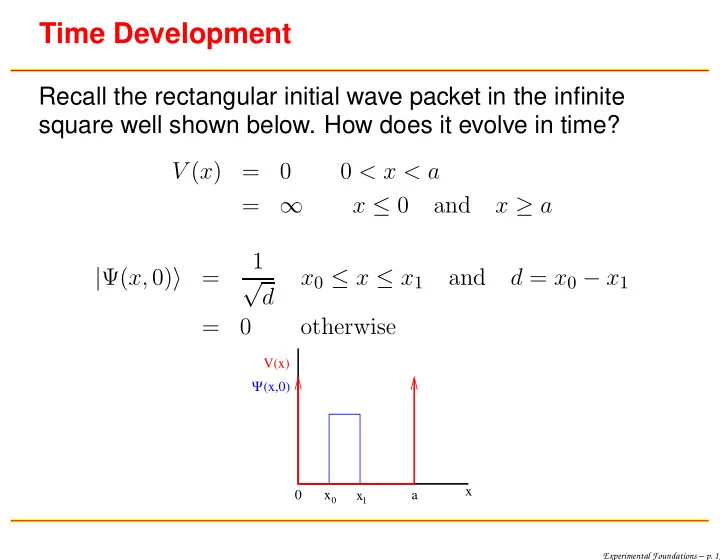
Time Development Recall the rectangular initial wave packet in the infinite square well shown below. How does it evolve in time? V ( x ) = 0 0 < x < a = x 0 and x a 1 | ( x, 0) = x 0 x x 1 and d = x 0


slide-1
SLIDE 1

Time Development

Recall the rectangular initial wave packet in the infinite square well shown below. How does it evolve in time?

V (x) = 0 < x < a = ∞ x ≤ 0 and x ≥ a |Ψ(x, 0) = 1 √ d x0 ≤ x ≤ x1 and d = x0 − x1 =

  • therwise

x0 x1 V(x) Ψ(x,0) a x

Experimental Foundations – p. 1/

slide-2
SLIDE 2

Probabilities of Different States

500 1000 1500 2000 2500 3000 Energy eV 0.1 0.2 0.3 0.4 Probability Square Wave in a Square Well

Experimental Foundations – p. 2/

slide-3
SLIDE 3

Time Development of Square Wave

0.2 0.4 0.6 0.8 1 x 2 4 6 8 Ψ2 t 0.‘ 0.2 0.4 0.6 0.8 1 x 2 4 6 8 Ψ2 t 0.004‘ 0.2 0.4 0.6 0.8 1 x 2 4 6 8 Ψ2 t 0.008‘ 0.2 0.4 0.6 0.8 1 x 2 4 6 8 Ψ2 t 0.012‘

Experimental Foundations – p. 3/

slide-4
SLIDE 4

Time Development of the Initial Gaussian

Recall the Gaussian initial wave packet for the free particle shown below. How does it evolve in time?

V (x) = 0 |Ψ(x, 0) = 1 (2πσ2)1/4e−x2/4σ2

3 2 1 1 2 3 4 x 0.1 0.2 0.3 0.4 0.5

Y

Experimental Foundations – p. 4/

slide-5
SLIDE 5

Time Development of the Initial Gaussian

1 2 3 4 5 6 x 1 2 3 4 5 Ψ2 t 0 1 2 3 4 5 6 x 1 2 3 4 5 P t 1.5 1 2 3 4 5 6 x 1 2 3 4 5 P t 3. 1 2 3 4 5 6 x 1 2 3 4 5 P t 4.5

Experimental Foundations – p. 5/

slide-6
SLIDE 6

Time Development of Nuclear Fusion

Consider a case of one dimensional nuclear ‘fusion’. A neutron is in the potential well of a nucleus that we will approximate with an infinite square well with walls at x = 0 and x = L. The eigenfunctions and eigenvalues are En = n22π2 2ma2 φn =

  • 2

a sin nπx a

  • 0 ≤ x ≤ a

= x < 0 and x > a . The neutron is in the n = 4 state when it fuses with another nucleus that is the same size, instantly putting the neutron in a new infinite square well with walls at x = 0 and x = 2a.

  • 1. What are the new eigenfunctions and eigenvalues of the fused

system?

  • 2. How will the initial wave packet evolve in time?

Experimental Foundations – p. 6/

slide-7
SLIDE 7

Time Development of Nuclear Fusion

2.5 5 7.5 10 12.5 15 17.5 20 xfm 0.05 0.1 0.15 0.2 ΨΨ t 0. 2.5 5 7.5 10 12.5 15 17.5 20 xfm 0.05 0.1 0.15 0.2 ΨΨ t 0.3 2.5 5 7.5 10 12.5 15 17.5 20 xfm 0.05 0.1 0.15 0.2 ΨΨ t 0.6 2.5 5 7.5 10 12.5 15 17.5 20 xfm 0.05 0.1 0.15 0.2 ΨΨ t 0.9

Experimental Foundations – p. 7/