Active Stimulation of the Quasi Coherent Mode by External Antenna - - PowerPoint PPT Presentation

active stimulation of the quasi coherent mode by external
SMART_READER_LITE
LIVE PREVIEW

Active Stimulation of the Quasi Coherent Mode by External Antenna - - PowerPoint PPT Presentation

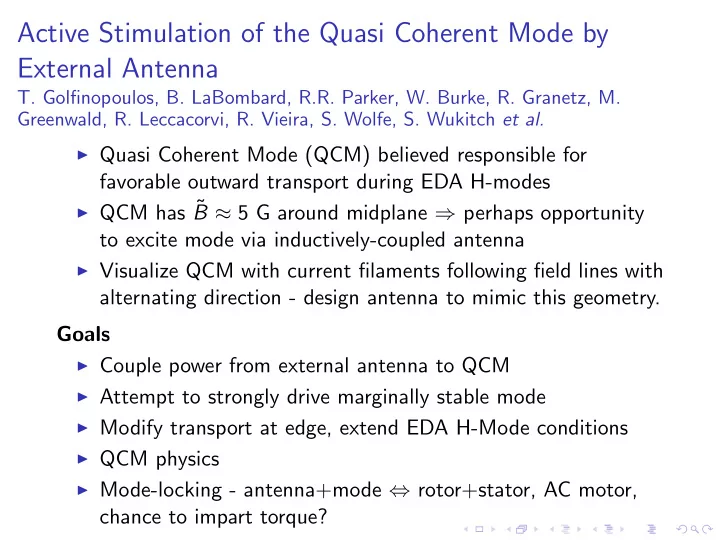
Active Stimulation of the Quasi Coherent Mode by External Antenna T. Golfinopoulos, B. LaBombard, R.R. Parker, W. Burke, R. Granetz, M. Greenwald, R. Leccacorvi, R. Vieira, S. Wolfe, S. Wukitch et al. Quasi Coherent Mode (QCM) believed

slide-1
SLIDE 1

Active Stimulation of the Quasi Coherent Mode by External Antenna

  • T. Golfinopoulos, B. LaBombard, R.R. Parker, W. Burke, R. Granetz, M.

Greenwald, R. Leccacorvi, R. Vieira, S. Wolfe, S. Wukitch et al.

◮ Quasi Coherent Mode (QCM) believed responsible for

favorable outward transport during EDA H-modes

◮ QCM has ˜

B ≈ 5 G around midplane ⇒ perhaps opportunity to excite mode via inductively-coupled antenna

◮ Visualize QCM with current filaments following field lines with

alternating direction - design antenna to mimic this geometry. Goals

◮ Couple power from external antenna to QCM ◮ Attempt to strongly drive marginally stable mode ◮ Modify transport at edge, extend EDA H-Mode conditions ◮ QCM physics ◮ Mode-locking - antenna+mode ⇔ rotor+stator, AC motor,

chance to impart torque?

slide-2
SLIDE 2

Antenna Design

(a) (b) Figure: (a) Antenna design Jan. ’11, Src.: R.

Leccacorvi; Concept: B. LaBombard; (b) Wiring schem. for QCM sys. M⇒matching network, f -dependent

◮ La-doped Mo wire strung

back and forth.

◮ Rapid radial decay

∝ e−kθz ⇒close to plasma

◮ Excited by variable-freq.

source, 1 kW amp. or greater.

◮ Sweep frequency across

range of QCM; detect resonances, f response.

◮ Dwell at fixed f , mod. signal

with slow square wave.

◮ Bandwidth 50-300 kHz so

WCM may also be targeted.

slide-3
SLIDE 3

Run Time

◮ Piggyback 0.1 s or less at end of flattops, especially for EDA

H-mode runs - allows us to assess antenna loading with plasma and calibrate matching network.

◮ Dedicated runs - start with Ohmic EDA H-mode plasmas

described in Snipes2001 (QCM is well-characterized for these plasmas):

  • 1. Low-field (3.2 T) to reduce H-mode threshold
  • 2. Ramp up field (4.2 T) to achieve desired q95 > 3.5 for QCM
  • 3. Slowly reduce L-mode target density below

¯ ne = 1.3 × 10²⁰ m−3 to make QCM marginally stable

  • 4. Drive antenna, swept f and constant f with square-wave mod.

◮ Diagnostics: Fast Magnetics, PCI, GPI, Reflectometer,

scanning probes (Langmuir+magnetic), HIREX Sr, Lyman-α