Contents 1. General Problem 2. Quasi-primal algebras Logics - - PowerPoint PPT Presentation

contents
SMART_READER_LITE
LIVE PREVIEW

Contents 1. General Problem 2. Quasi-primal algebras Logics - - PowerPoint PPT Presentation

General Problem Quasi-primal algebras Primal algebras Ubiquitous algebraizability General Problem Quasi-primal algebras Primal algebras Ubiquitous algebraizability Contents 1. General Problem 2. Quasi-primal algebras Logics associated


slide-1
SLIDE 1

General Problem Quasi-primal algebras Primal algebras Ubiquitous algebraizability

Logics associated with a quasi-primal algebra

Tommaso Moraschini

Joint work with Prof. Josep Maria Font

June 26, 2014

1 / 32 General Problem Quasi-primal algebras Primal algebras Ubiquitous algebraizability

Contents

  • 1. General Problem
  • 2. Quasi-primal algebras

Protoalgebraic logics Truth-equational logics Algebraizable logics An example

  • 3. Primal algebras

Logics of g-matrices Protoalgebraic logics Algebraizable logics An example

  • 4. Ubiquitous algebraizability

2 / 32 General Problem Quasi-primal algebras Primal algebras Ubiquitous algebraizability

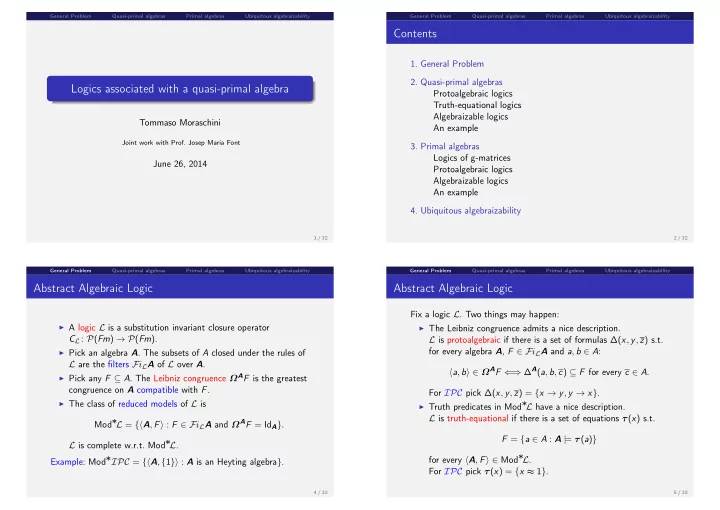
Abstract Algebraic Logic

◮ A logic L is a substitution invariant closure operator

CL : P(Fm) → P(Fm).

◮ Pick an algebra A. The subsets of A closed under the rules of

L are the filters FiLA of L over A.

◮ Pick any F ⊆ A. The Leibniz congruence ΩAF is the greatest

congruence on A compatible with F.

◮ The class of reduced models of L is

Mod∗L = {A, F : F ∈ FiLA and ΩAF = IdA}. L is complete w.r.t. Mod∗L. Example: Mod∗IPC = {A, {1} : A is an Heyting algebra}.

4 / 32 General Problem Quasi-primal algebras Primal algebras Ubiquitous algebraizability

Abstract Algebraic Logic

Fix a logic L. Two things may happen:

◮ The Leibniz congruence admits a nice description.

L is protoalgebraic if there is a set of formulas ∆(x, y, z) s.t. for every algebra A, F ∈ FiLA and a, b ∈ A: a, b ∈ ΩAF ⇐ ⇒ ∆A(a, b, c) ⊆ F for every c ∈ A. For IPC pick ∆(x, y, z) = {x → y, y → x}.

◮ Truth predicates in Mod∗L have a nice description.

L is truth-equational if there is a set of equations τ(x) s.t. F = {a ∈ A : A | = τ(a)} for every A, F ∈ Mod∗L. For IPC pick τ(x) = {x ≈ 1}.

5 / 32

slide-2
SLIDE 2

General Problem Quasi-primal algebras Primal algebras Ubiquitous algebraizability

Abstract Algebraic Logic

regularly algebraizable

  • algebraizable
  • regularly weakly

algebraizable

  • equivalential
  • weakly

algebraizable

  • assertional
  • protoalgebraic

truth-equational Figure : Some classes of the Leibniz hierarchy.

6 / 32 General Problem Quasi-primal algebras Primal algebras Ubiquitous algebraizability

General problem

◮ What can we say about the logic of a (finite) matrix A, F? ◮ Can we classify it within the Leibniz hierarchy somehow?

Yes, mechanically.

◮ Can we classify it within the Leibniz hierarchy in a nicer way?

Yes, for A being a quasi-primal algebra.

◮ How do algebraizable logics of a variety V look like? Are they

determined by a finite matrix? For varieties generated by a (finite) quasi-primal algebra.

7 / 32 General Problem Quasi-primal algebras Primal algebras Ubiquitous algebraizability

Quasi-primal algebras

Given a set A, the ternary discriminator function on A is the map t : A3 → A such that t(a, b, c) = a if a = b c

  • therwise

for every a, b, c ∈ A.

Definition

An algebra A is quasi-primal if there is a term t(x, y, z) which represents the ternary discriminator term on A, i.e., such that tA(x, y, z) is the ternary discriminator function of A.

9 / 32 General Problem Quasi-primal algebras Primal algebras Ubiquitous algebraizability

Protoalgebraic logics

When is a logic of A, F protoalgebraic?

Lemma

Let A be a quasi-primal algebra and C a non-almost inconsistent closure system over A. The logic determined by A, C is protoalgebraic if and only if it has theorems.

Proof.

◮ Pick a theorem ϕ(x) at most in variable x. ◮ Check that

∆(x, y) := {t

  • y, x, ϕ(x)
  • }.

is a set of protoimplication formulas for L.

10 / 32

slide-3
SLIDE 3

General Problem Quasi-primal algebras Primal algebras Ubiquitous algebraizability

Truth-equational logics

When is a logic of A, F truth-equational?

Theorem

Let A be a quasi-primal algebra, τ(x) a set of equations, F ∈ P(A) {A} and L the logic determined by A, F. The following conditions are equivalent: (i) τ(x) defines truth in A, F and L has theorems. (ii) L is truth-equational via τ(x). (iii) L is weakly-algebraizable via τ(x). The equivalence of (i) and (ii) is not true in general!

11 / 32 General Problem Quasi-primal algebras Primal algebras Ubiquitous algebraizability

A counterexample

A counterexample to direction (i)⇒(ii). Let A = {a, b, ⊤}, ✷, ✸, ⊤ be the algebra with unary-operations ✷ and ✸ defined as ✷a = ✷b = b ✷⊤ = ⊤ ✸b = ✸⊤ = ⊤ ✸a = b. Let L be the logic of A, {a, ⊤}. We have that:

◮ L has theorems. ◮ {a, ⊤} is equationally definable by {✷x ≈ ✸x}. ◮ A, {a, ⊤} ∈ Mod∗L.

It is possible to prove that also A, {⊤} ∈ Mod∗L. Hence truth is not not implicitly definable in Mod∗L.

12 / 32 General Problem Quasi-primal algebras Primal algebras Ubiquitous algebraizability

Truth-equational logics

Corollary

Let A be quasi-primal. The following conditions are equivalent: (i) There is a closure system C ⊆ P(A) s.t. A, C determines a non-trivial protoalgebraic logic. (ii) There is an unary term-function ¬A : A → A that is not surjective. For A finite we can strengthen (i) as: (i’) There is a closure system C ⊆ P(A) s.t. A, C determines a non-trivial weakly-algebraizable logic.

13 / 32 General Problem Quasi-primal algebras Primal algebras Ubiquitous algebraizability

Algebraizable logics

Theorem

Let A be a non-trivial finite quasi-primal algebra. The following conditions are equivalent: (i) L is algebraizable with equivalent algebraic semantics V(A). (ii) L has theorems and is the logic determined by A, F, for some F ⊆ A such that F is equationally definable and B ∩ F = B for every non-trivial B ∈ S(A).

14 / 32

slide-4
SLIDE 4

General Problem Quasi-primal algebras Primal algebras Ubiquitous algebraizability

Algebraizable logics

Some sufficient and necessary conditions (or a normal form for algebraizable logics of finite quasi-primal algebras, up to deductive equivalence):

Corollary

Let A finite, non-trivial and quasi-primal. TFAE: (i) There is an algebraizable logic of V(A). (ii) There is an algebraizable logic of V(A) with ρ(x, y) = {x ↔ y} and τ(x) = {x ↔ x ≈ x} for some term x ↔ y. (iii) There is a term x ↔ y s.t. x ↔ x : A → A is idempotent and non-surjective and for every a, b ∈ A a ↔ b ∈ {c ↔ c : c ∈ A} = ⇒ a = b.

15 / 32 General Problem Quasi-primal algebras Primal algebras Ubiquitous algebraizability

Logics of quasi-primal algebras

  • Summary. For the logic of a g-matrix A, C with C ⊆ A non-trivial

closure system and A non-trivial, finite and quasi-primal we have: protoalgebraic ← → having theorems truth-equational ← → having theorems + C = {F, A} for some F equationally definable algebraizable ← → truth-equational + F ∩ B = B for every non-trivial B ∈ S(A). Moreover:

◮ truth-equational ←

→ weakly-algebraizable.

◮ Every algebraizable logic of V(A) is of the kind above.

16 / 32 General Problem Quasi-primal algebras Primal algebras Ubiquitous algebraizability

Logics of quasi-primal algebras

regularly algebraizable

  • algebraizable
  • equivalential
  • weakly

algebraizable

  • protoalgebraic

Figure : Logics of finite quasi-primal algebras.

17 / 32 General Problem Quasi-primal algebras Primal algebras Ubiquitous algebraizability

An example

There are 6 matrices on Ł Ł Ł3, which do not determine a trivial logic. The truth predicate of each of them is equationally definable as follows: Ł Ł Ł3, {1} − → {x ≈ 1} Ł Ł Ł3, {1 2} − → {x ⊕ x ≈ 1, x ⊙ x ≈ 0} Ł Ł Ł3, {0} − → {x ≈ 0} Ł Ł Ł3, {1 2, 1} − → {x ⊕ x ≈ 1} Ł Ł Ł3, {0, 1 2} − → {x ⊙ x ≈ 0} Ł Ł Ł3, {0, 1} − → {x ⊕ x ≈ x}.

18 / 32

slide-5
SLIDE 5

General Problem Quasi-primal algebras Primal algebras Ubiquitous algebraizability

An example

◮ Each of these matrices, except Ł

Ł Ł3, { 1

2}, determines a

truth-equational logic.

◮ The unique matrices which determine an algebraizable logic

are Ł Ł Ł3, {1}, Ł Ł Ł3, {0}, Ł Ł Ł3, {1

2, 1} and Ł

Ł Ł3, {0, 1

2}. ◮ These 4 matrices determine the unique algebraizable logics of

V(Ł Ł Ł3).

19 / 32 General Problem Quasi-primal algebras Primal algebras Ubiquitous algebraizability

Primal algebras

Definition

A finite algebra A is primal if every n-ary function f : An → A, with n ≥ 1, can be represented by a term ϕ(x1, . . . , xn). Post n-valued chains. Given n ∈ ω, we let Pn = {0, . . . , n − 1}, ∧, ∨, ¬, 0, 1 be the algebra where ∧ and ∨ are the lattice operations relative to the order 0 < n − 1 < n − 2 < · · · < 2 < 1 and for every a ∈ Pn ¬(a) = a + 1 if a = n − 1

  • therwise.

21 / 32 General Problem Quasi-primal algebras Primal algebras Ubiquitous algebraizability

Logics of V(A)

How to associate algebras with a logic L? First idea: Mod∗L − → Alg∗L. This is not always a good idea: Alg∗L can fail to be a generalised quasi-variety also for nice logics. New kind of models yield a nicer class AlgL. AlgL = PsdAlg∗L Then, given A, let Log(A) = {L : AlgL = V(A)}, ≤.

22 / 32 General Problem Quasi-primal algebras Primal algebras Ubiquitous algebraizability

Logics of V(A)

Lemma

Let A be primal algebra. ⊢(·) : C(A) → Log(A) is a well-defined

  • rder reversing embedding.

◮ If A has at least three elements, there are logics of V(A)

which are not determined by a g-matrix of the form A, C.

23 / 32

slide-6
SLIDE 6

General Problem Quasi-primal algebras Primal algebras Ubiquitous algebraizability

Protoalgebraic logics

When is a logic of A, F protoalgebraic/equivalential?

Lemma

Let A be a primal algebra and C a non-almost inconsistent closure system over A. The logic L determined by A, C the following conditions are equivalent: (i) L finitely equivalential. (ii) L protoalgebraic. (iii) L has theorems. (iv) ∅ / ∈ C.

24 / 32 General Problem Quasi-primal algebras Primal algebras Ubiquitous algebraizability

Protoalgebraic logics

Proof.

◮ Enumerate A = {a1, . . . , an}. ◮ Assume w.l.o.g. a1 ∈ C(∅). ◮ Given 1 ≤ k ≤ n, let gk : A2 → A be the function defined as

gk(b, c) = a1 if b = c ak

  • therwise

for every b, c ∈ A.

◮ Pick a term x ↔k y which represents gk on A. ◮ The set

∆(x, y) := {x ↔k y : 1 ≤ k ≤ n} is a set of congruence formulas for L.

25 / 32 General Problem Quasi-primal algebras Primal algebras Ubiquitous algebraizability

Algebraizable logics

Theorem

Let A be a non-trivial primal algebra. The following conditions are equivalent: (i) L is algebraizable with equivalent algebraic semantics V(A). (ii) L is maximal in Log(A). (iii) L is the logic determined by A, F, for some F ∈ P(A) {∅, A}.

Corollary

Let A be a primal algebra. There are exactly |P(A)| − 2 algebraizable logics whose equivalent algebraic semantics is V(A).

26 / 32 General Problem Quasi-primal algebras Primal algebras Ubiquitous algebraizability

Logics of primal algebras

  • Summary. For the logic of a g-matrix A, C with C ⊆ A non-trivial

closure system and A non-trivial primal, the Leibniz hierarchy reduces to:

regularly algebraizable

  • algebraizable
  • equivalential

Figure : Logics of finite quasi-primal algebras.

27 / 32

slide-7
SLIDE 7

General Problem Quasi-primal algebras Primal algebras Ubiquitous algebraizability

An example

◮ There are exactly 2n − 2 algebraizable logics of V(Pn).

For n = 3 we have that:

◮ There are 61 different logics determined by a g-matrix whose

algebraic reduct is P3.

◮ 15 of these are equivalential. ◮ 6 of them are algebraizable and coincide with the algebraizable

logics of V(P3).

◮ There are other equivalential logics of V(P3).

28 / 32 General Problem Quasi-primal algebras Primal algebras Ubiquitous algebraizability

Definition

Definition

A finite algebra A is ubiquitous algebraizable if the matrix A, F determines an algebraizable logic of V(A) for every F ∈ P(A) {∅, A}. Primal algebras are ubiquitous algebraizable. Is the converse true? Recall that:

Theorem (Foster-Pixley)

Let A be a finite algebra. A is primal if and only if it is simple, has no subalgebra except itself, its only automorphism is the identity map and generates an arithmetical variety.

30 / 32 General Problem Quasi-primal algebras Primal algebras Ubiquitous algebraizability

Some results

This is work-in-progress. For the moment:

Theorem

Let A be a finite algebra in a congruence permutable variety. A is primal if and only if it is ubiquitous algebraizable. and

Lemma

Let A be a two-element algebra. A is primal if and only if it is ubiquitous algebraizable.

31 / 32 General Problem Quasi-primal algebras Primal algebras Ubiquitous algebraizability

Conclusion

Thank you!

32 / 32