
SLIDE 1
August 2008
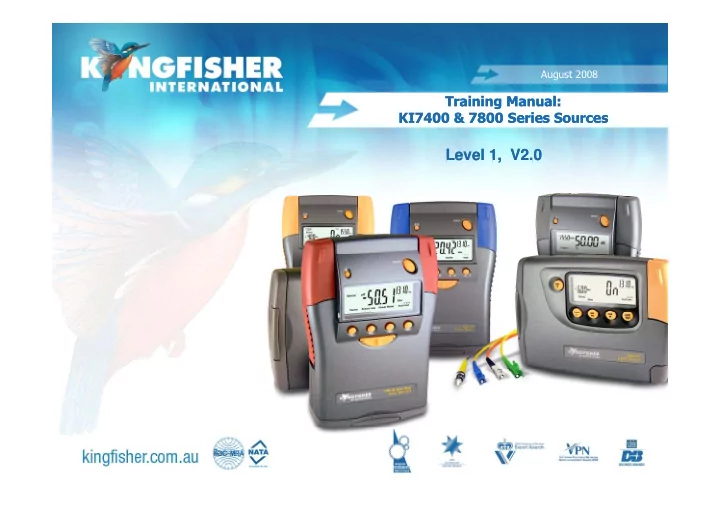
Training Manual: Training Manual: KI7400 & 7800 Series Sources KI7400 & 7800 Series Sources
Level 1, V2.0 Level 1, V2.0
1
Level 1, V2.0 Level 1, V2.0 1 Course Contents Course Contents - - PowerPoint PPT Presentation
August 2008 Training Manual: Training Manual: KI7400 & 7800 Series Sources KI7400 & 7800 Series Sources Level 1, V2.0 Level 1, V2.0 1 Course Contents Course Contents Course Contents Course Contents 1 1. General features
August 2008
Training Manual: Training Manual: KI7400 & 7800 Series Sources KI7400 & 7800 Series Sources
Level 1, V2.0 Level 1, V2.0
1
1 General features 4 Instrument setup 1. General features 2. Models 3. Instrument care 4. Instrument setup 5. Sending light & test tone 6. Change test tone frequency
2
1 / G l F t 1 / G l F t 1./ General Features 1./ General Features
190 hours
series instruments
t t d d t
including SFF
3
2 / M d l 2 / M d l 2./ Models 2./ Models
There are two model styles:
Laser
Usual warm up timing Specify PC or APC Usual warm up timing ** LED source EF compliant for 50μm
4
3 / I t t 3 / I t t 3./ Instrument care 3./ Instrument care
Keep the instrument in its carry case during storage and transport
s u e , e
again.
agents agents.
DO NOT use Acetone or other active solvents as damage may result.
5
4./ Prepare Instrument 4./ Prepare Instrument
a) Keypad b) Fit batteries b) Fit batteries c) Power On / Off d) Launch / Test cord configuration d) Launch / Test cord configuration e) Fit / remove adaptors
6
/ K d / K d a./ Keypad a./ Keypad
Hidden keypad Connector Connector Power On / Off Power On / Off RS232 Model: Backlight USB Model: No function F ft b tt Four soft buttons λ toggle Battery Battery Compartment
7
b / Fit batteries b / Fit batteries b./ Fit batteries b./ Fit batteries To Fit Batteries.
Or
Battery life. Alkaline ‘C’ batteries : 190 Hrs Alkaline C batteries : 190 Hrs Alkaline ‘AA’ batteries : approx 75 hours Low Battery Display. Indicator shows when approximately 10 hours left. Warning Warning. Do not use lithium batteries or other batteries with a nominal voltage greater than 1.8 V. The instrument may become damaged
8
/ P O / Off / P O / Off c./ Power On / Off c./ Power On / Off
10 minutes auto Off or Permanent operation Push the oval Low battery [POWER] button to turn ON or OFF indicator To defeat auto time out. To defeat auto time out. Hold down [POWER] for 3 seconds during turn ON
9
d / L h / T t d fi ti d / L h / T t d fi ti d./ Launch / Test cord configuration d./ Launch / Test cord configuration
The light source is either PC or APC connector specific. This is determined when ordering the instrument and can only be changed at the factory when ordering the instrument, and can only be changed at the factory.
green connector housing
t i t t bl t h i
blue connector housing
beige connector housing
Choose test cord interface to match required configuration
10
/ Ad t / Ad t fitti fitti e./ Adaptor e./ Adaptor - fitting fitting
11
Ad t Ad t l Adaptor Adaptor - removal removal
Current models:
q g
OR
Early models:
u out e st g adapto
12
5./ Sending Light 5./ Sending Light
Source can be operated in one of 3 ways: p y a) Autotest:
b) Manual:
c) Modulated:
13
a./ Auto Test Mode a./ Auto Test Mode
Start Autotest: Press [Auto test]
[Auto test]
the active port
serial number & λ
Source on Menu Auto test <<<
nm
1550
serial number & λ
toggle between source λs
Stop Autotest:
[Menu]
Source off Source Auto test
14
Source
b./ Manual Mode b./ Manual Mode
Source On:
[S ]
Press [Source]
power & active port: <<< / >>> [Source]
Source off Source Auto test
p p /
Toggle [-/+] to select λ or turn off
[-/+]
Source
Source
nm
1550
0 00
+Menu Mod <<<
dBm0.00 Source Off: Press [Menu]
[Menu]
Toggle [-/+] to off position
15
c./ Test Tone c./ Test Tone
Instrument must be in Manual Mode not Autotest
Modulation On: Press [Source]
[Source]
Press [Mod]
Perm
+1550
Source on
dBm
Menu Mod <<<
nm0.00 2000 Hz
1550
[Mod]
Modulation Off: Press [Mod] or Press [Menu]
[Menu]
16
6 / Ch d l ti f 6 / Ch d l ti f 6./ Change modulation frequency 6./ Change modulation frequency
RS232 Models
SHIFT KHz LEVEL dBm/w MAX/MIN SOURCE METER
Set up source in manual mode Open Hidden keypad
CANCEL SET SELECT RECALL
MEMORY
STORE
p yp Press [KHz] Toggle [-/+] to scroll : 270Hz, 1kHz, 2kHz Press [SET] to select tone frequency
Source Hz
+
Press [CANCEL] to exit without changing
Menu
17
USB Models
Default KHZ Level Max/Min dB/W P/F RL-NF RL-Adj
Set up source in manual mode Open Hidden keypad
M+ Set MR Exit dB/W P/F RL NF RL Adj
Open Hidden keypad Press [Г] then [KHz] Toggle [-/+] to scroll : 270Hz, 1kHz, 2kHz
Source
+
Press [Set] to select tone frequency Press [Exit] to exit without changing
Menu Hz
18
Application Notes Application Notes
Comprehensive selection available at ki fi h /A li ti N t ht www.kingfisher.com.au/ApplicationNotes.htm
19
19