Algebraic and Kripke Semantics for Many-Valued Probabilistic Logics - - PowerPoint PPT Presentation

algebraic and kripke semantics for many valued
SMART_READER_LITE
LIVE PREVIEW

Algebraic and Kripke Semantics for Many-Valued Probabilistic Logics - - PowerPoint PPT Presentation

Algebraic and Kripke Semantics for Many-Valued Probabilistic Logics Tommaso Flaminio (Joint works with Lluis Godo and Franco Montagna) Department of Theoretical and Applied Sciences, University of Insubria. Italy tommaso.flaminio@uninsubria.it


slide-1
SLIDE 1

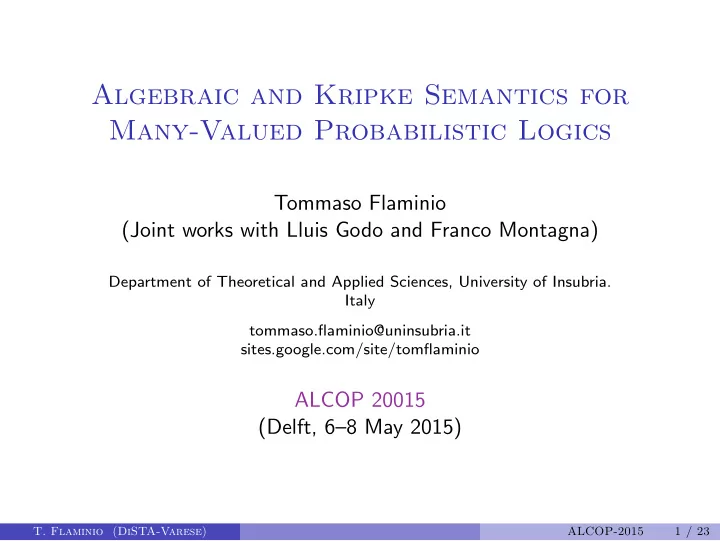
Algebraic and Kripke Semantics for Many-Valued Probabilistic Logics

Tommaso Flaminio (Joint works with Lluis Godo and Franco Montagna)

Department of Theoretical and Applied Sciences, University of Insubria. Italy tommaso.flaminio@uninsubria.it sites.google.com/site/tomflaminio

ALCOP 20015 (Delft, 6–8 May 2015)

  • T. Flaminio (DiSTA-Varese)

ALCOP-2015 1 / 23

slide-2
SLIDE 2

Outline

1

Lukasiewicz logic, MV-algebras and states

2 The modal logic FP(

L, L)

Probabilistic Kripke Models

3 The algebraizable logic SFP(

L, L)

SMV-algebras

4 Comparing the semantics 5 Open problems

  • T. Flaminio (DiSTA-Varese)

ALCOP-2015 2 / 23

slide-3
SLIDE 3

The language of Lukasiewicz logic consists in a set V = {p1, p2, . . .} of propositional variables, the binary connective →, and the truth-constant ⊥ (for falsity). Further connectives are defined as follows: ¬ϕ is ϕ → ⊥ ϕ&ψ is ¬(ϕ → ¬ψ) ϕ ↔ ψ is (ϕ → ψ)&(ψ → ϕ) ϕ ⊕ ψ is ¬ϕ → ψ ϕ ⊖ ψ is ¬(ϕ → ψ) ϕ ∧ ψ is ϕ&(ϕ → ψ) ϕ ∨ ψ is (ϕ → ψ) → ψ Axioms of L: ( L1) ϕ → (ψ → ϕ), ( L2) (ϕ → ψ) → ((ψ → χ) → (ϕ → χ)), ( L3) (¬ϕ → ¬ψ) → (ψ → ϕ), ( L4) ((ϕ → ψ) → ψ) → ((ψ → ϕ) → ϕ). The only inference rule is Modus Ponens: from ϕ and ϕ → ψ, derive ψ.

  • T. Flaminio (DiSTA-Varese)

ALCOP-2015 3 / 23

slide-4
SLIDE 4

An MV-algebra is a system A = (A, ⊕, ¬, 0, 1) satisfying the following conditions: (A, ⊕, 0) is a commutative monoid, ¬(¬x) = x for all x ∈ A, x ⊕ 1 = 1 for all x ∈ A, ¬(x ⊕ ¬y) ⊕ x = ¬(y ⊕ ¬x) ⊕ y for all x, y ∈ A. The class of MV-algebras forms a variety denoted by MV. In any MV-algebra one can define further operations as follows: x → y = (¬x ⊕ y), x ⊖ y = ¬(x → y), x ⊙ y = ¬(¬x ⊕ ¬y), x ↔ y = (x → y) ⊙ (y → x), x ∨ y = (x → y) → y, and x ∧ y = ¬(¬x ∨ y).

  • T. Flaminio (DiSTA-Varese)

ALCOP-2015 4 / 23

slide-5
SLIDE 5

Any MV-algebra A can be equipped with a partial order relation: for all x, y ∈ A, x ≤ y iff x → y = 1. An MV-algebra is said to be an MV-chain if ≤ is linear. An MV-algebra is semisimple if it is isomorphic to an MV-algebra of [0, 1]-valued functions on a compact Hausdorff space X. An MV-algebra is simple if it is isomorphic to an MV-subalgebra of the standard MV-chain: [0, 1]MV = ([0, 1], ⊕, ¬, 0, 1) where: ∀x, y ∈ [0, 1], x ⊕ y = min{1, x + y}, ¬x = 1 − x. (Notice: [0, 1]MV is generic for MV).

  • T. Flaminio (DiSTA-Varese)

ALCOP-2015 5 / 23

slide-6
SLIDE 6

States on MV-algebras

A state on an MV-algebra A is a map s : A → [0, 1] Satisfying: − s(1) = 1, − For all x, y ∈ A s.t. x ⊙ y = 0, s(x ⊕ y) = s(x) + s(y). A state s is said faithful if s(x) = 0, implies x = 0. For every MV-algebra A and every state s, there exists a unique Borel regular probability measure µ on the space of MV-homomorphisms H of A in [0, 1]MV such that, for every a ∈ A, s(a) =

  • H fa dµ.

In other words states represent the expected values of the elements of an MV-algebra, which are regarded as (bounded) random variables.

  • T. Flaminio (DiSTA-Varese)

ALCOP-2015 6 / 23

slide-7
SLIDE 7

The modal logic FP( L, L)

The language of FP( L, L) is obtained by adding a unary modality Pr in the language of Lukasiewicz logic. Formulas are defined by the stipulations: Every Lukasiewicz formula is a formula, For every Lukasiewicz formula ϕ, Pr(ϕ) is an atomic modal formula. (Atomic) modal formulas are closed under ⊕, ⊙, →, ¬. Axioms for FP( L, L) are: All the axioms of Lukasiewicz logic, Pr(¬ϕ) ↔ ¬ Pr(ϕ), Pr(ϕ → ψ) → (Pr(ϕ) → Pr(ψ)), Pr(ϕ ⊕ ψ) ↔ [(Pr(ϕ) → Pr(ϕ ⊙ ψ)) → Pr(ψ)]. Rules are modus ponens, and the necessitation for Pr:

ϕ Pr(ϕ).

  • T. Flaminio (DiSTA-Varese)

ALCOP-2015 7 / 23

slide-8
SLIDE 8

Probabilistic Kripke models

A Probabilistic Kripke Model for FP( L, L) is a system K = (X, s) where: X is a non empty set of evaluations of Lukasiewicz formulas into [0, 1]. s : [0, 1]X → [0, 1] is a state of [0, 1]X. If φ is a formula of FP( L, L), if K is a Kripke model, and x ∈ X, the truth-values

  • f Φ in K at x is defined as:

If Φ is a Lukasiewicz formula, then ΦK,x = x(Φ), If Φ is Pr(ψ) and ψ is

  • Lukasiewicz. Then Pr(ψ)K,x = s(fψ), where

fψ : x ∈ X → x(ψ) ∈ [0, 1]. If Φ is compound, then use truth functions of Lukasiewicz connectives. A probabilistic Kripke model (∗X, ∗s) is a hyperreal-valued probabilistic Kripke model, if each evaluation x ∈ X and the map ∗s ranges on a non-trivial ultrapower ∗[0, 1] of the real unit interval.

  • T. Flaminio (DiSTA-Varese)

ALCOP-2015 8 / 23

slide-9
SLIDE 9

Hyperreal-completeness for FP( L, L)

The logic FP( L, L) is (strongly) complete with respect to the class of hyperreal-valued probabilistic Kripke model.

  • T. Flaminio (DiSTA-Varese)

ALCOP-2015 9 / 23

slide-10
SLIDE 10

The logic SFP( L, L)

The language of SFP( L, L) is that of FP( L, L). Formulas are defined in the usual way dropping the restriction on the modality Pr. Axioms for SFP( L, L) are: All the axioms of Lukasiewicz logic, Pr(⊥) ↔ ⊥, Pr(¬ϕ) ↔ ¬ Pr(ϕ), Pr(Pr(ϕ) ⊕ Pr(ψ)) ↔ (Pr(ϕ) ⊕ Pr(ψ)), Pr(ϕ ⊕ ψ) ↔ Pr(ϕ) ⊕ Pr(ψ ⊖ (ϕ&ψ)). Rules are modus ponens, and the necessitation for Pr:

ϕ Pr(ϕ).

  • T. Flaminio (DiSTA-Varese)

ALCOP-2015 10 / 23

slide-11
SLIDE 11

Semantics for SFP( L, L)

There are two main semantics for SFP( L, L): Probabilistic Kripke models and SMV-algebras.

  • T. Flaminio (DiSTA-Varese)

ALCOP-2015 11 / 23

slide-12
SLIDE 12

Probabilistic Kripke models

A Probabilistic Kripke Model for SFP( L, L) is a system K = (X, s) where: X is a non empty set of evaluations of Lukasiewicz formulas into [0, 1]. s : [0, 1]X → [0, 1] is a state. If φ is a formula of SFP( L, L), if K is a Kripke model, and x ∈ X, the truth-values of Φ in K at x is defined as in the case of FP( L, L). KR1SAT denotes the set of all SFP( L, L)-1-satisfiable formulas. KR1TAUT denotes the set of SFP( L, L)-tautologies.

  • T. Flaminio (DiSTA-Varese)

ALCOP-2015 12 / 23

slide-13
SLIDE 13

SMV-algebras

An SMV-algebras is an algebra A = (A, ⊕, ¬, σ, 0, 1) where: (A, ⊕, ¬, 0, 1) is an MV-algebra, σ : A → A satisfies the following: σ(0) = 0, σ(¬x) = ¬σ(x), σ(σ(x) ⊕ σ(y)) = σ(x) ⊕ σ(y), σ(x ⊕ y) = σ(x) ⊕ σ(y ⊖ (x ⊙ y)). An SMV-algebra is said faithful if σ(x) = 0 implies x = 0. SMV 1SAT denotes the set of SFP( L, L)-1-satisfiable formulas in SMV-algebras. SMV 1TAUT denotes the set of SFP( L, L)-tautologies in SMV-algebras.

  • T. Flaminio (DiSTA-Varese)

ALCOP-2015 13 / 23

slide-14
SLIDE 14

An example

Let X he a non-empty Hausdorff space and let A = C (X) be the MV-algebra of continuous functions from X to [0, 1]. Let µ : B(X) → [0, 1] be a regular Borel probability measure on the Borel subsets

  • f X.

Define σ : A → A in the following manner: for every f ∈ A, σ(f ) =

  • X

f dµ. (where we identify every real number α ∈ [0, 1] with the function in C (X) constantly equal to α). Then (A, σ) is an SMV-algebra. Moreover (A, σ) is simple even though is not linearly ordered.

  • T. Flaminio (DiSTA-Varese)

ALCOP-2015 14 / 23

slide-15
SLIDE 15

On the variety of SMV-algebras

Unlike the case of MV-algebras, the variety SMV is NOT generated by its linearly ordered members. For instance σ(x ∨ y) = σ(x) ∨ σ(y) holds in every SMV-chain, but not in every SMV-algebra.

Theorem

The class of SMV-algebra is generated as a quasivariety, by its members (A, σ) such that σ(A) is an MV-chain.

  • T. Flaminio (DiSTA-Varese)

ALCOP-2015 15 / 23

slide-16
SLIDE 16

Standard SMV-algebras

We already noticed that SMV is not generated by SMV-chains. The following definition introduces a candidate for standard SMV-algebras.

Definition

An SMV-algebra (A, σ) is said to be σ-simple if A is semisimple (i.e. an algebra

  • f continuous [0, 1]-valued functions), and σ(A) is a simple algebra (i.e. an

MV-subalgebra of [0, 1]MV ). ST1SAT denotes the set of SFP( L, L)-1-satisfiable formulas in σ-simple SMV-algebras. ST1TAUT denotes the set of SFP( L, L)-tautologies in σ-simple SMV-algebras.

  • T. Flaminio (DiSTA-Varese)

ALCOP-2015 16 / 23

slide-17
SLIDE 17

Tensor SMV-algebras

An interesting subclass of SMV-algebras can be built from an MV-algebra and an (external) state s of A in the following manner: Let A be an MV-algebra, and let s : A → [0, 1] be a state. Let T be the MV-algebra defined as [0, 1]MV ⊗ A, Let σs : T → T be the internal state defined by: for all α ⊗ a ∈ T , σs(α ⊗ a) = α · s(a) ⊗ 1. Any SMV-algebra of this kind is called tensor SMV-algebra. Tensor1SAT denotes the set of 1- satisfiable SFP( L, L)-formulas in tensor SMV-algebras Tensor1TAUT denotes the set of all SFP( L, L)-tautologies in tensor SMV-algebras.

  • T. Flaminio (DiSTA-Varese)

ALCOP-2015 17 / 23

slide-18
SLIDE 18

1-Satisfiability

Let φ be a formula in SFP. The following are equivalent

1

φ ∈ ST1SAT,

2

φ ∈ KR1SAT,

3

φ ∈ SMV 1SAT.

  • T. Flaminio (DiSTA-Varese)

ALCOP-2015 18 / 23

slide-19
SLIDE 19

1-Tautologies

Let φ be a formula in SFP. The following are equivalent

1

φ ∈ ST1TAUT,

2

φ ∈ Tensor1TAUT,

3

φ ∈ KR1TAUT.

  • T. Flaminio (DiSTA-Varese)

ALCOP-2015 19 / 23

slide-20
SLIDE 20

Open problems (1)

We know that the logic SFP( L, L) is complete w.r.t. the class of SMV-algebra. In particular, the following holds

Theorem

Let φ be a formula of SFP, then

1

φ is a theorem of SFP( L, L),

2

φ ∈ SMV 1TAUT,

3

φ is a tautology for those SMV-algebras (A, σ) such that σ(A) is an MV-chain. Q1: Is SFP( L, L) complete w.r.t. σ-simple SMV-algebras? In other words, is SMV 1TAUT = ST1TAUT? equivalently, is SMV 1TAUT = KR1TAUT?

  • T. Flaminio (DiSTA-Varese)

ALCOP-2015 20 / 23

slide-21
SLIDE 21

Open problems (2)

We already noticed that SFP( L, L) extends FP( L, L). The latter is known to be complete w.r.t. hyperreal-valued probabilistic Kripke models. Q2: Is SFP( L, L) a conservative extension of FP( L, L)? In other words, if φ is an FP-formula and ∗X, ∗s is a hyperreal-valued Kripke model such that ∗X, ∗s | = φ, can we define an SMV-algebra (A, σ) such that (A, σ) | = φ? Remark (join work with Lluis Godo): If Q2 is true, then we (should) have a proof for the standard completeness of SFP( L, L). (SMV1TAUT=ST1TAUT=KR1TAUT).

  • T. Flaminio (DiSTA-Varese)

ALCOP-2015 21 / 23

slide-22
SLIDE 22

Cignoli R., D’Ottaviano I.M.L., Mundici D., Algebraic Foundations

  • f Many-valued Reasoning. Kluwer, Dordrecht, 2000.

Flaminio T., Godo L., A logic for reasoning on the probability of fuzzy

  • events. Fuzzy Sets and Systems, 158, 625–638, 2007.

Flamino T., Montagna F., An algebraic approach to states on MV-algebras. In Proceedings of EUSFLAT’07. M. ˇ Stˇ epniˇ cka, V. Nov´ ak, U. Bodenhofer (Eds.), Vol 2, 201–2006, 2007. H´ ajek P., Complexity of fuzzy probability logics II. Fuzzy Sets and Systems, 158(23), pp. 2605–2611, 2007. Mundici D., Averaging the truth-value in Lukasiewicz logic. Studia Logica 55(1), 113–127, (1995). Mundici D., Tensor Products and the Loomis-Sikorski Theorem for MV-Algebras. Advances in Applied Mathematics, 22, 227–248, 1999.

  • T. Flaminio (DiSTA-Varese)

ALCOP-2015 22 / 23

slide-23
SLIDE 23

THANK YOU FOR YOUR ATTENTION!

  • T. Flaminio (DiSTA-Varese)

ALCOP-2015 23 / 23