Outline Time series and forecasting Time series objects 1 in R - - PDF document

outline time series and forecasting
SMART_READER_LITE
LIVE PREVIEW

Outline Time series and forecasting Time series objects 1 in R - - PDF document

Time series and forecasting in R 1 Time series and forecasting in R 2 Outline Time series and forecasting Time series objects 1 in R Basic time series functionality 2 The forecast package 3 Rob J Hyndman Exponential smoothing 4 ARIMA


slide-1
SLIDE 1

Time series and forecasting in R 1

Time series and forecasting in R

Rob J Hyndman 29 June 2008

Time series and forecasting in R 2

Outline

1

Time series objects

2

Basic time series functionality

3

The forecast package

4

Exponential smoothing

5

ARIMA modelling

6

More from the forecast package

7

Time series packages on CRAN

Time series and forecasting in R Time series objects 4

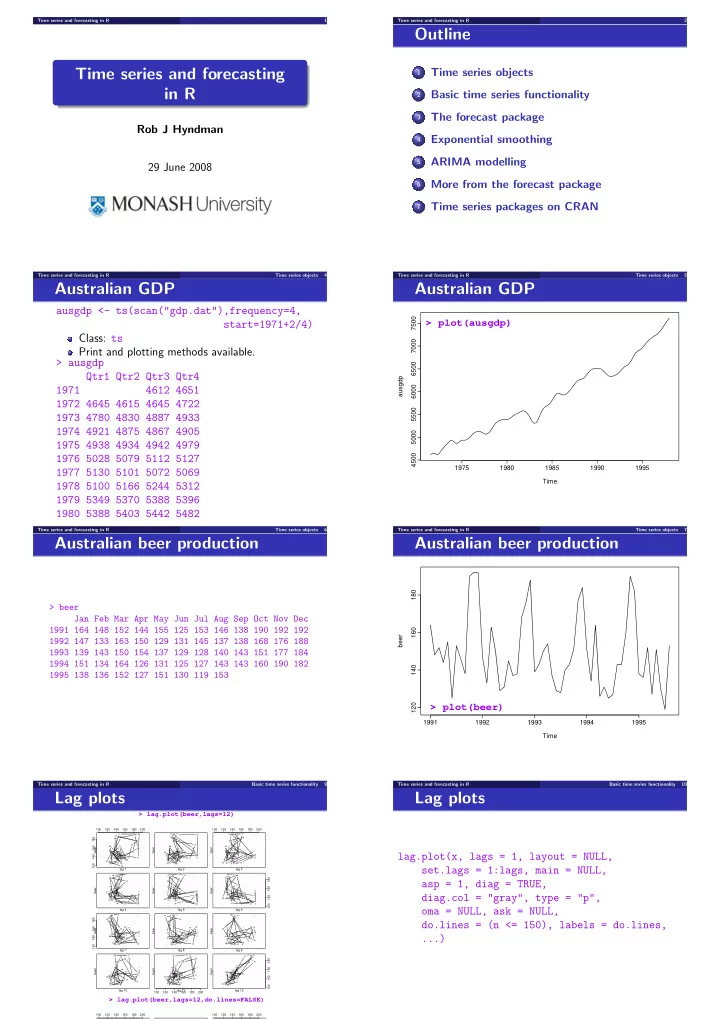
Australian GDP

ausgdp <- ts(scan("gdp.dat"),frequency=4, start=1971+2/4) Class: ts Print and plotting methods available. > ausgdp Qtr1 Qtr2 Qtr3 Qtr4 1971 4612 4651 1972 4645 4615 4645 4722 1973 4780 4830 4887 4933 1974 4921 4875 4867 4905 1975 4938 4934 4942 4979 1976 5028 5079 5112 5127 1977 5130 5101 5072 5069 1978 5100 5166 5244 5312 1979 5349 5370 5388 5396 1980 5388 5403 5442 5482

Time series and forecasting in R Time series objects 5

Australian GDP

Time ausgdp 1975 1980 1985 1990 1995 4500 5000 5500 6000 6500 7000 7500

> plot(ausgdp)

Time series and forecasting in R Time series objects 6

Australian beer production

> beer Jan Feb Mar Apr May Jun Jul Aug Sep Oct Nov Dec 1991 164 148 152 144 155 125 153 146 138 190 192 192 1992 147 133 163 150 129 131 145 137 138 168 176 188 1993 139 143 150 154 137 129 128 140 143 151 177 184 1994 151 134 164 126 131 125 127 143 143 160 190 182 1995 138 136 152 127 151 130 119 153

Time series and forecasting in R Time series objects 7

Australian beer production

Time beer 1991 1992 1993 1994 1995 120 140 160 180

> plot(beer)

Time series and forecasting in R Basic time series functionality 9

Lag plots

lag 1 beer

1 2 3 4 5 6 7 8 9 10 11 12 13 14 15 16 17 18 19 20 21 22 23 24 25 26 27 28 29 30 31 32 33 34 35 36 37 38 39 40 41 42 43 44 45 46 47 48 49 50 51 52 53 54 55

120 140 160 180 100 120 140 160 180 200 lag 2 beer

1 2 3 4 5 6 7 8 9 10 11 12 13 14 15 16 17 18 19 20 21 22 23 24 25 26 27 28 29 30 31 32 33 34 35 36 37 38 39 40 41 42 43 44 45 46 47 48 49 50 51 52 53 54

lag 3 beer

1 2 3 4 5 6 7 8 9 10 11 12 13 14 15 16 17 18 19 20 21 22 23 24 25 26 27 28 29 30 31 32 33 34 35 36 37 38 39 40 41 42 43 44 45 46 47 48 49 50 51 52 53

100 120 140 160 180 200 lag 4 beer

1 2 3 4 5 6 7 8 9 10 11 12 13 14 15 16 17 18 19 20 21 22 23 24 25 26 27 28 29 30 31 32 33 34 35 36 37 38 39 40 41 42 43 44 45 46 47 48 49 50 51 52

lag 5 beer

1 2 3 4 5 6 7 8 9 10 11 12 13 14 15 16 17 18 19 2021 22 23 24 25 26 27 28 29 30 31 32 33 34 35 36 37 38 39 40 41 42 43 44 45 46 47 48 49 50 51

lag 6 beer

1 2 3 4 5 6 7 8 9 10 11 12 13 14 15 16 17 18 19 20 21 22 23 24 25 26 27 28 29 30 31 32 33 34 35 36 37 38 39 40 41 42 43 44 45 46 47 48 49 50

120 140 160 180 lag 7 beer

1 2 3 4 5 6 7 8 9 10 11 12 13 14 15 16 17 18 19 2021 22 23 24 25 26 27 28 29 30 31 32 33 34 35 36 37 38 39 40 41 42 43 44 45 46 47 48 49

120 140 160 180 lag 8 beer

1 2 3 4 5 6 7 8 9 10 11 12 13 14 15 16 1718 19 20 21 22 23 24 25 26 27 28 29 30 31 3233 34 35 36 37 38 39 40 41 42 43 44 45 46 47 48

lag 9 beer

1 2 3 4 5 6 7 8 9 10 11 12 13 14 15 16 17 18 19 20 21 22 23 24 25 26 27 28 29 30 31 32 33 34 35 36 37 38 39 40 41 42 43 44 45 46 47

lag 10 beer

1 2 3 4 5 6 7 8 9 10 11 12 13 14 15 16 1718 19 20 21 22 23 24 25 26 27 28 29 3031 32 33 34 35 36 37 38 39 40 41 42 43 44 45 46

lag 11 beer

1 2 3 4 5 6 7 8 9 10 11 12 13 14 15 16 17 18 19 20 21 22 23 24 25 26 27 28 29 30 31 32 33 34 35 36 37 38 39 40 41 42 43 44 45

100 120 140 160 180 200 lag 12 beer

1 2 3 4 5 6 7 8 9 10 11 12 13 14 15 16 17 18 19 20 21 22 23 24 25 26 27 28 29 30 31 32 33 34 35 36 37 38 39 40 41 42 43 44

120 140 160 180

> lag.plot(beer,lags=12)

100 120 140 160 180 200 100 120 140 160 180 200

> lag.plot(beer,lags=12,do.lines=FALSE)

Time series and forecasting in R Basic time series functionality 10

Lag plots

lag.plot(x, lags = 1, layout = NULL, set.lags = 1:lags, main = NULL, asp = 1, diag = TRUE, diag.col = "gray", type = "p",

  • ma = NULL, ask = NULL,

do.lines = (n <= 150), labels = do.lines, ...)

slide-2
SLIDE 2

Time series and forecasting in R Basic time series functionality 11

ACF

0.0 0.2 0.4 0.6 0.8 1.0 1.2 1.4 −0.4 −0.2 0.0 0.2 0.4 0.6 0.8 1.0 Lag ACF

> acf(beer)

Time series and forecasting in R Basic time series functionality 12

PACF

0.2 0.4 0.6 0.8 1.0 1.2 1.4 −0.2 0.0 0.2 0.4 Lag Partial ACF

> pacf(beer)

Time series and forecasting in R Basic time series functionality 13

ACF/PACF

acf(x, lag.max = NULL, type = c("correlation", "covariance", "partial"), plot = TRUE, na.action = na.fail, demean = TRUE, ...) pacf(x, lag.max, plot, na.action, ...) ARMAacf(ar = numeric(0), ma = numeric(0), lag.max = r, pacf = FALSE)

Time series and forecasting in R Basic time series functionality 14

Spectrum

1 2 3 4 5 6 0.2 0.5 2.0 5.0 20.0 100.0 500.0 frequency spectrum

Raw periodogram

> spectrum(beer)

Time series and forecasting in R Basic time series functionality 15

Spectrum

1 2 3 4 5 6 10 20 50 100 200 500 1000 frequency spectrum

AR(12) spectrum

> spectrum(beer,method="ar")

Time series and forecasting in R Basic time series functionality 16

Spectrum

spectrum(x, ..., method = c("pgram", "ar")) spec.pgram(x, spans = NULL, kernel, taper = 0.1, pad = 0, fast = TRUE, demean = FALSE, detrend = TRUE, plot = TRUE, na.action = na.fail, ...) spec.ar(x, n.freq, order = NULL, plot = TRUE, na.action = na.fail, method = "yule-walker", ...)

Time series and forecasting in R Basic time series functionality 17

Classical decomposition

130 160 190

  • bserved

146 150 154

trend

−20 20 40

seasonal

−20 10 1991 1992 1993 1994 1995

random Time

Decomposition of additive time series decompose(beer)

Time series and forecasting in R Basic time series functionality 18

STL decomposition

120 160

data

−20 20

seasonal

146 152 158

trend

−15 −5 5 15 1991 1992 1993 1994 1995

remainder time

plot(stl(beer,s.window="periodic"))

slide-3
SLIDE 3

Time series and forecasting in R Basic time series functionality 19

Decomposition

decompose(x, type = c("additive", "multiplicative"), filter = NULL) stl(x, s.window, s.degree = 0, t.window = NULL, t.degree = 1, l.window = nextodd(period), l.degree = t.degree, s.jump = ceiling(s.window/10), t.jump = ceiling(t.window/10), l.jump = ceiling(l.window/10), robust = FALSE, inner = if(robust) 1 else 2,

  • uter = if(robust) 15 else 0,

na.action = na.fail)

Time series and forecasting in R The forecast package 21

forecast package

> forecast(beer) Point Forecast Lo 80 Hi 80 Lo 95 Hi 95 Sep 1995 138.5042 128.2452 148.7632 122.8145 154.1940 Oct 1995 169.1987 156.6506 181.7468 150.0081 188.3894 Nov 1995 181.6725 168.1640 195.1810 161.0131 202.3320 Dec 1995 178.5394 165.2049 191.8738 158.1461 198.9327 Jan 1996 144.0816 133.2492 154.9140 127.5148 160.6483 Feb 1996 135.7967 125.4937 146.0996 120.0396 151.5537 Mar 1996 151.4813 139.8517 163.1110 133.6953 169.2673 Apr 1996 138.9345 128.1106 149.7584 122.3808 155.4882 May 1996 138.5279 127.5448 149.5110 121.7307 155.3250 Jun 1996 127.0269 116.7486 137.3052 111.3076 142.7462 Jul 1996 134.9452 123.7716 146.1187 117.8567 152.0337 Aug 1996 145.3088 132.9658 157.6518 126.4318 164.1858 Sep 1996 139.7348 127.4679 152.0018 120.9741 158.4955 Oct 1996 170.6709 155.2397 186.1020 147.0709 194.2708 Nov 1996 183.2204 166.1298 200.3110 157.0826 209.3582 Dec 1996 180.0290 162.6798 197.3783 153.4957 206.5624 Jan 1997 145.2589 130.7803 159.7374 123.1159 167.4019 Feb 1997 136.8833 122.7595 151.0071 115.2828 158.4838 Mar 1997 152.6684 136.3514 168.9854 127.7137 177.6231 Apr 1997 140.0008 124.4953 155.5064 116.2871 163.7145 May 1997 139.5691 123.5476 155.5906 115.0663 164.0719 Jun 1997 127.9620 112.7364 143.1876 104.6764 151.2476 Jul 1997 135.9181 119.1567 152.6795 110.2837 161.5525 Aug 1997 146.3349 127.6354 165.0344 117.7365 174.9332

Time series and forecasting in R The forecast package 22

forecast package

Forecasts from ETS(M,Ad,M)

1991 1992 1993 1994 1995 1996 1997 100 120 140 160 180 200

> plot(forecast(beer))

Time series and forecasting in R The forecast package 23

forecast package

> summary(forecast(beer)) Forecast method: ETS(M,Ad,M) Smoothing parameters: alpha = 0.0267 beta = 0.0232 gamma = 0.025 phi = 0.98 Initial states: l = 162.5752 b = -0.1598 s = 1.1979 1.2246 1.1452 0.9354 0.9754 0.9068 0.8523 0.9296 0.9342 1.0160 0.9131 0.9696 sigma: 0.0578 AIC AICc BIC 499.0295 515.1347 533.4604 In-sample error measures: ME RMSE MAE MPE MAPE MASE 0.07741197 8.41555052 7.03312900 -0.29149125 4.78826138 0.43512047

Time series and forecasting in R The forecast package 24

forecast package

Automatic exponential smoothing state space modelling. Automatic ARIMA modelling Forecasting intermittent demand data using Croston’s method Forecasting using Theta method Forecasting methods for most time series modelling functions including arima(), ar(), StructTS(), ets(), and others. Part of the forecasting bundle along with fma, expsmooth and Mcomp.

Time series and forecasting in R Exponential smoothing 26

Exponential smoothing

Classic Reference Makridakis, Wheelwright and Hyndman (1998) Forecasting: methods and applications, 3rd ed., Wiley: NY. Current Reference

1฀3

Springer Series in Statistics Rob J.Hyndman · Anne B.Koehler J.Keith Ord · Ralph D.Snyder

Forecasting with Exponential Smoothing

The State Space Approach 1

Hyndman, Koehler, Ord and Snyder (2008) Forecasting with exponential smoothing: the state space approach, Springer-Verlag: Berlin.

Time series and forecasting in R Exponential smoothing 27

Exponential smoothing

Until recently, there has been no stochastic modelling framework incorporating likelihood calculation, prediction intervals, etc. Ord, Koehler & Snyder (JASA, 1997) and Hyndman, Koehler, Snyder and Grose (IJF, 2002) showed that all ES methods (including non-linear methods) are optimal forecasts from innovation state space models. Hyndman et al. (2008) provides a comprehensive and up-to-date survey of the area. The forecast package implements the framework of HKSO.

Time series and forecasting in R Exponential smoothing 28

Exponential smoothing

Seasonal Component Trend N A M Component (None) (Additive) (Multiplicative) N (None) N,N N,A N,M A (Additive) A,N A,A A,M Ad (Additive damped) Ad,N Ad,A Ad,M M (Multiplicative) M,N M,A M,M Md (Multiplicative damped) Md,N Md,A Md,M

General notation ETS(Error,Trend,Seasonal) ExponenTial Smoothing ETS(A,N,N): Simple exponential smoothing with ad- ditive errors ETS(A,A,N): Holt’s linear method with additive er- rors ETS(A,A,A): Additive Holt-Winters’ method with

slide-4
SLIDE 4

Time series and forecasting in R Exponential smoothing 29

Innovations state space models

No trend or seasonality and multiplicative errors Example: ETS(M,N,N) yt = ℓt−1(1 + εt) ℓt = αyt + (1 − α)ℓt−1 = ℓt−1(1 + αεt) 0 ≤ α ≤ 1 εt is white noise with mean zero. All exponential smoothing models can be written using analogous state space equations.

Time series and forecasting in R Exponential smoothing 30

Innovation state space models

Let xt = (ℓt, bt, st, st−1, . . . , st−m+1) and εt

iid

∼ N(0, σ2). Example: Holt-Winters’ multiplicative seasonal method Example: ETS(M,A,M) Yt = (ℓt−1 + bt−1)st−m(1 + εt) ℓt = α(yt/st−m) + (1 − α)(ℓt−1 + bt−1) bt = β(ℓt − ℓt−1) + (1 − β)bt−1 st = γ(yt/(ℓt−1 + bt−1)) + (1 − γ)st−m where 0 ≤ α ≤ 1, 0 ≤ β ≤ α, 0 ≤ γ ≤ 1 − α and m is the period of seasonality.

Time series and forecasting in R Exponential smoothing 31

Exponential smoothing

From Hyndman et al. (2008): Apply each of 30 methods that are appropriate to the data. Optimize parameters and initial values using MLE (or some other criterion). Select best method using AIC: AIC = −2 log(Likelihood) + 2p where p = # parameters. Produce forecasts using best method. Obtain prediction intervals using underlying state space model. Method performed very well in M3 competition.

Time series and forecasting in R Exponential smoothing 32

Exponential smoothing

fit <- ets(beer) fit2 <- ets(beer,model="MNM",damped=FALSE) fcast1 <- forecast(fit, h=24) fcast2 <- forecast(fit2, h=24)

ets(y, model="ZZZ", damped=NULL, alpha=NULL, beta=NULL, gamma=NULL, phi=NULL, additive.only=FALSE, lower=c(rep(0.01,3), 0.8), upper=c(rep(0.99,3),0.98),

  • pt.crit=c("lik","amse","mse","sigma"), nmse=3,

bounds=c("both","usual","admissible"), ic=c("aic","aicc","bic"), restrict=TRUE)

Time series and forecasting in R Exponential smoothing 33

Exponential smoothing

> fit ETS(M,Ad,M) Smoothing parameters: alpha = 0.0267 beta = 0.0232 gamma = 0.025 phi = 0.98 Initial states: l = 162.5752 b = -0.1598 s = 1.1979 1.2246 1.1452 0.9354 0.9754 0.9068 0.8523 0.9296 0.9342 1.016 0.9131 0.9696 sigma: 0.0578 AIC AICc BIC 499.0295 515.1347 533.4604

Time series and forecasting in R Exponential smoothing 34

Exponential smoothing

> fit2 ETS(M,N,M) Smoothing parameters: alpha = 0.247 gamma = 0.01 Initial states: l = 168.1208 s = 1.2417 1.2148 1.1388 0.9217 0.9667 0.8934 0.8506 0.9182 0.9262 1.049 0.9047 0.9743 sigma: 0.0604 AIC AICc BIC 500.0439 510.2878 528.3988

Time series and forecasting in R Exponential smoothing 35

Exponential smoothing

ets() function Automatically chooses a model by default using the AIC Can handle any combination of trend, seasonality and damping Produces prediction intervals for every model Ensures the parameters are admissible (equivalent to invertible) Produces an object of class ets.

Time series and forecasting in R Exponential smoothing 36

Exponential smoothing

ets objects Methods: coef(), plot(), summary(), residuals(), fitted(), simulate() and forecast() plot() function shows time plots of the

  • riginal time series along with the

extracted components (level, growth and seasonal).

slide-5
SLIDE 5

Time series and forecasting in R Exponential smoothing 37

Exponential smoothing

120 160

  • bserved

145 155

level

−1.0 0.0 0.5

slope

0.9 1.1 1991 1992 1993 1994 1995

season Time

Decomposition by ETS(M,Ad,M) method plot(fit)

Time series and forecasting in R Exponential smoothing 38

Goodness-of-fit

> accuracy(fit) ME RMSE MAE MPE MAPE MASE 0.0774 8.4156 7.0331 -0.2915 4.7883 0.4351 > accuracy(fit2) ME RMSE MAE MPE MAPE MASE

  • 1.3884

9.0015 7.3303 -1.1945 5.0237 0.4535

Time series and forecasting in R Exponential smoothing 39

Forecast intervals

Forecasts from ETS(M,Ad,M)

1991 1992 1993 1994 1995 1996 1997 100 120 140 160 180 200

> plot(forecast(fit,level=c(50,80,95)))

Forecasts from ETS(M,Ad,M)

1991 1992 1993 1994 1995 1996 1997 100 120 140 160 180 200

> plot(forecast(fit,fan=TRUE))

Time series and forecasting in R Exponential smoothing 40

Exponential smoothing

ets() function also allows refitting model to new data set.

> usfit <- ets(usnetelec[1:45]) > test <- ets(usnetelec[46:55], model = usfit) > accuracy(test) ME RMSE MAE MPE MAPE MASE

  • 4.3057 58.1668 43.5241 -0.1023

1.1758 0.5206 > accuracy(forecast(usfit,10), usnetelec[46:55]) ME RMSE MAE MPE MAPE MASE ACF1 Theil’s U 46.36580 65.55163 49.83883 1.25087 1.35781 0.72895 0.08899 0.73725

Time series and forecasting in R Exponential smoothing 41

forecast package

forecast() function Takes either a time series as its main argument, or a time series model. Methods for objects of class ts, ets, arima, HoltWinters, StructTS, ar and others. If argument is ts, it uses ets model. Calls predict() when appropriate. Output as class forecast.

Time series and forecasting in R Exponential smoothing 42

forecast package

forecast class contains Original series Point forecasts Prediction intervals Forecasting method used Forecasting model information Residuals One-step forecasts for observed data Methods applying to the forecast class: print plot summary

Time series and forecasting in R ARIMA modelling 44

ARIMA modelling

The arima() function in the stats package provides seasonal and non-seasonal ARIMA model estimation including covariates. However, it does not allow a constant unless the model is stationary It does not return everything required for forecast() It does not allow re-fitting a model to new data. So I prefer the Arima() function in the forecast package which acts as a wrapper to arima(). Even better, the auto.arima() function in the forecast package.

Time series and forecasting in R ARIMA modelling 45

ARIMA modelling

> fit <- auto.arima(beer) > fit Series: beer ARIMA(0,0,0)(1,0,0)[12] with non-zero mean Coefficients: sar1 intercept 0.8431 152.1132 s.e. 0.0590 5.1921 sigma^2 estimated as 122.1: log likelihood = -221.44 AIC = 448.88 AICc = 449.34 BIC = 454.95

slide-6
SLIDE 6

Time series and forecasting in R ARIMA modelling 46

How does auto.arima() work?

A seasonal ARIMA process Φ(Bm)φ(B)(1 − Bm)D(1 − B)dyt = c + Θ(Bm)θ(B)εt Need to select appropriate orders: p, q, P, Q, D, d Use Hyndman and Khandakar (JSS, 2008) algorithm: Select no. differences d and D via unit root tests. Select p, q, P, Q by minimising AIC. Use stepwise search to traverse model space.

Time series and forecasting in R ARIMA modelling 47

How does auto.arima() work?

AIC = −2 log(L) + 2(p + q + P + Q + k) where L is the maximised likelihood fitted to the differenced data, k = 1 if c = 0 and k = 0 otherwise. Step 1: Select current model (with smallest AIC) from: ARIMA(2, d, 2)(1, D, 1)m ARIMA(0, d, 0)(0, D, 0)m ARIMA(1, d, 0)(1, D, 0)m if seasonal ARIMA(0, d, 1)(0, D, 1)m Step 2: Consider variations of current model:

  • vary one of p, q, P, Q from current model by ±1
  • p, q both vary from current model by ±1.
  • P, Q both vary from current model by ±1.
  • Include/exclude c from current model

Model with lowest AIC becomes current model. Repeat Step 2 until no lower AIC can be found.

Time series and forecasting in R ARIMA modelling 48

ARIMA modelling

Forecasts from ARIMA(0,0,0)(1,0,0)[12] with non−zero mean

1991 1992 1993 1994 1995 1996 1997 100 120 140 160 180 200

> plot(forecast(fit))

Forecasts from ETS(M,Ad,M)

1991 1992 1993 1994 1995 1996 1997 100 120 140 160 180 200

> plot(forecast(beer))

Time series and forecasting in R ARIMA modelling 49

ARIMA vs ETS

Myth that ARIMA models more general than exponential smoothing. Linear exponential smoothing models all special cases of ARIMA models. Non-linear exponential smoothing models have no equivalent ARIMA counterparts. Many ARIMA models which have no exponential smoothing counterparts. ETS models all non-stationary. Models with seasonality or non-damped trend (or both) have two unit roots; all other models—that is, non-seasonal models with either no trend or damped trend—have one unit root.

Time series and forecasting in R More from the forecast package 51

Other forecasting functions

croston() implements Croston’s (1972) method for intermittent demand forecasting. theta() provides forecasts from the Theta method. splinef() gives cubic-spline forecasts, based on fitting a cubic spline to the historical data and extrapolating it linearly. meanf() returns forecasts based on the historical mean. rwf() gives “na¨ ıve” forecasts equal to the most recent observation assuming a random walk model.

Time series and forecasting in R More from the forecast package 52

Other plotting functions

tsdisplay() provides a time plot along with an ACF and PACF. seasonplot() produces a seasonal plot.

Time series and forecasting in R More from the forecast package 53

tsdisplay

1991 1992 1993 1994 1995 120 140 160 180

  • 5

10 15 −0.4 0.0 0.4 Lag ACF 5 10 15 −0.4 0.0 0.4 Lag PACF

> tsdisplay(beer)

Time series and forecasting in R More from the forecast package 54

seasonplot

  • 120

140 160 180 Month Jan Feb Mar Apr May Jun Jul Aug Sep Oct Nov Dec

> seasonplot(beer)

slide-7
SLIDE 7

Time series and forecasting in R Time series packages on CRAN 56

Basic facilities

stats Contains substantial time series capabilities including the ts class for regularly spaced time series. Also ARIMA modelling, structural models, time series plots, acf and pacf graphs, classical decomposition and STL decomposition.

Time series and forecasting in R Time series packages on CRAN 57

Forecasting and univariate modelling

forecast Lots of univariate time series methods including automatic ARIMA modelling, exponential smoothing via state space models, and the forecast class for consistent handling of time series

  • forecasts. Part of the forecasting

bundle. tseries GARCH models and unit root tests. FitAR Subset AR model fitting partsm Periodic autoregressive time series models pear Periodic autoregressive time series models

Time series and forecasting in R Time series packages on CRAN 58

Forecasting and univariate modelling

ltsa Methods for linear time series analysis dlm Bayesian analysis of Dynamic Linear Models. timsac Time series analysis and control fArma ARMA Modelling fGarch ARCH/GARCH modelling BootPR Bias-corrected forecasting and bootstrap prediction intervals for autoregressive time series gsarima Generalized SARIMA time series simulation bayesGARCH Bayesian Estimation of the GARCH(1,1) Model with t innovations

Time series and forecasting in R Time series packages on CRAN 59

Resampling and simulation

boot Bootstrapping, including the block bootstrap with several variants. meboot Maximum Entropy Bootstrap for Time Series

Time series and forecasting in R Time series packages on CRAN 60

Decomposition and filtering

robfilter Robust time series filters mFilter Miscellaneous time series filters useful for smoothing and extracting trend and cyclical components. ArDec Autoregressive decomposition wmtsa Wavelet methods for time series analysis based on Percival and Walden (2000) wavelets Computing wavelet filters, wavelet transforms and multiresolution analyses signalextraction Real-time signal extraction (direct filter approach) bspec Bayesian inference on the discrete power spectrum of time series

Time series and forecasting in R Time series packages on CRAN 61

Unit roots and cointegration

tseries Unit root tests and methods for computational finance. urca Unit root and cointegration tests uroot Unit root tests including methods for seasonal time series

Time series and forecasting in R Time series packages on CRAN 62

Nonlinear time series analysis

nlts R functions for (non)linear time series analysis tseriesChaos Nonlinear time series analysis RTisean Algorithms for time series analysis from nonlinear dynamical systems theory. tsDyn Time series analysis based on dynamical systems theory BAYSTAR Bayesian analysis of threshold autoregressive models fNonlinear Nonlinear and Chaotic Time Series Modelling bentcableAR Bent-Cable autoregression

Time series and forecasting in R Time series packages on CRAN 63

Dynamic regression models

dynlm Dynamic linear models and time series regression dyn Time series regression tpr Regression models with time-varying coefficients.

slide-8
SLIDE 8

Time series and forecasting in R Time series packages on CRAN 64

Multivariate time series models

mAr Multivariate AutoRegressive analysis vars VAR and VEC models MSBVAR Markov-Switching Bayesian Vector Autoregression Models tsfa Time series factor analysis dse Dynamic system equations including multivariate ARMA and state space models. brainwaver Wavelet analysis of multivariate time series

Time series and forecasting in R Time series packages on CRAN 65

Functional data

far Modelling Functional AutoRegressive processes

Time series and forecasting in R Time series packages on CRAN 66

Continuous time data

cts Continuous time autoregressive models sde Simulation and inference for stochastic differential equations.

Time series and forecasting in R Time series packages on CRAN 67

Irregular time series

zoo Infrastructure for both regularly and irregularly spaced time series. its Another implementation of irregular time series. fCalendar Chronological and Calendarical Objects fSeries Financial Time Series Objects xts Provides for uniform handling of R’s different time-based data classes

Time series and forecasting in R Time series packages on CRAN 68

Time series data

fma Data from Makridakis, Wheelwright and Hyndman (1998) Forecasting: methods and

  • applications. Part of the forecasting bundle.

expsmooth Data from Hyndman, Koehler, Ord and Snyder (2008) Forecasting with exponential smoothing. Part of the forecasting bundle. Mcomp Data from the M-competition and M3-competition. Part of the forecasting bundle. FinTS R companion to Tsay (2005) Analysis of financial time series containing data sets, functions and script files required to work some of the examples. TSA R functions and datasets from Cryer and Chan (2008) Time series analysis with applications in R TSdbi Common interface to time series databases fame Interface for FAME time series databases fEcofin Ecofin - Economic and Financial Data Sets

Time series and forecasting in R Time series packages on CRAN 69

Miscellaneous

hydrosanity Graphical user interface for exploring hydrological time series pastecs Regulation, decomposition and analysis of space-time series. RSEIS Seismic time series analysis tools paleoTS Modeling evolution in paleontological time-series GeneTS Microarray Time Series and Network Analysis fractal Fractal Time Series Modeling and Analysis