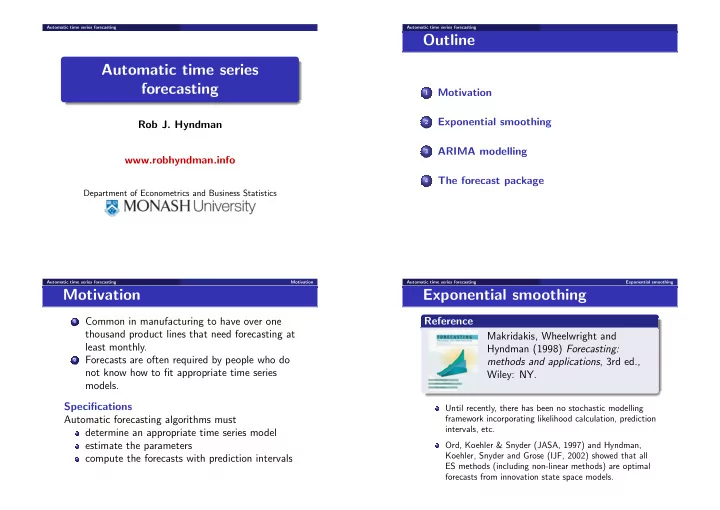
SLIDE 2 Automatic time series forecasting Exponential smoothing
Pegels’ (1969) taxonomy
Extended by Gardner (IJF 1985), Hyndman et al. (IJF 2002), and Taylor (IJF 2003).
Seasonal Component Trend N A M Component (None) (Additive) (Multiplicative) N (None) N,N N,A N,M A (Additive) A,N A,A A,M Ad (Additive damped) Ad,N Ad,A Ad,M M (Multiplicative) M,N M,A M,M Md (Multiplicative damped) Md,N Md,A Md,M
General notation E T S ր ↑ տ Error Trend Seasonal
Automatic time series forecasting Exponential smoothing
Automatic forecasting
From Hyndman et al. (IJF, 2002): Apply each of 30 methods that are appropriate to the data. Optimize parameters and initial values using MLE (or some other criterion). Select best method using AIC: AIC = −2 log(Likelihood) + 2p where p = # parameters. Produce forecasts using best method. Obtain prediction intervals using underlying state space model. Method performed very well in M3 competition.
Automatic time series forecasting ARIMA modelling
ARIMA modelling
Conventional ARIMA forecasting calculate forecasts from the best fitting ARIMA model Not necessarily the best forecasting ARIMA model. Model identification either subjective and complex, or based on information criteria that may not give good forecasts.
Automatic time series forecasting ARIMA modelling
Automatic Algorithm
Key ideas Fit ARIMA model to y1, . . . , yt and forecast yt+1|t, . . . , yt+h|t Calculate out-of-sample error at,i = (yt+i − ˆ yt+i|t) Calculate average MSEi =
1 n−h−m+1 n−h
a2
t,i and MSE = 1 h h
MSEi Choose model based on smallest MSEi or smallest MSE.