The Scenario-Planning-Process with the peri-urban region of Rostock - - PowerPoint PPT Presentation

the scenario planning process with the peri urban region
SMART_READER_LITE
LIVE PREVIEW

The Scenario-Planning-Process with the peri-urban region of Rostock - - PowerPoint PPT Presentation

Climate Change and Spatial Development: Adaptation strategies of urban and regional planning in urban regions of the Baltic Sea coast Peter Wibbeling, M.A. The Scenario-Planning-Process with the peri-urban region of Rostock Peter Wibbeling,


slide-1
SLIDE 1

Climate Change and Spatial Development: Adaptation strategies of urban and regional planning in urban regions of the Baltic Sea coast Peter Wibbeling, M.A.

1
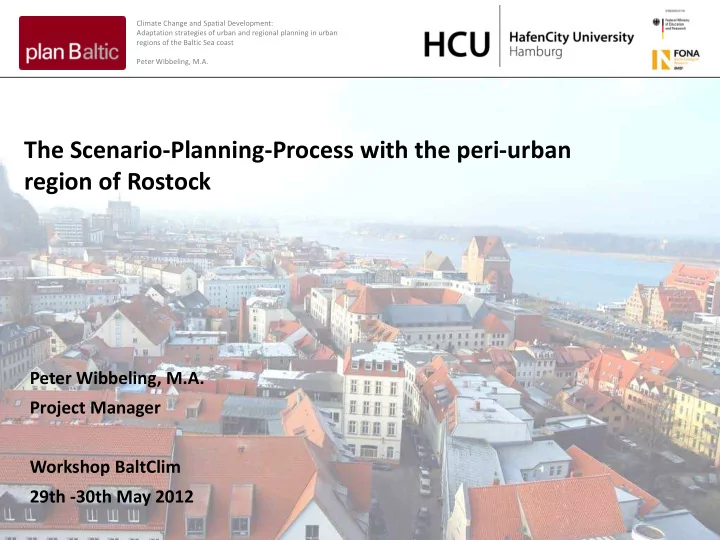
The Scenario-Planning-Process with the peri-urban region of Rostock

Peter Wibbeling, M.A. Project Manager Workshop BaltClim 29th -30th May 2012

slide-2
SLIDE 2

Climate Change and Spatial Development: Adaptation strategies of urban and regional planning in urban regions of the Baltic Sea coast Peter Wibbeling, M.A.

Content

  • A. The research project plan B:altic
  • B. The Scenario-Planning-Process with the peri-urban

region of Rostock

  • C. Challenges and Chances

2

slide-3
SLIDE 3

Climate Change and Spatial Development: Adaptation strategies of urban and regional planning in urban regions of the Baltic Sea coast Peter Wibbeling, M.A.

A: The research project plan B:altic

3

Social-ecological research, funded by a specific German research fund from 2009-2013 “Climate Change and Spatial Development: Adaptation strategies of urban and regional planning in urban regions of the Baltic Sea coast“

slide-4
SLIDE 4

Climate Change and Spatial Development: Adaptation strategies of urban and regional planning in urban regions of the Baltic Sea coast Peter Wibbeling, M.A.

Specific transdisciplinary research

4

Transdisciplinary research – what does this mean? production of knowledge to solve problems of the practical world. In order to avoid potential borders of knowledge, it transcends disciplinary boundaries and goes beyond scientifically generated knowledge by integrating non-scientific societal knowledge What are we doing? Intense transdisciplinary cooperation with the city of Rostock and the suburban region

slide-5
SLIDE 5

Climate Change and Spatial Development: Adaptation strategies of urban and regional planning in urban regions of the Baltic Sea coast Peter Wibbeling, M.A.

5

B: The Scenario-Planning-Process with the peri-urban region of Rostock

Source: http://maps.google.de_18.11.2010; modified

slide-6
SLIDE 6

Climate Change and Spatial Development: Adaptation strategies of urban and regional planning in urban regions of the Baltic Sea coast Peter Wibbeling, M.A.

Scenarios

6

„Scenarios are hypothetical sequences of events constructed for the purpose of focusing attention on causal processes and decision points. “ (Kahn& Wiener 1967) A scenario is a provocative, plausible story for how the future of an urban region might look like (Berkhout et al. 2002, Vliet et al. 2010).

slide-7
SLIDE 7

Climate Change and Spatial Development: Adaptation strategies of urban and regional planning in urban regions of the Baltic Sea coast Peter Wibbeling, M.A.

Scenario-Planning

7

Adequate method to cope with uncertainties, nescience and surprising events related to climate change and with complexity of possible future developments Both integrated: impacts of climate change (regional climate change scenarios of IPCC) and future development of society Participatory process that can facilitate the local society in their adaptation efforts Multiple viewpoints and societal knowledge can be integrated Platform for exchange and integration of different forms of knowledge (scientific, lay or informal) relevant for adaptation

slide-8
SLIDE 8

Climate Change and Spatial Development: Adaptation strategies of urban and regional planning in urban regions of the Baltic Sea coast Peter Wibbeling, M.A.

Future spatial development in Rostock

8

Aim: common and integrated adaptation strategies to climate change impacts

  • f the urban region of Rostock with focus on spatial development

Method: scenario planning (2010 – 2012; 3 main events), involving key stakeholders from different disciplines and institutions (politics, economy, administration, civil society)

slide-9
SLIDE 9

Climate Change and Spatial Development: Adaptation strategies of urban and regional planning in urban regions of the Baltic Sea coast Peter Wibbeling, M.A.

Stakeholder involvement

  • Gaining support of the political administration
  • Initiation of the process of climate change adaptation in Rostock

⇒ established core-working-group consisting of researchers and practitioners (urban and regional planners, environmental administration, coastal and flood protection) Task: intensive preparation of the inputs for the scenario-planning workshops; Joint coordination of the process and the content Balance between involvement of all stakeholders and scientific determination of the whole process by plan B:altic

9

slide-10
SLIDE 10

Climate Change and Spatial Development: Adaptation strategies of urban and regional planning in urban regions of the Baltic Sea coast Peter Wibbeling, M.A.

The Scenario-Planning-Process

10

Process so far: ⇒ kick-off research project with active participation of practitioners => common workshop on challenges of climate change

  • Starting point: Network analysis of relevant stakeholders
  • Discussion of results of network analysis with core-working-group as local experts

> Invitation of 80 stakeholders for the first workshop

slide-11
SLIDE 11

Climate Change and Spatial Development: Adaptation strategies of urban and regional planning in urban regions of the Baltic Sea coast Peter Wibbeling, M.A.

The Scenario-Planning-Process in Rostock

11

I Definition of the subject II Identification of key factors III Analysis of key factors IV Development of scenarios V Transfer of scenarios Spatial development 2050

Decision-making within the transdisciplinary process

Key factors of spatial development

Identifying key factors within the transdisciplinary process

Workshop 1 „Key factors for the future“

Discussion of alternative future developments Interdisciplinary process within plan B:altic

  • Evaluation of results of the first workshop
  • Relevance and interactions between key factors
  • Interactions between key factors and climate change
  • Translation into scenarios (computer-based)
  • Result: Four consistent scenarios

Transdisciplinary process

  • Discussion of scenarios
  • Revision of scenarios
  • Selection of scenarios for the second workshop

Workshop 2 „Scenarios as images of the future“

Discussion of scenarios Interdisciplinary process within plan B:altic

  • Evaluation of results of the second workshop
  • Revision of scenarios

Transdisciplinary process

  • Decisions concerning the third workshop

Workshop 3 „Climate change adaptation strategies“

Development of measures and strategies

⇒ first scenario-Workshop on climate change and spatial development in Rostock and the suburban-region with a wider participation of stakeholders. Joint analysis of the situation: Which impacts does climate change have

  • n the suburban-region?

Discussion of alternative future developments ⇒ second scenario-Workshop Discussion of scenarios: In which ways could the suburban-region develop? ⇒ third scenario-Workshop Development of measures and strategies

slide-12
SLIDE 12

Climate Change and Spatial Development: Adaptation strategies of urban and regional planning in urban regions of the Baltic Sea coast Peter Wibbeling, M.A.

First Workshop “Key factors for the future“

  • Integration of complexity and uncertainty in order to analyse

alternative future developments and interdependencies of 18 factors 4 climate factors 14 societal factors

12

slide-13
SLIDE 13

Climate Change and Spatial Development: Adaptation strategies of urban and regional planning in urban regions of the Baltic Sea coast Peter Wibbeling, M.A.

Development of scenarios

interrelationships and importance analysed combined to scenarios of future spatial development Choice of scenarios by: differentiability, consistency, interpretability, range

13

Spatial development in the Rostock Region

Key factor A Key factor B Key factor C

Scenario 1 Scenario 2 Scenario ...

A.1 A.2 A.3 B.1 B.2 B.3 C.1 C.2 C.3 Key factor ... … ... ...

slide-14
SLIDE 14

Climate Change and Spatial Development: Adaptation strategies of urban and regional planning in urban regions of the Baltic Sea coast Peter Wibbeling, M.A.

Development of scenarios

14

Sea level rise Extreme weather events Changes in precipitation Water Increase in temperature Development and quality of free areas Agriculture and forestry Harbor and maritime economy Tourism Demographic structure Housing Retail and industry Transport infrastructure Relationship urban-rural Energy policy Financial situation Policy priorities European Union Legal instruments

Weak Medium Strong

Relevance for spatial development

slide-15
SLIDE 15

Climate Change and Spatial Development: Adaptation strategies of urban and regional planning in urban regions of the Baltic Sea coast Peter Wibbeling, M.A.

Four different “images of the future“

15

Szenario 4: „Divers geprägt“ Szenario 3: „Klima der Extreme“ Szenario 2: „Alles in Maßen“ Szenario 1: „Entwicklung in Grenzen“

slide-16
SLIDE 16

Climate Change and Spatial Development: Adaptation strategies of urban and regional planning in urban regions of the Baltic Sea coast Peter Wibbeling, M.A.

Second Workshop “Scenarios as images of the future“

Scenarios as “images of the future“…

  • focus on climate change impacts combined with ecological and

societal developments

  • show four different images of the future
  • do not show the most likely future, but possible (long-term)

developments

  • a logical, consistent “image“

16

slide-17
SLIDE 17

Climate Change and Spatial Development: Adaptation strategies of urban and regional planning in urban regions of the Baltic Sea coast Peter Wibbeling, M.A.

Third Workshop “Climate change adaptation strategies“

  • Development, discussion and evaluation of measures and

strategies for climate change adaptation in the peri-urban region of Rostock Structural measures Spatial adapation measures Behaviour and information

  • Evaluation by the participants included:

identification of most important measures and short term measures

17

slide-18
SLIDE 18

Climate Change and Spatial Development: Adaptation strategies of urban and regional planning in urban regions of the Baltic Sea coast Peter Wibbeling, M.A.

C: Challenges

  • Climate change is an important challenge. But: Because of the long-

term character of climate change practitioners do not feel the urge to act

  • Climate change impacts interact with ecological and societal

developments

  • Complexity: in particular difficulty to communicate the aspect of

uncertainty

  • Perception that the development of scenarios is a “black-box“
  • Tendency to discuss the most “likely“ or the most “desirable“

future development

18

slide-19
SLIDE 19

Climate Change and Spatial Development: Adaptation strategies of urban and regional planning in urban regions of the Baltic Sea coast Peter Wibbeling, M.A.

Challenges

Transdisciplinary process:

Issue of limited ressources (time, capacity) with regard to core-working- group

  • Additional work for core-working-group members

 Ideal situation: Reduction of other tasks in order to gain capacity

  • Delegation of tasks (e.g. co-moderation) to the core-working-group

 Input by plan B:altic > commented by core-working-group > plan B:altic

  • No position within the administration for climate change adaptation

(focus on climate protection) Issue of the workshop concept: preset <> open

19

slide-20
SLIDE 20

Climate Change and Spatial Development: Adaptation strategies of urban and regional planning in urban regions of the Baltic Sea coast Peter Wibbeling, M.A.

Chances

  • The scenario-planning process

… initiated a regional learning process … contributed to the decision of the “Bürgerschaft“ in Rostock to develop a framework concept for climate change adaptation … made the participation of relevant regional stakeholders possible and strengthend the issue among them … showed the necessity for climate change adaption

20

slide-21
SLIDE 21

Climate Change and Spatial Development: Adaptation strategies of urban and regional planning in urban regions of the Baltic Sea coast Peter Wibbeling, M.A.

Chances

  • Scenario-Planning-Process and learning processes as starting point

for climate change adaptation

  • Exchanged knowledge and networks have the potential to improve

framework conditions in a sustainable way

  • Further use of results and new organisational structures

21

slide-22
SLIDE 22

Climate Change and Spatial Development: Adaptation strategies of urban and regional planning in urban regions of the Baltic Sea coast Peter Wibbeling, M.A.

22

Thank you for your attention!

Peter Wibbeling, M.A. Project Manager of plan B:altic HafenCity University Hamburg Chair of Urban Planning and Regional Development Winterhuder Weg 31 22085 Hamburg, Germany email: peter.wibbeling@hcu-hamburg.de phone: 040 - 42827-4506