3/22/2011 PROMOTING THE USE OF QUALITY WATER FOR URBAN AND PERI - - PDF document

3 22 2011
SMART_READER_LITE
LIVE PREVIEW

3/22/2011 PROMOTING THE USE OF QUALITY WATER FOR URBAN AND PERI - - PDF document

3/22/2011 PROMOTING THE USE OF QUALITY WATER FOR URBAN AND PERI URBAN AGRICULTURE: A REALITY IN DAKAR, SENEGAL Ndeye Mama Toure Dieng, FAOR, Dakar Sngal Quality water for safe food GENERAL INFORMATION PROJECT CODE GCP/SEN/061/SPA


slide-1
SLIDE 1

3/22/2011 1

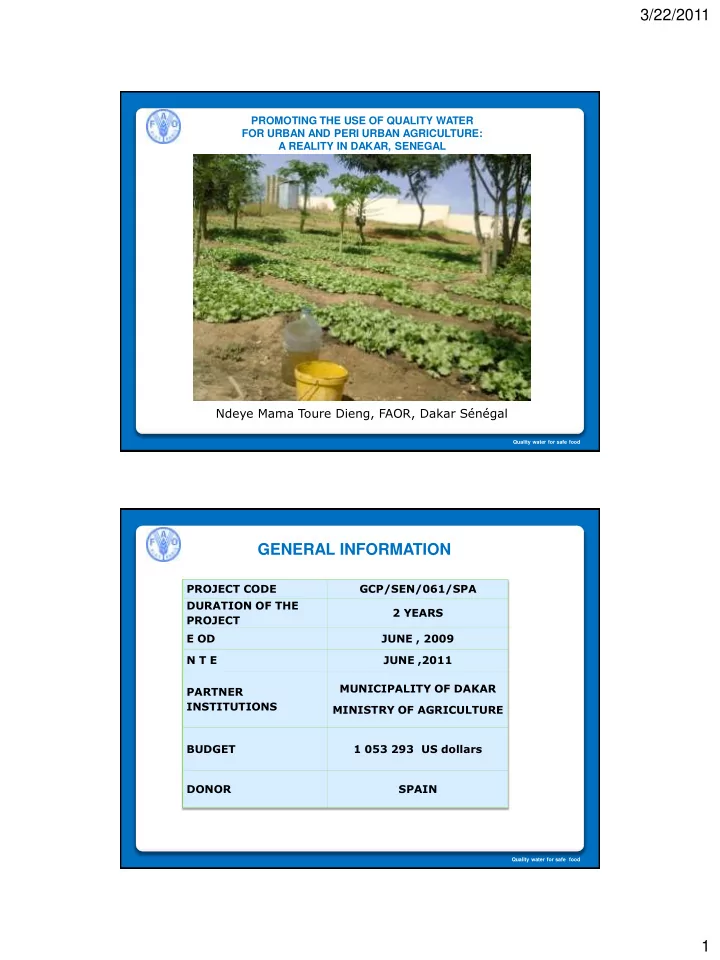
PROMOTING THE USE OF QUALITY WATER FOR URBAN AND PERI URBAN AGRICULTURE: A REALITY IN DAKAR, SENEGAL

Ndeye Mama Toure Dieng, FAOR, Dakar Sénégal

Quality water for safe food

PROJECT CODE GCP/SEN/061/SPA DURATION OF THE PROJECT 2 YEARS E OD JUNE , 2009 N T E JUNE ,2011 PARTNER INSTITUTIONS MUNICIPALITY OF DAKAR MINISTRY OF AGRICULTURE BUDGET 1 053 293 US dollars DONOR SPAIN

GENERAL INFORMATION

Quality water for safe food

slide-2
SLIDE 2

3/22/2011 2 AREA OF INTERVENTION OF THE PROJECT

PROJECT

Quality water for safe food

Patte dOie and Pikine Niayes area

AREA OF INTERVENTION OF THE PROJECT

Quality water for safe food

slide-3
SLIDE 3

3/22/2011 3 An alarming and paradoxical situation: The use of untreated water to produce vegetable that are mostly consumed raw (lettuce, cucumber, tomato and green pepper) While The national office of sanitation (ONAS) is implementing a wide program of wastewater treatment in Dakar:

  • two treatment plants
  • treated water used by a golf course and roads

constructors  Water is available but farmers do not have access to it. JUSTIFICATION OF THE PROJECT

Quality water for safe food

In Pikine and Guediawaye many farmers have stopped their activities due to lack of water, all the flourishing related activities have also stopped JUSTIFICATION OF THE PROJECT

Quality water for safe food

slide-4
SLIDE 4

3/22/2011 4

Producers in the Patte d’Oie and Camberene zone use water from digged ponds and are facing salinity and pollution problems

JUSTIFICATION OF THE PROJECT

Quality water for safe food

Small pond in the Patte d’Oie

slide-5
SLIDE 5

3/22/2011 5

Lettuce washed with water from the pond after harvest

JUSTIFICATION OF THE PROJECT

Quality water for safe food

Enhance the availabilty and access to quality water for sustainable urban and periurban agriculture in order to contribute to food and nutritional security and income generation for the population

MAIN OBJECTIVE OF THE PROJECT

Quality water for safe food

slide-6
SLIDE 6

3/22/2011 6

  • A new municipal governance
  • Institutional instability at ONAS with many changes of directors
  • 73% of targeted beneficiaries are on precarious land tenure:
  • rent, sharecroppers, entrusted
  • No way to deliver property rights
  • Nevertheless, the area remains for agriculture in all development plans and

the Mayor has stated that no more building authorization will be delivered

CONTEXT

Quality water for safe food

  • Improved tenure security for farmers in project area.
  • Two irrigation networks with treated wastewater serving 250 peri-

urban farmers

  • A manual on the use of extensive treatment systems and good

practices for the uses of wastewater

  • 1500 farmers and instututions are trained in:

 good agricultural practices  good uses of treated wastewater  maintenance of irrigation infrastructures and equipments  water quality monitoring

EXPECTED RESULTS

Quality water for safe food

slide-7
SLIDE 7

3/22/2011 7

  • Letter of Agreement with the Municipality of Dakar
  • Organization, information and awareness campaigns for producers
  • Capacity building in management for beneficiaries
  • Advocacy for land security of horticulture production areas

Implementation of a credit line within the Municipal Development Fund for UPA producers

  • Communication and relation with media

ACHIEVEMENTS SO FAR

Quality water for safe food

Letter Of Agreement ONAS – UPROVAN- PROJECT ONAS:

  • Provides 2000m3/day tertiary treated wastewater and 900m3/day secondary

treated wasterwater at 0.1 USD /m3 and 0.04 USD/m3 respectively

  • Supports the design of irrigation infrastructures and equipments, supervises the

works of installment of pumping, stores, transports and distributes treated waste water UPROVAN:

  • Uses the treated water for the purpose of horticulture production only
  • Implements the good practices for wasterwater use
  • Pays water bills to ONAS
  • Insures that the infrastructures and equipments are well maintained

Project :

  • Facilitates project implementation and negotiations among partners
  • Provides the funds to acquire the goods and services needed for the works
  • Monitors the implementation of the works

Quality water for safe food

slide-8
SLIDE 8

3/22/2011 8

  • Have an overview of the knowledge on extensive treatment

technologies using macrophytes and microphytes

  • Realize a pictorial manual on the use of extensive treatment

systems and good practices for the use of wastewater

  • Hold a workshop on extensive treatment technologies and

water quality management

Letter of Agreement with ENDA RUP

Quality water for safe food

Irrigation network schemes

Quality water for safe food

slide-9
SLIDE 9

3/22/2011 9

Construction works

Shelter for power driven pump water storage Basin under construction

Quality water for safe food

Irrigation Equipments

Quality water for safe food

slide-10
SLIDE 10

3/22/2011 10

Capacity building for producers Credit line of 100 000 USD FODEM Manual of procedures for the management and maintenance of infrastructures Material for monitoring water quality Seminar on water management and reuse of waste water during the symposium on UPH Training on Good practices for the use of wastewater Hortivar data base and use of IPPM cards Organizational management Management and maintenance of infrastructures

Quality water for safe food

CONCLUSIONS AND PERSPECTIVES

  • There is a need to increase the ratio of wastewater

recycling (80% of domestic water is dumped as used water)

  • The option of reuse of treated waste water in horticulture is

technically feasible

  • Its implementation has to be supported by an important

information and awareness campaign

  • Strengthening the partnership between sanitation offices,

farmers and support organisms is the key to success

Quality water for safe food

slide-11
SLIDE 11

3/22/2011 11 THANK YOU FOR YOUR ATTENTION

Quality water for safe food