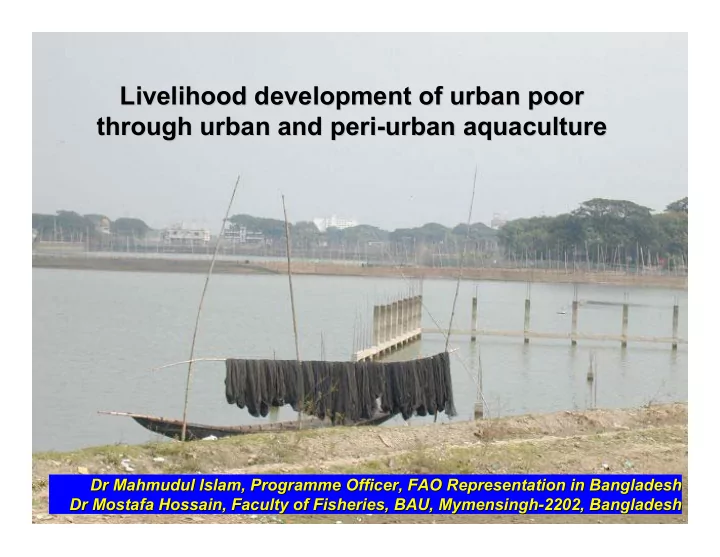
SLIDE 1 Livelihood development of urban poor Livelihood development of urban poor through urban and through urban and peri peri-
urban aquaculture
Dr Dr Mahmudul Mahmudul Islam, Programme Officer, FAO Representation in Bangladesh Islam, Programme Officer, FAO Representation in Bangladesh Dr Dr Mostafa Mostafa Hossain Hossain, Faculty of Fisheries, BAU, Mymensingh , Faculty of Fisheries, BAU, Mymensingh-
2202, Bangladesh
SLIDE 2 The world is urbanizing at a rapid pace The world is urbanizing at a rapid pace
- UN estimates that by the end of 2005, more than half
UN estimates that by the end of 2005, more than half the earth the earth’ ’s population will live in areas defined as s population will live in areas defined as “ “urban urban” ” though definitions of what is though definitions of what is “ “urban urban” ” vary vary from country to country from country to country Poverty in cities is rapidly expanding Poverty in cities is rapidly expanding
Many of the world’ ’s poor are migrating to cities in s poor are migrating to cities in search of income search of income-
earning opportunities
- The urban poor often suffer from malnutrition, mostly
The urban poor often suffer from malnutrition, mostly due to lack of purchasing power and high food prices due to lack of purchasing power and high food prices
- Urban poverty and the related issue of urban food
Urban poverty and the related issue of urban food security are therefore of prime concern security are therefore of prime concern
SLIDE 3 Asia is the world’s most populated region; it is the
home of more than half of humanity
By 2015, it is estimated that 16 of the world’s 26 cities
with populations of 10 million or more inhabitants will be in Asia
East, Southeast and South Asia are already the homes
- f some of the world’s largest urban agglomerations
The Asian urban population is growing at a rapid rate Dhaka, Delhi, Karachi, Seoul and Beijing all have
populations in excess of 10 million inhabitants
SLIDE 4 According to a report According to a report “ “Food into Cities Food into Cities” ” by FAO, 2001 by FAO, 2001
- Given the rapid rate of urbanization in Asia, the
Given the rapid rate of urbanization in Asia, the importance of efficient food supply should be importance of efficient food supply should be recognised by all stakeholders as a means of recognised by all stakeholders as a means of adequately feeding cities and an important determinant adequately feeding cities and an important determinant
- f food security for the urban poor
- f food security for the urban poor
- Furthermore, the pressure put on land and water by the
Furthermore, the pressure put on land and water by the urbanization process puts urban and urbanization process puts urban and periurban periurban food food production increasingly at risk production increasingly at risk
- This situation requires increased attention to maintain
This situation requires increased attention to maintain suitable land and water for food production suitable land and water for food production
SLIDE 5 16.3 16.4 4.3 26.4 World 17.2 26.2 4.9 18.8 Asia 51.1 44.9 15.8 35.2 24 Tokyo 70.9 47.1 26.0 55.2 9 Singapore 31.9 16.6 9.3 56.3 100 Seoul 33.4 49.4 12.5 25.2 12 Manila 55.0 35.4 15.3 43.1 6 Kuala Lumpur 4.3 13.7 1.3 9.7 0.3 New Delhi 17.4 51.4 5.9 11.5 4 Jakarta 9.5 48.0 2.8 5.9 5 Dhaka 18.1 51.6 6.1 11.9 3 Colombo 22.2 23.1 5.4 23.1 1 Beijing 32.5 41.9 9.6 22.9 10 Bangkok % of fish in total thereof fish grams/day total grams/day National consumpti
capta/kg/Y National animal protein consumption per capita % of city popn in national total City Source: Source: Ruckes Ruckes, 2000 , 2000
SLIDE 6
- It is clear that feeding the growing urban population
It is clear that feeding the growing urban population
- f Bangladesh is a matter of utmost urgency
- f Bangladesh is a matter of utmost urgency
- Since there are no simple solutions, policy and
Since there are no simple solutions, policy and implementation measures to deal with feeding city implementation measures to deal with feeding city dwellers have to touch on concerns ranging from dwellers have to touch on concerns ranging from agricultural productivity through post agricultural productivity through post-
harvest technologies, marketing and distribution to food technologies, marketing and distribution to food safety and the adequacy of consumer incomes safety and the adequacy of consumer incomes
- These concerns go beyond the geographical
These concerns go beyond the geographical jurisdictions of City Council to the national level jurisdictions of City Council to the national level and, ultimately, the global scale and, ultimately, the global scale
SLIDE 7 Bangladesh Bangladesh – – a country with vast potentials with fertile a country with vast potentials with fertile land, water and human resources land, water and human resources It emerged as the third richest country in respect of It emerged as the third richest country in respect of freshwater after China and India freshwater after China and India Fish and fisheries are part of our life and culture Fish and fisheries are part of our life and culture Native major carps, exotic carps, catfishes, tilapia, Native major carps, exotic carps, catfishes, tilapia, shrimp and prawn are main aquaculture species. shrimp and prawn are main aquaculture species. Shrimp and prawn attracted world market. Shrimp and prawn attracted world market. Bangladesh Bangladesh -
- 5th in terms of production and 7th in
5th in terms of production and 7th in terms of value of fish and fishery product in the world terms of value of fish and fishery product in the world
Fish and Bangladesh Fish and Bangladesh
SLIDE 8 Fish contributes Fish contributes 64 % of the animal protein intake 64 % of the animal protein intake 6% of GDP 6% of GDP 4.91% of national income ( 4.91% of national income (DoF DoF, 2005) , 2005) About 14 million people of Bangladesh are About 14 million people of Bangladesh are directly engaged in fisheries directly engaged in fisheries -
11 million in part part-
- time fishing and another 3 million in
time fishing and another 3 million in aquaculture ( aquaculture (DoF DoF, 2005) , 2005) Bangladesh earns 5.71% of its export earnings Bangladesh earns 5.71% of its export earnings from aquaculture ( from aquaculture (DoF DoF, 2005) , 2005)
SLIDE 9 22% 36% 42%
inland capture fisheries inland culture fisheries marine capture
sector sector-
- wise fish production in 2003
wise fish production in 2003-
04
SLIDE 10 Urban and Urban and peri peri-
- urban scenario of Bangladesh
urban scenario of Bangladesh
Asian cities are growing rapidly - many, including Dhaka,
Bangkok, Delhi, Jakarta and Shanghai, can be classified as “mega city” with populations more than 10 million
The growth of these large cities is accompanied by an
increase in number of urban households living in poverty
At present the number of urban popn. In Bangladesh is
37 million and it will reach to 80 million by 2020 (expected total popn. 175 million)
Increasing natural disaster, landlessness and
unemployment will enhance the migration of rural people
At present 37% of poor of Bangladesh live in the urban
areas, while food poverty is 42% among the urban population
SLIDE 11 Spatially aquaculture in Bangladesh can be divided in to Spatially aquaculture in Bangladesh can be divided in to three categories three categories Rural aquaculture Rural aquaculture The main source of fish production in Bangladesh though The main source of fish production in Bangladesh though has some problems especially in marketing has some problems especially in marketing Peri Peri-
urban aquaculture Peri Peri-
urban aquaculture -
- could be an important part of
could be an important part of aquaculture in the country owing to its proximity to the aquaculture in the country owing to its proximity to the cities cities Urban aquaculture Urban aquaculture Scope of urban aquaculture is limited due to lack of Scope of urban aquaculture is limited due to lack of waterbodies waterbodies, pollution and multiple use of water , pollution and multiple use of water
SLIDE 12
- Most of the Bangladeshi cities are located
Most of the Bangladeshi cities are located near one or more rivers near one or more rivers
- Inside the city areas and in the periphery
Inside the city areas and in the periphery there are many ponds, lakes and open water there are many ponds, lakes and open water bodies bodies
- The 6 metropolitan cities
The 6 metropolitan cities – – Dhaka, Dhaka, Chittagong, Chittagong, Khulna Khulna, , Rajshahi Rajshahi, , Sylhet Sylhet and and Barisal Barisal are rich in aquatic resources are rich in aquatic resources
- Especially the largest city Dhaka has
Especially the largest city Dhaka has numerous ponds, large lakes and open numerous ponds, large lakes and open waters waters Status of urban and Status of urban and peri peri urban aquatic resources urban aquatic resources and present practices and present practices
SLIDE 13 Name Name Area (Ha) Area (Ha) Bagabhaban Bagabhaban Lake Lake 6 6 Gulshan Lake Gulshan Lake 100 100 Banani Banani Lake Lake 50 50 Dhaka Zoo Lake Dhaka Zoo Lake 50 50 Uttora Uttora Lake Lake 100 100 Ramna Ramna Lake Lake 75 75 Sangsad/Crecent Sangsad/Crecent lake lake 50 50
- Govt. owned other ponds 100
- Govt. owned other ponds 100
Other privet ponds Other privet ponds 400 400
SLIDE 14
Beside the waterbodies waterbodies within the Dhaka within the Dhaka city area, there are number of large ponds, city area, there are number of large ponds, beels beels, open waters, ditches and small river , open waters, ditches and small river in the periphery of Dhaka, like in the periphery of Dhaka, like – – Jatrabari Jatrabari, , Demra Demra, , Khilgaon Khilgaon, , Tejgaon Tejgaon, Cantonment, , Cantonment, Mirpur Mirpur and other and other thanas thanas
- During monsoon, the thousands of ha of
During monsoon, the thousands of ha of land in the land in the peri peri-
urban areas of Dhaka become inundated with a high potential for become inundated with a high potential for short short-
term aquaculture (4-
6 months)
SLIDE 15 Aquaculture in Urban/ Aquaculture in Urban/peri peri urban areas of Dhaka urban areas of Dhaka
- Most of the water areas are not well managed for
aquaculture
- In mid 80s there were two project to culture fish in
Dhaka city under Department of Fisheries (DoF) – Dhaka City Aquaculture Project and Sub-project 3 under Integrated Aquaculture Development Project
- During the project period around 1,080 ha water
areas within Dhaka city were identified for aquaculture
- Most of the water bodies are under jurisdiction of
either BFDC or RAJUK
SLIDE 16
No proper fish culture is going on in the water No proper fish culture is going on in the water bodies including the lakes in the Gulshan, bodies including the lakes in the Gulshan, Dhanmondi Dhanmondi, , Uttora Uttora, Cantonment areas , Cantonment areas In other privately owned water bodies some people In other privately owned water bodies some people are culturing fish with very low input without any are culturing fish with very low input without any proper stocking or feed and fertilizer application proper stocking or feed and fertilizer application
SLIDE 17
- Some people culture fish in pen in
Some people culture fish in pen in Baroigram Baroigram, , Nasir Nasir Nagar Nagar and adjacent areas under and adjacent areas under Khilgaon Khilgaon and and Sabujbag Sabujbag thana thana for 4 for 4-
5 months
- The local form teams of 20
The local form teams of 20-
25 people and make fencing (bamboo and net) based on the land fencing (bamboo and net) based on the land
- wnership
- wnership
- This way they build 60
This way they build 60 -
70 small to large ghers ghers every year every year
- They culture pollutant resistant fish like tilapia,
They culture pollutant resistant fish like tilapia, Thai Thai pangas pangas, use wastes of bread factories. , use wastes of bread factories. Production is nearly 2.5 tons/ha Production is nearly 2.5 tons/ha
SLIDE 18 Case study Case study – – Trimohini Trimohini, , Nasirabad Nasirabad, , Khilgaon Khilgaon
Name of the farm owner: Name of the farm owner: Md.
Barek Species: Species: Rohu Rohu, , Katla Katla, Big head, Silver, Tilapia and , Big head, Silver, Tilapia and Carpio Carpio (No (No pangas pangas because of high feed intake) because of high feed intake) Fish fry/fingerlings: Fish fry/fingerlings: from commercial farms and supply to from commercial farms and supply to the pond just before monsoon (April the pond just before monsoon (April-
May) During flood/monsoon when water level increases, they During flood/monsoon when water level increases, they use net to cover their water areas use net to cover their water areas Feed: Feed: Rice bran, Rice polish, Wheat bran, Bakery Rice bran, Rice polish, Wheat bran, Bakery byproducts, Oil cake and aquatic weeds byproducts, Oil cake and aquatic weeds Training: Training: Some of the local received training from Some of the local received training from DoF DoF Harvesting period: Harvesting period: October October -
December February February -
April Fish selling Fish selling: : Mughda Mughda Arot Arot (wholesale) (wholesale)
SLIDE 19
Case study Case study – – Kazla Kazla, , Matuail Matuail, , Demra Demra
Name of the farm owner: Md. Shafi Uddin Ahmed
Farm size: about 20 ha
Species: Thai Sarputi, Kalibaus, Rohu, Katla, Big head, Silver, Tilapia and Carpio
Feed: Rice bran, Rice polish, Wheat bran, Bakery byproducts, Oil cake and Aquatic weeds Fertilizers: Cow-dung and inorganic fertilizers Fish fry/fingerlings: Hatcheries from Keranigonj, Norshindi farm and Jessore just before monsoon (April-May) Annual sell: Tk 30 lac Full time man power: 3 Supervisors and 5 Laborer (Seasonal fishermen hired)
SLIDE 20
SLIDE 21
SLIDE 22
SLIDE 23
SLIDE 24
SLIDE 25
SLIDE 26 Problem Problem
- Dhaka City Corporation (DCC) waste dumping
Dhaka City Corporation (DCC) waste dumping place is very near to these farms place is very near to these farms
- Sewage from the dumping places and from the
Sewage from the dumping places and from the industry mix with the farm water and sudden industry mix with the farm water and sudden death of huge amount of fish occur death of huge amount of fish occur
- The amount of sewerage water is very high
The amount of sewerage water is very high especially during monsoon when the especially during monsoon when the Rampura Rampura Sluice gate is open Sluice gate is open
Sewage from Dholaikhal Dholaikhal and and Maniknagar Maniknagar is is very high in August very high in August-
September
SLIDE 27
SLIDE 28
SLIDE 29 Overall problems Overall problems
Infra-
- structural development specially the real estate is a
structural development specially the real estate is a lucrative business and people are building houses, office lucrative business and people are building houses, office and other infrastructure in legal and illegal way over the lake and other infrastructure in legal and illegal way over the lake
- Grabbing of Govt. water bodies is going on and on.
Grabbing of Govt. water bodies is going on and on.
- Wastage from industries especially the toxic effluents mix
Wastage from industries especially the toxic effluents mix with urban water and make the water unsuitable for with urban water and make the water unsuitable for household usage let alone the fish culture household usage let alone the fish culture
- Fish mass mortality is very common and regular in city
Fish mass mortality is very common and regular in city lakes lakes
- Releasing predatory exotic fish in city water is also very
Releasing predatory exotic fish in city water is also very common common
- The ongoing culture practice lack trained personnel and any
The ongoing culture practice lack trained personnel and any sort of fish culture technology sort of fish culture technology
SLIDE 30
SLIDE 31 Case study Case study – – Aquaculture in and around Aquaculture in and around Sirajganj Sirajganj town town Sirajganj Sirajganj town has a town has a number of ponds, ditches number of ponds, ditches and small and small beels beels, within its , within its periphery periphery The urban aquaculture in The urban aquaculture in Sirajganj Sirajganj town includes town includes mostly the mostly the polyculture polyculture of
Indian major carps and Indian major carps and Chinese carps Chinese carps
Katakhali Katakhali khal khal in in Sirajganj Sirajganj Paurashava Paurashava
SLIDE 32
- The existing culture practices is mostly extensive
The existing culture practices is mostly extensive (only stocking), improved extensive (stocking and (only stocking), improved extensive (stocking and
- ccasional feeding and fertilization) and with a
- ccasional feeding and fertilization) and with a
limited scale, semi limited scale, semi-
- intensive (stocking, regular
intensive (stocking, regular fertilization and supplementary feeding) fertilization and supplementary feeding)
- The production rate is very low
The production rate is very low
- Fish production in ponds in
Fish production in ponds in Sirajgonj Sirajgonj city is as city is as low as 0.5 low as 0.5-
- 0.6ton/ha/yr and as high as 2.5
0.6ton/ha/yr and as high as 2.5 ton/ha/yr depending on the culture system ton/ha/yr depending on the culture system
SLIDE 33
SLIDE 34
SLIDE 35
SLIDE 36 Overall limitations of Urban Aquaculture Overall limitations of Urban Aquaculture
- Water area use pattern (Regulation and legislation)
Water area use pattern (Regulation and legislation)
- Infrastructural development/ land grabbing
Infrastructural development/ land grabbing
- Multi ownership and user conflict
Multi ownership and user conflict
- Lack of capital, technical know
Lack of capital, technical know-
how and trained personnel personnel
- Non/limited availability of quality fish seed
Non/limited availability of quality fish seed
- Annual flood and flush flood
Annual flood and flush flood
High input cost
- Pollution, fish mortality, exotic fish
Pollution, fish mortality, exotic fish
SLIDE 37 Possible solution Possible solution
- Water area use pattern (Regulation and legislation): The
Water area use pattern (Regulation and legislation): The regulation for the water use in urban areas should be updated regulation for the water use in urban areas should be updated regarding controlling authority and towards environment regarding controlling authority and towards environment friendly aquaculture production friendly aquaculture production
- Infrastructural development/ land grabbing should be stopped
Infrastructural development/ land grabbing should be stopped with a severe consequence for the land grabber with a severe consequence for the land grabber
Capital, technical know-
- how and trained persons are
how and trained persons are prerequisite for urban aquaculture prerequisite for urban aquaculture
Small-
scale long-
- term credit should be provided for the true
term credit should be provided for the true farmer with the least interest possible farmer with the least interest possible
- Training and other technical support like
Training and other technical support like – – easy easy-
to-
use bangla bangla manual for different type of fish culture) should be made manual for different type of fish culture) should be made available available
- Urban fish hatchery should be built to supply quality fish seed
Urban fish hatchery should be built to supply quality fish seed
- Sewage should be treated before releasing to the urban waters
Sewage should be treated before releasing to the urban waters
- Indiscriminate release of exotic fish should be prohibited
Indiscriminate release of exotic fish should be prohibited
SLIDE 38 Sewage Sewage-
fed aquaculture
Technologies for sewage-
fed aquaculture should be made available and introduced should be made available and introduced in the outskirts of the metropolitan cities in the outskirts of the metropolitan cities under GO and NGO initiative under GO and NGO initiative
- Technologies for recycling waste water
Technologies for recycling waste water should be applied in urban aquaculture should be applied in urban aquaculture
SLIDE 39 More and more fish species and culture patterns should More and more fish species and culture patterns should be brought under urban aquaculture be brought under urban aquaculture
- In the urban areas, cage culture, pond
In the urban areas, cage culture, pond-
dyke culture, different type of integrated culture, different type of integrated aquaculture and prawn culture should be aquaculture and prawn culture should be introduced introduced
All 4 Indian major carps, the exotic carps 4 Indian major carps, the exotic carps and catfish, barbs (silver and Thai), tilapia, and catfish, barbs (silver and Thai), tilapia, shing shing, , magur magur, , pabda pabda, , gulsha gulsha, , tengra tengra, , koi koi, , even some fresh water eels and minnows even some fresh water eels and minnows like like mola mola and and dhela dhela and and golda golda chingri chingri can be can be cultured in urban waters cultured in urban waters
SLIDE 40
Urban aquaculture and livelihood of poor Urban aquaculture and livelihood of poor
The only resource of the urban poor is manpower Many poor in the cities often do not have any job or specific skill to get a job in urban environment This un/semi-employed labour force (including women in the households) can be made engaged in aquaculture in public and private owned waters with little training, technical and financial support These people can be involved in every stages of the production cycle – farming, processing, transporting and retailing That will not only increase the total food production of the country, it will also help in using the urban waters in a eco- friendly way, creating employment, reducing the financial and nutritional poverty of urban poor
SLIDE 41 Before starting the full Before starting the full-
- scale semi intensive/intensive
scale semi intensive/intensive type of aquaculture in the urban and type of aquaculture in the urban and peri peri-
urban areas Legal, regulatory and policy frameworks including Legal, regulatory and policy frameworks including flood control and environmental standards should be flood control and environmental standards should be ensured ensured Capacity of city council should be built through Capacity of city council should be built through technical and financial support, including providing technical and financial support, including providing access to and facilities for the dissemination of access to and facilities for the dissemination of technologies and provide means for close coordination technologies and provide means for close coordination between the various stakeholders between the various stakeholders
SLIDE 42 The The city council city council should should -
- formulate and implement sound urban aquaculture policies and
formulate and implement sound urban aquaculture policies and programmes spanning urban and programmes spanning urban and peri peri-
urban areas
- ensure urban planning, management and policy instruments
ensure urban planning, management and policy instruments such as, facilitating water management systems, identifying land such as, facilitating water management systems, identifying land for major infrastructure and solid waste sanitary system for major infrastructure and solid waste sanitary system
- carry out appropriate studies and surveys to obtain a better
carry out appropriate studies and surveys to obtain a better understanding of the water resources understanding of the water resources
- ensure full participation of all stakeholders (producers, trader
ensure full participation of all stakeholders (producers, traders, s, transporters and consumers) in the planning transporters and consumers) in the planning
- recognise the potential for private sector involvement and
recognise the potential for private sector involvement and recognise the importance of the informal sector (street retailer recognise the importance of the informal sector (street retailers s and night markets etc.) and accept the sector's social, cultural and night markets etc.) and accept the sector's social, cultural and economic importance, particularly for the urban poor and economic importance, particularly for the urban poor
- make provision for and enforce nutritional safety, environmental
make provision for and enforce nutritional safety, environmental and hygiene regulations and hygiene regulations
SLIDE 43 The The private sector private sector should should
- create appropriate stakeholder associations
create appropriate stakeholder associations ( (arotdars arotdars, , forias forias, street retailers, market , street retailers, market traders, urban producers, truckers, traders, urban producers, truckers, consumers, women consumers, women’ ’s groups, etc.), chambers s groups, etc.), chambers
- f commerce and NGOs to enable an effective
- f commerce and NGOs to enable an effective
production, preservation and marketing production, preservation and marketing system system
- consider entering into partnerships with local
consider entering into partnerships with local authorities for facilitating investments in authorities for facilitating investments in required infrastructure and services for urban required infrastructure and services for urban and and peri peri-
- urban aquaculture and take
urban aquaculture and take responsibility for the environmental costs of responsibility for the environmental costs of their operations their operations
SLIDE 44 What the What the international organizations and donor international organizations and donor can do can do
recognise the growing importance of fish culture in recognise the growing importance of fish culture in urban areas and recognise the systems as urban areas and recognise the systems as deserving priority support and funding deserving priority support and funding recognise that urban aquaculture increasingly recognise that urban aquaculture increasingly require an inter require an inter-
sectoral perspective to address perspective to address demand of animal protein in cities and demand of animal protein in cities and subarbs subarbs recognize urban aquaculture as a potential mean to recognize urban aquaculture as a potential mean to sustain the livelihood of urban poor from the sustain the livelihood of urban poor from the nutritional and socioeconomic point nutritional and socioeconomic point provide support to enhance international information provide support to enhance international information diffusion and technical assistance on good urban diffusion and technical assistance on good urban aquaculture practices aquaculture practices
SLIDE 45 Acknowledgements Acknowledgements
FAO Representation in Bangladesh FAO Representation in Bangladesh Dr Md. Dr Md. Akhteruzzaman Akhteruzzaman, BFRF , BFRF
- Prof. Dr M. A.
- Prof. Dr M. A. Wahab
Wahab, BAU , BAU M.
Shahidul Islam, LPUPAP, FAO, Islam, LPUPAP, FAO, Sirajgonj Sirajgonj Raquib Raquib-
el-
Arif, Practical Action Bangladesh , Practical Action Bangladesh
SLIDE 46