The purpose of Section 9 is to Slide 1 Food Purchasing review the - - PDF document

the purpose of section 9 is to
SMART_READER_LITE
LIVE PREVIEW

The purpose of Section 9 is to Slide 1 Food Purchasing review the - - PDF document

The purpose of Section 9 is to Slide 1 Food Purchasing review the components that define for Child Care Centers and measure quality Section 9: Quality Standards (Step 5) With a Dash of Ethics (Section 6) National Food Service Management


slide-1
SLIDE 1

Slide 1

National Food Service Management Institute Section 9: Quality Standards 1

Section 9: Quality Standards (Step 5)

Food Purchasing for Child Care Centers

With a Dash of Ethics

(Section 6)

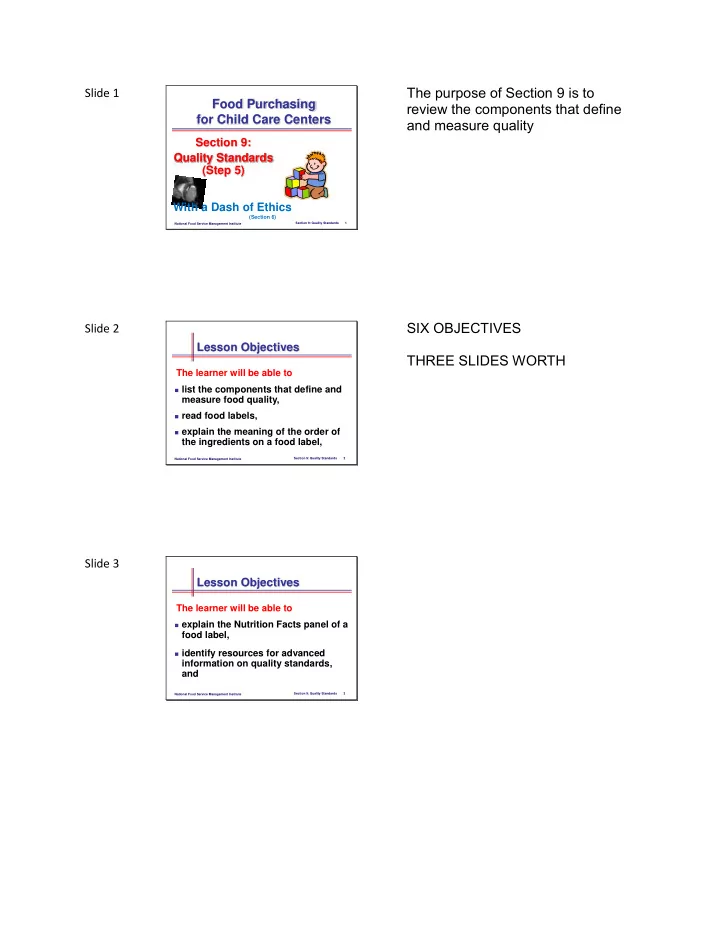
The purpose of Section 9 is to review the components that define and measure quality

Slide 2

National Food Service Management Institute Section 9: Quality Standards 2

 list the components that define and

measure food quality,

 read food labels,  explain the meaning of the order of

the ingredients on a food label,

Lesson Objectives

The learner will be able to

SIX OBJECTIVES THREE SLIDES WORTH

Slide 3

National Food Service Management Institute Section 9: Quality Standards 3

 explain the Nutrition Facts panel of a

food label,

 identify resources for advanced

information on quality standards, and

Lesson Objectives

The learner will be able to

slide-2
SLIDE 2

Slide 4

National Food Service Management Institute Section 9: Quality Standards 4

 decide which foods are of better

quality.

Lesson Objectives

The learner will be able to

Slide 5

National Food Service Management Institute Section 9: Quality Standards 5

Defining/Measuring Quality

 Ingredient list on the label  Nutrient content information  CN label information  Taste  Appearance  Children’s acceptance  Food preparation  Grade standards  Cost

There are many parts to defining and measuring quality. These parts are on the screen. IT IS DIFFICULT TO DEFINE AND MEASURE QUALITY BECAUSE QUALITY CONSISTS OF ALL THESE COMPONENTS SEE POSTER

Slide 6

National Food Service Management Institute Section 9: Quality Standards 6

Quality Standards

Reading food labels is a key element in developing quality standards.

READ SLIDE Food labels are a reliable source of information. The FDA of the USDHHS regulates the information on food labels.

slide-3
SLIDE 3

Slide 7

National Food Service Management Institute Section 9: Quality Standards 7

Retail and Wholesale Labels

 Common name of the product  Name and address of the

manufacturer, packer, or distributor

 Net contents in terms of

weight, measure, or count

 Ingredient list

All food labels must Include the following information:

Common name of the product

Name and address of the manufacturer, packer, or distributor

Net contents in terms of weight, measure, or count

Ingredient list

Slide 8

National Food Service Management Institute Section 9: Quality Standards 8

Ingredient List

The ingredients are listed in descending

  • rder by weight.

The red box outlines the ingredients

  • n this sample label for breaded

white chicken patties. Ingredients on a food label are listed in descending order by weight.

Slide 9

National Food Service Management Institute Section 9: Quality Standards 9

Ingredient List

The ingredients are listed in descending

  • rder by weight.

Ingredients: White chicken, enriched wheat flour (niacin, reduced iron, thiamine, mononitrate, riboflavin), water, dried whole eggs, enriched yellow corn flour (niacin, reduced iron, thiamine mononitrate, riboflavin), salt, sodium phosphate, soybean oil, modified food starch, spices, nonfat dry milk, leavening (sodium bicarbonate, sodium aluminum phosphate, sodium acid pyrophosphate), dextrose, enriched yellow corn meal (niacin, reduced iron, thiamine mononitrate, riboflavin), mono and diglycerides, dried whey, sugar, dried yeast, sodium alginate, natural flavor. Fried in vegetable oil.

1st ingredient on the list is “white chicken”. This means that the largest ingredient by weight in the breaded white chicken patties is “white chicken”. 2nd ingredient is “enriched wheat flour” is the second largest ingredient by weight in the breaded white chicken patties after “white chicken”. The 3rd ingredient is “water”, Therefore, the three ingredients that the breaded white chicken patties contain in greatest amounts are first “white chicken”, second “enriched wheat flour”, and third “water”.
slide-4
SLIDE 4

Note: If the participants ask the following questions about the ingredient list, here are the answers. If they do not ask, do not provide the information. ฀ What does “enriched” mean? It means that the ingredients that were lost when the outer covering of the wheat grain was removed or milled to make flour are added back. ฀ What nutrients are added back to the enriched flour? Those are the ones in parentheses

  • n the food label.

฀ What spices are used? Manufacturers are not required to declare the spices used. ฀ What does “white chicken” mean? It means the breast meat, the wing, and rib meat.

Slide 10

National Food Service Management Institute Section 9: Quality Standards 10

Ingredient Lists

 Ingredients lists help to determine

quality.

 Write down and compare the

ingredient lists of different brands.

 The first five or six ingredients are

enough to determine quality.

Ingredient lists on food labels are important because they help to determine food quality. ฀ When a center needs to compare the quality of different brands to decide which one to buy, it is helpful to write down and compare the ingredient lists. ฀ Emphasize that it is not necessary to list all of the ingredients to determine the quality of a food. The first five or six ingredients will provide the information needed to make a decision.

slide-5
SLIDE 5

Slide 11

National Food Service Management Institute Section 9: Quality Standards 11

Language Question?

NFSMI can help you!

 Phone: 800-321-3054  Fax: 800-321-3061  E-mail: nfsmi@olemiss.edu  Web site:

http://www.nfsmi.org

NFSMI 800-321-3054

Ingredient lists may contain words that they do not understand. ฀ The information services desk at the National Food Service Management Institute (NFSMI) will help answer any questions the participants might have about words on an ingredient list. ฀ NFSMI is funded by the U.S. Congress to provide research and education support for Child Nutrition Programs. ฀ The NFSMI toll-free telephone number is 800-321-3054 and the fax number is 800-321-3061. ฀ Tell the participants that if they have access to a computer, they can contact NFSMI via Email at nfsmi@olemiss.edu, or they can visit the NFSMI Web site at http://www.nfsmi.org. ฀ The Web site address, E-mail address, telephone number, and fax number for NFSMI can be found on page 76 of the participant manual.

Slide 12

National Food Service Management Institute Section 4: Quantities 12

ACTIVITY 8

The purpose of Activity 8 is to give us practice interpreting quality from food labels. Let’s do the activity either individually or in small groups. We have 5 minutes to do the activity. ฀ Have the participants open their manuals to Activity 8 on page 77. ฀ Read over the following directions of Activity 8 with them. Note: The complete activity, as shown on page 77 of the participant manual, can be found on page 207 of the instructor guide. Directions: An ingredient comparison is one part of the quality decision. In this activity, all

  • ther quality factors for the peaches
slide-6
SLIDE 6

are equal. Use only the ingredient lists in the following chart to answer the questions below. [The chart can be found on page 207 of the instructor guide and on slide 12.] Which brand has the higher quality? Which brand would you purchase? Why would you purchase this brand

  • f

peaches? ฀ When the participants are finished, show slide 12.

Slide 13

National Food Service Management Institute Section 9: Quality Standards 13

Activity 8

Sample A Sample B Sample C Brand Copper Spot Cleo Name on Label Sliced Peaches, Yellow Cling Peaches in Heavy Syrup Lite Sliced Peaches, Pear Juice from Concentrate Lite Sliced Peaches, Yellow Cling Peaches in Extra Light Syrup 1st ingredient Peaches Peaches Peaches 2nd ingredient Water Water Water 3rd ingredient Corn Syrup Pear Juice from Concentrate Sugar 4th ingredient Sugar

Before discussing the questions in Activity 8, ask the following questions in order to reinforce the “descending

  • rder by weight” concept:
  • Which ingredient does

Sample A have the most of? (Answer: peaches)

  • Which ingredient does

Sample A have the least of? (Answer: sugar)

  • Which ingredient does

Sample B have the most of? (Answer: peaches)

  • Which ingredient does

Sample B have the least of? (Answer: pear juice from concentrate)

  • Which ingredient does

Sample C have the most of? (Answer: peaches)

  • Which ingredient does

Sample C have the least of? (Answer: sugar) ฀ Go over the answers to the

slide-7
SLIDE 7

three questions found in Activity 8: NEXT SLIDE

  • Slide 14

National Food Service Management Institute Section 9: Quality Standards 14

Activity 8

Sample A Sample B Sample C Brand Copper Spot Cleo Name on Label Sliced Peaches, Yellow Cling Peaches in Heavy Syrup Lite Sliced Peaches, Pear Juice from Concentrate Lite Sliced Peaches, Yellow Cling Peaches in Extra Light Syrup 1st ingredient Peaches Peaches Peaches 2nd ingredient Water Water Water 3rd ingredient Corn Syrup Pear Juice from Concentrate Sugar 4th ingredient Sugar

Question 1: What brand has the higher quality?

  • Answer : Quality is in the mind of

the participant. All of these peaches are probably Grade B or Choice. The one in “Heavy Syrup” will have a deeper orange color and a firmer texture(due to osmosis of the syrup into the peach). The one in “Light Syrup” will be firmer and have a deeper color than the peach packed in “Pear Juice.” The sugar content of the peaches should be considered. Question 2: What brand would you purchase?

  • Answer: Any answer a participant

gives is acceptable. Be careful not to impose your own definition of quality. Question 3: Why would you purchase this brand of peaches?

  • Answer: Any of the reasons listed

under quality in Question 1 would be acceptable.

slide-8
SLIDE 8

Slide 15

National Food Service Management Institute Section 4: Quantities 15

ACTIVITY 9

The purpose of Activity 9 is to give the participants practice interpreting quality from food labels. Have the participants do the activity either individually or in small groups. Give them 5 minutes to do the activity. ฀ Have the participants open their manuals to Activity 9 on page 78. ฀ Read over the following directions of Activity 9 with them. Note: The complete activity, as shown on page 78 of the participant manual, can be found on page 210 of the instructor guide. Directions: An ingredient comparison is one part of the quality decision. In this activity, answer the questions below as if all

  • ther quality factors were equal.

Use the ingredient lists in the following chart in answering the

  • questions. [The chart can be found
  • n page 210 of the instructor guide

and on slide 13.] Which brand of these refried beans (could be more than one) would you purchase? Why did you decide to purchase that/those brand(s) of refried beans? When the participants are finished, show slide 13.

slide-9
SLIDE 9

Slide 16

National Food Service Management Institute Section 9: Quality Standards 16

Activity 9

Sample A Sample B Sample C Sample D Brand Maple Brand Hickory Brand Ash Brand Cypress Brand Name on Label Vegetarian Blend Refried Beans Fat Free Refried Beans Refried Beans Fat Free Refried Beans 1st ingredient Cooked Pinto Beans Cooked Pinto Beans Cooked Pinto Beans Cooked Pinto Beans 2nd ingredient Water Water Water Water 3rd ingredient Salt Salt Salt Salt 4th ingredient Soybean Oil Dried Pink Beans Partially Hydrogenated Lard with BHA and BHT to protect flavor Onion Powder 5th ingredient Dried Pink Beans Dried Onions and Dried Garlic Onion Powder Garlic Powder 6th ingredient Soybean Oil Chili Pepper

Before discussing the questions in Activity 9, ask the participants the following questions in

  • rder to reinforce the “descending
  • rder by weight” concept:
  • Which ingredient does Sample A

have the most of? (Answer: cooked pinto beans)

  • Which ingredient does Sample A

have the least of? (Answer: dried pink beans)

  • Which ingredient does Sample C

have the most of? (Answer: cooked pinto beans)

  • Which ingredient does Sample C

have the least of? (Answer: chili pepper)

Slide 17

National Food Service Management Institute Section 9: Quality Standards 17

Activity 9

Sample A Sample B Sample C Sample D Brand Maple Brand Hickory Brand Ash Brand Cypress Brand Name on Label Vegetarian Blend Refried Beans Fat Free Refried Beans Refried Beans Fat Free Refried Beans 1st ingredient Cooked Pinto Beans Cooked Pinto Beans Cooked Pinto Beans Cooked Pinto Beans 2nd ingredient Water Water Water Water 3rd ingredient Salt Salt Salt Salt 4th ingredient Soybean Oil Dried Pink Beans Partially Hydrogenated Lard with BHA and BHT to protect flavor Onion Powder 5th ingredient Dried Pink Beans Dried Onions and Dried Garlic Onion Powder Garlic Powder 6th ingredient Soybean Oil Chili Pepper

Continue showing slide 13 and go

  • ver the questions in Activity 9:
  • Question 1: Which brand of these

refried beans (could be more than

  • ne) would you purchase?
  • Answer to Question 1: Samples A,

B, and D are all acceptable

  • answers. Be sure to dignify the

participants’ answers even if they select Sample C. Sample C has lard and, therefore, a high saturated fat content, so it is not the best choice.

  • Question 2: Why did you decide to

purchase that/those brand(s) of refried beans?

  • Answer to Question 2: Answers

will vary. Some participants might say that they chose Sample C because it contains chili pepper. If this is the case, lead a discussion

  • n the benefits of the chili pepper
  • vs. the lard.
slide-10
SLIDE 10

Slide 18

National Food Service Management Institute Section 4: Quantities 18

ACTIVITY 10

Note: The purpose of Activity 10 is to give the participants practice interpreting quality from food labels. Have the participants do the activity either individually or in small groups. Give them 5 minutes to do the activity. ฀ Have the participants open their manuals to Activity 10 on page 79. Read over the following directions of Activity 10 with them. Note: The complete activity, as shown on page 79 of the participant manual, can be found on page 213 of the instructor guide. Directions: An ingredient comparison is one part of the quality decision. In this activity, answer the questions below as if all

  • ther quality factors were
  • equal. Use the ingredient lists in the

following chart in answering the

  • questions. [The chart can be found
  • n page 213 of the

instructor guide and on slide 14.] Which brand of tuna would you buy? Why did you select that brand of tuna? ฀ When the participants are finished, show slide 14.

slide-11
SLIDE 11

Slide 19

National Food Service Management Institute Section 9: Quality Standards 19

Activity 10

Sample A Sample B Sample C Brand Atlantic Pacific Gulf Name on Label Chunk Light Tuna in Water Solid White Albacore Tuna in Spring Water Chunk Light Tuna in Vegetable Oil 1st ingredient Chunk Light Tuna Solid White Tuna Chunk Light Tuna 2nd ingredient Water Spring Water Soybean Oil 3rd ingredient Vegetable Broth (contains soy) Vegetable Broth (contains soy) Vegetable Broth (contains soy) 4th ingredient Salt Salt Salt 5th ingredient Pyrophosphate

Before discussing the questions in Activity10, ask the participants the following questions in order to reinforce the “descending

  • rder by weight” concept:
  • Which ingredient does Sample B

have the most of? (Answer: solid white tuna)

  • Which ingredient does Sample B

have the least of? (Answer: pyrophosphate) ฀ Point out that “pyrophosphate” is a good example of an ingredient for which they might want to contact the information services at NFSMI for more information. PYROPHOSPHATE – A FOOD ADDITIVE FOOD ADDITIVE - A substance added to foods during processing to improve color, texture, flavor, or keeping qualities; examples are antioxidants, emulsifiers, thickeners, preservatives, and colorants

Slide 20

National Food Service Management Institute Section 9: Quality Standards 20

Activity 10

Sample A Sample B Sample C Brand Atlantic Pacific Gulf Name on Label Chunk Light Tuna in Water Solid White Albacore Tuna in Spring Water Chunk Light Tuna in Vegetable Oil 1st ingredient Chunk Light Tuna Solid White Tuna Chunk Light Tuna 2nd ingredient Water Spring Water Soybean Oil 3rd ingredient Vegetable Broth (contains soy) Vegetable Broth (contains soy) Vegetable Broth (contains soy) 4th ingredient Salt Salt Salt 5th ingredient Pyrophosphate

Continue showing slide 14 and go

  • ver the questions in Activity 10:
  • Question 1: Which brand of tuna

would you buy?

  • Answer: Answers will vary.

Personally, you may prefer the “Solid White Albacore Tuna in Spring Water” because it will be less fishy tasting and contain whiter meat. However, some participants may always have eaten “Chunk Light Tuna.” Be sure to dignify whatever selection they make.

  • Point out that children often get

used to a certain taste in tuna, so that taste preference can influence the brand a center buys.

  • Question 2: Why did you select
slide-12
SLIDE 12

that brand of tuna?

  • Answer to Question 2: Answers

will vary. Encourage the selection of tuna in water. You could have the participants look back at the recipe for tuna patties on page 25, which calls for water-packed tuna. Note: If you would like to learn more about tuna quality, look at page 132 in Choice Plus: A Reference Guide for Foods and Ingredients (United States Department of Agriculture, Food and Consumer Service [USDA/FCS], 1996).

Slide 21

National Food Service Management Institute Section 9: Quality Standards 21

Retail Food Labels

Retail food labels must contain

 all the information

required on all food labels plus

 serving sizes (found

  • n the Nutrition

Facts panel).

Food products that are packaged for sale in a retail store must contain all the information required on all food labels plus

  • nutrition information and
  • serving sizes.

฀ Nutrition information and serving sizes are found on the Nutrition Facts panel, such as the one shown on slide 15 and also on page 81 of the participant manual.

Slide 22

National Food Service Management Institute Section 9: Quality Standards 22

Nutrition Facts Panel

 The title—Nutrition

Facts—signals the panel contains nutrition information.

The title of the nutrition facts panel—Nutrition Facts (indicated by the box) —signals that the panel contains nutrition information.

slide-13
SLIDE 13

Slide 23

National Food Service Management Institute Section 9: Quality Standards 23

Nutrition Facts Panel

 Serving Sizes

 More consistent

across product lines

 Stated in household

and metric measures

 Reflect amounts

actually eaten

The red box highlights the part of the Nutrition Facts panel that indicates the serving size of the product and the number of servings in a container. ฀ Point out that the serving sizes indicated are usually more consistent across product lines. ฀ The serving sizes are stated in both household (½ cup) and metric (114g) measures. ฀ The serving sizes reflect the actual amounts people eat.

Slide 24

National Food Service Management Institute Section 9: Quality Standards 24

Serving sizes are for healthy adults and must be adjusted for children.

Nutrition Facts Panel

Serving sizes on the Nutrition Facts panel are for healthy adults and must be adjusted for children.

Slide 25

National Food Service Management Institute Section 9: Quality Standards 25

Nutrition Facts Panel

 Calories  Calories from fat

The Nutrition Facts panel indicates the number of calories and also the number of calories from fat (highlighted by the box) a product contains per serving. ฀ Calories from fat are shown on the label to help consumers meet the Dietary Guidelines for Americans 2005 that recommend that people keep total fat intake between 20 to 35 percent of calories, with most fats coming from sources of polyunsaturated and monounsaturated fatty acids. 1

slide-14
SLIDE 14

1At press time, CACFP nutrition guidance recommends that people get no more than 30 percent

  • f their calories in their
  • verall diet from fat.

Slide 26

National Food Service Management Institute Section 9: Quality Standards 26

Nutrition Facts Panel

 List of nutrients

most important to the health of today’s consumers.

the Nutrition Facts panel contains a list of nutrients (highlighted by the box) that are most important to the health of today’s consumers. ฀ The nutrients that are most important are listed first. For example, most consumers need to worry about getting too much fat or cholesterol rather than too few vitamins or minerals, as in the past.

Slide 27

National Food Service Management Institute Section 9: Quality Standards 27

Nutrition Facts Panel

 Percent Daily Value

 How a food fits into

an overall daily diet

 Based on a 2,000

calorie diet

The Nutrition Facts panel indicates the percent daily value of a nutrient (highlighted by the box). ฀ The percent daily value shows how a food fits into an overall daily diet. ฀ Percent daily values are based on a 2,000 calorie diet.

slide-15
SLIDE 15

Slide 28

National Food Service Management Institute Section 9: Quality Standards 28

Nutrition Facts Panel

 Percent Daily Value

 How a food fits into

an overall daily diet

 Based on a 2,000

calorie diet Percent daily values are based on a 2,000 calorie diet. Your daily values may be higher

  • r lower depending on your calorie needs.

The Nutrition Facts panel indicates the calorie diet on which the percent daily values are based. ฀ Point out that on this sample panel this information is indicated in the area highlighted by the box at the bottom

  • f the panel and says “Percent daily

values are based on a 2,000 calorie

  • diet. Your daily values may be

higher

  • r lower depending on your calorie

needs.”

Slide 29

National Food Service Management Institute Section 9: Quality Standards 29

Nutrition Facts Panel

 Daily maximums and

minimums

 Maximums and

minimums for an

  • verall daily diet

 Based on a certain

calorie diet

The Nutrition Facts panel gives some daily values as maximums and some as minimums (highlighted by the box). ฀ The maximums and minimums are for an overall daily diet based on a certain number of calories. ฀ Some daily values are maximums. Those are the ones with the words “less than” before the amount. An example is fat—65 grams or less. ฀ Other daily values are minimums. Those are the ones with nothing before the amount. An example is carbohydrate—300 grams or more. ฀ Labels of larger packages, such as the

  • ne on slide 23, list the daily values for

a 2,000 calorie and a 2,500 calorie diet.

slide-16
SLIDE 16

Slide 30

National Food Service Management Institute Section 9: Quality Standards 30

Nutrition Facts Panel

 Calories per gram  Fat  Carbohydrate  Protein

The labels of larger packages like this one also indicate the number of calories per gram of fat, carbohydrate, and protein (highlighted by the box).

Slide 31

National Food Service Management Institute Section 9: Quality Standards 31

Definitions

Building Blocks for Fun and Healthy Meals, appendix G

The nutrition information on a label may contain words such as “low fat,” “high fiber,” “free,” “low,” and “light.” ฀ Point out that these words are clearly defined. ฀ The definitions for these and other words can be found in appendix G, “Nutrient Descriptors and Their Definitions,” in Building Blocks for Fun and Healthy Meals (USDA/FNS, 2000). ฀ Ask the participants, “How will the information on the Nutrition Facts panel help you make decisions concerning quality?”

Slide 32

National Food Service Management Institute Section 9: Quality Standards 32

Nutrition Facts and Quality

 Look for a lower value of

 fat  saturated fat  sodium

 Look for a higher value of

 vitamins  minerals

We should look for a lower value for nutrients most people need to limit, such as

  • fat,
  • saturated fat, or
  • sodium.

฀ We also should look for higher values for nutrients most people need to increase in their diets, such as

  • vitamins and
  • minerals.
slide-17
SLIDE 17

Slide 33

National Food Service Management Institute Section 4: Quantities 33

ACTIVITY 11

Activity 11 Note: The purpose of Activity 11 is to give the participants practice interpreting Nutrition Facts panels. Have the participants do the activity either individually or in small groups. Give them 5 minutes to do the activity. Have the participants open their manuals to Activity 11 on page 82. ฀ Read over the following directions of Activity 11 with them. Note: The complete activity, as shown on page 82 of the participant manual, can be found on page 220 of the instructor guide. Directions: Look at the nutrition facts for tuna in the following chart. All other quality factors for the brands of tuna are equal. Consider just the nutrition facts and answer the questions below. [The chart can be found on page 220 of the instructor guide and on slide 27.] Which two brands of tuna would you buy? Why did you choose those two brands of tuna? ฀ When the participants are finished, show slide 27 and go over the answer to the first question in Activity 11:

slide-18
SLIDE 18

Slide 34

National Food Service Management Institute Section 9: Quality Standards 34

Activity 11

Sample A Sample B Sample C Brand Atlantic Pacific Gulf Name on Label Chunk Light Tuna in Water Solid White Albacore Tuna in Spring Water Chunk Light Tuna in Vegetable Oil Serving Size ¼ cup ¼ cup ¼ cup Servings per Container 2.5 2.5 2.5 Calories per Serving 60 70 110 Calories from Fat 5 10 50 Total Grams of Fat 0.5 g 1 g 6 g Grams of Saturated Fat 1 g Sodium 250 mg 250 mg 250 mg

Question 1: Which two brands of tuna would you buy?

  • Answer to Question 1: Sample A

(Atlantic) and Sample B (Pacific) Continue showing slide 27 and go

  • ver the answer to the second

question in Activity 11:

  • Question 2: Why did you choose

those two brands of tuna?

  • Answer to Question 2: The total

fat, saturated fat, and calories from fat are lower in Sample A and Sample B. Again, remember to dignify any answer, but encourage discussion about choosing the tuna with the lower fat content.

Slide 35

National Food Service Management Institute Section 9: Quality Standards 35

 Voluntary Federal program for

Child Nutrition Programs

 Centers using CN labels are

protected against audit claims if label serving size is followed

CN Labeling Program

Child Nutrition (CN) labels are a part

  • f the Child Nutrition (CN) Labeling

Program.

  • This is a voluntary Federal

labeling program for Child Nutrition Programs.

  • The CN Labeling Program

protects centers that use CN labeled products against audit claims, as long as the centers follow the label serving size.

slide-19
SLIDE 19

Slide 36

National Food Service Management Institute Section 9: Quality Standards 36

 On foods obtained only from

wholesale distributors

 Indicates a food’s contribution to the

meal pattern requirements of the Child Nutrition Program

 Meat/meat alternates  Juice/juice drinks

Child Nutrition (CN) Label

Food products with CN labels are available only from wholesale distributors. ฀ State that a CN label indicates a food’s contribution to the meal pattern requirements of Child Nutrition Programs. Commercially prepared food products that contribute to the meat/meat alternate component of the meal pattern requirement are eligible for a CN label. Examples of these products are

  • beef patties,
  • pizzas,
  • breaded fish portions, and
  • other main dish items.

฀ Juice and juice drink products that contain at least 50% full-strength juice by volume are also eligible for the CN label. ฀ Ask the participants, “How can you recognize a CN label?” ฀ Point out that a CN label always contains five features.

Slide 37

National Food Service Management Institute Section 9: Quality Standards 37

CN Label

distinctive CN border

A CN label always contains the distinctive CN border. This border has the letters “CN” along each side.

slide-20
SLIDE 20

Slide 38

National Food Service Management Institute Section 9: Quality Standards 38

CN Label

meal pattern contribution statement

A CN label always contains the meal pattern contribution statement. ฀ For example, this product is equivalent to 2 oz of the meat/meat alternate component of the meal pattern.

Slide 39

National Food Service Management Institute Section 9: Quality Standards 39

CN Label

six-digit product identification number

a CN label always contains a unique six-digit product identification number (in the upper right hand corner). ฀ The Xs in the sample CN logo are

  • nly used to demonstrate the placement
  • f the CN identification number.

฀ Tell the participants that a CN label that contains all Xs (or other nonnumber symbols) or all zeros as the CN identification number is not a valid CN label. ฀ If a CN label is not valid, the Food and Nutrition Service cannot provide a warranty for its use toward meal pattern requirements.

slide-21
SLIDE 21

Slide 40

National Food Service Management Institute Section 9: Quality Standards 40

CN Label

USDA/FNS authorization statement

A CN label always contains the USDA/FNS authorization statement. ฀ This statement is “Use of this logo and statement authorized by the Food and Nutrition Service, USDA (date).”

Slide 41

National Food Service Management Institute Section 9: Quality Standards 41

CN Label

month and year of final FNS approval

A CN label always contains the month and year of final FNS

  • approval. The month and year are

found at the end of the authorization statement. ฀ In this sample label, the month and year are noted by Xs. Tell the participants that a label with Xs for the month and year is not a valid CN label

Slide 42

National Food Service Management Institute Section 9: Quality Standards 42

CN Label

This slide shows a sample food label that contains a CN label on it. The CN label is highlighted by the box. ฀ Point out that this food label can be found on page 85 of the participant manual.

slide-22
SLIDE 22

Slide 43

National Food Service Management Institute Section 9: Quality Standards 43

CN Label Resources

appendix M appendix C

If you would want additional information on CN labels and on reading food labels in general, they should read

  • appendix C in the Food Buying

Guide for Child Nutrition Programs (USDA/FNS, 2001) and

  • appendix M in Building Blocks for

Fun and Healthy Meals (USDA/FNS, 2000).

Slide 44

National Food Service Management Institute Section 9: Quality Standards 44

CN Label Resources

 USDA/FNS Web site  http://www.fns.usda.gov/c

nd/CNlabeling/default.htm

The USDA/FNS Web site has information on the CN label. ฀ The address for this Web site is http://www.fns.usda.gov/cnd/CNlabelin g/default.htm.

Slide 45

National Food Service Management Institute Section 9: Quality Standards 45

Cost and Quality

Product Cost per 6 oz Solid White Albacore Tuna $1.29 Chunk Light Tuna in Water $0.59 Chunk Light Tuna in Oil $0.59 No-drain package—Solid White Albacore $2.22* No-drain package—Chunk Light Tuna $1.62*

*The no-drain package weighs 7 oz. The price in the table

was converted to 6 oz for an equal comparison.

Most cases, cost and quality are directly related. ฀ Albacore is the variety of fish that produces the solid white form of tuna. Solid white is the highest quality tuna. ฀ Solid white is also the most costly form

  • f tuna.

The table shows that solid white albacore tuna is more expensive than the other forms for both the regularly packaged tuna ($1.29 vs. $0.59) and the no-drain package ($2.22 vs. $1.62). Note: The no-drain package weighs 7

  • z. The price in the table was

converted to 6 oz for an equal comparison. ฀ The Yellowfin variety of tuna produces chunk white. Chunk white follows solid white in quality.

slide-23
SLIDE 23

฀ Chunk white is not often found on the retail market. The table does not contain chunk white tuna because it was not available in the retail store. ฀ Both the Bluefin and Skipjack varieties produce the chunk light form of tuna. Chunk light is of lower quality than solid white and chunk white. ฀ Chunk light is the least expensive form

  • f tuna.

฀ State that the table shows that chunk light is less expensive than solid white albacore tuna.

  • For the regularly packaged tuna, both

chunk light tuna in water ($0.59) and chunk light tuna in oil ($0.59) are less expensive than solid white albacore tuna ($1.29).

  • For the no-drain package, chunk light

tuna ($1.62) is less expensive than solid white albacore ($2.22). Slide 46

National Food Service Management Institute Section 9: Quality Standards 46

Cost and Quality

The smaller the pea size, the smaller the sieve.

Here is another example where cost and quality are related. ฀ Point out that English or green peas are available in different sizes. Slide 39 shows six pea sizes with #1 as the smallest and #6 as the largest.

  • The size of the pea is called the

sieve.

  • The smaller the pea size, the

smaller the sieve.

slide-24
SLIDE 24

Slide 47

National Food Service Management Institute Section 9: Quality Standards 47

Cost and Quality

As the cost goes down, the size

  • f the pea

goes up.

Sieve Size Cost 1 $0.98 2 3 $0.89 4 $0.65 5 $0.50 6 $0.40

The slide shows a comparison of the cost of No. 300 cans of green peas that have different sieve sizes. ฀ This comparison shows that as the cost goes down, the size of the pea goes up. ฀ Point out that many efforts are being made to encourage children to eat vegetables. ฀ Children are more likely to eat a smaller pea. Thus, a center should consider buying a smaller pea even though it is more expensive. ฀ Point out that the use of a product can influence the cost versus quality decision. Activity 12 will demonstrate this point.

Slide 48

National Food Service Management Institute Section 4: Quantities 48

ACTIVITY 12

Activity 12 Note: The purpose of Activity 12 is to demonstrate how the use of a product will influence the cost versus quality decision. Have the participants do the activity either individually or in small groups. Give them 5 minutes to do the activity. Have the participants open their manuals to Activity 12 on page 88. ฀ Read over the following directions of Activity 12 with them. Directions: Read the following information about tomatoes. Then, look at the cost comparison in the chart below and answer the following questions. ฀ Canned tomatoes are most often used in mixed dishes where small pieces make a better presentation and texture. ฀ Canned tomatoes are available wholepeeled, diced, and crushed. ฀ In this example, the packing medium for the tomatoes is tomato puree.

slide-25
SLIDE 25

฀ The tomatoes you are going to buy will be used in vegetable soup. Cost Comparison for No. 2½ Can Tomatoes Product Cost Crushed tomatoes packed in tomato puree $1.29 Whole-peeled tomatoes packed in tomato puree $1.49 Diced tomatoes packed in tomato puree $1.49 Which of these tomatoes would you buy? Why would you buy these tomatoes? SHOW NEXT SLIDE.

Slide 49

National Food Service Management Institute Section 9: Quality Standards 49

Activity 12

Product Cost Crushed tomatoes packed in tomato puree $1.29 Whole-peeled tomatoes packed in tomato puree $1.49 Diced tomatoes packed in tomato puree $1.49

Cost Comparison for No. 2½ Can Tomatoes

go over the answers to the questions inActivity 12:

  • Question 1: Which of these

tomatoes would you buy?

  • Answer to Question 1: “Crushed

tomatoes packed in tomato puree” is the preferred answer.

  • Question 2: Why would you buy

these tomatoes?

  • Answer to Question 2: There are

three main reasons:

  • 1. the cost is lower;
  • 2. the tomatoes are smaller pieces,

and since you are serving small children, there is less chance of a choking hazard; and

  • 3. if the whole tomatoes are

purchased, an employee will have to use preparation time to crush the tomatoes. Note: Taste/texture preferences and how a center cooks will also influence the decision about which product to buy. Some centers might prefer the diced tomatoes because the children prefer that texture. Be sure to honor all participants’ responses

slide-26
SLIDE 26

and decisions.

Slide 50

National Food Service Management Institute Section 9: Quality Standards 50

Your eyes are the best resource for buying quality.

Controlling Quality

Retail Vendor

when they are purchasing from a retail vendor, their eyes are the best resource for buying quality food. when purchasing from a retail vendor, participants can see and smell an item or read the label before buying it. ฀ For example, participants can see and smell the fresh fruit, fresh vegetables, fresh bread, or fresh meat they buy.

Slide 51

National Food Service Management Institute Section 9: Quality Standards 51

Food descriptions, not Food specifications

Controlling Quality

Wholesale Vendor

When purchasing from a wholesale vendor, centers must have good written food descriptions, not food specifications, to determine the quality of food that will be delivered.

slide-27
SLIDE 27

Slide 52

National Food Service Management Institute Section 9: Quality Standards 52

 Not generally appropriate for child

care centers

 Lengthy technical documents  Not cost-effective for smaller food

purchases

Food Specifications

Although “specifications” is the word they have probably heard most

  • ften in relation to purchasing,

specifications are not generally appropriate for child care centers because they are lengthy technical documents that are not cost effective for smaller food purchases.

Slide 53

National Food Service Management Institute Section 9: Quality Standards 53

Limited to food characteristics that

 can be measured at the kitchen

door

 are absolutely necessary to

communicate with a vendor

Food Descriptions

Descriptions are more appropriate for child care centers. ฀ A description is limited to those food characteristics that

  • can be measured at the kitchen

door or

  • are absolutely necessary to

communicate with a vendor.

Slide 54

National Food Service Management Institute Section 9: Quality Standards 54

One ingredient

  • - salt

One ingredient plus seasonings

  • - canned peaches

Multiple ingredients

  • - chicken patty

1 2 3

Food Groups

The foods that a center buys can be divided into three groups in order to control quality:

  • one-ingredient foods (such as

salt),

  • one-ingredient-plus-seasonings

foods (such as canned peaches), and

  • multiple-ingredient foods (such as

a chicken patty).

slide-28
SLIDE 28

Slide 55

National Food Service Management Institute Section 9: Quality Standards 55

  • Simple foods
  • Flour
  • Sugar
  • Corn meal
  • Salt
  • Pepper
  • Fresh fruits and vegetables
  • Mustard
  • Chicken stock
  • Standard of identity

One-Ingredient Foods

One ingredient foods are simple foods. ฀ Flour, sugar, corn meal, salt, pepper, fresh fruits and vegetables, mustard, and chicken stock are all examples of foods in the one-ingredient group. ฀ Point out that some of these foods actually have more than one ingredient, but these are simple foods that have been on the market for many years and their manufacturing processes are stable. Most one-ingredient foods have a standard of identity, as well as many commonly used multiple-ingredient foods, such as mayonnaise.

Slide 56

National Food Service Management Institute Section 9: Quality Standards 56

Standards of Identity

 Developed by the Federal

government

 Establish the ingredients

a food must have to be called a specific name

Standards of identity are developed by the Federal government. ฀ State that standards of identity control the name of a food by establishing the ingredients a food must have to be called a specific name. ฀ An example is mayonnaise. A food must contain certain ingredients if it is to be called “mayonnaise.”

slide-29
SLIDE 29

Slide 57

National Food Service Management Institute Section 9: Quality Standards 57

Standards of Identity

 No need to write

descriptions

 Just write name of food

from standard of identity

A center does not need to write descriptions for foods that have a standard of identity. ฀ A center just needs to write the name

  • f the food from the standard of

identity.

Slide 58

National Food Service Management Institute Section 9: Quality Standards 58

Standards of Identity

 Found in Code of Federal

Regulations (C.F.R.)

 C.F.R. Web site:

http://www.gpoaccess.gov/cfr/index.html

The details of any standard of identity can be found in the Code of Federal Regulations (C.F.R.). ฀ The Web site of the C.F.R. is http://www.gpoaccess.gov/cfr/index.ht ml.

Slide 59

National Food Service Management Institute Section 9: Quality Standards 59

Fresh Fruits and Vegetables

 One-ingredient foods  No standard of identity  Grade standard

(use in description)

Fresh fruits and vegetables are one- ingredient foods. ฀ Unlike most other one-ingredient foods, fresh fruits and vegetables do not have a standard of identity. ฀ However, they do have a grade

  • standard. Emphasize that the grade

standard should be indicated in the description.

slide-30
SLIDE 30

Slide 60

National Food Service Management Institute Section 9: Quality Standards 60

U.S. Grade A U.S. Grade B U.S. Grade C Grade Standards

The U.S. grade standards are

  • U.S. Grade A,
  • U.S. Grade B, and
  • U.S. Grade C.

฀ Emphasize that it is not a U.S. grade standard if there is no shield around the words.

Slide 61

National Food Service Management Institute Section 9: Quality Standards 61

One-Ingredient- Plus-Seasonings Foods

 Canned and frozen fruits

and vegetables

 Private labels

(institutional distributors)

 Based on grade standards  Reliable for processed fruits

and vegetables

One-ingredient plus-seasonings foods are mostly canned and frozen fruits and vegetables. ฀ State that institutional distributors have a private labeling program based

  • n grade

standards. ฀ Point out that the private labeling program for processed fruits and vegetables is reliable and that centers can depend on private labels to define quality for them. ฀ Point out that most canned and frozen fruits and vegetables are not actually graded by USDA inspectors but are packed to the U.S. grade standards by the buying/corporate distributor groups. ฀ State that each group has standards for its first, second, and third quality labels.

slide-31
SLIDE 31

Slide 62

National Food Service Management Institute Section 9: Quality Standards 62

Private Label Equivalents

  • Fruits
  • U.S. Grade A or U.S. Fancy = first
  • U.S. Grade B or U.S. Choice = second
  • U.S. Grade C or U.S. Standard = third
  • Vegetables
  • U.S. Grade A or U.S. Fancy = first
  • U.S. Grade B or U.S. Extra Standard = second
  • U.S. Grade C or U.S. Standard = third

The U.S. grade standards and the private label equivalents. ฀ For fruits,

  • the first quality private label is

equal to U.S. Grade A or U.S. Fancy,

  • the second quality private label is

equal to U.S. Grade B or U.S. Choice, and

  • the third quality private label is

equal to U.S. Grade C or U.S. Standard. ฀ Point out that the majority of private label groups pack “Grade B or Choice” peaches, pears, and fruit cocktail under the first quality label. For vegetables,

  • the first quality private label is

equal to U.S. Grade A or U.S. Fancy,

  • the second quality private label is

equal to U.S. Grade B or U.S. Extra Standard, and

  • the third quality private label is

equal to U.S. Grade C or U.S. Standard.

Slide 63

National Food Service Management Institute Section 9: Quality Standards 63

One-Ingredient- Plus-Seasonings Foods

 In descriptions, simply write down the

quality level for the label you want.

Packed to U.S. Grade A standard

Private labels make writing descriptions easier because you can indicate the quality by simply writing down the quality level for the label you want. ฀ Each distributor group uses a distinctive logo or color for each of the three quality levels. ฀ All distributors have a chart with their brands and those of their competitors. You can ask their distributor representative for a copy of the brand chart.

slide-32
SLIDE 32

Slide 64

National Food Service Management Institute Section 9: Quality Standards 64

Brand Chart

Here is an example of Premier Foodservice Distributors of America.

  • The black Nugget label indicates

their first quality fruits and vegetables.

  • The red Nugget label indicates

their second quality fruits and vegetables.

  • The green Nugget label indicates

their third quality fruits and vegetables. ฀ What institutional distributors do you purchase from and what brands do you buy?

Slide 65

National Food Service Management Institute Section 9: Quality Standards 65

Multiple-Ingredient Foods

 Highly processed foods

 Hot dogs  Chicken nuggets

 Largest percentage of budget

Most difficult descriptions to write!

Multiple ingredient foods are highly processed foods such as hot dogs and chicken nuggets. ฀ These are also the foods for which a large percentage of the food budget is spent. ฀ Emphasize that the descriptions for these foods are the most difficult to write. If you want further training on how to write descriptions for these foods, you can contact NFSMI.

slide-33
SLIDE 33

Slide 66

National Food Service Management Institute Section 9: Quality Standards 66

There’s never . . .

. . . enough time!

There is never enough time to write food descriptions all at once. ฀ In most small centers, the task of writing descriptions belongs to the director, who has many demands on his/her time. ฀ Emphasize that even though time is scarce, a center needs to find some time to write descriptions. Remember: “How do you know what you are getting if you do not know what you ask for?”

Slide 67

National Food Service Management Institute Section 9: Quality Standards 67

Prioritize

 Set priorities when

writing descriptions.

 Use time available for

biggest budget items.

it is important to set priorities when writing descriptions. ฀ The amount of money spent on an item should determine how the available time is allocated. ฀ Thus, a center should concentrate on writing descriptions for the biggest budget items first.

Slide 68

National Food Service Management Institute Section 9: Quality Standards 68

80% of dollars spent on 20% of items

Rule of Thumb

Generally, 80% of the food budget is spent on 20% of the total items. A center should select items from the 20% list before spending time on descriptions where less money is spent.

slide-34
SLIDE 34

Slide 69

National Food Service Management Institute Section 9: Quality Standards 69

Schedule Descriptions!

 Make a list of all foods and how

much you spend on them a year.

 Develop a schedule for writing

descriptions.

 Work on one description until it

is complete.

Before writing food descriptions, a center should make a list of all foods it purchases and approximately how much it spends on those foods a year. ฀ Next, the center should develop a schedule for writing descriptions. ฀ Then, it should work on one description until it is complete. Trying to work on several at the same time increases the chance for error.

Slide 70

National Food Service Management Institute Section 9: Quality Standards 70

Schedule Descriptions!

Date Food Amount Spent Week of January 12 Chicken Nuggets $3,468.78 Week of February 9 Beef Patties $3,264.13 Week of March 9 Ground Beef $2,973.67 Week of April 6 Pizza $2,942.24 Week of May 11 Ham $2,887.59 Week of June 8 Hot Dogs $2,795.62 Week of July 13 Chicken Patties $2,754.23

Here is a sample schedule for writing or revising descriptions. This sample schedule is the one found

  • n page

93 of the participant manual. ฀ State that the items on the schedule were selected on the basis of the amount

  • f money the center spent on them

during the past year. ฀ The seven items with the highest dollar expenditure were placed on this first schedule. ฀ Point out that this schedule means that the description for chicken nuggets will be written first because it is the item with the highest dollar expenditure. ฀ The person in the center who is responsible for writing the descriptions will write the description for chicken nuggets the week of January 12. ฀ The next description written will be the one for beef patties (the item with the second highest dollar expenditure). This description is scheduled to be written the week of February 9.

slide-35
SLIDE 35

Slide 71

National Food Service Management Institute Section 9: Quality Standards 71

Important! Do not rush the process! if you are a director, you might be thinking, “But I have to put a request for price quotes out next week! ฀ “Do not rush the process!” ฀ It may not be possible to write descriptions for more than one multiple- ingredient food a month and complete all of the other tasks that a director must accomplish. ฀ If the descriptions your center has at the moment are wrong, those descriptions will have to stay wrong until there is time to write good descriptions.

Slide 72

National Food Service Management Institute Section 9: Quality Standards 72

Before Writing a Description

 Determine if there is a standard

  • f identity.

 Research references for sample

descriptions.

 Obtain labels from acceptable

products and complete an ingredient comparison.

The tasks that must be accomplished before a center can write a food Description are:

  • The center must determine if there

is a standard of identity for the food.

  • The center should research

References to see if there are sample descriptions.

  • Also, the center should obtain

labels from products that are acceptable and complete an ingredient comparison like the one for peaches on page 77. State that the knowledge required to write descriptions requires time and

  • effort. Just when a person thinks he
  • r she understands a

product, the manufacturing technology changes, and the product description must be changed.

slide-36
SLIDE 36

Slide 73

National Food Service Management Institute Section 9: Quality Standards 73

Save Time By . . .

. . . working with other child care center directors in your community!

One way a center director can save time is to work with other child care center directors in his/her community in writing descriptions. ฀ One center could research chicken products, another could take responsibility for beef patties, and a third for another product. ฀ Even though the centers may compete with each other in recruitment, they will find it beneficial to cooperate with each other in writing food descriptions.

Slide 74

National Food Service Management Institute

A Dash of Ethics

(Section 6)

Section 9: Quality Standards 74

Slide 75

National Food Service Management Institute Section 6: Ethics 75

 what is good or bad

and

 moral duty and

  • bligation.

Ethics

A serious topic that deals with

“Ethics” apply to all parts of our lives. “Ethics” is a serious topic that deals with what is good and bad and with moral duty and obligation.

slide-37
SLIDE 37

Slide 76

National Food Service Management Institute Section 6: Ethics 76

Professional Ethics

The principles of conduct governing an individual or a group

“Professional ethics” are the principles of conduct governing an individual or a group.

Slide 77

National Food Service Management Institute Section 6: Ethics 77

Federal Principle

All child care centers must have a written standard of conduct for their employees to follow.

A Federal principle is that all child care centers must have a written standard of conduct for their employees to follow. ฀ Point out that a standard of conduct is a written document that describes the expected behavior of employees related to ethics. ฀ The standard of conduct needs to be approved by the board of directors or the owners. The board/owners might write the standard of conduct, or center staff might need to guide the board/owners in developing the standard of conduct by writing a draft and presenting it to the board/owners for consideration. ฀ Tell participants that if their centers do not already have a standard of conduct, they should set a short-term goal of taking the proper steps to ensure that one is written

slide-38
SLIDE 38

Slide 78

National Food Service Management Institute Section 6: Ethics 78

Standard of Conduct

7 C.F.R.

  • pt. 3019.42

If your centers do not already have a standard of conduct, they should set a short-term goal of taking the proper steps to ensure that one is written. ฀ the Federal regulation related to a standard of conduct is found at 7 C.F.R.

  • pt. 3019.42.

Slide 79

National Food Service Management Institute Section 6: Ethics 79

Rule of Thumb

If you question an action, do not proceed!

There may be no right or wrong way to handle a situation. One important value may contradict another. ฀A good rule of thumb is “If you question an action, do not proceed.”

Slide 80

National Food Service Management Institute

In closing…

Top Five Reasons to Use This Information

Section 9: Quality Standards 80

slide-39
SLIDE 39

Slide 81

National Food Service Management Institute

Slide 82

National Food Service Management Institute