Nutrition for the Cadet Caloric Requirements Disciplined Eating - - PowerPoint PPT Presentation

nutrition for the cadet
SMART_READER_LITE
LIVE PREVIEW

Nutrition for the Cadet Caloric Requirements Disciplined Eating - - PowerPoint PPT Presentation

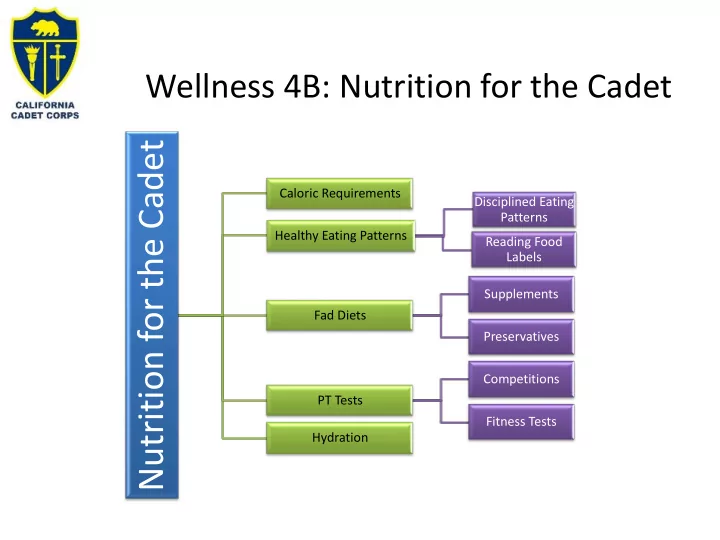
Wellness 4B: Nutrition for the Cadet Nutrition for the Cadet Caloric Requirements Disciplined Eating Patterns Healthy Eating Patterns Reading Food Labels Supplements Fad Diets Preservatives Competitions PT Tests Fitness Tests Hydration


slide-1
SLIDE 1

Wellness 4B: Nutrition for the Cadet

Nutrition for the Cadet

Caloric Requirements Healthy Eating Patterns Disciplined Eating Patterns Reading Food Labels Fad Diets Supplements Preservatives PT Tests Competitions Fitness Tests Hydration

slide-2
SLIDE 2

HEALTH & WELLNESS AGENDA

  • B1. Caloric Requirements For Moderately Active Lifestyle
  • B2. Healthy Eating Patterns For A Cadet Requirement
  • B3. Reading Nutrition Labels
  • B4. Fad Diets, Supplements, Preservatives
  • B5. Nutrition For PT Tests, Competitions, And Fitness Tests
  • B6. Hydration
slide-3
SLIDE 3

NUTRITION FOR THE CADET: UNIT OBJECTIVES

The desired outcome of this unit is for students to learn various nutritional facts, proper diets of nutrition, and planning for specific activities in a student cadet's life.

Plan of Action:

1. Define energy balance, caloric intake, and caloric expenditure 2. Define a Kcal and compare Kcal to cal 3. Explain and expand on each individual tier of the Physical Activity Pyramid 4. List the 3 stages in the slogan of the CDC for establishing healthy eating habits. 5. Define each of the 3 stages of the Reflect, Replace and Enforce model 6. Understand that the USDA has tools for aiding in improving healthy eating 7. Define discipline in the matter of healthy eating 8. List the main concepts of The Definite Dozen with explanations 9. Understand the Principle of Reinforcement, cognitive theory and self- determination theory

  • 10. Define each indicator found on labels and what information each of the 6

indicators holds

slide-4
SLIDE 4

NUTRITION FOR THE CADET: UNIT OBJECTIVES

  • 11. Define fad diets, compare them to healthy balanced diets
  • 12. Understand what dietary supplements are and what is in them
  • 13. Define and understand performance enhancing drugs such as anabolic

steroids, peptide hormones, and diuretics; explain the health risks of all

  • 14. Understand Carbo-loading and High Protein diets, explain their effectiveness
  • r ineffectiveness
  • 15. Understand the anatomical importance of factors relating to hydration,

dehydration, and hyponatremia.

  • 16. Explain the similarities and differences between heat stroke and heat

exhaustion.

slide-5
SLIDE 5

NUTRITION FOR THE CADET: CALORIC REQUIREMENTS FOR A MODERATELY ACTIVE LIFESTYLE

Objectives: Cadets will be able to

  • Define energy balance, caloric intake, and caloric expenditure
  • Define a Kcal and compare Kcal to cal
  • Explain and expand on each individual tier of the Physical Activity Pyramid

Essential Question: How do you utilize caloric intake to cater to exercise expectations?

slide-6
SLIDE 6

CALORIC REQUIREMENTS FOR A CADET

  • Energy balance, which is a combination of two

factors

  • caloric intake: energy in/food
  • caloric expenditure: calories used/burned during

physical activity or workouts

  • Calorie: the amount of energy in food products
  • Kilo-calorie (Kcal): a unit of energy or heat.
  • Weight management is always calories in vs Kcals
  • burned. In order to balance caloric intake of 3,500

calories, in order to not gain weight the individual must burn 3,500 kcals in the same amount of time. The number 3,500 is significant because 3,500 is equal to one pound of fat.

slide-7
SLIDE 7

CALORIC REQUIREMENTS FOR MODERATE ACTIVE LIFESTYLE

slide-8
SLIDE 8

CALORIC REQUIREMENTS FOR MODERATE ACTIVE LIFESTYLE

  • Physical Activity Pyramid has five tiers to achieve the ideal balance. From the

base to the top of the model is moderate physical activity, vigorous aerobics, vigorous sport and recreation, muscle fitness exercise, and flexibility exercises.

  • Moderate physical activity is utilized in the long term of controlling fat

accumulation

  • Vigorous aerobics is more intense than moderate activities, it is continuous

leading to a slightly higher caloric expenditure

  • Vigorous sport and recreation is even more intensity of activity and allows

for more calories to be burned due to the increase in time spent on it

  • Muscle fitness exercises see more caloric burn due to the type of exercise;

it is a dense workout and even after a workout continues to help burn calories due to the body needing to rebuild the muscles, using energy to do so

  • Flexibility exercises are not a high-calorie burner type exercise, but they

burn more calories than just resting and are a necessary need for overall fitness

slide-9
SLIDE 9

Physical Activity Pyramid

slide-10
SLIDE 10

CHECK ON UNDERSTANDING

  • 1. ____________ is the stage of the

physical activity pyramid that burns the most calories.

  • 2. A calorie and a Kcal are the same

thing? (T/F)

  • 3. It’s safe to say that the more you

weigh, the more calories you burn during exercises and activities? (Yes

  • r No)
slide-11
SLIDE 11

NUTRITION FOR THE CADET: HEALTHY EATING PATTERNS FOR A CADET

Objectives: Cadets will be able to

  • List & define the 3 stages in the Slogan of the CDC for establishing

healthy eating habits; Reflect, Replace & Reinforce.

  • Use the USDA has tools for aiding in improving healthy eating
  • Define discipline in the matter of healthy eating
  • List the main concepts of The Definite Dozen with explanations
  • Understand the Principle of Reinforcement

Essential Question: How do we master a healthier eating habit?

slide-12
SLIDE 12

Reflect, Replace, and Reinforce

The CDC has a three-stage slogan of Reflect, Replace, and Reinforce.

  • Stage One: Reflect
  • Make a list of eating/snacking habits like a food diary
  • Annotate habits such as eating too quickly, eating when not hungry,

dessert intake, and skipping meals

  • Identify the unhealthy habits
  • Create a list of cues of when you may be triggered to eat, (examples:
  • pening the refrigerator or cabinet when not hungry, seeing food on a

counter and partaking, feeling bored or tired and just grabbing food)

  • Ask questions according to your cue list about avoiding bad food and

seeking healthy food

slide-13
SLIDE 13

Reflect, Replace, and Reinforce

  • Stage Two: Replace
  • Replace unhealthy habits with healthier ones
  • Eat slower
  • Eat only when hungry
  • Plan well-balanced meals.
  • Stage Three: Reinforce
  • The mental health and integrity portion of

the guidance

  • Be patient with oneself, the change isn’t

instantaneous

  • Forgive oneself if missteps take place
  • Take it one day at a time towards progress
slide-14
SLIDE 14

www.ChooseMyPlate.gov

  • www.ChooseMyPlate.gov
  • Free online digital planner
  • Information on healthy eating
  • Takes the individual's information and creates a

ChooseMyPlate meal plan

  • Generates a PDF of how many calories and what

category intake amounts are needed with spots a person can fill in if they reached the target or not

slide-15
SLIDE 15

ChooseMyPlate Website

https://www.choosemyplate.gov/resources/MyPlatePlan

slide-16
SLIDE 16

Discipline to Establish Patterns

  • To establish a pattern in

healthy/healthier eating, an individual must create a sense of discipline.

– Discipline is learning to be obedient, training oneself to improve on a skill or regimen and stick to it – Research how to safely, effectively, and realistically achieve their desired goal.

slide-17
SLIDE 17

Definite Dozen

To establish any change in behavior is heavily rooted in

  • psychology. The Definite Dozen, developed by Pat

Summitt, is a competitive principle mostly related to sports performance but can be utilized as productive steps to developing a disciplined eating habit pattern.

1. Respect yourself and others- an individual cannot have self-respect without giving respect to others. 2. Take full responsibility- be candid as possible in accountability, there are no shortcuts to success 3. Develop and demonstrate loyalty- be loyal to yourself and don’t cheat. i.e. in your food journals or diaries. Seek out quality people to be around to support you

slide-18
SLIDE 18

Definite Dozen

4. Learn to be a good communicator- listen to input and give honest feedback when it comes to the topics of accolades, discipline, downfalls, struggles, and other accountable factors to a supportive person or group 5. Discipline yourself, so no one has to- if you have an accountability partner or group be truthful with yourself and them 6. Make hard work your passion- do the hard stuff first, plan your work & work your plan, do not eat dessert first. 7. Don’t just work hard, work smart- Focus on your strengths to minimize your weaknesses 8. Put the team before you- in group success there is individual

  • success. Your team can be family, friends, and champions for

you in your life

slide-19
SLIDE 19

Definite Dozen

9. Make winning an attitude- positive attitude is a choice

  • 10. Be a competitor- be the best you that you can be daily. Win!
  • 11. Change is a must- Push yourself to places you haven’t’ been

before

  • 12. Handle success like you handle failure – you can’t always

control what happens, but you can control how you handle it. Learn from failure. Continue to seek new goals

slide-20
SLIDE 20

Reinforcement

  • The why to institute positive eating patterns is following the principles of

reinforcement

  • The principle of reinforcement is rooted in rewards and punishments for

doing an action correctly. If you achieve a goal, give yourself a (non-food) reward to celebrate. If you fail to achieve a goal, continue working until you eventually reach it. This is called positive and negative reinforcement.

  • Punishment is related to reinforcement. You might punish yourself by

denying a pleasurable event when you fail to reach your goal

slide-21
SLIDE 21

CHECK ON UNDERSTANDING

1. Name the CDC three-stage slogan 2. Changing pattern of eating healthy is an easy task for everyone (T/F) 3. ChooseMyPlate is a costly resource for changing eating patterns (Yes/No) 4. What trait is key to establishing patterns in healthier eating?

slide-22
SLIDE 22

NUTRITION FOR THE CADET: READING NUTRITION LABELS

Objectives: Cadets will be able to

  • Define each indicator found on labels and what information

each of the 6 indicators holds Essential Question: How to read food labels correctly to plan accordingly

slide-23
SLIDE 23

Reading Nutrition Labels

  • Nutrition labels in common terms are food labels, nutritional information that

appears in the food that is packaged that is regulated by the United States of Department of Agriculture (USDA).

– Servings are the number of servings that the serving size is and how many servings per container. – Calories category breaks down how many calories the serving is and usually how many calories are from fat. – Nutrients that should be limited section are comprised of written in percentages of the daily value, these usually include total fat, saturated fat, trans-fat, cholesterol, and sodium percentages. – Carbohydrate and protein sections guided by the daily percentages values include fiber, sugars, proteins, and total carbohydrate quantities. – Micronutrients specify the percentages of vitamins and minerals. – Footnote gives the variance of the difference of percentages based on a 2,000 calorie and 2,500 calorie diets to try to give as much information and specification as possible

slide-24
SLIDE 24

Reading Nutrition Labels

slide-25
SLIDE 25

Serving Information

  • Number of Servings
  • Size of servings
slide-26
SLIDE 26

Calories

  • How many calories per serving
  • Learn your estimated calorie requirements at:

https://www.choosemyplate.gov/resources/MyPlatePlan

slide-27
SLIDE 27

Nutrition

  • Nutrients to get less of:

– Saturated Fat – Sodium – Added Sugars

  • Nutrients to get more of

– Dietary Fiber – Vitamin D – Calcium – Iron – Potassium

slide-28
SLIDE 28

Percent Daily Value

  • Percentage of the Daily

Value for each nutrient in a serving of the food

  • Expressed in grams,

milligrams or micrograms

  • For ‘good’ nutrients,

you want a high %

  • For ‘bad’ nutrients, you

want a low %

slide-29
SLIDE 29

CHECK ON UNDERSTANDING

  • 1. If a bag of chips contains 3 servings and a serving is 160

calories, how many calories are you eating if you eat the whole bag?

  • 2. Who regulates food labels?
  • 3. Is saturated fat healthy for you? How about dietary fiber?

How can you tell from the nutrition label?

slide-30
SLIDE 30

NUTRITION FOR THE CADET: FAD DIETS, SUPPLEMENTS AND PRESERVATIVES

Objectives: Cadets will be able to

  • Define Fad diets, compare them to healthy balanced diets
  • Understand what dietary supplements are and what is in them
  • Define and understand performance enhancing drugs such as

anabolic steroids, peptide hormones, and diuretics; explain the health risks of all. Essential Question: What are the surface facts on fad diets, supplements and performance enhancing drugs?

slide-31
SLIDE 31

Fad Diets

Fad Diets:

  • Popular diets
  • Not always rooted in scientific evidence
  • Widespread in North America
  • Purport to shed excess pounds, easily
  • Dietary restrictions
  • Often not nutritionally sound
  • May cause health issues or long-term

problems.

slide-32
SLIDE 32

Fad Diets

Examples of Fad Diets:

– South Beach Diet a low-carb diet, – Gluten-Free is a wheat, barley or rye free diet – Macrobiotic diet which is rooted in the philosophy of Yin and Yang in Buddhist culture and is very low- calorie it poses a risk to starvation

slide-33
SLIDE 33

Dietary Supplements

Dietary supplements are manufactured products intended to supplement the diet when taken by mouth. – Supplements include vitamins, minerals, amino acids, botanical products, and herbs, as well as additives such as enzymes, glandulars, organ tissues, and metabolics. – These types of substances can be pills, capsules, tablets, powders, and liquids – they are labeled as a food type/supplement, and cannot be labeled as drugs – they are regulated under the Dietary Supplement Health and Education Act (DSHE) of 1994. – There are literally thousands of dietary supplements for various reasons: to build stronger bones, regulate blood sugar, and maintain bowel reliability, etc.
slide-34
SLIDE 34

Performance Enhancing Drugs

Performance enhancing drugs sometimes sold under the guise of food supplements, but they can have serious side effects

– Mostly used to improve physical appearance – Anabolic Steroids have a slew of health complications including liver and kidney problems, enlarged heart, high blood pressure, risk of stroke and heart attack, hair loss, acne, and mood swings and aggression – Peptide Hormones/ Growth Hormones (GH), the side effect are serious and are long term or irreversible, such as myocardial ischemia (artery disease, plaque buildup in the artery), myocardial infarction (complete blockage in the artery, heart attack) and angina (chest pain) due to use. – Diuretics will cause a suppressed immune system, causes thermal regulation to be out of balance, bone loss, electrolyte imbalance, and

  • fatigue. Can lead to malnutrition, stunted growth, and hyperthermia.
slide-35
SLIDE 35
slide-36
SLIDE 36

Peptide Hormones

  • Peptides include the hormone
  • xytocin, glutathione (stimulates tissue

growth), melittin (honeybee venom), the pancreatic hormone insulin, and glucagon (a hyperglycemic factor).

  • Peptides build muscle mass and reduce

body fat

  • Body builders use them to bulk up.

They don’t have as many side-effects as anabolic steroids

  • They are illegal without a doctor’s

prescription, but widely abused

slide-37
SLIDE 37

Preservatives

  • Preservatives are non-nutrients
  • May be harmful: toxins, cholesterols, and additives

that are dyed

  • Can be beneficial: antioxidants
  • Manufacturers of foods have to add preservatives to

food to give them a shelf life and prevent items from spoiling too quickly

  • Often-used preservatives are sodium (salt) and

sugars

slide-38
SLIDE 38

CHECK ON UNDERSTANDING

  • 1. Fad diets are highly effective and safe

(T/F)

  • 2. Anabolic steroids are usually used to

improve ________ __________.

  • 3. Diet pills, laxatives, and enemas are all

d____________________.

slide-39
SLIDE 39

NUTRITION FOR THE CADET: NUTRITION FOR PT TESTS, COMPETITIONS, AND FITNESS TESTS

Objectives: Cadets will be able to

  • Understand Carbo-loading and High Protein diets, explain

their effectiveness or ineffectiveness. Essential Question: How do you select the correct nutrition plan for the correct exercise plan in order to improve performance in fitness tests?

slide-40
SLIDE 40

Nutrition For PT Tests, Competitions, And Fitness Tests

  • Glycogen loading or Carbohydrate loading:

– increase carbohydrate intake to store the energy in the body before a prolonged, endurance, or high-performance activity. This practice is widely used by distance runners, cyclists, and for exercises that take several hours

  • Protein diets do not ultimately increase performance
  • r endurance
  • Fat- loading is the same principle of carbo-loading, but

with fat substances. It doesn’t work.

slide-41
SLIDE 41

CHECK ON UNDERSTANDING

  • 1. Carbohydrate loading is also known as

______________ ____________.

  • 2. High Protein diets are more beneficial

than carbo-loading before exercise. (T/F)

  • 3. Explain why carbohydrate loading works.
slide-42
SLIDE 42

NUTRITION FOR THE CADET: HYDRATION

Objectives: Cadets will be able to

  • Understand the anatomical importance of factors relating to

hydration, dehydration, and hyponatremia

  • Explain the similarities and differences between heat stroke

and heat exhaustion Essential Question: In what ways is hydration a basic necessity for health and function of the body?

slide-43
SLIDE 43

Hydration

  • Antidiuretic hormone (ADH), also known as arginine

vasopressin, is a hormone secreted from the pituitary glands in the brain

  • ADH function is to regulate water and electrolyte

balance in the blood by controlling how much water is excreted in urine

  • Hydration is completely controlled by ADH, ensuring

the blood is not saturated or dehydrated with water. It also conserves water.

  • It is important to maintain hydration levels but when

there is an endurance exercise, activity, or high- performance challenge an individual should prepare for this by regularly drinking water days before, during, and after the event

slide-44
SLIDE 44

Hydration

  • Hydration is the balance of water fluids in the blood

and body

  • Dehydration is water loss in the body or a harmful

reduction in the amount of water in the body

  • The output of water through basic body functions is

completed through evaporation from the skin, respiratory tract, kidneys, and large intestines

  • During exercise, the amount of water being expelled is

determined by environmental temperature, body size, and metabolic rate

  • Hyponatremia is when the blood sodium levels drop

below normal ranges of 136 to 143 millimoles per liter

slide-45
SLIDE 45

Heat Exhaustion

  • Lack of replenishing water

to balance the body can lead to heat exhaustion

  • Symptoms are fatigue and

weakness, excessive sweating, nausea or vomiting, a rapid, weak pulse, and heat cramps

  • Treatment is to get to a

cooler place, drink water if fully conscious, take a cool shower or use a cool compress

slide-46
SLIDE 46

Heat Stroke

  • Heatstroke is a very serious

medical condition

  • The body completely fails to

maintain body temperature

  • Symptoms are high fever (>103

degrees), headache, cessation of sweating, nausea or vomiting, a rapid, strong pulse, confusion,

  • unconsciousness. Can lead to

death.

  • Treatment: Call 911/seek medical

care, reduce body temperature any way you can

slide-47
SLIDE 47
slide-48
SLIDE 48

CHECK ON UNDERSTANDING

  • 1. Explain the differences

between Heat Exhaustion and Heatstroke.

  • 2. What does ADH stand for?
  • 3. Define dehydration.