
SLIDE 1
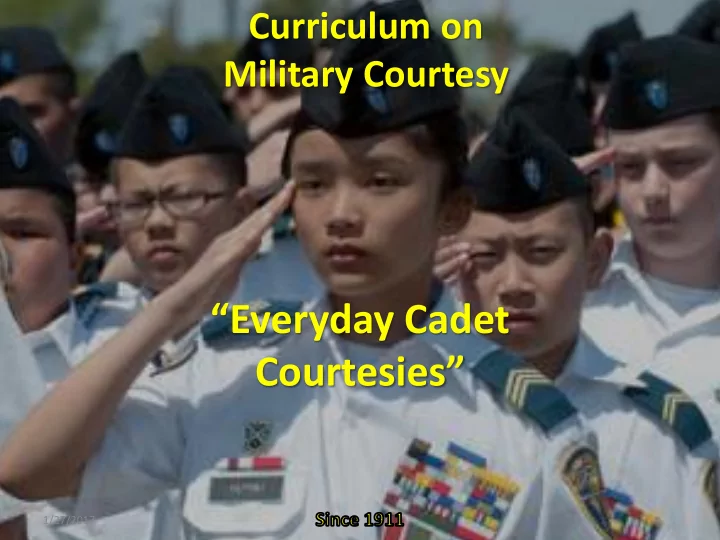
California Cadet Corps Curriculum on Military Courtesy
“Everyday Cadet Courtesies”
1/27/2017
Everyday Cadet Courtesies 1/27/2017 Daily Cadet Courtesies Agenda - - PowerPoint PPT Presentation
California Cadet Corps Curriculum on Military Courtesy Everyday Cadet Courtesies 1/27/2017 Daily Cadet Courtesies Agenda A1. Introduction to Military Courtesy A2. Rank A3. Addressing People (Title/Sir) A4.
1/27/2017
A1. Describe what military courtesy is and why it’s important in the Cadet Corps.
Military Courtesy: A required set of rules that govern how members of the military (or Cadet Corps) address and treat each other. Found in: Tradition Regulation Unit Pride
The courtesy you learn and practice here in the Cadet Corps will also prepare you for success in any occupation you choose, not just the military.
A2. Identify all Cadet Corps and US Army ranks. Be familiar with the military history of rank. Understand the purpose of each rank.
US Army (1911)
the British (1780s)
Commissions, and Warrants
Spanish words (lieutenant, colonel, etc)
ancient times (at least 500 b.c.)
few militaries (Communist) have attempted to eliminate rank…only to return to them because of no command and control.
"tenant" meaning "holding." Literally, lieutenants are placeholders.
pronouncing the word, "lieuftenant."
major generals.
French spelling "colonel" but the Spanish pronunciation was "coronel" which became more popular.
sharpshooters looked for officers. Officers soon learned to take off their rank insignia as they approached the battle line.
tell whom what to do.
and responsibility
CPT MAJ With each rank comes new leadership lessons.
– (Addressed as "Cadet") – Lowest rank: a “Recruit” who’s in their first semester of CACC. Primary role is to carry out orders issued to them to the best of his/her ability. – Squad member.
– (Addressed as "Cadet") – RCTs are advanced to this level after one semester of CACC (or earlier) and passing their PTA. Carries
– Squad member.
– (Addressed as "Cadet") – CDTs are advanced to this level after their second semester of CACC (or earlier) and passing their
– Squad member.
– (Addressed as "Corporal") – CFCs are advanced to this level after their third semester of CACC (or earlier) and passing their PTA. Carries out orders issued to them to the best of his/her ability. – Squad member. However, now as a non-commissioned officer may have to fill in for the squad leader or may be tasked to lead small work details. Recruits wear the uniform without any rank.
– (Addressed as "Sergeant") – CPLs are promoted to this level after taking the C/SGT exam and passing their PTA. Often in this rank cadets experience their first official leadership position, Squad Leader. Considered to have the greatest impact on Cadets because SGTs oversee them in their daily tasks. SGTs set an example and the standard for Entry-Level Cadets to look up to, and live up to. – Assistant Squad Leader (5-11 Cadets).
– (Addressed as "Sergeant") – SGTs are promoted to this level after taking the C/SSG exam and passing their PTA. Also, commands a squad (9 to 10 Cadets). Often has one or more SGTs under their leadership. – Squad Leader (5-11 cadets), Company Clerk/Guidon Bearer, Battalion Staff NCO
– (Addressed as "Sergeant") – SSGs are promoted to this level after passing a promotion board and completing their PTA. Often SFCs serve as platoon Sergeant and advise the platoon leader as well as mentor squad leaders. SFCs are key to staff function. – Company Supply Sergeant, Battalion Staff NCO, Regimental Staff NCO
– (Addressed as "Sergeant") – SFCs are promoted to this level after passing a promotion board and completing their PTA. Principal NCO at the Battalion, and all staff levels. – Platoon Sergeant, Battalion/Regimental/Brigade/10th Corps Staff NCO
– (Addressed as "First Sergeant") – SFCs or MSGs are promoted to this level after passing a promotion board and completing the MSG PTA and being assigned to the First Sergeant Position. Principal NCO and life-blood of the company: the trainer, tutor, and wise counselor. Instructs
– Company First Sergeant, HHC First Sergeant
– (Addressed as " Sergeant Major ") – 1SGs or MSGs are promoted to this level after passing a promotion board. SGMs experience and abilities are equal to that of the CSM, but the sphere of influence regarding leadership is generally limited to those directly under his charge. – Battalion Operations NCO, Regimental/Brigade/10th Corps Staff NCO
– (Addressed as "Command Sergeant Major") – SGMs are promoted to this level after passing a promotion board. CSMs normally serve at the Brigade level and above. – Battalion/Regiment/Brigade/10th Corps Command Sergeant Major
– (Addressed as "Lieutenant") – SSGs and above are promoted to this entry-level officer rank after completing OCS, Promotion Board, and Officer PTAs . Leads platoon-size elements consisting of the platoon SGT and two or more squads (Commands at least 14 Cadets). – Platoon Leader, Company Staff Officer
– (Addressed as "Lieutenant") – 2LTs are promoted to the senior lieutenant rank after completing a promotion board and 1LT PTAs. 1LTs are often assigned as the Company XO. – Company Executive Officer, Battalion Staff Officer
– (Addressed as "Captain") – 1LTs are promoted to this rank after completing a promotion board and Captain PTAs. Captains command companies (at least 32 cadets) and are primary staff officers at the Battalion – Company Commander, Battalion Staff Officer
– (Addressed as "Major") – CPTs are promoted to this rank after completing a promotion board and Major
– Battalion Executive Officer, Regimental/Brigade/10th Corps Staff Officer
– (Addressed as "Colonel") – MAJs are promoted to this rank after completing a promotion board and LTC
– Battalion/Regimental Commander, Brigade Deputy/XO, 10th Corps Staff Officer
– (Addressed as "Colonel") – LTCs are promoted to this rank after completing a promotion board and COL
– Brigade Commander, !0th Corps Command Element
CR 1-5 in 2017 removed Cadet Warrant Officer ranks from our system. There will be Cadet Warrant Officers around in dwindling numbers for a short time.
1 2 3 4 5 6 7 8 9 10 11 12 13 14 15 16 17
PRIVATE (PVT/PV2) (Addressed as "Private") Lowest rank: a trainee who’s starting Basic Combat Training (BCT). Primary role is to carry out orders issued to them to the best of his/her ability. (PVT does not have an insignia) PRIVATE FIRST CLASS (PFC) (Addressed as "Private") PV2s are promoted to this level after one year—or earlier by request of
military training. Carries out orders issued to them to the best of his/her ability. SPECIALIST (SPC) (Addressed as "Specialist") Can manage other enlisted Soldiers of lower rank. Has served a minimum of two years and attended a specific training class to earn this promotion. People enlisting with a four-year college degree can enter BCT as a Specialist.
CORPORAL (CPL) (Addressed as "Corporal") The base of the Non-Commissioned Officer (NCO) ranks, CPLs serve as team leader, the smallest Army units. Like SGTs, they are responsible for individual training, personal appearance and cleanliness of Soldiers. SERGEANT (SGT) (Addressed as "Sergeant") Typically commands a squad (9 to 10 Soldiers). Considered to have the greatest impact on Soldiers because SGTs oversee them in their daily tasks. In short, SGTs set an example and the standard for Privates to look up to, and live up to. STAFF SERGEANT (SSG) (Addressed as "Sergeant") Also commands a squad (9 to 10 Soldiers). Often has one or more SGTs under their leadership. Responsible for developing, maintaining and utilizing the full range of his Soldiers' potential. SERGEANT FIRST CLASS (SFC) (Addressed as "Sergeant") Key assistant and advisor to the platoon leader. Generally, has 15 to 18 years of Army experience and puts it to use by making quick, accurate decisions in the best interests of the Soldiers and the country. MASTER SERGEANT (MSG) (Addressed as "Sergeant") Principal NCO at the battalion level, and often higher. Not charged with all the leadership responsibilities of a 1SG, but expected to dispatch leadership and other duties with the same professionalism.
FIRST SERGEANT (1SG) (Addressed as "First Sergeant") Principal NCO and life-blood of the company: the provider, disciplinarian and wise counselor. Instructs other SGTs, advises the Commander and helps train all enlisted Soldiers. Assists Officers at the company level (62 to 190 Soldiers). SERGEANT MAJOR (SGM) (Addressed as "Sergeant Major") SGMs experience and abilities are equal to that of the CSM, but the sphere of influence regarding leadership is generally limited to those directly under his charge. Assists Officers at the battalion level (300 to 1,000 Soldiers). COMMAND SERGEANT MAJOR (CSM) (Addressed as " Command Sergeant Major") Functioning without supervision, a CSM’s counsel is expected to be calm, settled and accurate—with unflagging enthusiasm. Supplies recommendations to the commander and staff, and carries out policies and standards on the performance, training, appearance and conduct of enlisted personnel. Assists Officers at the brigade level (3,000 to 5,000 Soldiers). SERGEANT MAJOR OF THE ARMY There’s only one Sergeant Major of the Army. This rank is the epitome of what it means to be a Sergeant and oversees all Non-Commissioned Officers. Serves as the senior enlisted advisor and consultant to the Chief of Staff of the Army (a four-star General).
WARRANT OFFICER 1 (WO1) Appointed by warrant from the Secretary of the Army. WO1s are technically and tactically focused officers who perform the primary duties of technical leader, trainer, operator, manager, maintainer, sustainer, and advisor. CHIEF WARRANT OFFICER 2 (CW2) Chief Warrant Officers become commissioned officers as provided by the President of the United States. CW2s are intermediate level technical and tactical experts who perform increased duties and responsibilities at the detachment through battalion levels. CHIEF WARRANT OFFICER 3 (CW3) Advanced-level experts who perform the primary duties that of a technical and tactical leader. They provide direction, guidance, resources, assistance, and supervision necessary for subordinates to perform their duties. CW3s primarily support operations levels from team or detachment through brigade. CHIEF WARRANT OFFICER 4 (CW4) Senior-level experts in their chosen field. They primarily support battalion, brigade, division, corps, and echelons above corps operations. CW4s typically have special mentorship responsibilities for other WOs and provide essential advice to commanders on WO issues. CHIEF WARRANT OFFICER 5 (CW5) Master-level technical and tactical experts that support brigade, division, corps, echelons above corps, and major command operations. They provide leader development, mentorship, advice, and counsel to WOs and branch officers.
SECOND LIEUTENANT (2LT)
(Addressed as "Lieutenant") Typically the entry-level rank for most Commissioned Officers. Leads platoon-size elements consisting of the platoon sergeant and two or more squads (16 to 44 Soldiers). FIRST LIEUTENANT (1LT) (Addressed as "Lieutenant") A seasoned lieutenant with 18 to 24 months’ service. Leads more specialized weapons platoons and indirect fire computation
personnel). CAPTAIN (CPT) (Addressed as "Captain") Commands and controls company-sized units (62 to 190 Soldiers), together with a principal NCO assistant. Instructs skills at service schools and The United States Army combat training centers and is often a Staff Officer at the battalion level. MAJOR (MAJ) (Addressed as "Major") Serves as primary Staff Officer for brigade and task force command regarding personnel, logistical and operational missions. LIEUTENANT COLONEL (LTC) (Addressed as "Lieutenant Colonel " or "Colonel") Typically commands battalion-sized units (300 to 1,000 Soldiers), with a CSM as principal NCO assistant. May also be selected for brigade and task force Executive Officer. COLONEL (COL)
(Addressed as "Colonel") Typically commands brigade-sized units (3,000 to 5,000 Soldiers), with a CSM as principal NCO assistant. Also, found as the chief of divisional-level staff agencies.
BRIGADIER GENERAL (BG) (Addressed as "General") Serves as Deputy Commander to the commanding general for Army divisions. Assists in
MAJOR GENERAL (MG) (Addressed as "General") Typically commands division-sized units (10,000 to 15,000 Soldiers). LIEUTENANT GENERAL (LTG) (Addressed as "General") Typically commands corps-sized units (20,000 to 45,000 Soldiers). GENERAL (GEN) (Addressed as "General") The senior level of Commissioned Officer typically has over 30 years of experience and
Staff of the Army is a four-star General. GENERAL OF THE ARMY (GOA) This is only used in time of War where the Commanding Officer must be equal or of higher rank than those commanding armies from other nations. The last officers to hold this rank served during and immediately following WWII.
1 2 3 4 E.C. 5 6 7 8 9 10 11 12 13 14 15 16 17 18 19 20 21 22 23 24 25 27 28 29 26
all ranks using titles or rank. Know when to use “Sir” and “Ma’am”.
Example1: A C/SSG asks a CFC “Do you understand, Cadet?” The CFC answers “Yes, Sergeant!” Example2: A C/CSM greets a C/LTC with “Good morning, Colonel” and the C/LTC responds with “Good morning, Sergeant Major”
A4. Describe the process of saluting. Give the correct verbal greeting for each time of day.
Knights in armor raised visors with the right hand when meeting a comrade. This practice gradually became a way of showing respect and, in early American history, sometimes involved removing the hat. By 1820, the motion was modified to touching the hat, and since then it has become the hand salute used today. You salute to show respect toward an officer, flag, or our country.
thumb snug along the hand in line with the fingers, and not across your palm.
your forefinger touches the outer edge of your right eyebrow (just above and to the right of your right eye).
forefinger touches the right front corner of the visor.
forming a straight line from your elbow to your fingertips. Your upper arm (elbow to shoulder) is horizontal to the ground.
Time of Day Greeting
0000-1159:59 “Good Morning Sir/Ma’am/Sergeant” 1200-1659:59 “Good Afternoon Sir/Ma’am/Sergeant” 1700-2359:59 “Good Evening Sir/Ma’am/Sergeant” CACC Standard Greeting
A4. Give the correct response to each situation in the Rules for
Dress Situation Correct Response
Uniform
US flag is raised or lowered
*Note: Accompanied by Reveille or Retreat
Stop, stand at attention, face the flag and salute until flag is finished being raised or lowered or last note of music is played. Uniform
US Flag passes by
Stop, stand at attention and salute until flag is 6 paces away Uniform
Pass by an officer
Salute and greet him/her 6 paces away, continue walking without stopping Uniform
Pass an officer from behind
Salute and greet with “By your leave, Sir/Ma’am” and continue walking without stopping Uniform
Reporting to an officer
Salute and say “Sir/Ma’am, Cadet (include your rank and name) reporting as ordered.” Uniform
Reporting to an NCO
Stand at Parade Rest and say “Sergeant (or First Sergeant or Sergeant Major), Cadet (include your rank and name) reporting as ordered.” Uniform
Reciting the Pledge of Allegiance
Salute and recite the pledge Civilian
US flag is raised or lowered
*Note: Accompanied by Reveille or Retreat
Stop, stand at attention, put your hand over your heart, and face the flag until it is finished being raised or lowered or last note of music is played . Civilian
US Flag passes by
Stop, stand at attention until flag is 6 paces away Civilian
Pass by an officer
Greet him/her 6 paces away, continue walking Civilian
Pass an officer from behind
Greet with “By your leave, Sir/Ma’am” and continue walking without stopping Civilian
Reporting to an officer
Stand at attention and say “Sir/Ma’am, Cadet (include your rank and name) reporting as ordered.” Civilian
Reporting to an NCO
Stand at parade rest and say “Sergeant (or First Sergeant or Sergeant Major), Cadet (include your rank and name) reporting as ordered.”
Dress Situation Correct Response
Civilian Reciting the Pledge of Allegiance Place your hand over your heart and recite the pledge Uniform US flag is raised or lowered Entire Formation Salutes at “Present, Arms” Command Uniform An officer passes by Formation’s leader salutes on behalf of the unit, continues marching without stopping. If at Parade Rest or At Ease, the formation is called to Attention. Civilian US flag is raised or lowered Entire formation stands at attention and salutes Civilian An officer passes by Formation’s leader greets officer on behalf of the unit, continues marching without stopping. If at Parade Rest or At Ease, the formation is called to Attention
Dress Situation Correct Response
Uniform
Civilian Reciting the Pledge of Allegiance Stand at attention, place your hand over your heart and recite the Pledge Uniform
Civilian Reporting to an officer Salute and say “Sir/Ma’am, Cadet (include your rank and name) reporting as ordered.” Uniform
Civilian Reporting for a Board Salute the Board President and say “Sir/Ma’am/Sergeant Cadet (include your rank and name) reporting for board.” Uniform
Civilian Reporting to an NCO Stand at parade rest and say “Sergeant (or First Sergeant or Sergeant Major), Cadet (include your rank and name) reporting as
Uniform
Civilian Pass by an officer or passing from behind Greet officer Uniform
Civilian US Flag passes by; National anthem is Sung Stand at attention and place your hand over your heart (If in civilian clothes)
Flag of the United States:
– As it’s being raised or lowered – As it’s passing by in a parade – As you are passing by it in a parade – As you are pledging allegiance
Commander in Chief:
– President of the United States – Governor of the State of California
Officers in the CACC:
– Warrant Officers – Company Grade Officers (2LT- CPT) – Field Grade Officers (MAJ-COL)
Officers in the military:
– Army, Navy, Air Force, Marines, Coast Guard – California State Military Forces – Officers of Foreign countries (If you recognize them)
– All Ranks
If you can’t salute, you should still attempt to render a respectful verbal greeting.
A6. Report to an officer or NCO correctly in an office or outside.
– Cadet removes headgear, knocks twice, and enters when told to do so. – Cadet approaches within three steps of the officer's desk, halts, salutes, and reports, "Sir (Ma'am), Recruit Jones reporting as ordered." – The salute is held until the report-in is completed and the salute has been returned by the officer. – When the business is completed, the cadet salutes, holds the salute until it has been returned, executes an about face, and departs.
– When reporting outdoors, the Cadet moves rapidly (double time) toward the officer, halts approximately three steps from the officer, salutes, and reports (as when indoors). – When the Cadet is dismissed by the officer, salutes are again exchanged.
Tip: When reporting to a Non-Commissioned Officer the salute is not rendered and the “Sir/Ma’am” is replaced with rank.
A7. Properly call a room to Attention, or a group or formation
–
– At Ease.
– “Room, Attention”-if you are the first person to see him or her. If there is already an officer in the room,
relieved with an “at ease”, “as you were”, “at rest”, “carry on” or similar statement. – “Room, At Ease”- When an NCO of superior rank enters the room, the first cadet to recognize the NCO calls the room to "At ease." Remain at ease until relieved.
– Continue Working – The officer should be greeted by the person in charge.
– Commandants may establish local policies on calling the room to attention
– During Mess, the command “At Ease” may be given, however you should remain seated, stay silent, and continue eating. Leaders, under normal circumstances, do not want to interrupt limited meal time.
A8. Describe the position of honor for junior and senior personnel walking, posted, or entering a vehicle together.
– For hundreds of years men fought with swords and shields. Most warriors carried the sword in their right and the shield in their left hand. Individuals and units who were proud of their fighting ability and desire to go offensive requested the right side of the battle line as a post of honor. – Thus, the right became the honored side. – When you permit a senior ranking individual to sit or walk on your right, you’re showing them respect by allowing them to symbolically fill the post of honor.
– Senior inspector is to the left and as a result has the best vantage point from which to conduct the inspection.
– When entering a car, the junior ranking person enters first. – The senior person enters last. – When leaving the car, the senior officer goes first. – The senior person sits on the right.
A10. Identify the basic courtesies cadets should use at all times.
A9. Identify examples of Cadet Corps Customs/Traditions.
The California Cadet Corps has a long, proud tradition going back to its formation in
mission – to make our cadets better citizens of the United States of America.
Stillwell Saber Red Beret for Survival Summer Camp
A11. Identify, from a list Taboos, things that members of the Cadet Corps will not do.
around you.
Uniform worn properly = I care Clean, neat and tidy – ready to do my job and be a leader How you present yourself Hair, hands/nails Breath, body odor Clean clothes Pressed uniform Insignia worn correctly Shoes shined
A14. List in order the positions of the chain of command from Cadet through the Governor. Describe the three chains of command that exist within the Cadet Corps structure.
Her Boss His Boss Her Boss His Boss His Boss Her Boss Your Boss YOU Governor His Boss
Cadet Chain CACC Chain School Chain
Bde Cmd Sgt Major Bn Cmd Sgt Major First Sergeant Squad Leader YOU Corps CSM Platoon Sergeant 10th Corps: S1, S2, S3, S4, S5 & Asstants & NCOs Brigade: S1, S2, S3, S4, S5 & Asstants & NCOs Company: Clerk, Supply, Admin, Training NCOs YOU Battalion: S1, S2, S3, S4, S5 & Asstants & NCOs
Battalion Commander YOU 10th Corps Cdr Platoon Leader Cdr, YCPTF Executive Officer Commandant YOU Governor