Surveying in Floodplains NFIP Updates NHLSA Annual Meeting - - PDF document

surveying in floodplains
SMART_READER_LITE
LIVE PREVIEW

Surveying in Floodplains NFIP Updates NHLSA Annual Meeting - - PDF document

NHLSA Annual Meeting 12/02/2016 Agenda Surveying in Floodplains NFIP Updates NHLSA Annual Meeting December 2, 2016 FEMA Floodplain Maps and Studies FEMA Elevation Certificate Jennifer Gilbert, CFM Senior Planner, Floodplain


slide-1
SLIDE 1
  • 1

Surveying in Floodplains

NHLSA Annual Meeting December 2, 2016

Jennifer Gilbert, CFM

Senior Planner, Floodplain Management Program Coordinator New Hampshire Office of Energy and Planning

2

Agenda

  • NFIP Updates
  • FEMA Floodplain Maps and Studies
  • FEMA Elevation Certificate
  • Letter of Map Changes

3

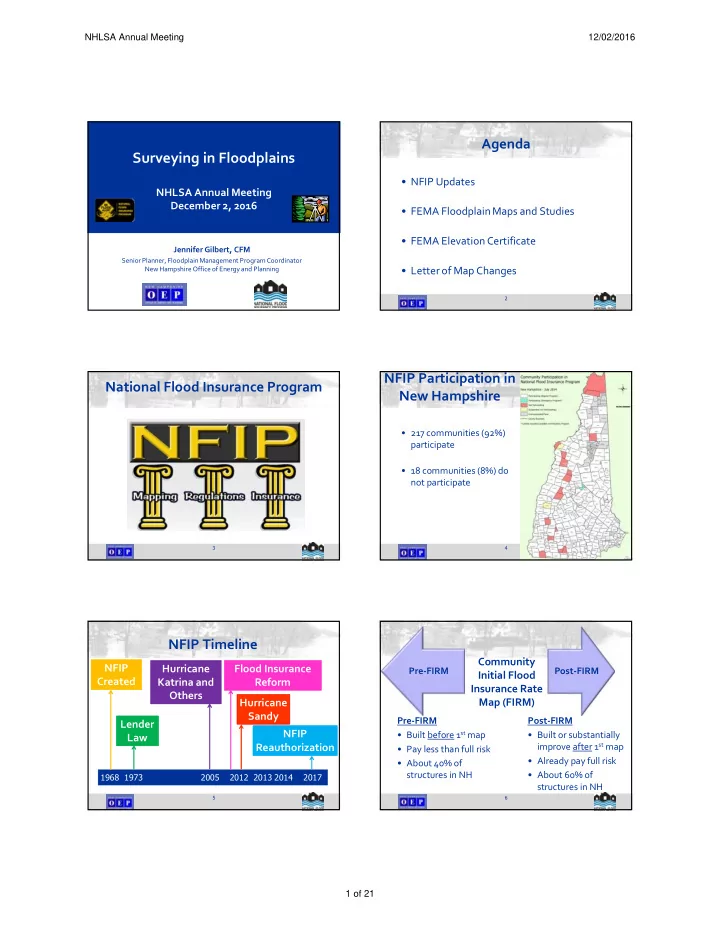
National Flood Insurance Program

4

NFIP Participation in New Hampshire

  • 217 communities (92%)

participate

  • 18 communities (8%) do

not participate

5

NFIP Timeline

NFIP Created Lender Law Hurricane Katrina and Others Hurricane Sandy Flood Insurance Reform NFIP Reauthorization

1968 1973 2005 2012 2013 2014 2017

6

Pre-FIRM

  • Built before 1st map
  • Pay less than full risk
  • About 40% of

structures in NH Post-FIRM

  • Built or substantially

improve after 1st map

  • Already pay full risk
  • About 60% of

structures in NH

Community Initial Flood Insurance Rate Map (FIRM)

Pre-FIRM Post-FIRM NHLSA Annual Meeting 12/02/2016 1 of 21

slide-2
SLIDE 2
  • 2

7

Pre-FIRM vs Post-FIRM Rates

Same premiums but different risks Premiums differ and are based on the various risks

8

Overview of Flood Insurance Changes

  • Biggert-Waters Flood Insurance Reform Act of 2012

– Implementation began in October 2013 – Some rate increases to full risk were immediate and significant – Big impact on real estate market

  • Homeowners Flood Insurance Affordability Act of 2014

– Implementation began in June 2014 – Repealed and modified provisions of Biggert-Waters – Slowed rate increases but still moving to full risk rates

9

Full Risk Rates

  • Full-risk rates are

property-specific and elevation-rated

  • Completion of a FEMA

Elevation needed to determine a structure’s full risk rate

10

Properties Seeing Highest Premium Rate Increases

Increases of 25% per year until reach full risk rates:

  • Non-Primary Residences (<50% of year)
  • Non-Residential Business

– Named insured is commercial enterprise carried out to generate income; business building or mixed use building

  • Severe Repetitive Loss Properties

11

2017 NFIP Reauthorization & Reform

  • NFIP Reauthorization

Biggert-Waters Flood Insurance Reform Act of 2012 extended the NFIP authority through September 30, 2017.

  • Flood Insurance Market Parity and

Modernization Act (H.R. 2901) Legislation to facilitate development of a more robust private market for private flood insurance.

Floodplain Mapping

NHLSA Annual Meeting 12/02/2016 2 of 21

slide-3
SLIDE 3
  • 3

13

County Map Effective Date Carroll 03/19/2013 Cheshire 05/23/2006 Coos 02/20/2013 Grafton 02/20/2008 Hillsborough 09/25/2009 Merrimack 04/19/2010 Rockingham 05/17/2005 Strafford (partial) 05/17/2005 Strafford (partial) 09/30/2015 Sullivan 05/23/2006

Current Status of Digital Floodplain Maps in NH

Belknap County – No Digital Maps

14 14

Vertical Datum on NH Maps

NGVD 1929

  • Belknap
  • Grafton
  • Rockingham
  • Strafford (Non-

Coastal only) NAVD 1988

  • Carroll
  • Cheshire
  • Coos
  • Hillsborough
  • Merrimack
  • Strafford (Coastal

portion only)

  • Sullivan

15

FEMA Discovery Projects in NH

  • Nashua River Watershed by USGS

(Meeting held in 4/16)

  • Winnipesaukee River Watershed by USGS

(Meeting held in 9/16)

  • Lower Connecticut River Watershed by UNH

(Meeting in early 2017)

16

FEMA Discovery Projects in NH

  • Nashua River Watershed by USGS

(Meeting held in 4/16)

  • Winnipesaukee River Watershed by USGS

(Meeting held in 9/16)

  • Lower Connecticut River Watershed by UNH

(Meeting in early 2017)

17

FEMA Discovery Projects in NH

  • Nashua River Watershed by USGS

(Meeting held in 4/16)

  • Winnipesaukee River Watershed by USGS

(Meeting held in 9/16)

  • Lower Connecticut River Watershed by UNH

(Meeting in early 2017)

18

FEMA Discovery Projects in NH

  • Nashua River Watershed by USGS

(Meeting held in 4/16)

  • Winnipesaukee River Watershed by USGS

(Meeting held in 9/16)

  • Lower Connecticut River Watershed by UNH

(Meeting in early 2017) NHLSA Annual Meeting 12/02/2016 3 of 21

slide-4
SLIDE 4
  • 4

19

FEMA Mapping Projects in NH

  • Merrimack River

Basin (USGS)

  • Salmon Falls-

Piscataqua Rivers Watershed (outside of current Coastal Project area) (UNH)

20

Flood Insurance Rate Maps (FIRM) and Flood Insurance Study (FIS)

21

Digital FIRMs

22

New Digital FIRMs

23

Where to Find Floodplain Maps

FEMA Map Service Center

24

FEMA Map Service Center

www.msc.fema.gov/portal

NHLSA Annual Meeting 12/02/2016 4 of 21

slide-5
SLIDE 5
  • 5

25

FEMA’s National Flood Hazard Layer

26

http://www.granit.unh.edu/

GRANITViewII

27

Where to Find BFEs

29

Zone AE - Riverine

196.4 ft 195.8 ft 193.1 ft

30

NHLSA Annual Meeting 12/02/2016 5 of 21

slide-6
SLIDE 6
  • 6

31

Steps on Using the FIS to Determine the BFE

  • Riverine BFE

– Floodway Data Table – Flood Profile

  • Pond & Lake BFE

– Summary of Stillwater Elevations Table

32

Zone AE - Riverine

33

Zone AE

34 35 36

Zone AE – Lakes, Ponds, Ocean

NHLSA Annual Meeting 12/02/2016 6 of 21

slide-7
SLIDE 7
  • 7

37

Zone AE

38

Coastal Areas

39

Zone AE

40

Transects

41

Zone AE

42

FIS Transect Data Table

NHLSA Annual Meeting 12/02/2016 7 of 21

slide-8
SLIDE 8
  • 8

Determining the BFE in Zone AO

44

Zone AO

Highest Adjacent Grade + Depth Number on FIRM Flood Elevation

Determining the BFE in Zone A

46

Why are there Zone As with no BFE?

  • Not cost effective in

areas where there is no

  • r little development
  • Zone A Floodplain areas

based on approximate methods or historical flood data

  • LiDAR is helping

47

FEMA Guidance Document

Managing Floodplain Development in Approximate Zone A Areas

48

Determining BFE for a LOMA

For LOMA purposes, determine if any base flood elevation data is available from:

  • Federal (USACE, USGS)
  • State (DOT, DES, OEP)
  • Community
  • All proposals for development greater than 50 lots
  • r 5 acres, whichever is the lesser, include BFE data

within such proposals

NHLSA Annual Meeting 12/02/2016 8 of 21

slide-9
SLIDE 9
  • 9

49

LOMA in Zone A with no BFE

  • Submit letter with LOMA

application stating checked with sources and request FEMA to determine BFE

  • FEMA may required local

survey data:

– Surveyed cross section(s) of property – Culvert, bridge, or dam data if in vicinity of property

Fact Sheet #6 - Surveying for a LOMA in Zone A

50 51

Questions FEMA Elevation Certificate

53

FEMA Elevation Certificate

  • Current version released

in

  • Expiration date:

11/30/2018

54

NHLSA Annual Meeting 12/02/2016 9 of 21

slide-10
SLIDE 10
  • 10

55

FEMA Elevation Certificate

NFIP Administrative Tool:

  • Community compliance
  • Building elevation certification
  • Policy rating
  • Map amendment/revision support

56

Elevation Certificate Sections

Section A – Property Information Section B – FIRM Information Section C – Building Elevation Information Section D – Certification Section E – Building Elevation (no BFE) Section F – Property Owner Certification Section G – Community Information

56 57

Section A – Property Information

58

  • C2.a
  • C2.g
  • C2.f
  • C2.e
  • C2.d

Building Diagram #1A

59

Building Diagram #1B

60

Building Diagram #2A (previously #2)

NHLSA Annual Meeting 12/02/2016 10 of 21

slide-11
SLIDE 11
  • 11

61

New Building Diagram #2B

62

Building Diagram #3

63

Building Diagram #4

64

Building Diagram #5

  • C2.a
  • C2.

b

  • C2.c

65

Building Diagram #6

66

Building Diagram #7

NHLSA Annual Meeting 12/02/2016 11 of 21

slide-12
SLIDE 12
  • 12

67

Building Diagram #8

68

Building Diagram #9

69 70

Importance of Correctly Documenting Flood Openings on EC

  • If no openings are documented or are

documented incorrectly on the EC, it can affect:

– What is considered the lowest floor – Flood insurance premium – Compliance with community’s regulations

71

  • Average insurance premium
  • Compliance with regulations

BFE

Openings Documented

  • n EC

Correctly

72

BFE

  • High insurance premium
  • Non-compliance with regulations

Openings Documented

  • n EC

Incorrectly

NHLSA Annual Meeting 12/02/2016 12 of 21

slide-13
SLIDE 13
  • 13

73

Purpose of Flood Openings

Allow water to flow in and out to relieve pressure

  • f standing or slow-moving water

74

Two Types of Flood Openings

Engineered Openings

– Designed and certified by a registered design professional as meeting the performance required by regulations.

Non-Engineered Openings

– Openings used to satisfy the prescriptive

  • requirements. Wide variety of options are

available to satisfy these requirements.

75

Engineered Vents

Sources: Smart Vent and American Surveyor

76

Non-Engineered Flood Opening Requirements

  • Must be on at least 2 different walls
  • The total square inches of flood openings

must be equal to or greater than the square footage of enclosure – Example: An 800 sqft enclosure must have at least 800 square inches of

  • penings

77

Non-Engineered Flood Opening Requirements

  • The bottom of a flood
  • pening cannot be more

than 1 foot above the grade (interior or exterior, whichever is higher)

78

Examples of Non-Engineered Flood Openings

NHLSA Annual Meeting 12/02/2016 13 of 21

slide-14
SLIDE 14
  • 14

79

Examples of Non-Engineered Flood Openings

80

Examples of Non-Engineered Flood Openings

81

Examples of Non-Engineered Flood Openings

82

Important Points about Non-Engineered Flood Vents

  • Know how to determine the net opening of the

non-engineered flood openings

– Net open area is not the size of the vent itself – Net open area can usually be found on face of vent.

Ventilation vent must be permanently disabled in the open position to count as an opening

83

Important Points about Non-Engineered Flood Vents

  • Insect screens are allowed if they don’t

impede the flow of floodwaters

  • Openings may be installed in garage and

crawlspace doors

  • Not counted as openings

– Any type of door – Any type of glass windows

84

Unacceptable Flood Openings

Source: SmartVent

NHLSA Annual Meeting 12/02/2016 14 of 21

slide-15
SLIDE 15
  • 15

85 86 87 87

Section B – FIRM Information

87

Is BFE provided to the nearest tenth?

88

Acceptable Sources of BFE

  • FIS
  • FIRM
  • Zone A (no BFE)

– Other State or Federal Agency’s Determination – Community Determination

89

Unacceptable Sources of BFE

  • Property owner’s determination of the

highest flood height on their property

  • A LOMA for another property
  • Personal opinion about what the base

flood elevation should be

90 90

Section C – Building Elevation Information

“NA” should be entered in all non-applicable data fields. NHLSA Annual Meeting 12/02/2016 15 of 21

slide-16
SLIDE 16
  • 16

91

Bottom Floor Elevation

92

Section D - Certification

93

Section E – Building Elevation Information (No BFE)

If purpose of EC is for LOMA, Sections A, B, and C must be completed.

94

Section F – Property Owner Certification

95

Section G – Community Info

96

Education and Training

  • Webinars

www.nh.gov/oep/planning/programs/fmp/news-events.htm

– Elevation Certificates

  • January 5, 2017 from 1 PM to 3:30 PM

– Tools for Determining the BFE

  • January 12, 2017 from 1 PM to 2 PM
  • FEMA Independent Study course

https://training.fema.gov/is/courseoverview.aspx?code=IS-1103

– Elevation Certificate for Surveyors 2 hours (0.2 CEUs) NHLSA Annual Meeting 12/02/2016 16 of 21

slide-17
SLIDE 17
  • 17

97

EC Made EZ Videos

http://floodinsurancetraining.com/ec-made-ez-online

Also on YouTube

98

Questions Letter of Map Changes (LOMC)

100

Lender Floodplain Requirements

  • Flood Disaster Protection Act of 1973
  • National Flood Insurance Reform Act of 1994
  • Lending institutions cannot make, increase,

extend, or renew a loan for a building located in the floodplain without NFIP flood insurance

101

FEMA Letter of Map Amendment (LOMA)

  • Official FEMA process to remove a structure
  • r entire or portion of a property

inadvertently included in the floodplain

  • Usually the only documentation that a lender

will accept to release the flood insurance requirement

  • Must prove through elevation data that the

structure is located on ground higher than the floodplain

102

Lowest Adjacent Grade (LAG)

  • LAG is primary elevation for removal (NOT

the structure’s lowest floor)

  • LAG includes any

attached accessory such as garage attached to house by a breezeway/deck, etc.

NHLSA Annual Meeting 12/02/2016 17 of 21

slide-18
SLIDE 18
  • 18

103

Lowest Adjacent Grade (LAG)

  • LAG includes any support

for any portion of the structure and must include ground elevation at point where any piers, posts, or columns touch ground.

  • Supporting member

entirely or partially in water will not be removed.

104

Letter of Map Amendment (LOMA) (MT-EZ Form)

  • Removes an existing

Single-Residential Structure or Lot, which is not elevated on fill.

  • No application fee
  • Upon receipt of all

required data, FEMA issues a determination within 60 days.

105

MT-EZ Forms

Section A Section B

106

Additional Information Required with MT-EZ Forms

1. Copy of effective FIRM (FIRMette) 2. Copy of Subdivision Plat Map OR Copy of the Property Deed accompanied by Tax Map or other certified map

107 108

Letter of Map Amendment (LOMA) and Letter of Map Revision based on Fill (LOMR-F) (MT-1 Form)

  • Existing or Multiple Residential Structures/Lots

(LOMA) or Proposed (CLOMA)

  • Existing Structure(s) Built on Fill

(LOMR-F) or Proposed (CLOMR-F)

  • Existing Structure(s) inadvertently included in

Regulatory Floodway

  • Application fee for LOMR-F
  • Upon receipt of all required data, FEMA issues a

determination within 60 days.

NHLSA Annual Meeting 12/02/2016 18 of 21

slide-19
SLIDE 19
  • 19

109

MT-1 Submittal Information

  • Property Information
  • Elevation Information
  • Community Acknowledgement
  • Requests involving fill
  • Requests involving inadvertent inclusion in

floodway

  • Copy of effective FIRM (FIRMette)
  • Copy of Subdivision Plat Map OR copy of

the Property Deed accompanied by Tax Map or other certified map

110

MT-1 Technical Guidance

  • Regulatory

Floodway

  • Zone AO LOMA

process

  • Metes & Bounds

Considerations (removing portion

  • f property)

111

Intervening High Ground

112

Intervening High Ground

113

Intervening High Ground

  • Elevation of subject must show LAG or

lowest lot elevation ; NOT the elevation of the intervening high ground.

  • Certified comments must be included that

explain the presence of naturally occurring intervening high ground and reference the data submitted in support of the intervening high ground.

114

Letters of Map Revisions (LOMR) (MT-2 Form)

  • LOMR (Existing) and CLOMR (Proposed)

– Changes to boundaries of the Floodplains or Floodways or to the BFE (either higher or lower)

  • Processing Fee
  • Upon receipt of all required data, FEMA issues

a determination within 90 days.

NHLSA Annual Meeting 12/02/2016 19 of 21

slide-20
SLIDE 20
  • 20

115

MT-2 Application Forms

  • Form 1 – Overview & Concurrence (req for all)
  • Form 2 – Riverine Hydrology & Hydraulics (if req)
  • Form 3 – Riverine Structures (if req)
  • Form 4 – Coastal Analysis (if req)
  • Form 5 – Coastal Structures (if req)
  • Form 6 – Alluvial Fan Flooding (if req)

116

MT-2 Submittal Requirements

  • 1. Completed application forms
  • 2. Narrative on project and submittal
  • 3. Hydrologic computations
  • 4. Hydraulic computations
  • 5. Certified topographic map
  • 6. Annotated FIRM to show changes
  • 7. Any documentation to satisfy NFIP requirements
  • 8. Review fee payment
  • 9. Endangered Species Act compliance documentation

for CLOMRs only.

117

Online LOMC

  • Available to any applicant who would like

to submit a LOMC request directly to FEMA

  • All types of LOMC requests can be

submitted along with payment (if req.)

  • Applicants can check status at any time
  • Determination timeframe slightly quicker

than mailing forms

118

Benefits of Online LOMC

  • Ability to save and come back to

application

  • Immediate receipt of case number
  • Real-time updates
  • Manage multiple LOMC requests
  • More efficient communication with LOMC

reviewer staff

119

Online LOMC

  • Online LOMC Submittal Tool

http://www.fema.gov/change-flood-zone- designation-online-letter-map-change

  • Online LOMC Training

http://www.fema.gov/online-lomc-training

– Online LOMC Tutorial for Amendments – Online LOMC Tutorial for Revisions

120

NHLSA Annual Meeting 12/02/2016 20 of 21

slide-21
SLIDE 21
  • 21

121

Online LOMC

122

eLOMA

  • Web-based application
  • Provides licensed land surveyors and

professional engineers with system to submit simple LOMA requests

  • Only for a sub-set of LOMA requests
  • Determination in minutes
  • Must be Licensed Professional to use

123 124

https://hazards.fema.gov/femaportal/resources/eLOMA_ User_Tutorial_2015_FINAL.pdf

125

Questions

126

Upcoming Education and Training

Surveying in Floodplains May 10, 2017 (Wednesday) 9:30 am to 4 pm UNH - Manchester

NHLSA Annual Meeting 12/02/2016 21 of 21