Rod Cutting Problem Dynamic Programming A company buys long steel - - PowerPoint PPT Presentation

rod cutting problem
SMART_READER_LITE
LIVE PREVIEW

Rod Cutting Problem Dynamic Programming A company buys long steel - - PowerPoint PPT Presentation

Rod Cutting Problem Dynamic Programming A company buys long steel rods (of length n), and cuts them into shorter one to sell CISC5835, Algorithms for Big Data integral length only CIS, Fordham Univ. cutting is free rods of diff


slide-1
SLIDE 1

Dynamic Programming CISC5835, Algorithms for Big Data CIS, Fordham Univ.

Instructor: X. Zhang

Rod Cutting Problem

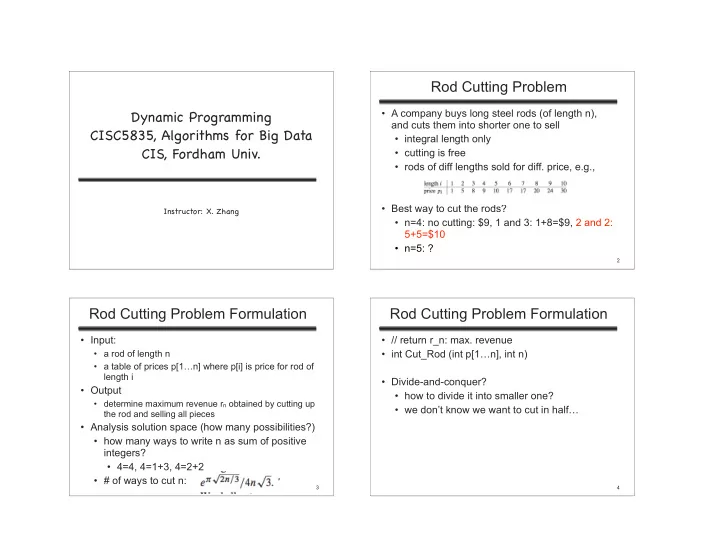
  • A company buys long steel rods (of length n),

and cuts them into shorter one to sell

  • integral length only
  • cutting is free
  • rods of diff lengths sold for diff. price, e.g.,
  • Best way to cut the rods?
  • n=4: no cutting: $9, 1 and 3: 1+8=$9, 2 and 2:

5+5=$10

  • n=5: ?

2

Rod Cutting Problem Formulation

  • Input:
  • a rod of length n
  • a table of prices p[1…n] where p[i] is price for rod of

length i

  • Output
  • determine maximum revenue rn obtained by cutting up

the rod and selling all pieces

  • Analysis solution space (how many possibilities?)
  • how many ways to write n as sum of positive

integers?

  • 4=4, 4=1+3, 4=2+2
  • # of ways to cut n:

3

Rod Cutting Problem Formulation

  • // return r_n: max. revenue
  • int Cut_Rod (int p[1…n], int n)
  • Divide-and-conquer?
  • how to divide it into smaller one?
  • we don’t know we want to cut in half…

4

slide-2
SLIDE 2

Rod Cutting Problem

  • // return rn: max. revenue for rod of length n
  • int Cut_Rod (int n, int p[1…n])
  • Start from small
  • n=1, r1=1 //no possible cutting
  • n=2, r2=5 // no cutting (if cut, revenue is 2)
  • n=3, r3=8 //no cutting
  • r4=9 (max. of p[4], p[1]+r3, p[2]+r3, p[3]+r1)
  • r5 = max (p[5], p[1]+r4, p[2]+r2, p[3]+r2, p[4]+r1)

5

Rod Cutting Problem

  • // return rn: max. revenue for rod size n
  • int Cut_Rod (int n, int p[1…n])
  • Given a rod of length n, consider first rod to cut out
  • if we don’t cut it at all, max. revenue is p[n]
  • if first rod to cut is1: max. revenue is p[1]+rn-1
  • if first rod to cut out is 2: max. revenue is p[2]+rn-2, …
  • max. revenue is given by maximum among all the

above options

  • rn = max (p[n], p[1]+rn-1, p[2]+rn-2, …, p[n-1]+r1)

6

Optimal substructure

  • // return rn: max. revenue for rod size n
  • int Cut_Rod (int n, int p[1…n])
  • rn = max (p[n], p[1]+rn-1, p[2]+rn-2, …, p[n-1]+r1)
  • Optimal substructure: Optimal solution to a

problem of size n incorporates optimal solutions to problems of smaller size (1, 2, 3, … n-1).

7

Rod Cutting Problem

  • // return r_n: max. revenue for rod size n
  • int Cut_Rod (int p[1…n], int n)
  • rn = max (p[n], p[1]+rn-1, p[2]+rn-2, …, p[n-1]+r1)

8

slide-3
SLIDE 3
  • // return r_n: max. revenue for rod size n
  • int Cut_Rod (int p[1…n], int n)

Recursive Rod Cutting

9

Running time T(n)

Closed formula: T(n)=2n Recursive calling tree: n=4

Subproblems Graph

10

  • Avoid recomputing subproblems

again and again by storing subproblems solutions in memory/table (hence “programming”)

  • trade-off between space and

time

  • Overlapping of subproblems
  • Avoid recomputing subproblems again and again

by storing subproblems solutions in memory/ table (hence “programming”)

  • trade-off between space and time
  • Two-way to organize
  • top-down with memoization
  • Before recursive function call, check if subproblem

has been solved before

  • After recursive function call, store result in table
  • bottom-up method
  • Iteratively solve smaller problems first, move

the way up to larger problems

Dynamic Programming

11

Memoized Cut-Rod

12

// stores solutions to all problems // initialize to an impossible negative value // A recursive function // If problem of given size (n) has been solved before, just return the stored result // same as before…

slide-4
SLIDE 4

Memoized Cut-Rod: running time

13

// stores solutions to all problems // initialize to an impossible negative value // A recursive function // If problem of given size (n) has been solved before, just return the stored result // same as before…

Bottom-up Cut-Rod

14

// stores solutions to all problems // Solve subproblem j, using solution to smaller subproblems

Running time: 1+2+3+..+n-1=O(n2)

Bottom-up Cut-Rod (2)

15

// stores solutions to all problems

What if we want to know who to achieve r[n]? i.e., how to cut? i.e., n=n_1+n_2+…n_k, such that p[n_1]+p[n_2]+…+p[n_k]=rn

Recap

  • We analyze rod cutting problem
  • Optimal way to cut a rod of size n is found by
  • 1) comparing optimal revenues achievable

after cutting out the first rod of varying len,

  • This relates solution to larger problem to

solutions to subproblems

  • 2) choose the one yield largest revenue

16

slide-5
SLIDE 5

maximum (contiguous) subarray

  • Problem: find the contiguous subarray within an

array (containing at least one number) which has largest sum (midterm lab)

  • If given the array [-2,1,-3,4,-1,2,1,-5,4],
  • contiguous subarray [4,-1,2,1] has largest sum = 6
  • Solution to midterm lab
  • brute-force: n2 or n3
  • Divide-and-conquer: T(n)=2 T(n/2)+O(n), T(n)=nlogn
  • Dynamic programming?

17

Analyze optimal solution

  • Problem: find contiguous subarray with largest sum
  • Sample Input: [-2,1,-3,4,-1,2,1,-5,4] (array of size n=9)
  • How does solution to this problem relates to smaller

subproblem?

  • If we divide-up array (as in midterm)
  • [-2,1,-3,4,-1,2,1,-5,4] //find MaxSub in this array

[-2,1,-3,4,-1] [2,1,-5,4] still need to consider subarray that spans both halves This does not lead to a dynamic programming sol.

  • Need a different way to define smaller subproblems!

18

  • Problem: find contiguous subarray with largest sum

A Index

  • MSE(k), max. subarray ending at pos k, among all

subarray ending at k (A[i…k] where i<=k), the one with largest sum

  • MSE(1), max. subarray ending at pos 1, is A[1..1], sum is -2
  • MSE(2), max. subarray ending at pos 2, is A[2..2], sum is 1
  • MSE(3) is A[2..3], sum is -2
  • MSE(4)?

Analyze optimal solution

19

  • A
  • Index
  • MSE(k) and optimal substructure
  • MSE(3): A[2..3], sum is -2 (red box)
  • MSE(4): two options to choose
  • (1) either grow MSE(3) to include pos 4
  • subarray is then A[2..4], sum is

MSE(3)+A[4]=-2+A[4]=2

  • (2) or start afresh from pos 4
  • subarray is then A[4…4], sum is A[4]=4 (better)
  • Choose the one with larger sum, i.e.,
  • MSE(4) = max (A[4], MSE(3)+A[4])

Analyze optimal solution

20

How a problem’s optimal solution can be derived from

  • ptimal solution to smaller

problem

slide-6
SLIDE 6
  • A
  • Index
  • MSE(k) and optimal substructure
  • Max. subarray ending at k is the larger between A[k…k] and
  • Max. subarray ending at k-1 extended to include A[k]

MSE(k) = max (A[k], MSE(k-1)+A[k])

  • MSE(5)= , subarray is
  • MSE(6)
  • MSE(7)
  • MSE(8)
  • MSE(9)

Analyze optimal solution

21

MSE(4)=4, array is A[4…4]

  • A
  • Index
  • Once we calculate MSE(1) … MSE(9)
  • MSE(1)=-2, the subarray is A[1..1]
  • MSE(2)=1, the subarray is A[2..2]
  • MSE(3)=-2, the subarray is A[2..3]
  • MSE(4)=4, the subarray is A[4…4]
  • … MSE(7)=6, the subarray is A[4…7]
  • MSE(9)=4, the subarray is A[9…9]
  • What’s the maximum subarray of A?
  • well, it either ends at 1, or ends at 2, …, or ends at 9
  • Whichever yields the largest sum!

Analyze optimal solution

22 23

  • A
  • Index
  • Calculate MSE(1) … MSE(n)
  • MSE(1)= A[1]
  • MSE(i) = max (A[i], A[i]+MSE(i-1));
  • Return maximum among all MSE(i),

for i=1, 2, …n

Idea to Pseudocode

(int, start,end) MaxSubArray (int A[1…n]) { // Use array MSE to store the MSE(i) MSE[1]=A[1]; max_MSE = MSE[1]; for (int i=2;i<=n;i++) { MSE[i] = ?? if (MSE[i] > max_MSE) { max_MSE = MSE[i]; end = i; } } return (max_MSE, start, end) } Practice: 1) fill in ?? 2) How to find out the starting index of the max. subarray, i.e., the start parameter?

24

Running time Analysis

int MaxSubArray (int A[1…n], int & start, int & end) { // Use array MSE to store the MSE(i) MSE[1]=A[1]; max_MSE = MSE[1]; for (int i=2;i<=n;i++) { MSE[i] = ?? if (MSE[i] > max_MSE) { max_MSE = MSE[i]; end = i; } } return max_MSE; }

  • It’s easy to see that

running time is O(n)

  • a loop that iterates

for n-1 times

  • Recall other solutions:
  • brute-force: n2 or n3
  • Divide-and-conquer:

nlogn

  • Dynamic programming

wins!

slide-7
SLIDE 7

What is DP? When to use?

  • We have seen several optimization problems
  • brute force solution
  • divide and conquer
  • dynamic programming
  • To what kinds of problem is DP applicable?
  • Optimal substructure: Optimal solution to a

problem of size n incorporates optimal solution to problem of smaller size (1, 2, 3, … n-1).

  • Overlapping subproblems: small subproblem

space and common subproblems

25

Optimal substructure

  • Optimal substructure: Optimal solution to a

problem of size n incorporates optimal solution to problem of smaller size (1, 2, 3, … n-1).

  • Rod cutting: find rn (max. revenue for rod of len n)

rn = max (p[1]+rn-1, p[2]+rn-2, p[3]+rn-3,…, p[n-1]+r1, p[n])

  • A recurrence relation (recursive formula)
  • => Dynamic Programming: Build an optimal solution

to the problem from solutions to subproblems

  • We solve a range of sub-problems as needed

26 Sol to problem instance of size n Sol to problem instance of size n-1, n-2, … 1

Optimal substructure in Max. Subarray

  • Optimal substructure: Optimal solution to a

problem of size n incorporates optimal solution to problem of smaller size (1, 2, 3, … n-1).

  • Max. Subarray Problem:
  • MSE(i) = max (A[i], MSE(i-1)+A[i])
  • Max Subarray = max (MSE(1), MSE(2), …MSE(n))

27

  • Max. Subarray Ending at position i

is the either the max. subarray ending at pos i-1 extended to pos i; or just made up of A[i]

Overlapping Subproblems

  • space of subproblems must be “small”
  • total number of distinct subproblems is a polynomial in

input size (n)

  • a recursive algorithm revisits same problem

repeatedly, i.e., optimization problem has

  • verlapping subproblems.
  • DP algorithms take advantage of this property
  • solve each subproblem once, store solutions in a table
  • Look up table for sol. to repeated subproblem using

constant time per lookup.

  • In contrast: divide-and-conquer solves new

subproblems at each step of recursion.

28

slide-8
SLIDE 8

Longest Increasing Subsequence

  • Input: a sequence of numbers given by an array a
  • Output: a longest subsequence (a subset of the

numbers taken in order) that is increasing (ascending order)

  • Example, given a sequence
  • 5, 2, 8, 6, 3, 6, 9, 7
  • There are many increasing subsequence: 5, 8, 9;
  • r 2, 9; or 8
  • The longest increasing subsequence is:

2, 3, 6, 9 (length is 4)

29

LIS as a DAG

  • Find longest increasing subsequence of a

sequence of numbers given by an array a 5, 2, 8, 6, 3, 6, 9, 7

Observation:

  • If we add directed edge from smaller number to larger one, we get

a DAG.

  • A path (such as 2,6,7) connects nodes in increasing order
  • LIS corresponds to longest path in the graph.

30

Graph Traversal for LIS

  • Find longest increasing subsequence of a

sequence of numbers given by an array a 5, 2, 8, 6, 3, 6, 9, 7

Observation:

  • LIS corresponds to longest path in the graph.
  • Can we use graph traversal algorithms here?
  • BFS or DFS?
  • Running time

31

  • Find Longest Increasing Subsequence of a

sequence of numbers given by an array a

Let L(n) be the length of LIS ending at n-th number L(1) = 1, LIS ending at pos 1 is 5

L(2) = 1, LIS ending at pos 2 is 2 L(7)= // how to relate to L(1), …L(6)?

  • Consider LIS ending at a[7] (i.e., 9). What’s the number before 9?

.… ? ,9

Dynamic Programming Sol: LIS

32 1 2 3 4 5 6 7 8

slide-9
SLIDE 9
  • Given a sequence of numbers given by an array a

Let L(n) be length of LIS ending at n-th number

Consider all increasing subsequence ending at a[7] (i.e., 9).

  • What’s the number before 9?
  • It can be either NULL, or 6, or 3, or 6, 8, 2, 5 (all those numbers

pointing to 9)

  • If the number before 9 is 3 (a[5]), what’s max. length of this

seq? L(5)+1 where the seq is …. 3, 9

Dynamic Programming Sol: LIS

33 1 2 3 4 5 6 7 8 LIS ending at pos 5

  • Given a sequence of numbers given by an array a

Let L(n) be length of LIS ending at n-th number

Consider all increasing subsequence ending at a[7] (i.e., 9).

  • It can be either NULL, or 6, or 3, or 6, 8, 2, 5 (all those numbers

pointing to 9)

  • L(7)=max(1, L(6)+1, L(5)+1, L(4)+1, L(3)+1, L(2)+1, L(1)+1)
  • L(8)=?

Dynamic Programming Sol: LIS

34 Pos: 1 2 3 4 5 6 7 8

  • Given a sequence of numbers given by an array a

Let L(n) be length of LIS ending at n-th number. Recurrence relation: Note that the i’s in RHS is always smaller than the j

  • How to implement? Running time?
  • LIS of sequence = Max (L(i), 1<=i<=n) // the longest

among all

Dynamic Programming Sol: LIS

35 Pos: 1 2 3 4 5 6 7 8

Next, two-dimensional subproblem space

i.e., expect to use two-dimensional table 36

slide-10
SLIDE 10

Longest Common Subseq.

  • Given two sequences

X = 〈x1, x2, …, xm〉 Y = 〈y1, y2, …, yn〉 find a maximum length common subsequence (LCS) of X and Y

  • E.g.:

X = 〈A, B, C, B, D, A, B〉

  • Subsequence of X:

– A subset of elements in the sequence taken in order but not necessarily consecutive

〈A, B, D〉, 〈B, C, D, B〉, etc

37

Example

X = 〈A, B, C, B, D, A, B〉 X = 〈A, B, C, B, D, A, B〉 Y = 〈B, D, C, A, B, A〉 Y = 〈B, D, C, A, B, A〉

  • 〈B, C, B, A〉 and 〈B, D, A, B〉 are longest common

subsequences of X and Y (length = 4)

  • BCBA = LCS(X,Y): functional notation, but is it not a function
  • 〈B, C, A〉, however is not a LCS of X and Y

38

Brute-Force Solution

  • Check every subsequence of X[1 . . m] to see if it is

also a subsequence of Y[1 .. n].

  • There are 2m subsequences of X to check
  • Each subsequence takes O(n) time to check

– scan Y for first letter, from there scan for second, and so on

  • Worst-case running time: O(n2m)

– Exponential time too slow

39

Towards a better algorithm

Simplification:

1. Look at length of a longest-common subsequence 2. Extend algorithm to find the LCS itself later

Notation:

– Denote length of a sequence s by |s| – Given a sequence X = 〈x1, x2, …, xm〉 we define the i-th prefix

  • f X as (for i = 0, 1, 2, …, m)

Xi = 〈x1, x2, …, xi〉 – Define: c[i, j] = | LCS (Xi, Yj) = |LCS(X[1..i], Y[1..j])|: the length of a LCS of sequences Xi = 〈x1, x2, …, xi〉 and Yj = 〈y1, y2, …, yj〉 – |LCS(X,Y)| = c[m,n] //this is the problem we want to solve

40

slide-11
SLIDE 11

Find Optimal Substructure

  • Given a sequence X = 〈x1, x2, …, xm〉, Y = 〈y1, y2, …, yn〉
  • To find LCS (X,Y) is to find c[m,n]

c[i, j] = | LCS (Xi, Yj) | //length LCS of i-th prefix of X and j-th prefix of Y // X[1..i], Y[1..j]

  • How to solve c[i,j] using sol. to smaller problems?
  • what’s the smallest (base) case that we can answer right

away?

  • How does c[i,j] relate to c[i-1,j-1], c[i,j-1] or c[i-1,j]?

41

Recursive Formulation

c[i-1, j-1] + 1 if X[i]= Y[j] c[i, j] = max(c[i, j-1], c[i-1, j])

  • therwise (i.e., if X[i] ≠ Y[j])

X: 1 2 i m Y: 1 2 j n … …

compare X[i], Y[j]

Base case: c[i, j] = 0 if i = 0 or j = 0

LCS of an empty sequence, and any sequence is empty

General case:

42

Recursive Solution. Case 1

Case 1: X[i] ==Y[j] e.g.: X4 = 〈A, B, D, E〉 Y3 = 〈Z, B, E〉

  • Choice: include one element into common sequence (E)

and solve resulting subproblem LCS of X3 = 〈A, B, D〉 and Y2 = 〈Z, B〉

– Append X[i] = Y[j] to the LCS of Xi-1 and Yj-1 – Must find a LCS of Xi-1 and Yj-1

c[4, 3] = c[4 - 1, 3 - 1] + 1

43

Recursive Solution. Case 2

Case 2: X[i] ≠ Y[j] e.g.: X4 = 〈A, B, D, G〉 Y3 = 〈Z, B, D〉

  • Must solve two problems
  • find a LCS of Xi-1 and Yj: Xi-1 = 〈A, B, D〉 and Yj = 〈Z, B, D〉
  • find a LCS of Xi and Yj-1 : Xi = 〈A, B, D, G〉 and Yj-1 = 〈Z, B〉

c[i, j] = max { c[i - 1, j], c[i, j-1] }

44

Either the G or the D is not in the LCS (they cannot be both in LCS)

If we ignore last element in Xi If we ignore last element in Yj

slide-12
SLIDE 12

Recursive algorithm for LCS

// X, Y are sequences, i, j integers //return length of LCS of X[1…i], Y[1…j] LCS(X, Y, i, j) if i==0 or j ==0 return 0; if X[i] == Y[ j] // if last element match then c[i, j] ←LCS(X, Y, i–1, j–1) + 1 else c[i, j] ←max{LCS(X, Y, i–1, j), LCS(X, Y, i, j–1)}

45

Optimal substructure & Overlapping Subproblems

  • A recursive solution contains a “small” number of distinct

subproblems repeated many times.

  • e.g., C[5,5] depends on C[4,4], C[4,5], C[5,4]
  • Exercise: Draw there subproblem dependence graph
  • each node is a subproblem
  • directed edge represents “calling”, “uses solution
  • f” relation
  • Small number of distinct subproblems:
  • total number of distinct LCS subproblems for two

strings of lengths m and n is mn.

46

Memoization algorithm

Memoization: After computing a solution to a subproblem, store it in a table. Subsequent calls check the table to avoid redoing work. LCS(X, Y, i, j) if c[i, j] = NIL // LCS(i,j) has not been solved yet then if x[i] = y[j] then c[i, j] ←LCS(x, y, i–1, j–1) + 1 else c[i, j] ←max{LCS(x, y, i–1, j), LCS(x, y, i, j–1)}

Same as before

47

Bottom-Up

C[2,3] C[2,4] C[3,3] C[3,4]

Y A B C B D A B

X B D C A B A

Initialization: base case c[i,j] = 0 if i=0, or j=0 //Fill table row by row // from left to right for (int i=1; i<=m;i++) for (int j=1;j<=n;j++) update c[i,j] return c[m, n] Running time = Θ(mn)

48

0 1 2 3 4 5 6 7

1 2 3 4 5 6

C[3,4]= length of LCS (X3, Y4) = Length of LCS (BDC, ABCB) i-th row, 4-th column element

slide-13
SLIDE 13

Dynamic-Programming Algorithm

A B C B D A B B D C A B A

1 1 1 1 1 1 1 1 1 2 2 2 1 2 2 2 2 2 1 2 2 2 3 3 1 2 2 3 3 3 4 1 2 2 3 3 4 4 1

Reconstruct LCS tracing backward:

how do we get value

  • f C[i,j] from? (either

C[i-1,j-1]+1, C[i-1,j], C[i, j-1) as red arrow indicates…

49

Output A Output B Output C Output B

Matrix

Matrix: a 2D (rectangular) array of numbers, symbols, or expressions, arranged in rows and columns. e.g., a 2 × 3 matrix (there are two rows and three columns) Each element of a matrix is denoted by a variable with two subscripts, a2,1 element at second row and first column of a matrix A. an m × n matrix A:

50

Matrix Multiplication:

Matrix Multiplication

51

Dimension of A, B, and A x B?

Total (scalar) multiplication: 4x2x3=24

Total (scalar) multiplication: n2xn1xn3

Multiplying a chain of Matrix

Given a sequence/chain of matrices, e.g., A1, A2, A3, there are different ways to calculate A1A2A3

  • 1. (A1A2)A3)
  • 2. (A1(A2A3))

Dimension of A1: 10 x 100 A2: 100 x 5 A3: 5 x 50 all yield the same result But not same efficiency

52

slide-14
SLIDE 14

Matrix Chain Multiplication

Given a chain <A1, A2, … An> of matrices, where matrix Ai has dimension pi-1x pi, find optimal fully parenthesize product A1A2…An that minimizes number of scalar multiplications. Chain of matrices <A1, A2, A3, A4>: five distinct ways A1: p1 x p2 A2: p2 x p3 A3: p3 x p4 A4: p4 x p5

53

# of multiplication: p3p4p5+ p2p3p5+ p1p2p5

Find the one with minimal multiplications?

Matrix Chain Multiplication

  • Given a chain <A1, A2, … An> of matrices, where matrix Ai

has dimension pi-1x pi, find optimal fully parenthesize product A1A2…An that minimizes number of scalar multiplications.

  • Let m[i, j] be the minimal # of scalar multiplications needed to

calculate AiAi+1…Aj (m[1…n]) is what we want to calculate)

  • Recurrence relation: how does m[i…j] relate to smaller

problem

  • First decision: pick k (can be i, i+1, …j-1) where to divide AiAi+1…Aj

into two groups: (Ai…Ak)(Ak+1…Aj)

  • (Ai…Ak) dimension is pi-1 x pk, (Ak+1…Aj) dimension is pk x pj

54

Summary

  • Keys to DP
  • Optimal Substructure
  • overlapping subproblems
  • Define the subproblem: r(n), MSE(i), LCS(i,j) LCS
  • f prefixes …
  • Write recurrence relation for subproblem: i.e.,

how to calculate solution to a problem using sol. to smaller subproblems

  • Implementation:
  • memoization (table+recursion)
  • bottom-up table based (smaller problems first)
  • Insights and understanding comes from practice! 55