
SLIDE 1
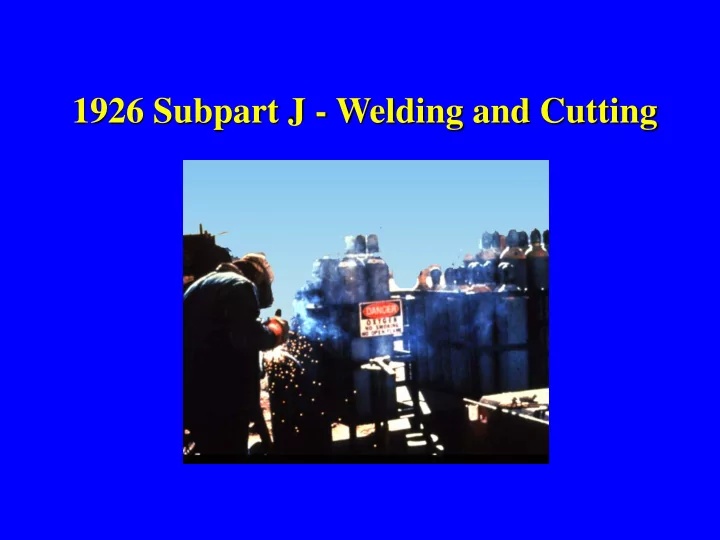
1926 Subpart J - Welding and Cutting 1926 Subpart J - Welding and - - PowerPoint PPT Presentation
1926 Subpart J - Welding and Cutting 1926 Subpart J - Welding and Cutting (1926.350 to 1926.354) 1926.350 Gas Welding and Cutting 1926.351 Gas Welding and Arc Welding 1926.352 Fire Prevention 1926.353 Ventilation and protection in
1926.350 Gas Welding and Cutting 1926.351 Gas Welding and Arc Welding 1926.352 Fire Prevention 1926.353 Ventilation and protection in welding,
cutting, andheating.
1926 Subpart J - Authority for 1926 Subpart J
1926.350 (a)(1) Valve protection caps shall be in place and secured. 1926.350 (a)(5) Valve protection caps shall not be used for lifting cylinders from one vertical position to another. Bars shall not be used under valves or valve protection caps to pry cylinders loose when
be used to thaw cylinders loose.
1926.350(a)(6) Unless cylinders are firmly secured
purpose, regulators shall be removed and valve protection caps put in place before cylinders are moved.
Valve cap
1926.350(a)(4) Transporting of cylinders When cylinders are transported by powered vehicles, they shall be secured in a vertical position.
1926.350(a)(7) A suitable cylinder truck, chain, or
to keep cylinders from being knocked over while in use.
1926.350(a)(8) Cylinder valve When work is finished, when cylinders are empty, or when cylinders are moved at any time, the cylinder valve shall be closed. 1926.350(a)(9) Upright position Compressed gas cylinders shall be secured in an upright position at all times except, if necessary, for short periods of time while cylinders are actually being hoisted or carried.
Valve
1926.350(a)(10) Oxygen cylinders in storage shall be separated from fuel-gas cylinders or combustible materials(especially oil or grease), a minimum distance of 20 feet (6.1 m) or by a noncombustible barrier at least 5 feet (1.5 m) high having a fire-resistance rating of at least one-half hour. 1926.350(a)(11) Inside of buildings, cylinders shall be stored in a well-protected, well- ventilated, dry location, at least 20 feet (6.1 m) from highly combustible materials such as oil or excelsior. Cylinders should be stored in definitely assigned places away from elevators, stairs, or gangways. Assigned storage places shall be located where cylinders will not be knocked over or damaged by passing
tampering by unauthorized persons.
1926.350 (d)(1) Before a regulator to a cylinder valve is connected, the valve shall be opened slightly and closed immediately. (This action is generally termed "cracking" and is intended to clear the valve of dust or dirt that might otherwise enter the regulator.) The person cracking the valve shall stand to one side of the outlet, not in front of it.
1926.350(d)(3) Suitable regulators Fuel gas shall not be used from cylinders through torches or
equipped with shutoff valves without reducing the pressure through a suitable regulator attached to the cylinder valve or manifold. 1926.(d)(4) Removal of regulator Before a regulator is removed from a cylinder valve, the cylinder valve shall always be closed and the gas released from the regulator.
1926.350 (f)(1) Hose colors Fuel gas hose and oxygen hose shall be easily distinguishable from each
made by different colors or by surface characteristics readily distinguishable by the sense of touch. Oxygen and fuel gas hoses shall not be
hose having more than one gas passage shall not be used.
1926.350 (f)(2) Taped sections When parallel sections
hose are taped together, not more than 4 inches
be covered by tape.
4” 12”
1926.350 (f)(3) Inspections All hose in use, carrying acetylene, oxygen, natural or manufactured fuel gas, or any gas or substance which may ignite or enter into combustion, or be in any way harmful to employees, shall be inspected at the beginning
Defective hose shall be removed from service.
cracking
1926.350 (f)(5) Hose couplings shall be of the type that cannot be unlocked or disconnected by means of a straight pull without rotary motion.
1926.350 (g)(1) Torches. Clogged torch tip openings shall be cleaned with suitable cleaning wires, drills, or other devices designed for such purpose. 1926.350(g)(2) Torches in use shall be inspected at the beginning of each working shift for leaking shutoff valves, hose couplings, and tip
shall not be used. 1926.350 (g)(3) Lighters Torches shall be lighted by friction lighters or other approved devices, and not by matches or from hot work.
Striker
FUMES MAY PRODUCE METAL FUME FEVER
SYMPTOMS RESEMBLE:
Trembling, Nausea, Vomiting may also occur.
WELDERS EXPOSED TO FUMES CONTAINING IRON, CHROMIUM, CHROMATES, LEAD AND ALUMINUM MAY SUFFER:
PROBLEMS
NOSE, AND THROAT
SPLATTERING METAL
EXPOSURE TO ULTRAVIOLET RADIATION CAN CAUSE SEVERE SKIN BURNS
EPIDERMIS DERMIS SUBDERMIS
REDUCED POWER AND PAIN DUE TO DISTORTED POSTURE