Red Wing Bridge Project PAC #7/TAC #10 Meeting January 16, 2014 - - PowerPoint PPT Presentation

red wing bridge project
SMART_READER_LITE
LIVE PREVIEW

Red Wing Bridge Project PAC #7/TAC #10 Meeting January 16, 2014 - - PowerPoint PPT Presentation

Red Wing Bridge Project PAC #7/TAC #10 Meeting January 16, 2014 Agenda Process Overview and Progress to Date Whats Been Accomplished Minnesota Approach Alternatives River Crossing Environmental Assessment Process


slide-1
SLIDE 1

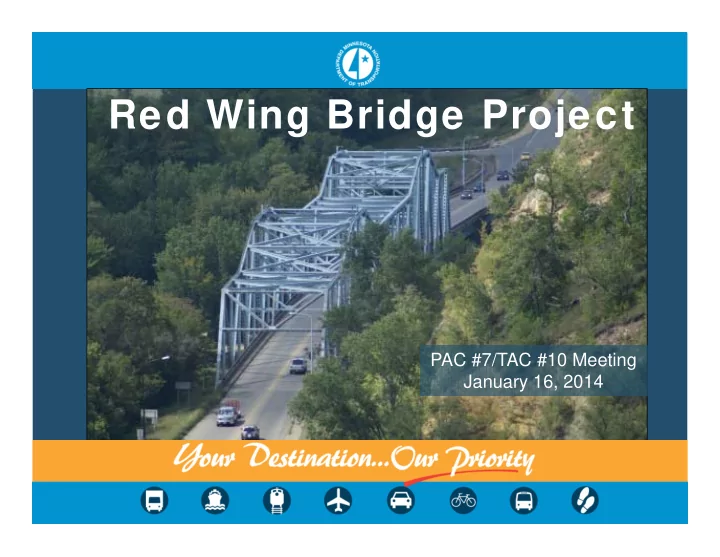
Red Wing Bridge Project

PAC #7/TAC #10 Meeting January 16, 2014
slide-2
SLIDE 2

Agenda

  • Process Overview and Progress to Date

– What’s Been Accomplished – Minnesota Approach Alternatives – River Crossing

  • Environmental Assessment Process
  • Visual Quality Process
  • Public Outreach Update
  • Next Meetings
slide-3
SLIDE 3

Schedule Overview and Progress to Date

  • MnDOT and WisDOT began the study and design

process seven years in advance of planned construction;

– Unique project setting – High value natural and cultural resources; – Applicable federal and state regulations; – Importance of on-going stakeholder involvement

  • Initial coordination and studies began in 2011;
  • Alternative Analysis began in early 2012;
  • Construction is planned for 2018
slide-4
SLIDE 4

What’s Been Accomplished

  • Determined the river crossing will be kept at current

location;

  • Identified and refined a recommended set of

concepts for the Minnesota and Wisconsin approach roadways;

  • Decided to proceed with a new two-lane river

crossing;

slide-5
SLIDE 5

What’s Been Accomplished (cont…)

  • Completed Bridge 9103 Rehabilitation Study;
  • Identified a recommended river crossing bridge type

(details to follow….);

  • Identified a recommended alternative for the

Wisconsin approach

slide-6
SLIDE 6

Wisconsin Approach – Preferred Option

slide-7
SLIDE 7

Minnesota Approach Alternatives – Evaluation Progress

  • Completed the Bridge 9103 Rehabilitation Study;
  • Identified and completed an initial screening of a

range of options;

  • Three options were carried forward;
  • Conducted a comprehensive evaluation of the

remaining options in coordination with FHWA

slide-8
SLIDE 8

Rehabilitate Bridge 9103

slide-9
SLIDE 9

Replace In-place

slide-10
SLIDE 10

Buttonhook

slide-11
SLIDE 11

Minnesota Approach Alternatives – Next Steps

  • Coordinating with local and national FHWA staff to

ensure full and fair consideration of all factors;

  • Complete technical evaluation;
  • Obtain public input;
  • Identify recommended option(s) to carry forward

into the EA process

slide-12
SLIDE 12

River Crossing Bridge Type Evaluation

slide-13
SLIDE 13

Tied Arch

  • Grade and Profile
  • Span Arrangement
  • Constructability
  • Inspection and

Maintenance

slide-14
SLIDE 14
slide-15
SLIDE 15
slide-16
SLIDE 16

Steel Box Girder

  • Grade and Profile
  • Span Arrangement
  • Constructability
  • Inspection and

Maintenance

slide-17
SLIDE 17
slide-18
SLIDE 18
slide-19
SLIDE 19

Segmental Concrete Box Girder

  • Grade and Profile
  • Span Arrangement
  • Constructability
  • Inspection and

Maintenance

slide-20
SLIDE 20
slide-21
SLIDE 21
slide-22
SLIDE 22

River Crossing- Technical Findings

Advantages Disadvantages  Shallow structure depth  Potential volatility of steel prices  Highest construction cost  Highest maintenance costs  Inspection more difficult

Tied Arch

slide-23
SLIDE 23

River Crossing- Technical Findings

Steel Box Girder

Advantages Disadvantages  Conventional construction  Potential volatility of steel prices  Relatively straight forward inspection  Requires repainting  Opportunity for color enhancement  Modest profile impacts (particularly as compared to concrete segmental)  Construction cost is nearly as low as the concrete segmental (within 2%)

slide-24
SLIDE 24

River Crossing- Technical Findings

Concrete Segmental Box Girder

Advantages Disadvantages  Complex erection is not required  Requires substantial profile increase  Relatively straight forward inspection  Reduced opportunities for color enhancement  Lowest long term maintenance costs  Lowest construction cost  Greatest structure depth  Longest distance at maximum grade

slide-25
SLIDE 25

Historic Aesthetic Considerations

slide-26
SLIDE 26
slide-27
SLIDE 27
slide-28
SLIDE 28
slide-29
SLIDE 29
slide-30
SLIDE 30
slide-31
SLIDE 31
slide-32
SLIDE 32
slide-33
SLIDE 33
slide-34
SLIDE 34
slide-35
SLIDE 35
slide-36
SLIDE 36
slide-37
SLIDE 37

River Crossing - Recommendation

Recommended Alternate: Steel Box Girder

slide-38
SLIDE 38

Environmental Assessment (EA)

  • Detailed impact assessment process addressing federal and

state requirements;

  • One or more “build” alternatives may be evaluated;
  • Considers full range of social, economic and natural

environmental issues;

  • Continued opportunities for stakeholder involvement;
  • Concludes with identification of preferred alternative to

advance to detailed design and construction

slide-39
SLIDE 39

Visual Quality Process

  • Conducted during preparation of the EA;
  • Prescribed process centered on engaging community

stakeholders;

  • Primary outcome will be a plan defining the aesthetic

elements of the project (i.e. bridge color, lighting, railings, pier design, etc…);

  • More details regarding the process will be provided at the

next PAC and TAC meetings

slide-40
SLIDE 40

Public Outreach Update

  • Listening Session #4 - November 2013
  • City Council presentation – November 2013
  • Open House #3 – March 2014 (tentative)
  • Newsletter #3 – to be issued prior to Open House #3
  • Project Presentation Opportunities
  • Website: http://www.dot.state.mn.us/d6/projects/redwing-

bridge/index.html

slide-41
SLIDE 41

Next Meetings

  • February 20th TAC #11 - 1:00 p.m. to 3:00 p.m. –

Red Wing Library

  • March 20th PAC #8 - 1:00 p.m. to 3:00 p.m. – Red

Wing Library

slide-42
SLIDE 42

Questions / Comments

Chad Hanson, P.E. Senior Design Engineer MnDOT – Rochester 507-286-7637 chad.hanson@state.mn.us