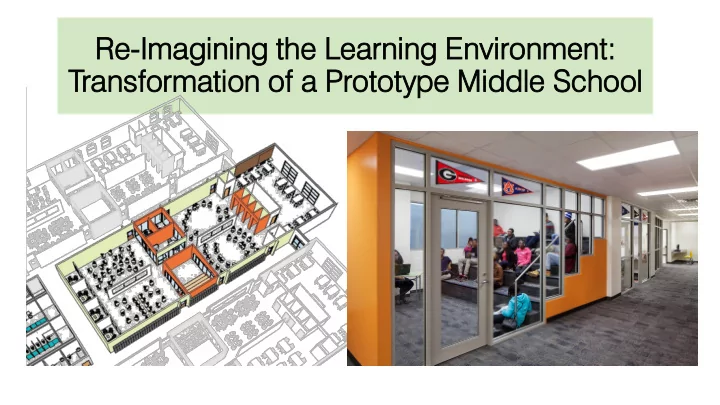
SLIDE 1 Re Re-Imagini ning th the Le Learn rning En Envi vironment: t: Tra ransformation o
roto toty type Mi Middl dle Scho hool
SLIDE 2 Learning Objectives
- Show how fresh thinking from district leadership established a new design
direction.
- Understand the collaborative approach to engaging stakeholders
- Describe how new district initiatives were incorporated into the design
- Emphasize the importance of training and support of school staff to
effectively provide instruction in the new environment
SLIDE 3 History
1997 Competition
w pro rototype M MS for 1, r 1,250 250 stude students; 1 1,5 ,500 co core
SLIDE 4 History
- 9 sites
- 3 plan variations
- Plan modified to accommodate
tight, sloping sites
SLIDE 5
New Direction
SLIDE 6 Charrette Process
Presentation of New Concepts
SLIDE 7
21st Century Teaching / Learning Factors
SLIDE 8
21st Century Teaching / Learning Factors
SLIDE 9
21st Century Teaching / Learning Factors
SLIDE 10 District Initiatives
Persona nalized L ed Learni ning ng R Roadm dmap
- Detailed outline of organized strategy to
provide personalized learning
SLIDE 11 District Initiatives
Tea each-to to-On One
- Pilot program, nationally sponsored
- Teamed with advisors from Kennesaw State
- Reconfigures groups of existing classrooms
into one large space for multiple learning groups
- Team teaching; collaborative planning &
shared resources
- Develop rituals & routines to manage
classroom behavior
SLIDE 12
Charrette Process
SLIDE 13
Charrette Results
SLIDE 14
Charrette Results
SLIDE 15
Charrette video
SLIDE 16
Academic Environment Priorities
SLIDE 17 Original Plan
Gross Area: 186,530 SF General Classrooms: 42 Science Labs: 12 Special Ed: 6 Connections Band: 1 Orchestra: 1 Choral: 1 Art: 1 Technology: 1 F/CS: 1 Business 1 FL/ESOL 4
SLIDE 18 Re-Envisioned Plan
Gross Area: 187,180 SF General Classrooms: 42 Science Labs: 12 Special Ed: 6 Connections Band: 1 Orchestra: 1 Choral: 1 Art: 2 Technology: 1 Healthcare Science: 1 Business 1 FL/ESOL 4 Collaborative Forum: 1 Large: 12 Medium: 32 Small: 54
SLIDE 19
Academic Area Reorganization
SLIDE 20
Learning Neighborhood
SLIDE 21
Forum/Atrium
SLIDE 22
Furniture
SLIDE 23
Finishes / Maintenance
SLIDE 24
Additional Projects
SLIDE 25 Takeaways
- Immersive teaching/learning environments are not
a solution for all districts.
- Collaborative teaching environments are not one-
size-fits-all
- Clear direction from district leadership is essential
to establishing the unique needs of each program.
- Professional development is critical to be able to
effectively use new space configurations.
SLIDE 26
Questions